Generate Flashcards for Sound
Turn Sound notes into flashcards instantly with AI. Try out free to study faster!
Generate Flashcards with AI Free
Generate Flashcards for Sound
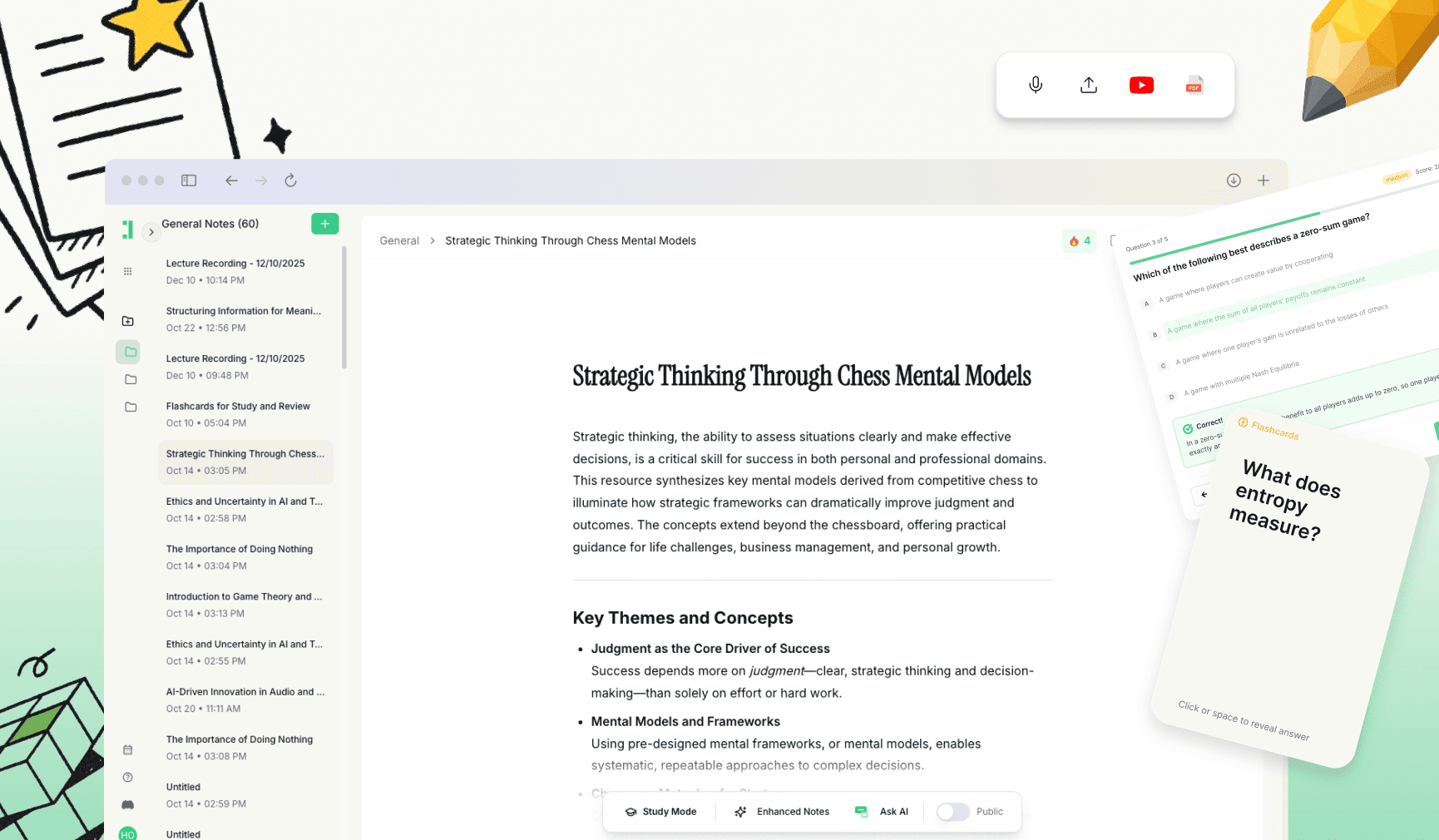
Turn your notes, PDFs, slides, or lectures into Sound flashcards so you can review faster and remember more. Whether you are studying wave behavior, acoustics, or the physics of hearing, Duetoday helps you transform complex theory into bite-sized study sets.
Stop Rereading, Start Recalling
Upload your documents or paste your text, and Duetoday will identify key concepts to build a custom deck in seconds. Upload → Generate → Review → Master.
What are Sound flashcards?
Sound flashcards are structured study aids that cover the fundamental properties of longitudinal waves. They break down complex topics like frequency, pitch, amplitude, loudness, and the Doppler effect into clear, testable questions.
The outcome is simple: instead of passively rereading a textbook chapter on acoustics, you actively test your brain's ability to retrieve information. This builds stronger neural pathways and ensures you actually understand how sound travels through different mediums.
If you already have notes, Duetoday can generate a clean deck in minutes.
Why flashcards are one of the best ways to study Sound
Sound is a topic rooted in relationships—like how frequency relates to pitch or how density affects the speed of sound. Flashcards force you to isolate these variables and master them individually before connecting the bigger picture.
Using active recall and spaced repetition helps you move beyond memorizing definitions to truly understanding wave mechanics. Key benefits include:
Remember physics terms like compression and rarefaction without cramming.
Separate similar concepts easily (e.g., loudness vs. intensity).
Learn wave interactions step-by-step (reflection, refraction, diffraction).
Practice applying formulas like v = fλ quickly in your head.
What to include in your Sound flashcards
Good flashcards follow the "atomic" rule: one idea per card. When studying sound, your cards should be question-based rather than just a list of terms to ensure your brain is actually working during your study session.
Focus on these four main categories:
Definitions & Key Terms: "What is an ultrasonic wave?" "Define resonance in one sentence."
Processes & Steps: "How does sound travel through a solid vs. a gas?"
Comparisons: "How is pitch different from frequency?"
Application: "What happens to the perceived frequency if the source moves closer?"
Example Prompts for your deck:
What is the speed of sound in dry air at 20°C?
How does the medium's elasticity affect sound speed?
State the relationship between amplitude and energy.
What is the human audible range of frequencies?
Describe the role of the cochlea in hearing.
What causes a sonic boom?
How to study Sound with flashcards (a simple system)
Don't just flip through cards mindlessly. Use a "two-pass" approach. First, generate your deck from your class slides or textbook and do a quick run-through to see what you already know. Then, focus your energy on the difficult concepts like wave interference or decibel scales.
Review in short, 15-minute bursts. It is much more effective to study your sound flashcards three times a day for five minutes than to stare at them for an hour straight. Repeat the cards you get wrong more frequently until they become second nature.
Make a deck from your notes or generate it from your PDF.
Do one quick round to find weak spots in wave theory.
Review weak cards daily for three days.
Mix in harder application cards (like Doppler effect math) each session.
Do a final mixed review before your physics quiz or exam.
Generate Sound flashcards automatically in Duetoday
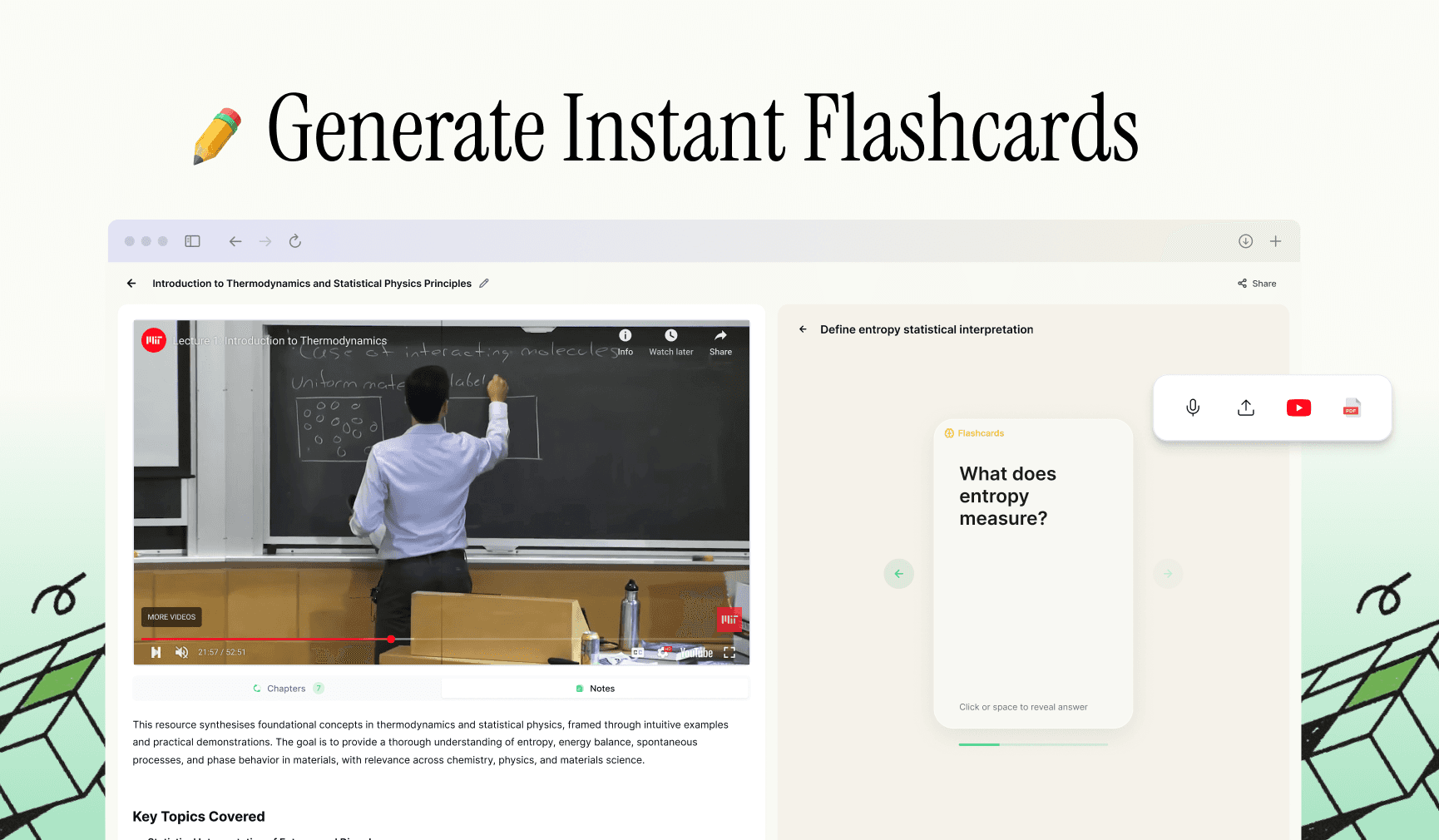
Making cards manually is slow, messy, and inconsistent. You often end up writing too much on one card, which actually makes it harder to learn. Duetoday uses AI to scan your materials and extract the most important information for you.
Position yourself for success: upload your physics PDF or lecture transcript, and let the AI do the heavy lifting. You get a professional study deck in seconds that you can edit and customize.
Upload or paste your Sound study material.
Click "Generate Flashcards."
Review, edit, and start studying immediately.
Start with your notes and get a deck you can actually use today.
Common Sound flashcard mistakes (and how to fix them)
Most students make cards that are too wordy. If a card has three sentences on the back, you aren't memorizing a concept; you're memorizing a paragraph. Keep it simple.
Cards are too long → Split into one idea (e.g., separate Speed, Frequency, and Wavelength).
Only memorizing words → Add "explain why/how" prompts for concepts like resonance.
Confusing similar concepts → Create specific comparison cards for period vs. frequency.
No review schedule → Use Duetoday's system to repeat tough cards more often.
No application practice → Add scenario cards, such as "What happens to sound in a vacuum?"
Ready to generate your Sound flashcards?
Stop wasting hours on manual data entry. Upload your notes, generate your deck, and start mastering the physics of sound with active recall today.
Works with notes, PDFs, slides, and transcripts.
FAQ
How many flashcards do I need for Sound? For a standard unit, 30-50 cards usually cover the basics of wave properties, hearing, and acoustic phenomena.
What’s the best format for Sound flashcards? Question-and-answer format is best. Avoid simple term-definition pairs; instead, ask "How does X affect Y?"
How often should I review Sound flashcards? Review new cards daily for the first three days, then space them out to every few days as you become more confident.
Should I make cards from a textbook or slides? Use both! Textbooks provide the depth for definitions, while lecture slides highlight what your instructor thinks is most important for the exam.
How do I stop forgetting Sound formulas? Use cards that ask you to identify the units or the relationship between variables (e.g., "If wavelength doubles, what happens to frequency?").
What if my flashcards feel too easy? Combine concepts. Instead of asking what frequency is, ask how a change in frequency changes a musical note's pitch.
Can I generate Sound flashcards from a PDF automatically? Yes, Duetoday allows you to upload any PDF and instantly converts the text into a structured flashcard deck.
Are digital flashcards better than paper for Sound? Digital cards are often better because they allow for faster organization and the ability to include diagrams of wave patterns easily.
How long does it take to make a full Sound deck? With Duetoday, it takes less than a minute. Manually, it could take over an hour to write and format 50 cards.
Can Duetoday generate and organize my flashcards for me? Absolutely. Our AI analyzes your specific content to create relevant, high-quality study sets tailored to your material.

Duetoday is an AI-powered learning OS that turns your study materials into personalised, bite-sized study guides, cheat sheets, and active learning flows.