Generate Flashcards for Solid State Physics
Easily generate or make Solid State Physics flashcards to master crystal structures and thermodynamics using AI.
Generate Flashcards with AI Free

Generate Flashcards for Solid State Physics
Turn your notes, PDFs, slides, or lectures into Solid State Physics flashcards so you can review faster and remember more. Whether you are tackling Bragg's Law or complex phonons, our tool helps you master the physics of solids.
Generate Solid State Physics FlashcardsUpload notes / paste text
In Duetoday, you simply upload your material, generate a custom deck, review or edit the content, and start studying with active recall immediately.
What are Solid State Physics flashcards?
Solid State Physics flashcards are targeted study tools that cover the fundamental properties of rigid matter. They focus on key terms like lattice vectors, Reciprocal Space, Brillouin zones, and the electronic properties of materials. These cards condense complex mathematical derivations and physical concepts into quick, digestible questions.
Instead of passively rereading dense textbooks on condensed matter, flashcards force you to test yourself. You build stronger neural pathways by actively recalling formulas and structural definitions, moving from recognition to true mastery. If you already have lecture notes, Duetoday can generate a clean deck in minutes.
Why flashcards work for Solid State Physics
Solid State Physics requires a mix of spatial visualization, mathematical application, and conceptual understanding of quantum mechanics within crystals. Flashcards bridge the gap between abstract theory and practical problem-solving.
By using active recall and spaced repetition, you ensure that high-level concepts like Fermi levels or superconductivity stick in your long-term memory without the need for last-minute cramming.
Remember crystal system parameters and symmetry operations effortlessly
Separate similar concepts like the Drude model vs. the Sommerfeld model
Learn processes step-by-step, such as the derivation of heat capacity models
Practice applying rules like the Bloch Theorem or Ewald sphere construction
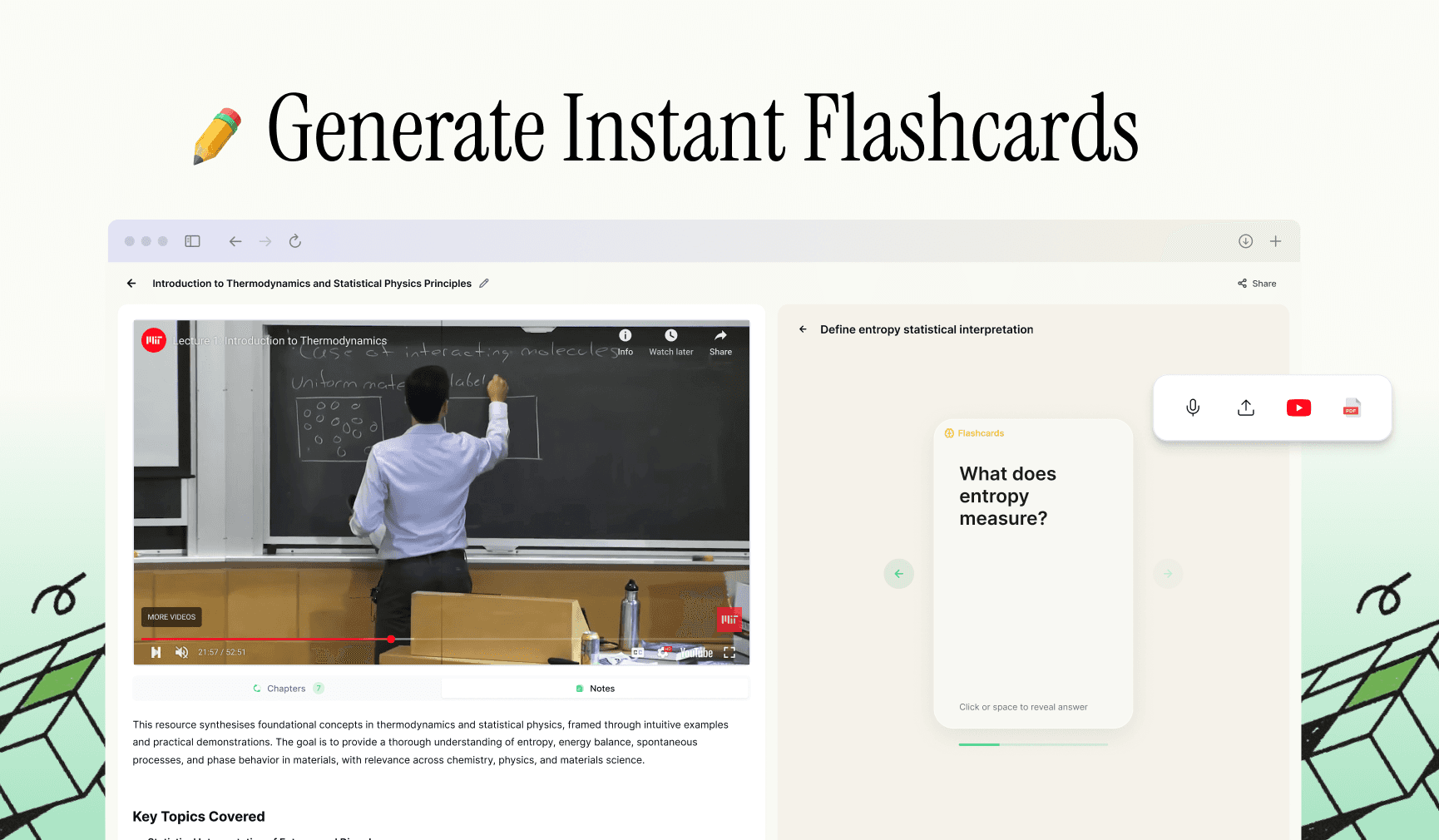
What to include in your Solid State Physics flashcards
Great physics flashcards follow the "atomic" rule: one specific idea per card. This prevents "the illusion of competence" where you think you know a concept because you recognize the general wording. Use question-based prompts to challenge your brain.
Focus on four main categories: definitions of material states, physical processes, comparative models, and mathematical application scenarios.
Definitions & key terms: "What is a Unit Cell?" "Define the Meissner effect."
Processes & steps: "What is the first step in determining a Miller Index?"
Comparisons: "How does an Insulator differ from a Semiconductor in terms of band gap?"
Application: "When would you use the Debye model over the Einstein model for specific heat?"
How to study Solid State Physics with flashcards
Studying the physics of solids is most effective when you use a two-pass system. First, build your deck from your syllabus or notes. Then, perform review rounds that focus on concepts you find difficult, such as reciprocal lattices or k-space mappings.
Keep your sessions short but frequent. It is better to review 15 minutes a day than 4 hours once a week. This consistency allows the spaced repetition algorithm to show you the hardest cards at the perfect moment for retention.
Make a deck from your Solid State notes or generate it from content.
Do one quick round to find weak spots like specific crystal math.
Review weak cards daily for three to five days.
Mix in a few harder cards, like derivation steps, each session.
Do a final mixed review before your midterm or final exam.
Generate Solid State Physics flashcards automatically in Duetoday
Making cards manually for a subject as technical as Solid State Physics is slow and prone to errors, especially with complex formulas. Duetoday simplifies this by using AI to extract the most important information from your documents.
Position yourself for success by uploading your PDFs or lecture slides. Duetoday instantly generates structured flashcards, allowing you to spend your time studying rather than formatting.
Upload or paste your Solid State Physics material
Click Generate Flashcards
Review, edit, and start studying
Generate Solid State Physics Flashcards in Duetoday
Start with your notes and get a deck you can actually use today.
Common Solid State Physics flashcard mistakes
Many students make the mistake of putting an entire page of notes on one card. In physics, if a card is too long, you'll likely split it into smaller, one-concept ideas to ensure you actually understand the underlying mechanics.
Cards are too long: split 'Crystal Systems' into individual cards for each type.
Only memorizing words: include 'Why and How' cards for things like lattice vibrations.
Confusing similar models: create specific comparison cards for Drude vs. Sommerfeld.
No review schedule: use the Duetoday system to repeat weak cards more often.
FAQ
How many flashcards do I need for Solid State Physics? For a standard semester course, 150-300 cards usually cover the core definitions, formulas, and crystal structures effectively.
What’s the best format for Solid State Physics flashcards? Question and answer format is best. Use the front for the term ('Bloch's Theorem') and the back for the mathematical definition and its physical implication.
How often should I review Solid State Physics flashcards? Ideally, daily for new cards. Once you master a concept like Miller Indices, you can move it to a weekly review schedule.
Should I make cards from a textbook or slides? Use lecture slides for the core 'must-knows' defined by your professor, and textbooks to clarify complex derivation steps for specific cards.
How do I stop forgetting formulas after a few days? Spaced repetition is key. By reviewing the formula in context of its application on a flashcard, you build a mental map that prevents forgetting.
What if my flashcards feel too easy or too hard? If they are too hard, split the card into two. If they are too easy, combine them or add a 'challenge' question to the back.
Can I generate Solid State Physics flashcards from a PDF automatically? Yes, Duetoday can read your PDF textbooks or notes and extract the most relevant physics concepts into flashcards instantly.
Are digital flashcards better than paper for this subject? Digital cards are superior for Solid State Physics because you can easily include diagrams of crystal lattices and use AI-driven spaced repetition.
How long does it take to make a full Solid State deck? Manually it could take hours, but Duetoday can generate a comprehensive draft deck in under a minute.
Can Duetoday generate and organize my flashcards for me? Yes, Duetoday categorizes and organizes your cards based on the content you upload, making it easy to study by topic.

Duetoday is an AI-powered learning OS that turns your study materials into personalised, bite-sized study guides, cheat sheets, and active learning flows.