Generate Flashcards for Separation Processes
Generate or make Separation Processes flashcards from your engineering notes. This guide explains how to study mass transfer.
Generate Flashcards with AI Free
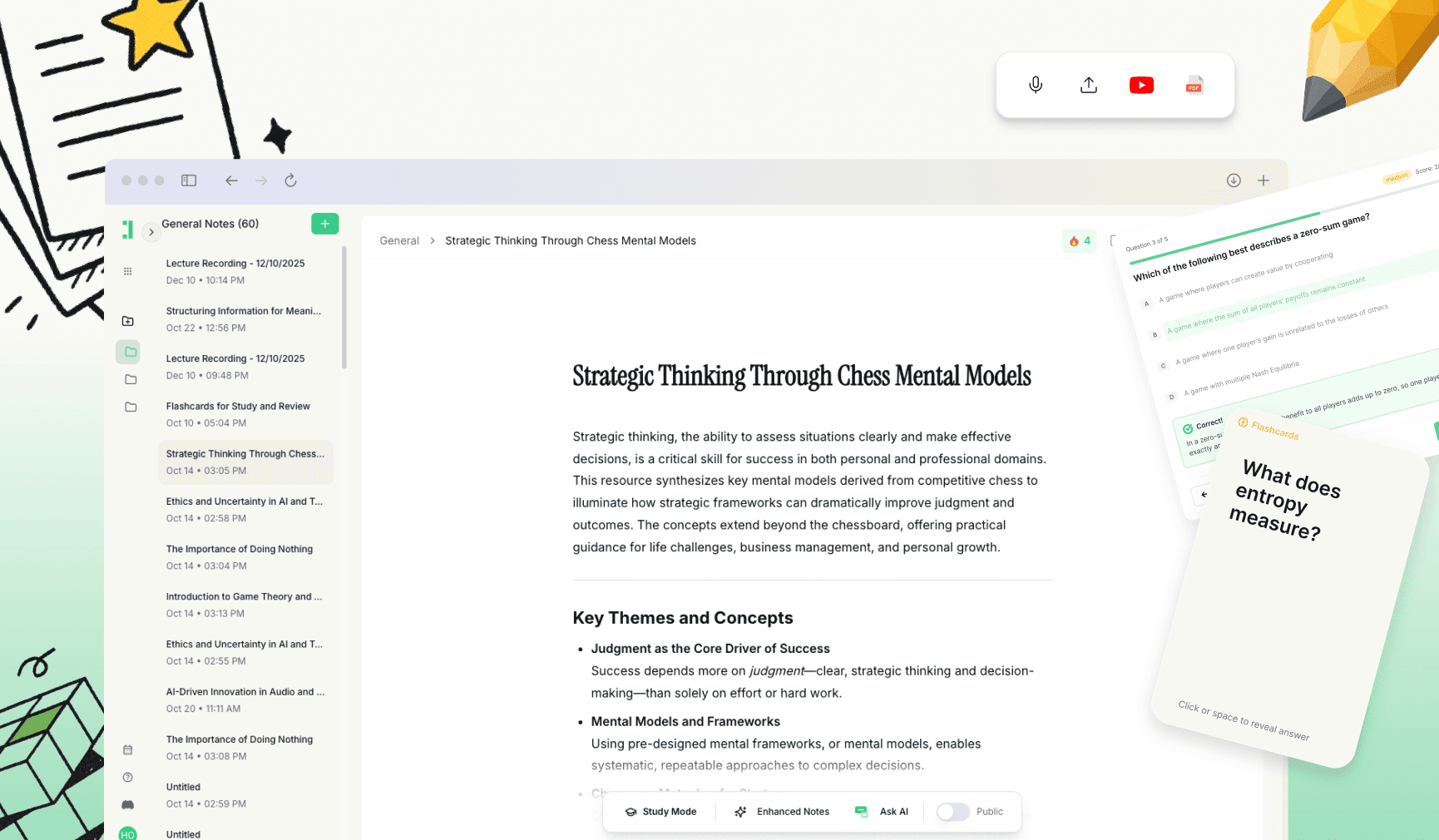
Turn your notes, PDFs, slides, or chemical engineering lectures into Separation Processes flashcards so you can review faster and remember more. Master complex equilibrium data and mass transfer principles without spent hours on manual formatting.
What are Separation Processes flashcards?
Separation Processes flashcards are focused study tools designed to break down complex chemical engineering operations into digestible units. They cover essential concepts like phase equilibria, stage-wise operations, mass transfer coefficients, and equipment design for processes like distillation, absorption, and liquid-liquid extraction.
The outcome is simple: instead of passively rereading dense textbooks or looking at McCabe-Thiele diagrams, you test yourself on the underlying logic and formulas to build long-term recall. If you already have lecture notes or slides, Duetoday can generate a clean deck in minutes so you can focus on the math and theory.
Why flashcards work for Separation Processes
This subject requires a mix of conceptual understanding and the ability to apply specific formulas to varying conditions. Flashcards force your brain to retrieve information actively, which is far more effective for high-stakes engineering exams.
Remember boiling point diagrams and equilibrium curves without cramming
Separate similar concepts like physical absorption vs. chemical absorption
Learn multi-stage processes step-by-step (feed trays, reflux, and stripping)
Practice applying Raoult’s and Henry’s laws quickly
What to include in your Separation Processes flashcards
Good engineering flashcards follow the one idea per card rule. They should focus on the 'why' and 'how' just as much as the 'what.' Use question-based prompts to challenge your understanding of mass transfer driving forces.
Definitions & Key Terms: What is the Relative Volatility (alpha) and why does it matter?
Processes & Steps: What are the four assumptions of the McCabe-Thiele method?
Comparisons: How does packed column design differ from tray column design?
Application: What happens to the slope of the operating line if the reflux ratio increases?
Example prompts: Define the HETP concept, State the Fenske equation purpose, or Explain the effect of entrainment on column efficiency.
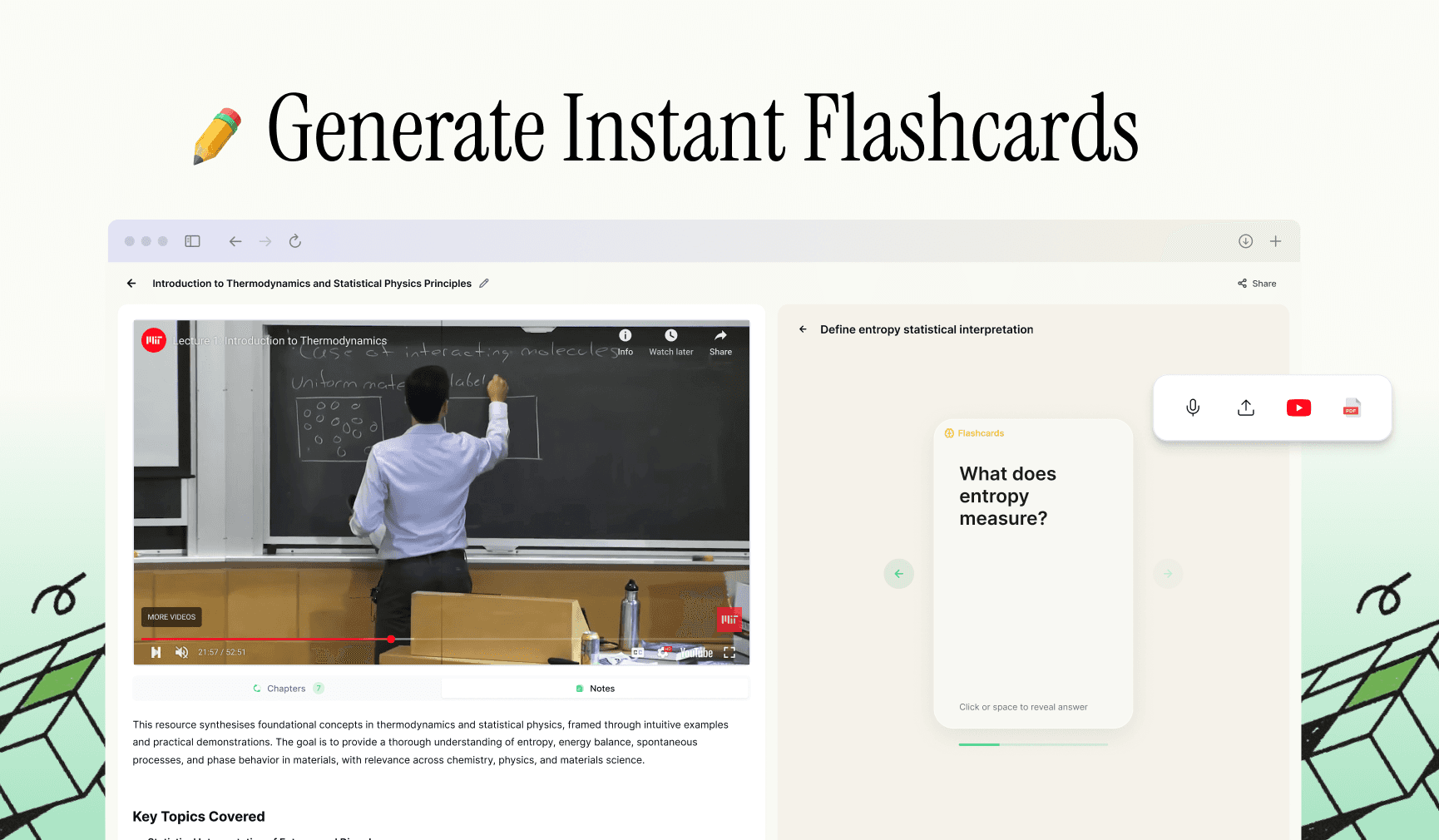
How to study Separation Processes with flashcards
The best way to master this subject is a two-pass approach. First, build your deck from your syllabus using Duetoday's AI, then enter a cycle of active retrieval and refinement. Engineering concepts often build on one another, so consistency is key.
Make a deck from your notes or textbook chapters on distillation and extraction.
Do one quick round to identify which formulas you keep forgetting.
Review weak cards—like those on non-ideal solutions—daily for a few days.
Mix in a few harder design problems or scenario cards each session.
Do a final mixed review of all separation types before your final exam.
Generate Separation Processes flashcards automatically in Duetoday
Making cards manually for chemical engineering is slow, messy, and inconsistent. Copying equations and drawing diagrams by hand takes time better spent solving problems. Duetoday simplifies this by converting your study materials into structured decks instantly.
Upload or paste your Separation Processes material (PDFs/Slides/Notes).
Click Generate Flashcards.
Review, edit, and start studying with our built-in player.
Stop rereading. Start recalling. Upload your material and get a deck you can actually use today.
Common Separation Processes flashcard mistakes
Most students make cards that are too wordy, making them hard to review. Keep your engineering cards lean.
Cards are too long: Split complex derivations into one step per card.
Only memorizing formulas: Add explain the physical meaning of prompts.
Ignoring units: Add cards that test the standard units for mass transfer coefficients.
No review schedule: Spaced repetition is the only way to keep the math fresh.
FAQ
How many flashcards do I need for Separation Processes? Typically, 50-80 cards per major unit (like Distillation or Membrane Separation) is enough to cover the core theory and formulas.
What’s the best format for these flashcards? Question and answer format works best, especially for testing your knowledge of how variables interact in a process.
How often should I review my cards? Review new concepts daily and older concepts 1-2 times per week to ensure the information stays in long-term memory.
Should I make cards from a textbook or slides? Use both. Textbooks are great for detailed theory, while slides often highlight the specific formulas your professor prioritizes.
How do I stop forgetting formulas after a few days? Use flashcards to test the *derivation* or the *application* of the formula, not just the symbols themselves.
What if my flashcards feel too easy? This is a sign you need to add application-based questions, such as What happens to the tray count if the feed is subcooled?
Can I generate flashcards from a PDF automatically? Yes, Duetoday can read your engineering PDFs and extract the most important technical concepts for you.
Are digital flashcards better than paper? Yes, because digital tools allow you to use spaced repetition algorithms that prioritize the cards you find difficult.
How long does it take to make a full deck? With Duetoday, you can generate a comprehensive deck from your notes in less than 60 seconds.
Can Duetoday handle chemical engineering symbols? Yes, our AI is designed to understand and format technical content for engineering students.

Duetoday is an AI-powered learning OS that turns your study materials into personalised, bite-sized study guides, cheat sheets, and active learning flows.