
Generate Flashcards for Robotics
Generate or make Robotics flashcards for engineering and computer science subjects to master kinematics and AI.
Generate Flashcards with AI Free
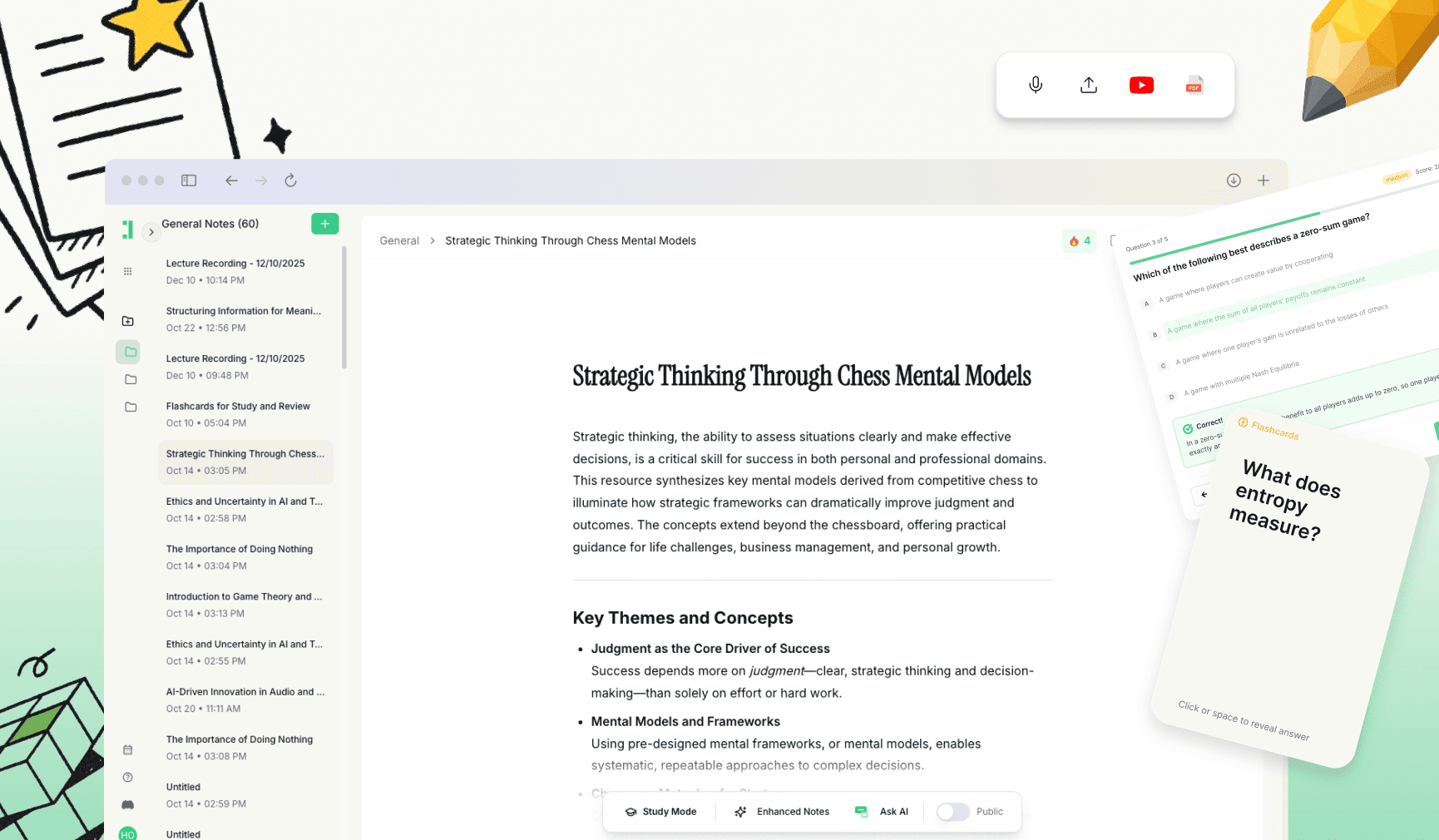
What are Robotics flashcards?
Robotics flashcards are focused study tools designed to help you master the multidisciplinary field of robotics, covering mechanics, electronics, and computer science. These cards distill complex concepts like forward kinematics, PID control, actuator types, and sensor fusion into bite-sized questions and answers.
The ultimate outcome of using these cards is moving beyond passive reading. Instead of just looking at a diagram of a robotic arm, you test your ability to explain the degrees of freedom or calculate torque requirements on the fly. If you already have lecture notes or textbook chapters, Duetoday can generate a clean deck in minutes so you can spend your time studying instead of formatting.
Why flashcards are one of the best ways to study Robotics
Robotics requires a deep understanding of both theoretical formulas and practical application. Flashcards leverage active recall and spaced repetition to ensure you don't forget foundational laws while moving into advanced automation topics.
Master technical vocabulary: Quickly memorize terms like odometry, dead reckoning, and end-effectors.
Internalize Mathematical Models: Practice recognizing and applying transformation matrices and Jacobian equations.
Diagnostic Logic: Learn to troubleshoot circuit behaviors and sensor errors by heart.
Step-by-Step Algorithms: Memorize the stages of path-planning algorithms like A* or SLAM.
What to include in your Robotics flashcards
Effective robotics cards follow the atomic rule: one specific idea per card. This prevents your brain from getting overwhelmed by the sheer complexity of the subject matter.
Definitions & Key Terms: What is the difference between a cobot and an industrial robot?
Processes & Steps: What are the four stages of the sense-think-act cycle?
Comparisons: How does a LiDAR sensor differ from an ultrasonic sensor in mapping?
Application: Given a 3-DOF arm, how is the workspace volume defined?
Try these example prompts: 'Define Inverse Kinematics,' 'What is the purpose of a H-bridge in motor control?', or 'Explain the role of a Kalman Filter in navigation.'
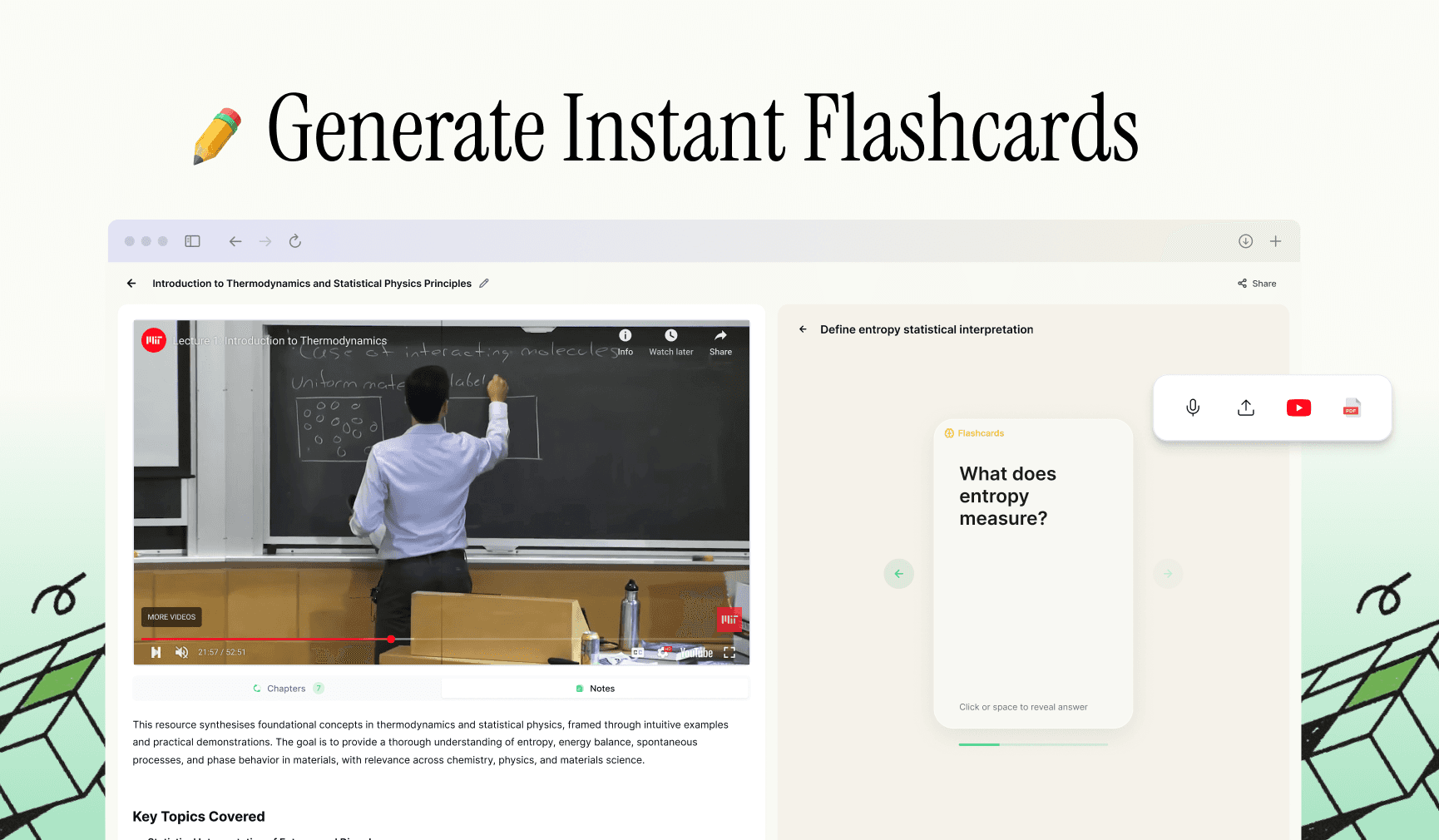
How to study Robotics with flashcards (a simple system)
Mastering robotics involves a two-pass approach. First, you build your deck to capture facts; then, you engage in iterative review sessions to build deep intuition for how systems interact.
Generate your deck from your syllabus, PDFs, or lab notes.
Perform a rapid first pass to identify which modules (e.g., control systems vs. vision) are your weakest.
Review difficult cards daily, focusing on the math and logic-heavy topics.
Mix your cards to simulate real-world problems where electronic and mechanical issues overlap.
Do a final self-test before your exam or lab practical to ensure total recall.
Generate Robotics flashcards automatically in Duetoday
Making cards manually is a slog—especially when you have to copy-paste complex definitions and equations. Duetoday eliminates the busywork by using AI to scan your materials and create study-ready decks instantly.
Simply upload your Robotics PDFs, slides, or transcripts, and click generate. You can then edit your cards for specific exam focus and start studying immediately. Your notes shouldn't just sit in a folder; turn them into an interactive study experience.
Common Robotics flashcard mistakes (and how to fix them)
Many students create ineffective cards by trying to put an entire textbook page on one card. Avoid these common pitfalls:
Cards are too long: Don't describe an entire robot; split it into base, joints, and controllers.
Ignoring the math: Ensure you have separate cards for the variables in an equation.
Lack of visuals: Robotics is visual; describe the physical orientation or use the AI tutor to clarify space.
No review schedule: Don't just study once; use spaced repetition to keep information fresh.
Ready to generate your Robotics flashcards?
Stop rereading and start recalling. Turn your complex robotics material into a structured deck today.
FAQ
How many flashcards do I need for Robotics? It depends on the course, but a typical introductory robotics module usually requires 100-150 cards to cover mechanics, sensors, and basic programming.
What’s the best format for Robotics flashcards? Question-and-answer format is best for definitions, while 'Problem-Step' format works well for kinematics and circuit calculations.
How often should I review Robotics flashcards? Review new cards daily for the first week, then use spaced repetition to check back every few days as the concepts stick.
Should I make cards from a textbook or lecture notes? Use lecture notes for the core exam material and textbooks to clarify complex mathematical proofs or sensor data sheets.
How do I stop forgetting Robotics formulas? Create cards that ask 'What does [variable] represent in this formula?' to build understanding rather than just rote memorization.
What if my flashcards feel too easy? If cards are too easy, combine them into 'Application' cards where you must explain how multiple concepts interact in a robotic system.
Can I generate Robotics flashcards from a PDF automatically? Yes, Duetoday can read your technical PDFs and extract the most important definitions and formulas into cards.
Are digital flashcards better than paper for Robotics? Digital is usually better for Robotics as it allows you to quickly update cards as you learn new code or hardware specifications.
How long does it take to make a full Robotics deck? With Duetoday, you can generate a full deck in under a minute after uploading your source material.
Can Duetoday organize my flashcards for me? Yes, Duetoday organizes your cards by topic or document, making it easy to find specific sections like 'Control Theory' or 'Actuators.'

Duetoday is an AI-powered learning OS that turns your study materials into personalised, bite-sized study guides, cheat sheets, and active learning flows.