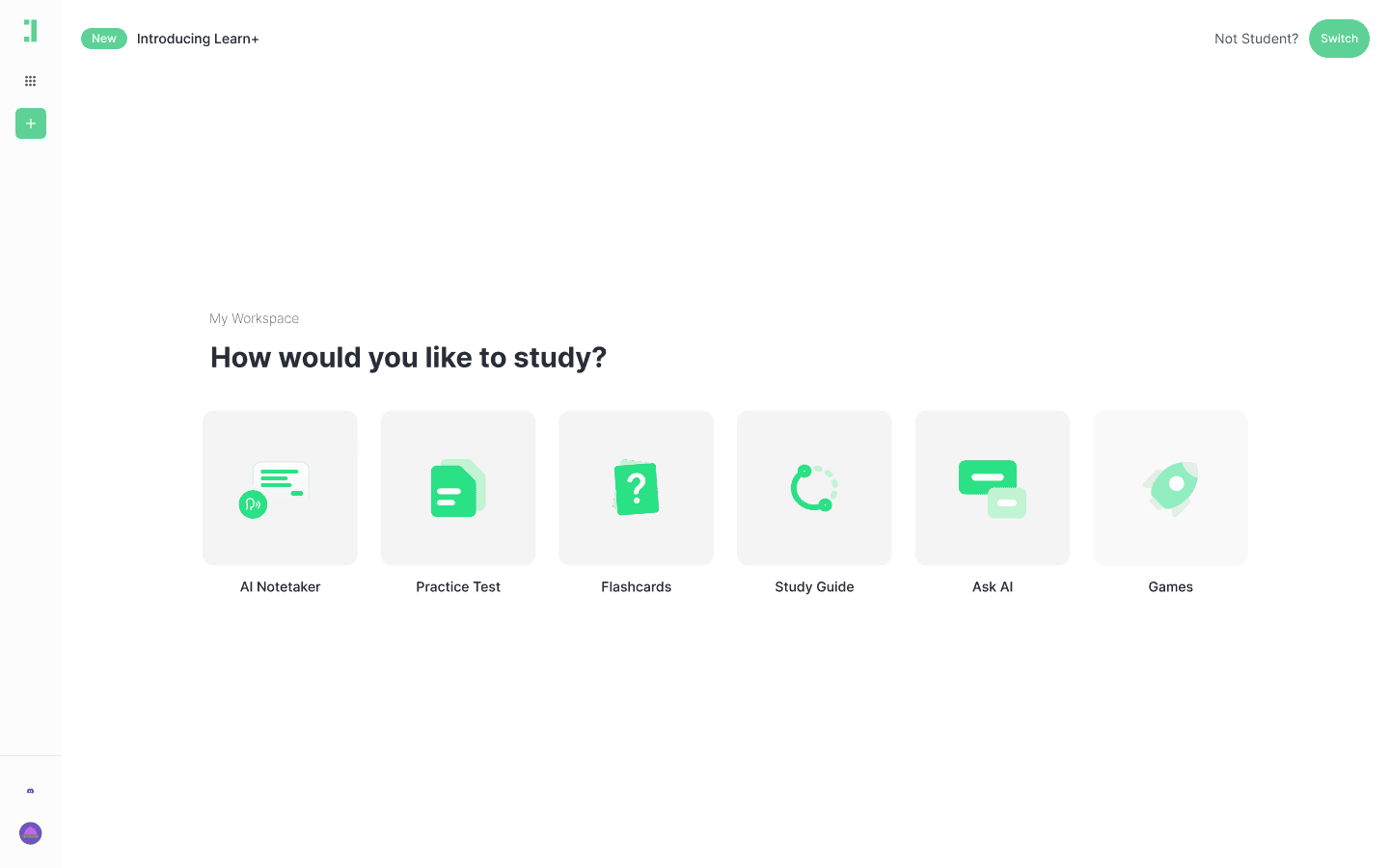
Generate Flashcards for Reinforcement Learning
Make Reinforcement Learning flashcards to master MDPs and Q-Learning. Generate study decks from your notes and PDFs quickly.
Generate Flashcards with AI Free
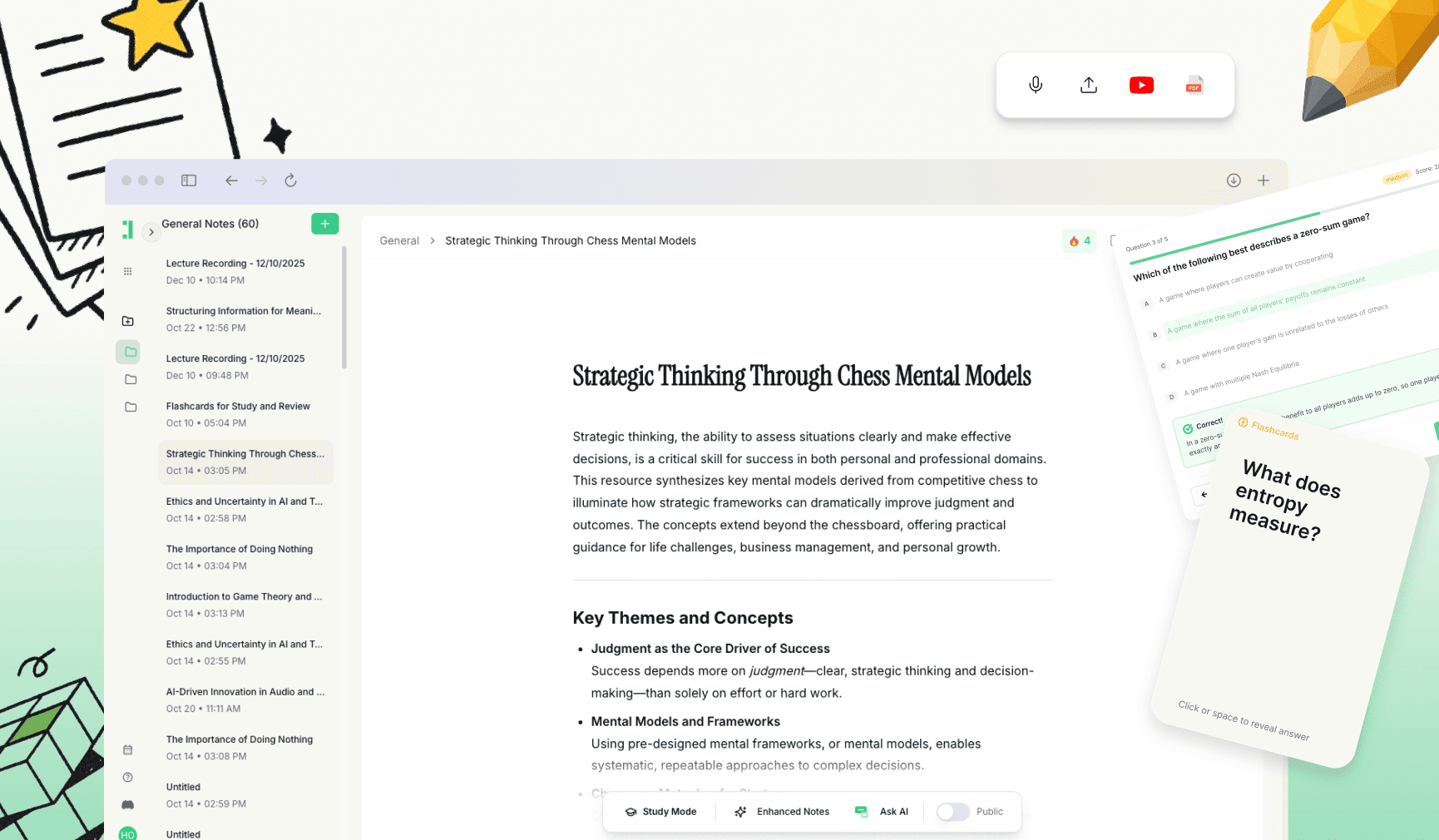
What are Reinforcement Learning flashcards?
Reinforcement Learning (RL) flashcards are concise study tools designed to help you master the complex algorithms, mathematical frameworks, and terminology inherent in machine learning agents. These flashcards cover everything from foundational concepts like Reward Signals and States to advanced topics like Deep Q-Networks (DQN) and Actor-Critic models.
Instead of passively rereading dense textbooks or watching long lectures, these flashcards force you to define terms, apply formulas, and differentiate between exploration and exploitation. The goal is to build high-level intuition and low-level technical accuracy simultaneously. If you already have lecture slides or PDFs from your CS course, Duetoday can generate a targeted deck in seconds.
Why flashcards work for Reinforcement Learning
Reinforcement Learning requires both conceptual understanding and the ability to recall specific mathematical relationships. Flashcards leverage active recall and spaced repetition to ensure you don't forget the nuances of the Bellman Equation or the difference between SARSA and Q-Learning.
Internalize the jargon of states, actions, rewards, and environments.
Distinguish between model-based and model-free approaches quickly.
Memorize update rules and loss functions for various algorithms.
Practical application: Practice selecting the right RL approach for different scenarios.
What to include in your Reinforcement Learning flashcards
Effective RL flashcards focus on the one idea per card rule. You want to avoid cognitive overload by breaking down iterative processes into their core components. We recommend four primary card types: Definitions & Key Terms, Process & Algorithms, Comparisons, and Mathematical Application.
Definitions: What is the Discount Factor (Gamma)? or Define a Markov Property.
Algorithms: What are the four components of a Markov Decision Process (MDP)?
Comparisons: How does On-policy learning differ from Off-policy learning?
Application: When should you use Thompson Sampling over Epsilon-greedy?
Example Prompts for your deck:
Define the exploration-exploitation trade-off.
What is the update rule for Q-Learning?
What is the role of a Value Function?
How does Experience Replay improve DQN stability?
What is the advantage of using Policy Gradients?
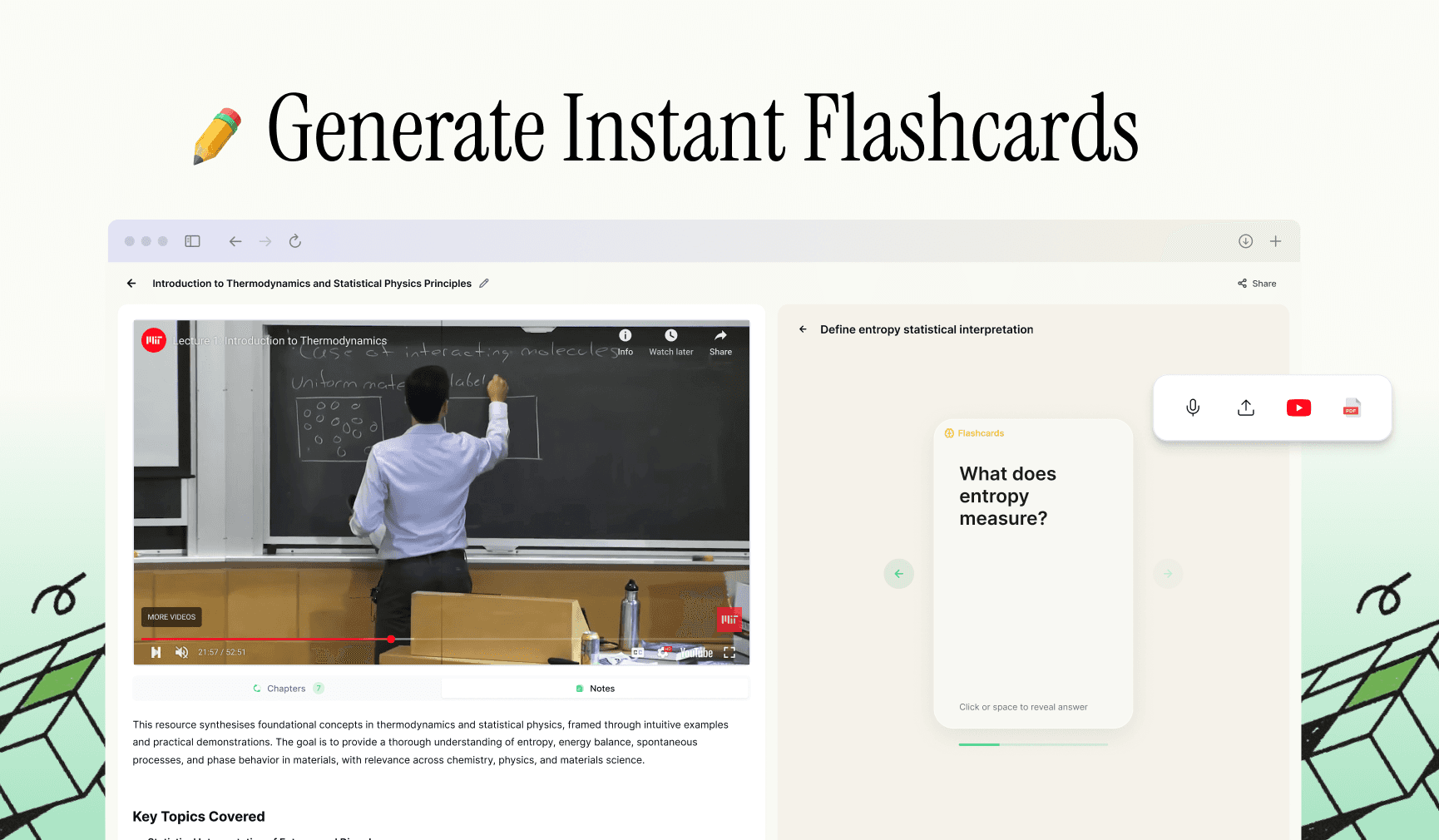
How to study Reinforcement Learning with flashcards
Mastering RL requires a systematic approach. Start by generating a deck from your course materials. Read through the deck once to ensure you understand the logic behind the answers. Then, start your first active pass. Use the two-pass system where you filter out the cards you know immediately and focus your energy on the difficult mathematical derivations.
Generate your deck from notes or research papers.
Perform a rapid round to identify your confusion points (e.g., Policy Iteration vs Value Iteration).
Review high-difficulty cards daily to strengthen neural pathways.
Mix in scenario-based questions to ensure you can apply the theory.
Conduct a full deck review before your exam or technical interview.
Generate Reinforcement Learning flashcards automatically
Building an RL deck manually is exhausting because of the complex notation and diagrams involved. Duetoday automates this process, allowing you to spend more time studying and less time formatting. Simply upload your lecture slides, research papers, or transcripts, and let the AI extract the most important concepts for you.
Upload your RL material (PDF, Slides, or Text).
Click 'Generate Flashcards'.
Review, edit, and start your study session immediately.
Common Reinforcement Learning flashcard mistakes
Avoid these common pitfalls when studying RL:
Cards are too complex: Don't put the entire Bellman Equation on one card; break it into sections.
Ignoring the 'Why': Don't just memorize the name of an algorithm; make a card for its specific use case.
Neglecting hyperparameters: Ensure you have cards for learning rates, discount factors, and epsilon values.
Inconsistent Review: RL concepts build on each other; skipping a week of review makes advanced topics harder to grasp.
FAQ
How many flashcards do I need for Reinforcement Learning? Usually, a comprehensive introductory course requires between 80 to 120 cards covering basic MDPs, Bellman Equations, and classic algorithms.
What’s the best format for RL flashcards? Q&A style is best for definitions, while 'Fill-in-the-blank' works well for memorizing parts of an algorithm's update rule.
How often should I review my RL deck? Aim for daily reviews for new concepts, then transition to every 3-5 days once the material starts to stick.
Should I make cards from a textbook or slides? Both are useful. Textbooks are better for theoretical definitions, while slides often highlight the specific algorithms your instructor values.
How do I stop forgetting the Bellman Equation? Use incremental flashcards that ask for parts of the equation before asking for the whole formula.
What if my flashcards feel too hard? Break the question down into smaller pieces. If a card asks 'Explain PPO,' change it to 'What is the main goal of PPO?'
Can I generate RL flashcards from a PDF? Yes, Duetoday can digest complex machine learning PDFs and turn them into structured flashcards automatically.
Are digital flashcards better than paper for RL? Digital is superior for RL because you can easily include code snippets and updated algorithm versions without rewriting everything.
How long does it take to make a full RL deck? Manually it could take hours, but with Duetoday's AI generator, it takes less than a minute.
Can Duetoday organize my cards by algorithm? Yes, you can generate specific decks for different topics like 'Bandits,' 'Value-based,' or 'Policy-based' methods.

Duetoday is an AI-powered learning OS that turns your study materials into personalised, bite-sized study guides, cheat sheets, and active learning flows.