Generate Flashcards for Reflection and Refraction
Generate Reflection and Refraction flashcards in seconds with AI. Try out free now!
Generate Flashcards with AI Free
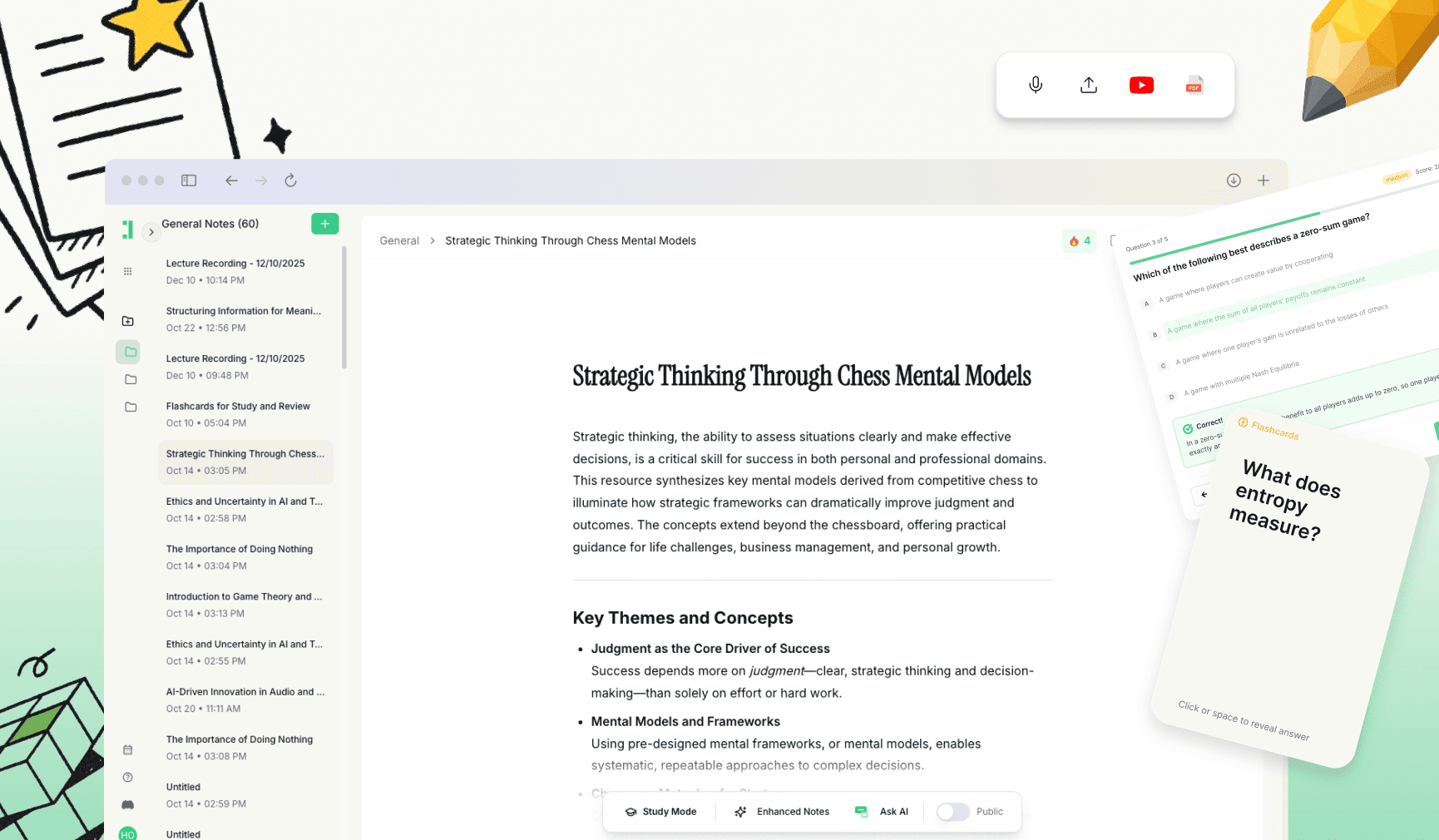
Generate Flashcards for Reflection and Refraction
Turn your physics notes, PDFs, slides, or lab reports into Reflection and Refraction flashcards so you can review faster and remember more. Whether you are studying Snell's Law or the properties of concave mirrors, mastering the behavior of light requires active recall, not just passive reading.
Generate Reflection and Refraction Flashcards
With Duetoday, the process is simple: upload your course materials, and our AI instantly identifies key laws and formulas to generate a structured deck. You can then review, edit, and use spaced repetition to ensure the concepts stick before your next exam.
What are Reflection and Refraction flashcards?
Reflection and Refraction flashcards are focused study tools that cover the fundamental principles of optics. These cards break down complex behaviors like how light bounces off surfaces (reflection) and how it bends when passing through different media (refraction).
Instead of rereading a textbook chapter on light waves, these flashcards force you to test yourself on specific variables, such as the angle of incidence, focal points, and indices of refraction. This active testing builds the neural pathways needed for quick recall during physics problems. If you already have notes, Duetoday can generate a clean deck in minutes so you can spend your time studying rather than formatting.
Why flashcards work for Reflection and Refraction
Optics is a subject that relies heavily on a mix of terminology, geometric diagrams, and mathematical formulas. Flashcards are one of the most effective ways to study this because they allow you to isolate individual variables and rules without becoming overwhelmed by the entire chapter at once.
By using active recall and spaced repetition, you ensure that you aren't just memorizing definitions, but truly understanding the relationship between light and various surfaces. This method helps you:
Remember key terms like 'normal line' and 'critical angle' without cramming.
Separate similar concepts like Specular vs. Diffuse reflection.
Learn processes step-by-step, such as how to locate an image in a ray diagram.
Practice applying Snell's Law and the mirror equation quickly.
What to include in your Reflection and Refraction flashcards
Good physics flashcards follow the 'atomic' rule: one idea per card. Because light behavior is highly visual and mathematical, your questions should be specific and prompt you to visualize or calculate an outcome. Using a mix of question styles ensures you are prepared for both multiple-choice and problem-solving exam sections.
Definitions & key terms: "What is the law of reflection?" "Define the index of refraction."
Processes & steps: "What happens to a light ray when it enters a denser medium?"
Comparisons: "How does a converging lens differ from a diverging lens?"
Application: "If the angle of incidence is 30 degrees, what is the angle of reflection?"
Example prompts to try: "What is the formula for Snell's Law?", "Describe a virtual image in a plane mirror.", "What condition is required for total internal reflection to occur?", and "Where is the focal point located relative to the center of curvature?"
How to study Reflection and Refraction with flashcards
To master optics, you should use a two-pass approach. Start by building your deck from your lectures and then move into high-intensity review rounds. Since optics is a cumulative subject, early mastery of basic reflection makes later refraction units much easier.
Make a deck from your notes or generate it from your textbook PDF in Duetoday.
Do one quick round to find weak spots, especially in formula application.
Review weak cards daily to strengthen your memory of sign conventions.
Mix in tougher ray-tracing cards to simulate real exam questions.
Do a final mixed review of both reflection and refraction before your test.
Generate Reflection and Refraction flashcards automatically in Duetoday
Making physics cards manually is slow and messy—drawing diagrams and writing out formulas by hand takes hours that you should be using to actually study. Duetoday eliminates the friction of preparation so you can focus on the physics.
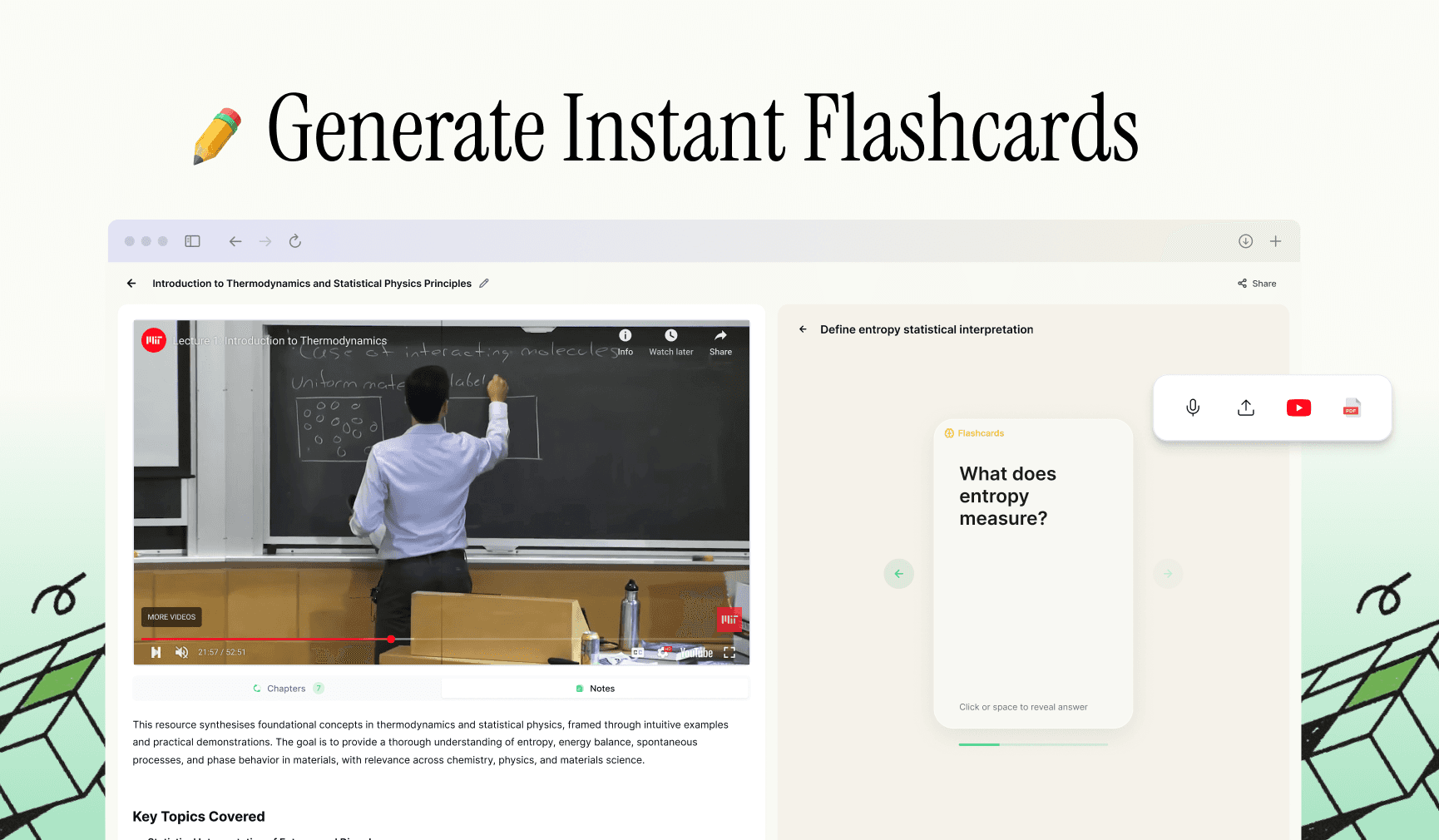
Simply upload your lab notes or textbook chapters, and Duetoday's AI will parse the text for the most important laws and concepts. In seconds, you'll have a study-ready deck.
Upload or paste your physics material.
Click Generate Flashcards.
Review, edit, and start studying immediately.
Generate Reflection and Refraction Flashcards in Duetoday
Start with your notes and get a deck you can actually use today.
Common Reflection and Refraction flashcard mistakes
Most students make the mistake of creating cards that are way too wordy. If a card contains a whole paragraph on how a lens works, you'll end up memorizing the text instead of the concept. Keep them short: one question, one answer. Additionally, don't just memorize the words—ensure you have cards that ask 'why' or 'how' to ensure conceptual mastery, and always include the specific sign conventions for mirrors and lenses to avoid easy mistakes on math problems.
FAQ
How many flashcards do I need for Reflection and Refraction? A typical unit usually requires between 30 and 50 cards to cover all definitions, formulas, and common ray-tracing scenarios.
What’s the best format for these flashcards? Question-and-answer format is best. For example, "What is the relationship between the angle of incidence and reflection?" works better than a simple term-definition card.
How often should I review my physics flashcards? Review them daily via spaced repetition in the week leading up to an exam to move the concepts from short-term to long-term memory.
Should I make cards from a textbook or my notes? Use both. Textbooks provide the formal definitions, while lecture notes often contain the specific examples and problems your instructor prioritizes.
How do I stop forgetting formulas after a few days? Include 'application' cards that require you to state which formula to use for a specific scenario rather than just reciting the letters.
Can I generate these flashcards from a PDF automatically? Yes, Duetoday is designed to read your physics PDFs and generate a full deck of flashcards instantly.
Are digital flashcards better than paper for optics? Yes, because digital tools like Duetoday allow for faster editing and use AI to schedule reviews based on which cards you find most difficult.
Can Duetoday handle the math involved in these topics? Absolutely. The AI identifies formulas like the mirror equation and Snell's Law and creates cards to help you memorize them.

Duetoday is an AI-powered learning OS that turns your study materials into personalised, bite-sized study guides, cheat sheets, and active learning flows.