Generate Flashcards for Reaction Rates
Generate Reaction Rates flashcards in seconds. Upload notes to master kinetics today for free.
Generate Flashcards with AI Free
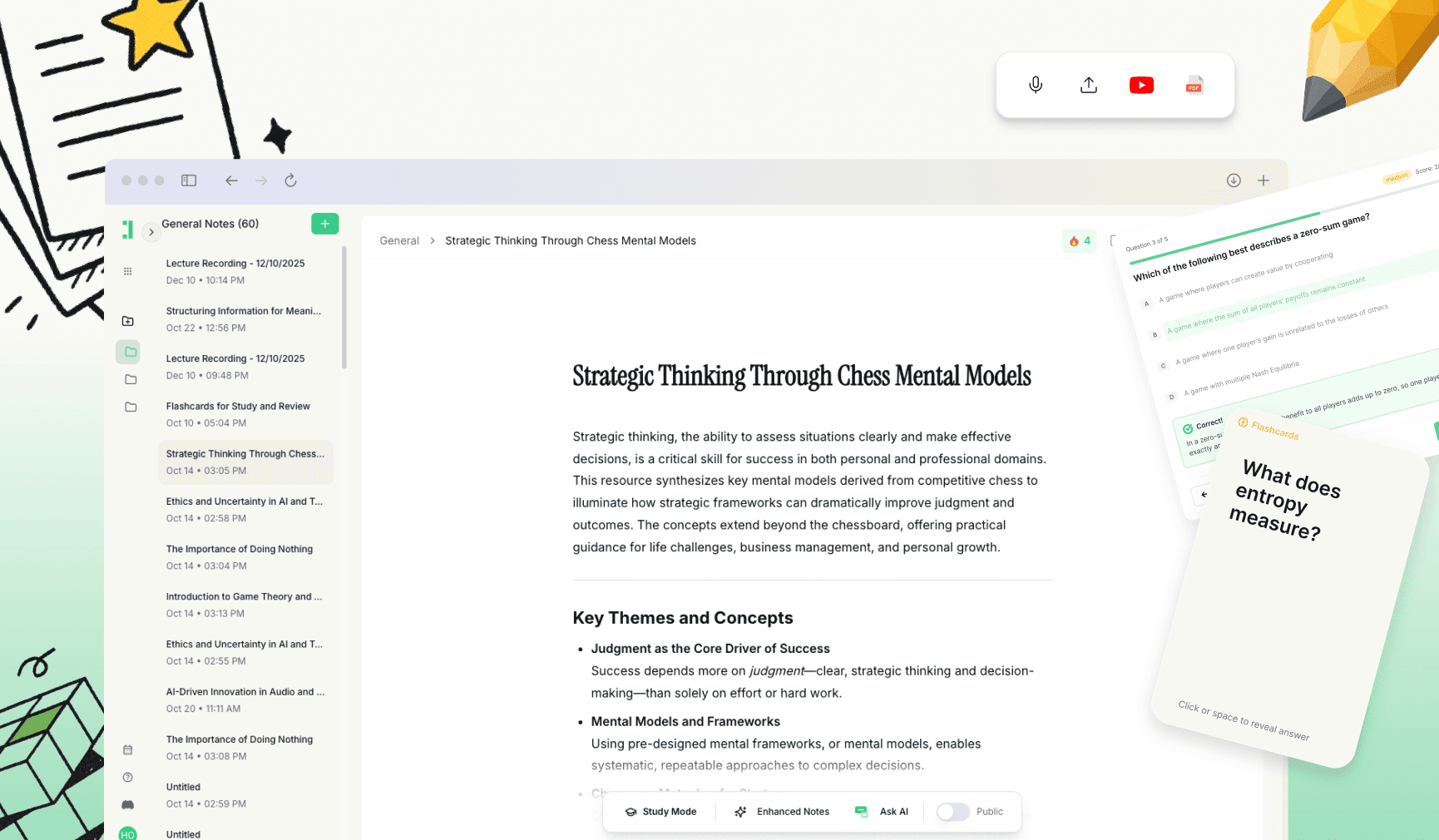
Generate Flashcards for Reaction Rates
Turn your notes, PDFs, slides, or chemistry lectures into Reaction Rates flashcards so you can review faster and remember more. Understanding how quickly substances transform requires mastery of specific variables; Duetoday helps you nail them all.
Generate Reaction Rates FlashcardsUpload notes / paste text
In Duetoday, the process is simple: upload your chemistry materials, click generate, and our AI builds a comprehensive deck. You can then refine the cards and start your study session immediately.
What are Reaction Rates flashcards?
Reaction Rates flashcards cover the fundamental principles of chemical kinetics. This includes key terms like activation energy and molarity, the steps of a reaction mechanism, rate law formulas, and the factors that influence how fast a reaction occurs (temperature, concentration, surface area, and catalysts).
Instead of passively rereading your textbook, these flashcards force you to engage in active recall. By testing your ability to predict shifts in rate or identify catalysts, you build a deeper functional understanding of chemistry. If you already have notes, Duetoday can generate a clean deck in minutes.
Why flashcards work for Reaction Rates
Reaction Rates require a mix of rote memorization (definitions) and procedural application (calculating rates). Flashcards bridge this gap by breaking complex kinetics into bite-sized, testable units. Using active recall and spaced repetition, you ensure that the difference between an intermediate and a transition state stays fresh in your mind.
Remember constants and units without cramming before the exam.
Separate similar concepts like zero-order vs. first-order reactions.
Learn reaction pathways step-by-step, from reactants to products.
Practice applying the Arrhenius equation and rate laws quickly.
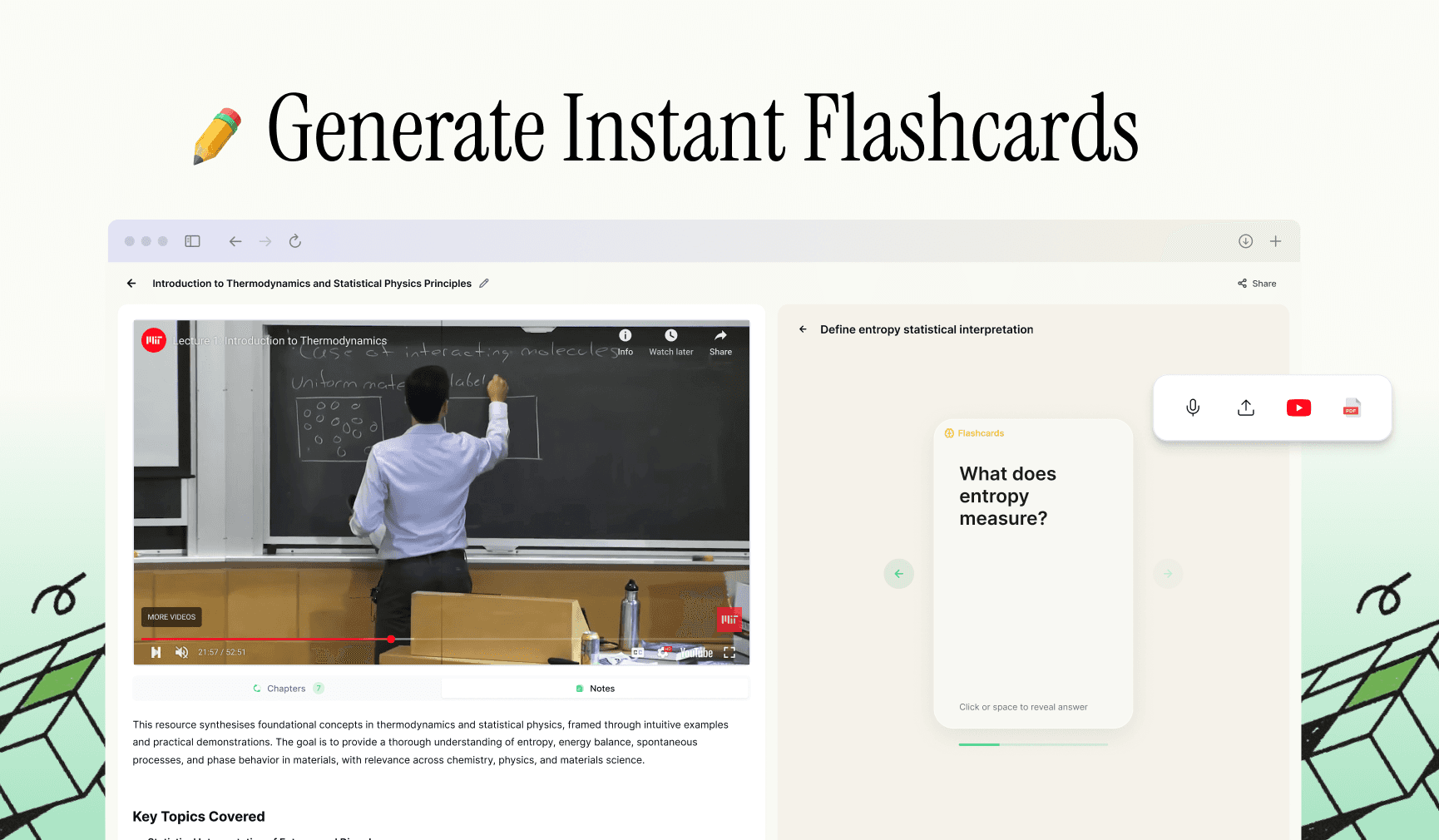
What to include in your Reaction Rates flashcards
Effective flashcards follow the "one idea per card" rule. Use question-based prompts to trigger your brain's retrieval process. We recommend focusing on four main categories to cover all your bases.
Definitions & key terms: "What is the definition of activation energy?"
Processes & steps: "What is the first step in a bimolecular reaction mechanism?"
Comparisons: "How does a catalyst differ from a reactant?"
Application: "If concentration doubles in a second-order reaction, what happens to the rate?"
Example prompts: "Define the half-life of a reaction," "What units are used for a zero-order rate constant?", and "State the collision theory requirements for a successful reaction."
How to study Reaction Rates with flashcards
Start with a "two-pass" approach. Use your first pass to identify which concepts—like Le Chatelier’s principle or energy profile diagrams—are giving you trouble. Then, move into targeted rounds focused specifically on those difficult areas.
Make a deck from your lecture notes or lab reports.
Do one quick round to find weak spots in your kinetics knowledge.
Review weak cards (like rate law derivations) daily for a few days.
Mix in a few harder stoichiometry cards to keep your brain sharp.
Do a final mixed review before your chemistry midterm or final.
Generate Reaction Rates flashcards automatically in Duetoday
Making cards manually is slow, messy, and takes time away from actual studying. Duetoday eliminates the busywork by using AI to scan your PDFs and slides, extracting the most important kinetics data for you.
Upload or paste your Reaction Rates material.
Click Generate Flashcards.
Review, edit, and start studying instantly.
Generate Reaction Rates Flashcards in Duetoday
Start with your notes and get a deck you can actually use today.
Common Reaction Rates flashcard mistakes
Avoid making cards that are essentially paragraphs. If a card is too long, you’ll end up memorizing the flow of the text rather than the chemistry concept. Ensure you aren't just memorizing definitions; include cards that ask "why" a temperature increase speeds up a reaction to build true comprehension. Finally, don't ignore the math—practice cards for calculating the rate constant are essential.
Ready to generate your Reaction Rates flashcards?
Stop rereading and start recalling. Upload your notes, generate your deck, and master chemical kinetics with active recall. Duetoday works with notes, PDFs, slides, and even lecture transcripts.
Start Generating Flashcards
FAQ
How many flashcards do I need for Reaction Rates? Usually 30 to 50 cards are sufficient to cover the core definitions, formulas, and conceptual graphs for a standard unit.
What’s the best format for Reaction Rates flashcards? A mix of "Definition" cards and "Scenario" cards (e.g., 'What happens to the rate if...') works best for chemistry.
How often should I review Reaction Rates flashcards? Review daily leading up to your exam, focusing on the cards you marked as 'Difficult' using spaced repetition.
Should I make cards from a textbook or slides? Use both. Slides often highlight what the professor thinks is important, while textbooks provide the precise definitions needed for full credit.
How do I stop forgetting the rate law formulas? Create separate cards for each order (0, 1, 2) and their corresponding units for the rate constant 'k'.
What if my flashcards feel too easy? Add 'Challenge' cards that require you to explain the underlying logic, such as explaining the Maxwell-Boltzmann distribution.
Can I generate Reaction Rates flashcards from a PDF? Yes, Duetoday allows you to upload any chemistry PDF and converts the text into structured flashcards automatically.
Are digital flashcards better than paper for Reaction Rates? Digital cards are generally better because they allow for the easy inclusion of reaction coordinate diagrams and use algorithms to show you hard cards more often.
How long does it take to make a full deck? With Duetoday, you can generate a full deck in under a minute, compared to over an hour by hand.
Can Duetoday organize my cards by sub-topic? Yes, the AI can categorize cards into sections like Catalysis, Collision Theory, and Rate Laws for more organized studying.

Duetoday is an AI-powered learning OS that turns your study materials into personalised, bite-sized study guides, cheat sheets, and active learning flows.