Generate Flashcards for Reaction Engineering
Easily make or generate Reaction Engineering flashcards from your notes to master kinetics and reactor design quickly.
Generate Flashcards with AI Free
What are Reaction Engineering flashcards?
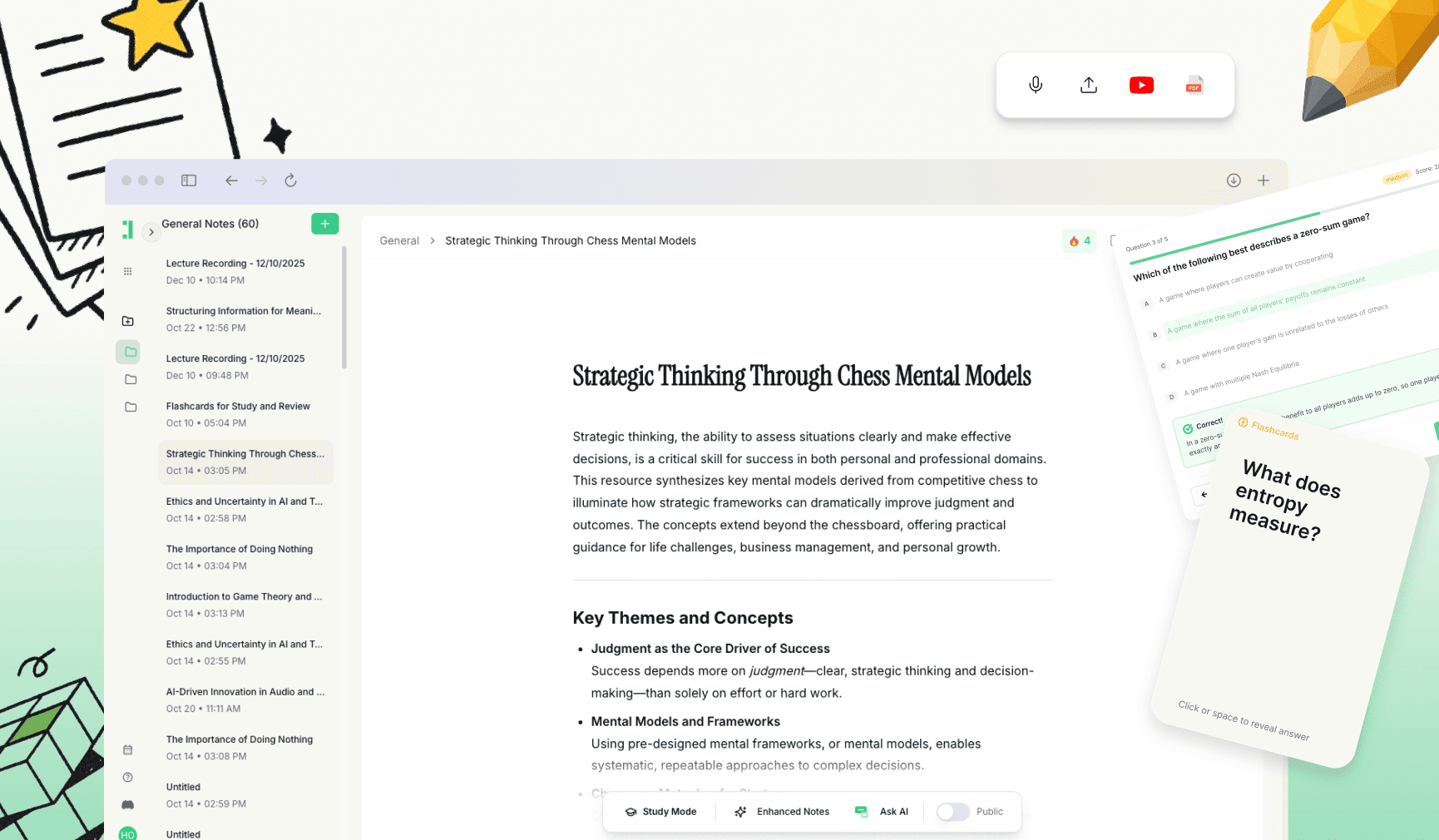
Reaction Engineering flashcards are specialized study tools designed to help chemical engineering students master the complex interplay between chemical kinetics, thermodynamics, and reactor design. These cards cover essential topics such as rate laws, stoichiometry, energy balances, and the performance of different reactor types like Batch, CSTR, and PFR.
The goal is to move beyond passive reading of dense textbooks. By using flashcards, you force your brain to retrieve specific formulas and concepts instantly, building the mental muscle memory required for advanced engineering problem-solving. If you already have lecture slides or PDFs from your course, Duetoday can generate a professional flashcard deck in minutes.
Why flashcards work for Reaction Engineering
Reaction Engineering is a subject built on logic and mathematical relationships. Flashcards are ideal for this because they allow you to break down multi-step derivations into manageable chunks of information. Instead of being overwhelmed by a 10-page chapter on non-isothermal reactors, you can test yourself on individual dependencies and governing equations.
Memorize reaction rate constants and Arrhenius parameters efficiently.
Distinguish between different reactor characteristics (e.g., CSTR vs. PFR) at a glance.
Learn complex sequences like the steps of catalytic mechanisms.
Practice applying conversion and selectivity formulas without looking at your notes.
What to include in your Reaction Engineering flashcards
Effective reaction engineering cards should follow the one-concept rule. Avoid putting an entire derivation on one card; instead, focus on the critical transition points or the final design equations. Using question-and-answer formats ensures you are actively testing your knowledge rather than just recognizing familiar text.
Definitions & Key Terms: What is the definition of Space Time (tau)?
Processes & Steps: What are the four steps of a catalytic reaction sequence?
Comparisons: How does conversion compare between a PFR and CSTR for a 1st order reaction?
Application: What happens to the rate constant if the temperature increases?
Example prompts include: Write the design equation for a PFR in terms of conversion, Define the Damköhler number, or What are the assumptions for an ideal CSTR?
How to study Reaction Engineering with flashcards
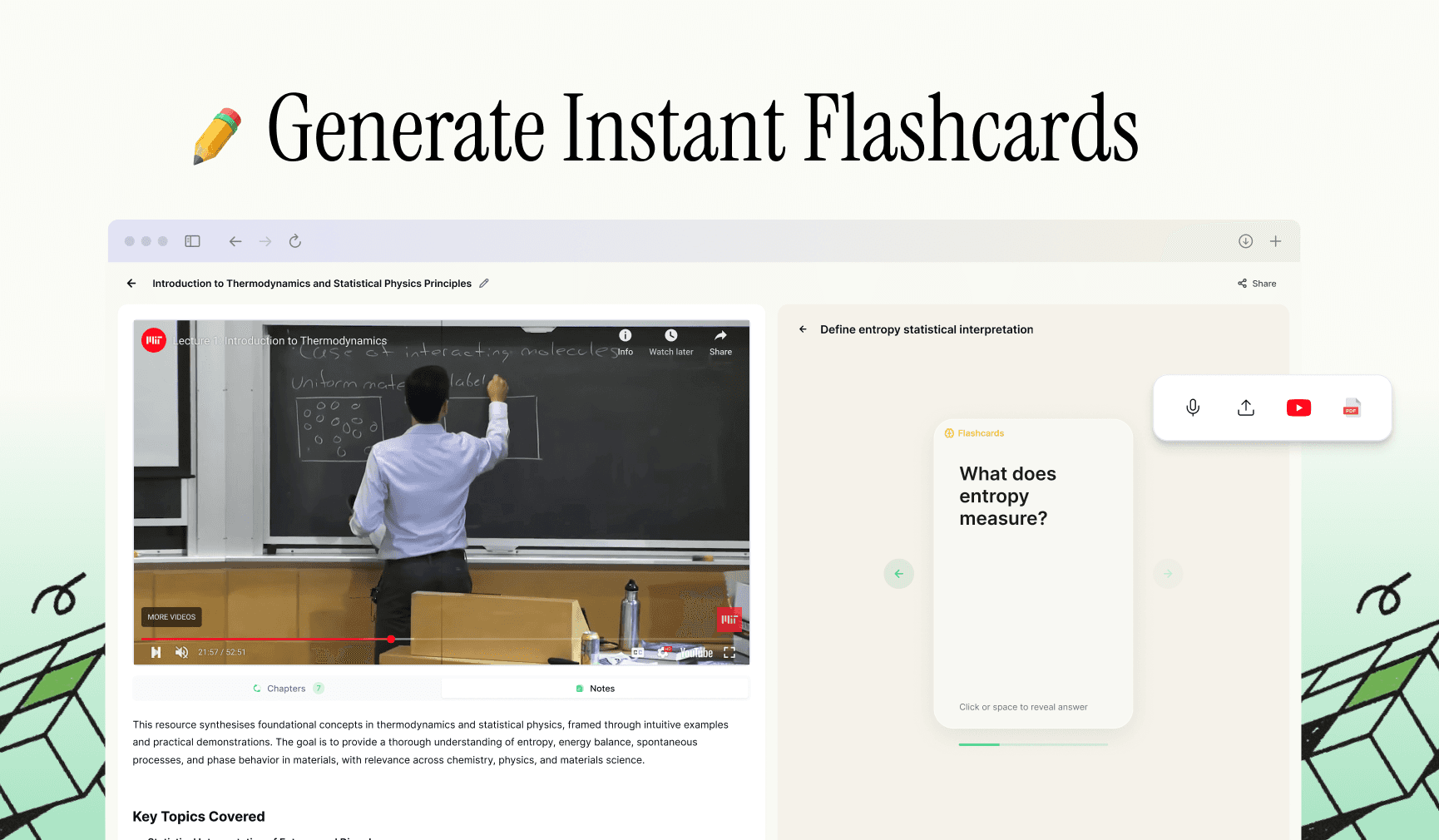
To master this subject, use a two-pass approach. First, use your generated deck to familiarize yourself with the fundamental design equations and rate laws. Once the basics are solid, move into a shuffled review where you mix concepts from different chapters to simulate a real exam environment.
Generate a deck from your specific lecture notes or textbook chapters.
Perform a daily quick-fire round to identify which formulas you keep forgetting.
Focus heavily on weak cards that involve sign conventions or complex units.
Gradually introduce cards involving non-isothermal effects as you progress.
Complete a full mixed review before your midterms or finals.
Generate Reaction Engineering flashcards automatically
Manually writing out dozens of complex equations on physical cards is time-consuming and prone to errors. Duetoday simplifies this by using AI to scan your materials and extract the most important engineering concepts for you.
Simply upload your PDFs, lecture slides, or typed notes and let the tool do the heavy lifting. You'll get a structured, accurate deck that you can edit, expand, and study immediately. This allows you to spend more time solving problems and less time formatting paper cards.
Common Reaction Engineering mistakes to avoid
Many students make their flashcards too wordy, which leads to rote memorization of sentences rather than understanding concepts. Ensure your cards force you to think about the 'why' behind the math. Don't forget to include cards on units and dimensions—messing those up is a common way to lose points on exams.
Avoid long derivations; split them into key logical steps.
Don't just memorize the formula; include an 'application' card for when to use it.
Ensure you have cards specifically for different reactor setups (Series vs. Parallel).
Keep a consistent review schedule to combat the forgetting curve.
Ready to generate your Reaction Engineering flashcards?
Stop stressing over massive textbooks. Upload your notes, generate your deck, and start studying with active recall today. Duetoday works with PDFs, slides, and transcripts to give you the ultimate study edge.
Frequently Asked Questions
How many flashcards do I need for Reaction Engineering? Typically, a comprehensive deck for a standard semester-long course will range from 150 to 300 cards, depending on the number of reactor types covered.
What is the best format for these flashcards? A mix of 'Question and Answer' for definitions and 'Completion' for design equations works best.
How often should I review them? We recommend 15-20 minutes daily. Spaced repetition is the best way to keep complex kinetics fresh in your mind.
Should I use textbook or lecture notes? Ideally both. Your lecture notes provide the professor's focus, while the textbook provides the granular detail for AI generation.
How do I stop forgetting the formulas? Use 'variable-focused' cards. Don't just learn the equation; learn what every single Greek letter and subscript represents.
Can I generate these from a PDF? Yes, Duetoday is designed to extract data directly from engineering PDFs and slides.
Are digital cards better than paper? For engineering, digital is often better because you can easily include high-quality images of reaction plots and reactor diagrams.
How long does it take to make a full deck? With Duetoday, it takes less than 60 seconds after uploading your document.
Can Duetoday handle mathematical notation? Yes, the AI is trained to understand and format technical engineering equations for your study sessions.

Duetoday is an AI-powered learning OS that turns your study materials into personalised, bite-sized study guides, cheat sheets, and active learning flows.