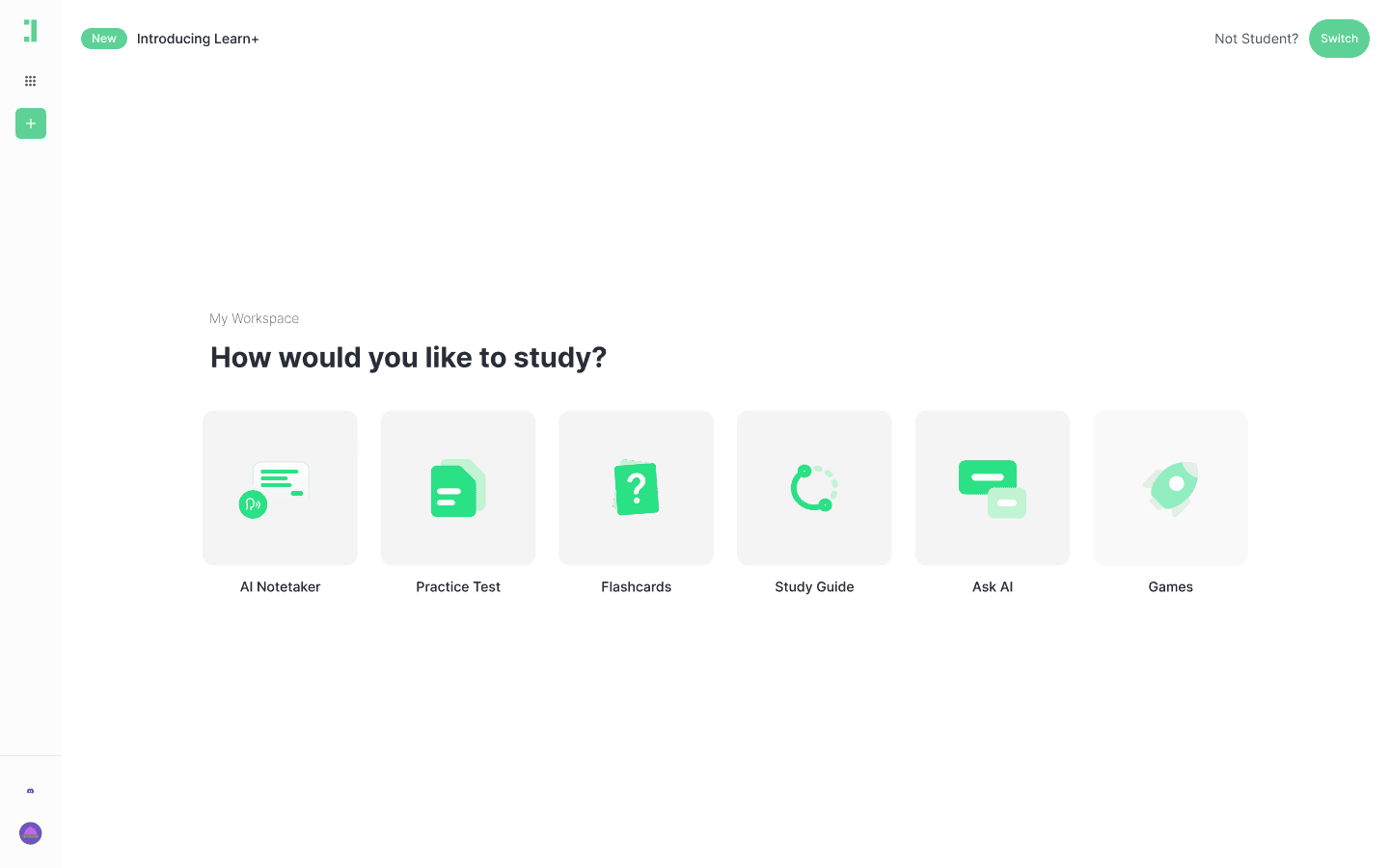
Generate Flashcards for Quantum Mechanics II
Make Quantum Mechanics II flashcards from your notes. Generate study guides for perturbation theory and spin today.
Generate Flashcards with AI Free
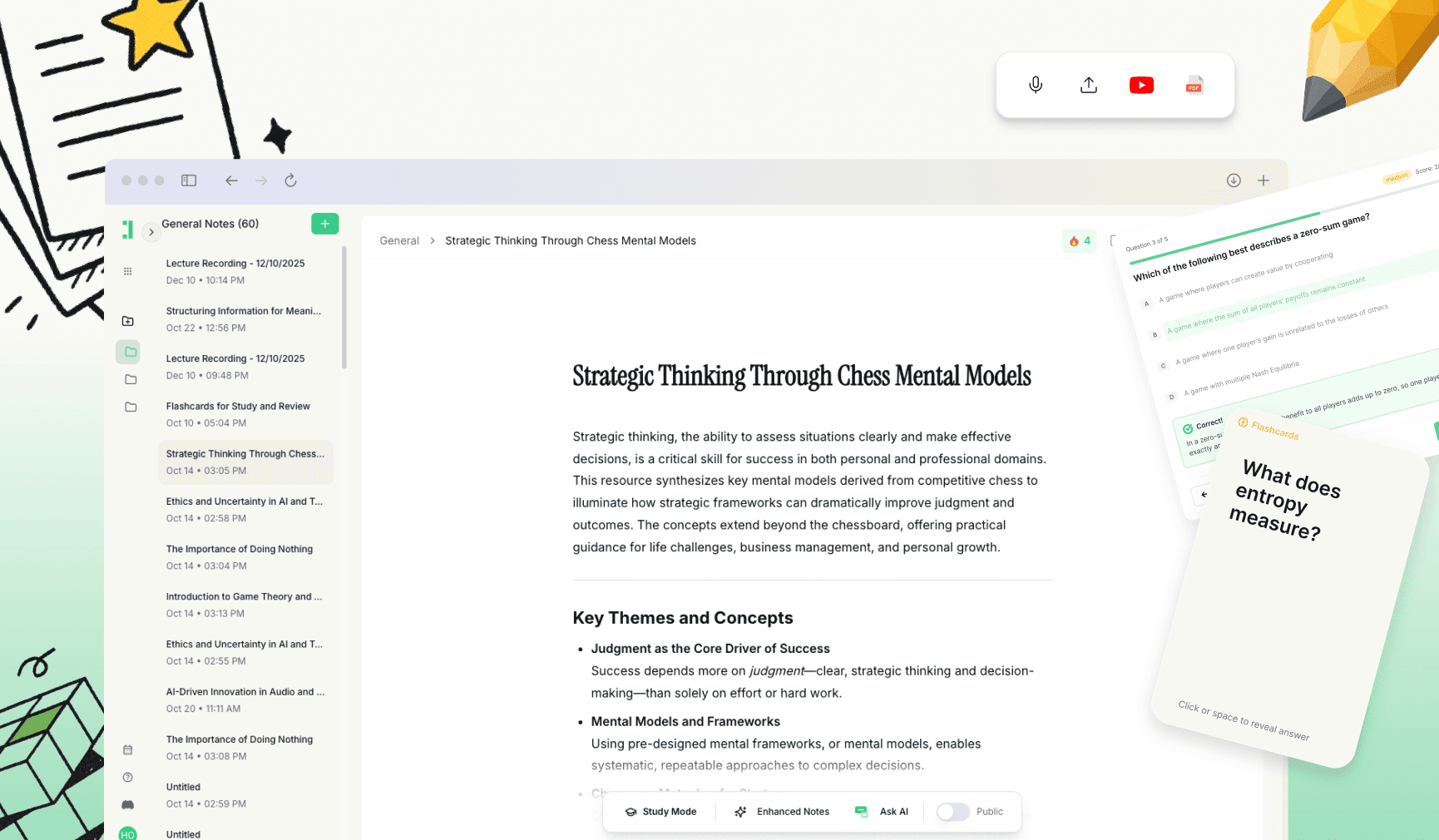
What are Quantum Mechanics II flashcards?
Quantum Mechanics II flashcards are specialized study tools designed to help you master advanced physics concepts like time-independent and time-dependent perturbation theory, identical particles, and scattering theory. These flashcards break down complex mathematical derivations and physical postulates into digestible, question-and-answer pairs.
Instead of passively rereading dense textbooks or complex lecture slides, these flashcards force you to engage in active recall. By testing your knowledge of the Variational Method or the WKB approximation, you build the mental pathways necessary to solve exam-level problems. If you already have lecture notes, Duetoday can generate a clean deck in minutes so you can spend your time practicing rather than formatting cards.
Why flashcards work for Quantum Mechanics II
Quantum Mechanics II requires a mix of conceptual understanding and rigorous mathematical application. Flashcards allow you to isolate specific operators, commutators, and boundary conditions that are often lost in long derivations. Using active recall and spaced repetition ensures that these foundational rules remain sharp in your memory.
Remember Hilbert space properties without cramming
Separate similar concepts (e.g., First-order vs. Second-order corrections)
Learn multi-step processes like the Born approximation
Practice applying selection rules and angular momentum addition
What to include in your Quantum Mechanics II flashcards
The most effective flashcards for advanced physics stick to the "one idea per card" rule. They move beyond simple definitions and focus on the conditions under which specific theorems apply. Effective cards help you bridge the gap between high-level theory and the actual math required for problem sets.
Definitions & Key Terms: "What is the physical meaning of the Fine Structure constant?"
Processes & Steps: "What is the first step in applying the Variational Method?"
Comparisons: "How does the Dirac equation differ from the Schrödinger equation regarding spin?"
Application: "When is the adiabatic approximation valid?"
Example Prompts: 'State the Pauli Exclusion Principle in terms of wave functions', 'What is the first-order energy correction formula for a non-degenerate system?', and 'Define the scattering amplitude f(theta)'.
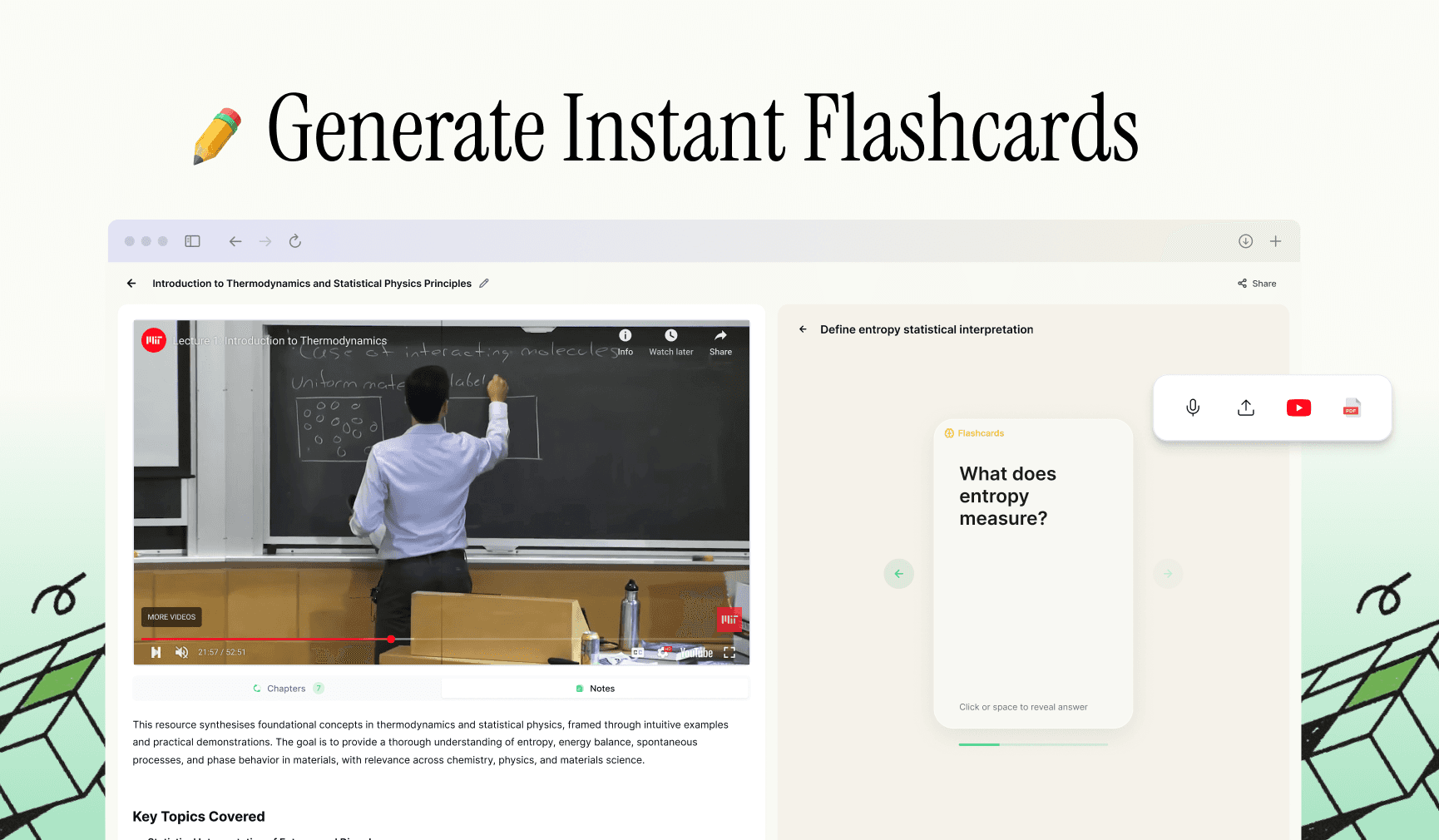
How to study Quantum Mechanics II with flashcards
Mastering Quantum Mechanics II requires a two-pass approach. First, use your generated deck to familiarize yourself with the core theorems and definitions. Second, use the cards to trigger 'mental derivations' where you outline the steps to solve a classic problem (like the Stark Effect) before checking the card's back.
Make a deck from your lecture notes or textbook PDFs in Duetoday.
Do one quick round to identify which approximations you find most confusing.
Review weak cards—like those covering Clebsch-Gordan coefficients—daily.
Mix in difficult operators or commutation relations into every session.
Perform a final review of all selection rules before your exam.
Generate Quantum Mechanics II flashcards automatically
Manually writing out LaTeX formulas on physical cards is incredibly slow and prone to errors. Duetoday streamlines this by letting you upload your heavy PDFs, lecture slides, or messy handwritten notes and turning them into structured study material instantly.
Upload your Quantum Mechanics II syllabus or transcripts
Click Generate Flashcards
Review the AI-generated deck and start studying immediately
Generate Quantum Mechanics II Flashcards in Duetoday
Start with your notes and get a deck you can actually use today.
Common Quantum Mechanics II flashcard mistakes
Many students make cards that are essentially paragraphs. For a subject as technical as this, brevity is key to avoiding cognitive overload. Avoid these common pitfalls:
Cards are too long: Don't paste the whole derivation; ask for the single next step.
Ignoring symbols: Ensure you can identify all variables in a formula (e.g., what is 'a' in the Bohr radius?).
Focusing only on math: Include conceptual 'why' questions to understand physical intuition.
No review schedule: Don't wait until the night before the midterm to open your deck.
FAQ
How many flashcards do I need for Quantum Mechanics II? A typical semester-long course usually requires 150-250 cards to cover all theorems, approximations, and particle statistics thoroughly.
What’s the best format for these flashcards? Question-and-answer format is best. Use the front for the 'Goal' (e.g., find the ground state energy) and the back for the 'Method' and 'Formula'.
How often should I review? Because of the mathematical complexity, daily reviews are recommended for the first week, moving to every three days once the formulas feel familiar.
Should I make cards from a textbook or slides? Use slides for the exam's specific focus, but use textbooks for the deeper derivations and boundary conditions often tested in graduate-level physics.
How do I stop forgetting formulas? Use 'cloze deletion' where you hide one part of a formula. This forces your brain to reconstruct the relationship between physical constants.
What if my flashcards feel too easy? Add more application-based questions, such as 'Under what physical conditions does this approximation fail?' to increase the difficulty.
Can I generate flashcards from a PDF? Yes, Duetoday can read your Quantum Mechanics textbooks or research papers and extract the most relevant study points automatically.
Are digital flashcards better than paper? Yes, digital cards allow for easy inclusion of complex LaTeX formulas and better organization of topics like 'Spin' or 'Perturbation Theory'.
How long does it take to make a full deck? With Duetoday, you can generate a full chapter's worth of flashcards in under 60 seconds.
Can Duetoday handle Greek symbols and equations? Absolutely, the AI is built to recognize and format mathematical notation commonly used in advanced physics.

Duetoday is an AI-powered learning OS that turns your study materials into personalised, bite-sized study guides, cheat sheets, and active learning flows.