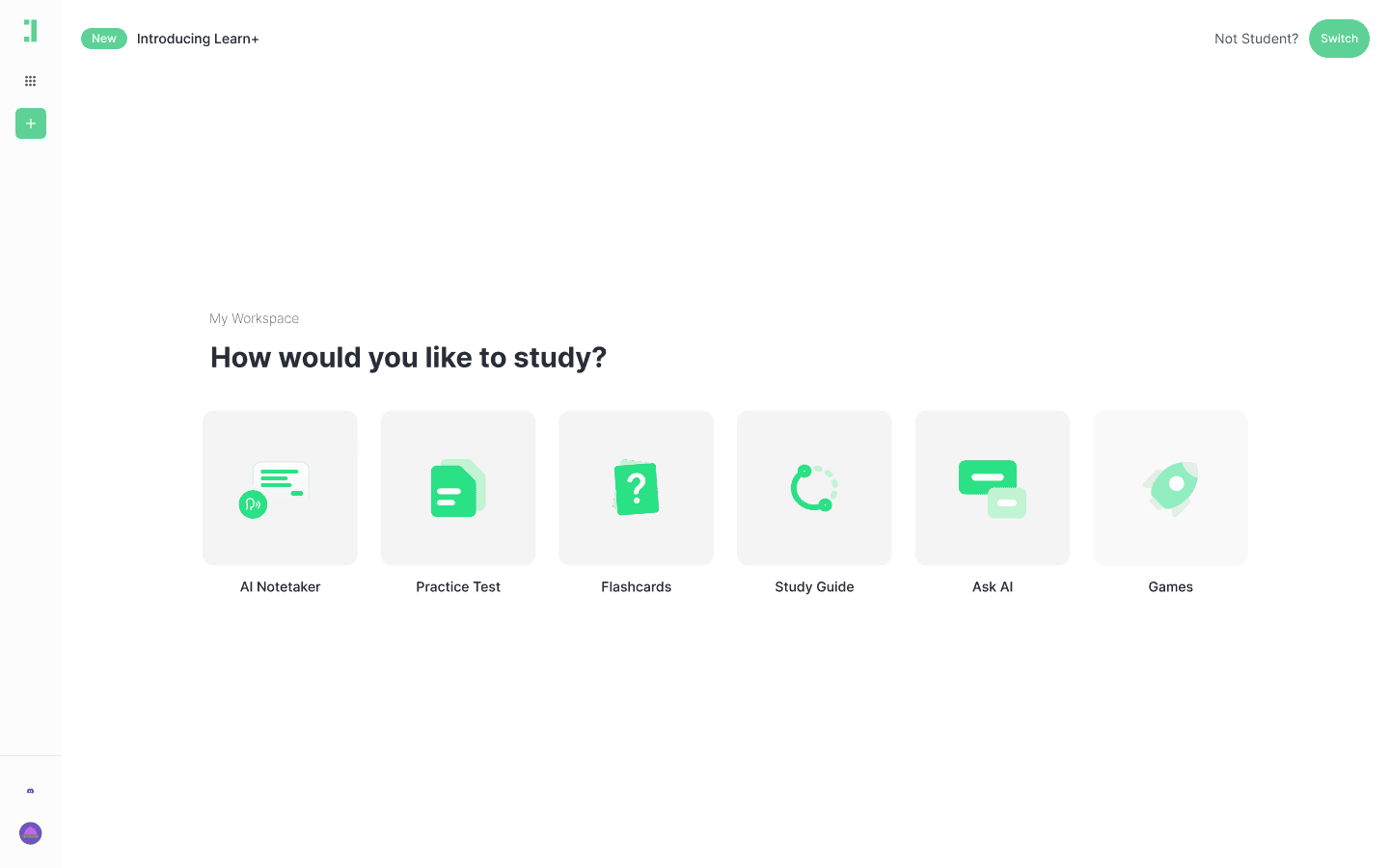
Generate Flashcards for Quantum Mechanics I
Generate or make high-quality Quantum Mechanics I flashcards to master wave functions and Schrodinger equations.
Generate Flashcards with AI Free
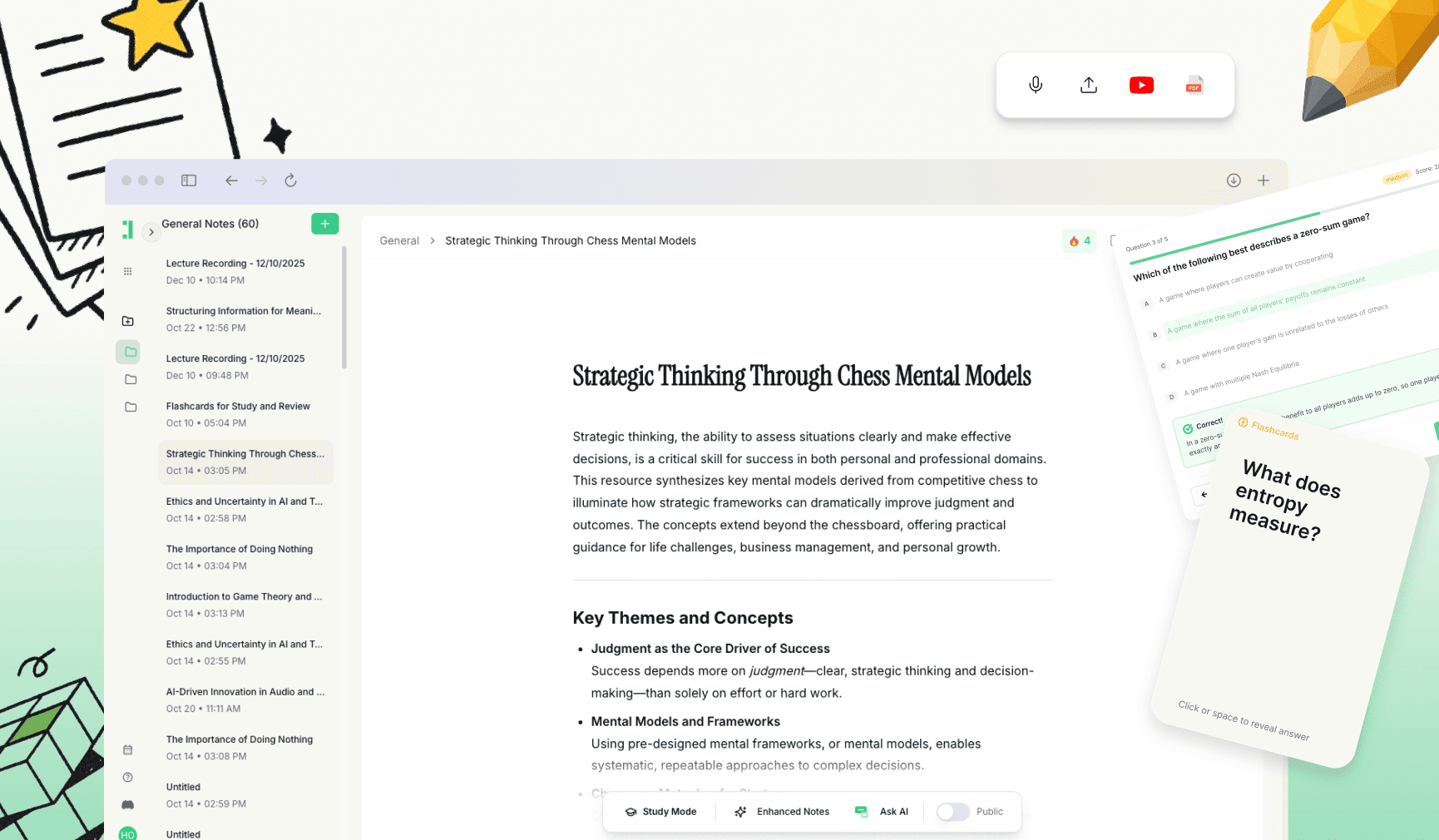
What are Quantum Mechanics I flashcards?
Quantum Mechanics I flashcards are specialized study tools designed to break down the complex mathematical and physical pillars of subatomic physics. They cover essential concepts like wave-particle duality, the Schrodinger equation, operators, and quantum states. Instead of staring at dense textbooks, these cards force you to recall specific postulates and mathematical proofs on demand.
The outcome is simple: you move from passive reading to active mastery. By testing yourself on specific Dirac notation or potential well boundary conditions, you build the neural pathways required to solve p-set problems and exam questions with speed and accuracy. If you already have lecture notes, Duetoday can generate a clean deck in minutes.
Why flashcards are one of the best ways to study Quantum Mechanics I
Quantum Mechanics requires a unique blend of abstract conceptual understanding and rigorous mathematical application. Flashcards are perfect for this because they isolate variables, formulas, and interpretations that are easily confused during a long lecture. They help bridge the gap between 'understanding' a concept and 'executing' it during a test.
Memorize key operators and their corresponding physical observables.
Distinguish between Eigenstates, Eigenvalues, and Expectation Values.
Internalize the steps for solving the time-independent Schrodinger equation.
Practice rapid identification of boundary conditions for different potentials.
What to include in your Quantum Mechanics I flashcards
Effective flashcards follow the 'atomic' rule: one specific idea per card. For Quantum Mechanics, this means avoiding long derivations and focusing on the logic, the result, or the definition. Use question-based prompts to trigger your brain's retrieval mechanism.
Definitions & Key Terms: "What is the physical significance of the Wave Function squared?"
Processes & Steps: "What are the three steps to normalize a wave function?"
Comparisons: "How does a Boson differ from a Fermion in terms of spin?"
Application: "What is the energy of the ground state for a particle in a 1D box?"
Try these example prompts: "State the Heisenberg Uncertainty Principle formula," "What happens to the wave function at an infinite potential wall?", or "Define a Hermitian operator."
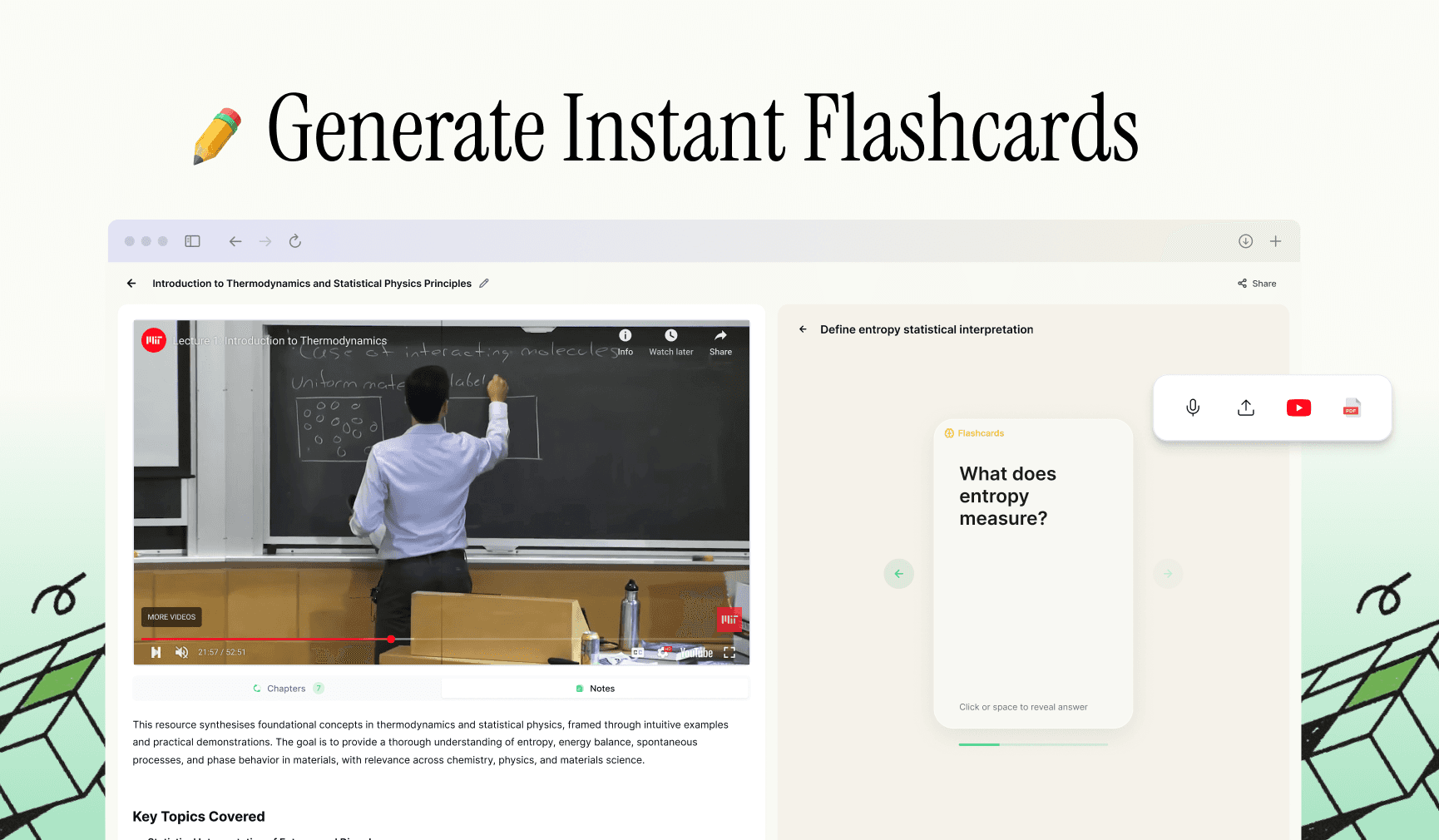
How to study Quantum Mechanics I with flashcards
Start with a 'two-pass' approach. First, generate your deck from your syllabus or notes and do a broad sweep to identify which mathematical proofs or concepts feel fuzzy. Quantum Mechanics is cumulative, so mastering the basics of Hilbert space early is vital for understanding later chapters like angular momentum.
Review your deck in short, frequent sessions rather than one long marathon. If you get a card wrong—mathematically or conceptually—flag it for immediate repetition. Spacing out your reviews ensures that formulas move from short-term memory into your long-term toolkit for the final exam.
Generate a deck from your specific textbook or professor's slides.
Complete a 'diagnostic' round to find your weakest concepts.
Focus on high-frequency formulas daily.
Mix in conceptual 'why' cards with mathematical 'how' cards.
Perform a full deck review before your midterms or finals.
Generate Quantum Mechanics I flashcards automatically
Attempting to manually write out flashcards for Quantum Mechanics is a recipe for burnout. The equations are long, the Greek symbols are tedious to write, and you often spend more time formatting than actually studying. Duetoday solves this by automating the heavy lifting.
Simply upload your PDFs, lecture transcripts, or handwritten notes, and our AI identifies the core physics principles to create a balanced deck instantly. You can then refine the cards, add personalized hints, and start your study session immediately.
Upload your Quantum Mechanics notes or problem sets.
Click 'Generate Flashcards'.
Review, edit, and master the quantum world.
Common Quantum Mechanics I flashcard mistakes
The biggest mistake is making cards that are essentially 'mini-textbooks.' If a card requires a 10-minute derivation to answer, it’s not a flashcard—it’s a practice problem. Keep them short and punchy. Also, avoid only memorizing formulas; make sure you include cards that ask what happens if a physical parameter (like mass or potential) changes.
Overcrowded cards: Keep one formula or one concept per card.
Ignoring units: Always include the units or constants (like h-bar).
Formula-only study: Don't forget the 'Interpreting Quantum Mechanics' part.
Static reviewing: Shuffle your deck to avoid 'order memorization'.
Ready to generate your Quantum Mechanics I flashcards?
Stop rereading your notes and start testing your knowledge. Turn your complex lecture materials into an organized study system today. Upload your Quantum Mechanics material and let Duetoday build your perfect deck.
FAQ
How many flashcards do I need for Quantum Mechanics I? Typically, 100-150 cards per semester cover the core postulates, formulas, and specific potential cases thoroughly.
What’s the best format for these flashcards? A mix of 'Prompt-Answer' for definitions and 'Scenario-Constraint' for mathematical boundary conditions works best.
How often should I review them? Daily for 15 minutes is better than once a week for two hours, especially for memorizing constant values and commutators.
Should I make cards from a textbook or slides? Use slides for what your professor emphasizes for exams, but use textbooks to clarify complex derivation steps.
How do I stop forgetting formulas after a few days? Use spaced repetition—increase the time between reviews specifically for the cards you get right consistently.
What if my flashcards feel too easy? Add 'application' cards, such as asking what the expected result of a measurement would be given a specific wave function.
Can I generate flashcards from a PDF? Yes, Duetoday can ingest your textbook chapters or lecture PDFs and extract the most relevant quantum concepts.
Are digital flashcards better than paper for physics? Digital is superior for physics because you can easily include complex LaTeX equations and images of probability distributions.
How long does it take to make a full deck? Manually it takes hours; with Duetoday, it takes less than a minute once your notes are uploaded.
Can Duetoday organize my cards by topic? Yes, it categorizes your cards into sub-topics like 'Operators,' 'Spin,' and 'Potentials' for targeted study.

Duetoday is an AI-powered learning OS that turns your study materials into personalised, bite-sized study guides, cheat sheets, and active learning flows.