Generate Flashcards for Process Design
Generate and make Process Design flashcards to master workflow mapping, system optimization, and engineering logic.
Generate Flashcards with AI Free
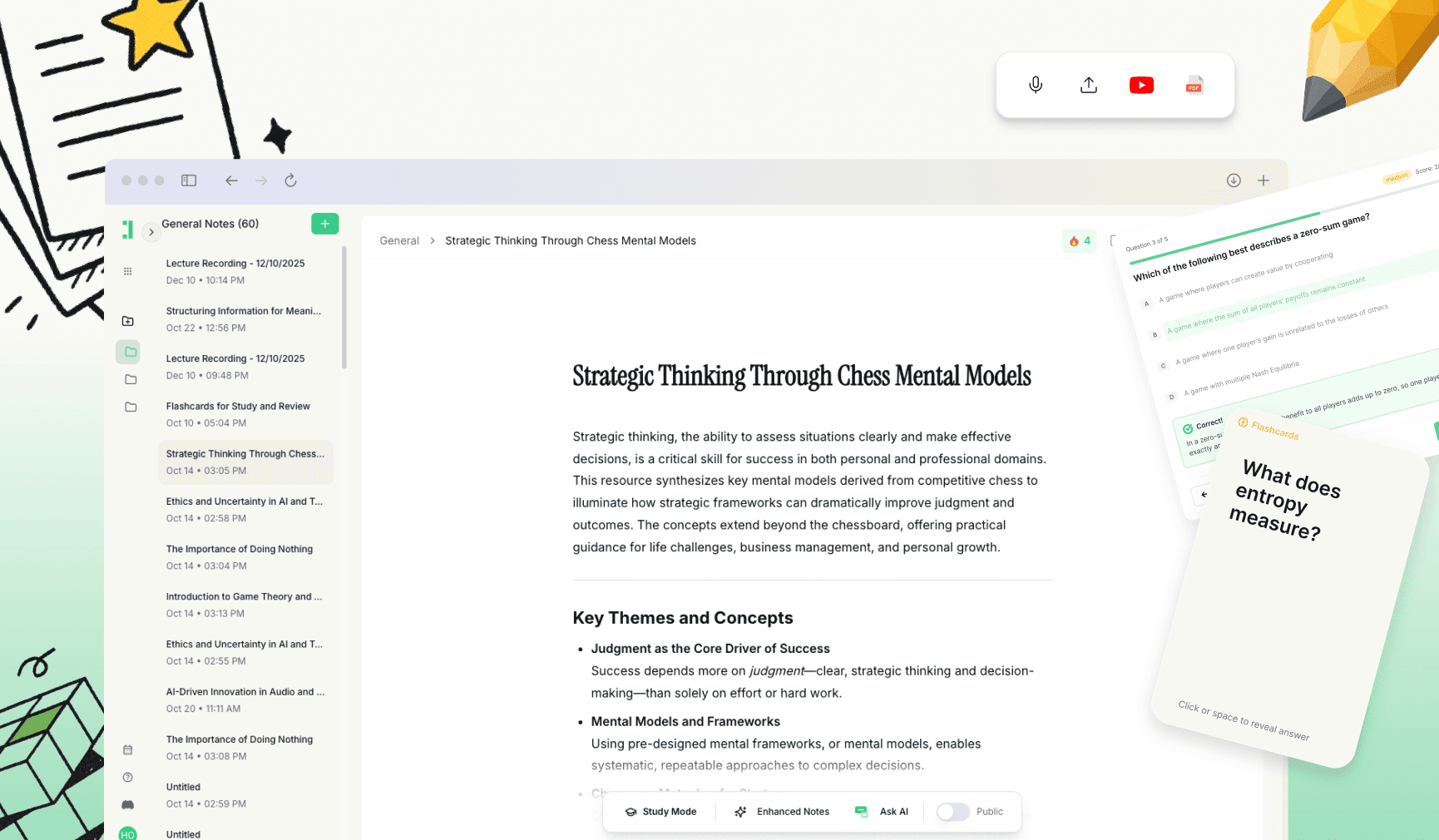
What are Process Design flashcards?
Process Design flashcards are concise study tools designed to help you master the methodologies, symbols, and logic used to create or improve organizational workflows. These flashcards cover critical areas such as BPMN symbols, throughput analysis, bottleneck identification, and system requirements. By breaking down complex architectural diagrams into bite-sized questions, you transform passive reading into active problem-solving.
The main outcome is clarity: instead of getting lost in massive process maps, you test your ability to identify specific components and rules. If you already have lecture notes or textbook chapters, Duetoday can generate a clean deck in minutes, allowing you to focus on the logic rather than the manual data entry.
Why flashcards work for Process Design
Process Design requires a mix of theoretical knowledge and practical application. You need to remember specific definitions while also understanding how different steps in a sequence impact the final output. Flashcards leverage active recall to ensure you aren't just recognizing a diagram, but actually understanding the 'why' behind each step.
Using spaced repetition helps move these complex systems into your long-term memory without the need for midnight cramming sessions. You can practice identifying symbols, calculating cycle times, and applying optimization rules until they become second nature.
Remember technical symbols and notations (ISO, BPMN) without confusion.
Separate similar concepts like 'Lean' vs. 'Six Sigma' methodologies.
Learn multi-stage workflows step-by-step to understand dependencies.
Practice applying formulas like Little's Law or capacity calculations quickly.

What to include in your Process Design flashcards
Effective Process Design flashcards follow the 'atomic' rule: one specific idea per card. Because the subject involves many visual and logical steps, your cards should prompt you to explain the relationship between inputs, transformations, and outputs.
Definitions & key terms: Focus on terms like 'bottleneck,' 'latency,' and 'scalability.'
Processes & steps: Ask 'What is the first step in a Root Cause Analysis?' or 'What follows a decision diamond?'
Comparisons: Contrast 'As-Is' processes versus 'To-Be' processes.
Application: Use scenario cards like 'If arrival rate exceeds service rate, what happens to the queue?'
Try these example prompts: 'Define Total Quality Management (TQM),' 'What does a dashed arrow represent in a data flow diagram?', 'List the 5 phases of DMAIC,' or 'How is lead time calculated?'
How to study Process Design with flashcards
The best way to study is a two-pass approach. Start by generating a deck from your slides or transcripts, then do a rapid-fire round to identify which design principles are sticking and which ones feel fuzzy. Don't spend too long on any single card; if you don't know it, mark it for review and move on.
Generate your deck directly from your Process Design notes in Duetoday.
Do a daily 'lightning round' of 15 minutes to keep concepts fresh.
Repeat the 'bottleneck' and 'logic' cards more frequently until they are memorized.
Mix in your diagrams to ensure you can identify symbols out of context.
Perform a final comprehensive review before your design review or exam.
Common Process Design flashcard mistakes
Many students create cards that are too wordy. If a card contains an entire paragraph about Six Sigma, you'll memorize the text pattern rather than the concept. Split complex methodologies into individual cards for each phase or tool. Another common error is only memorizing the names of tools without understanding their application. Always include 'When would you use this?' prompts to ensure you are ready for real-world design scenarios.
Ready to generate your Process Design flashcards?
Stop wasting hours manually copying terms into apps or onto paper. Upload your PDFs, lecture slides, or process manuals to Duetoday and let our AI build your study deck for you. Start recalling the material today and walk into your next exam with total confidence.

FAQ
How many flashcards do I need for Process Design? It depends on the complexity of the process, but typically 40-70 cards cover the fundamental rules, symbols, and formulas for a standard course module.
What’s the best format for Process Design flashcards? A mix of 'Term/Definition' and 'Scenario/Solution' works best to cover both the terminology and the logic of design.
Can I generate Process Design flashcards from a PDF automatically? Yes, Duetoday allows you to upload any Process Design PDF and converts the text and logic into study-ready flashcards instantly.
How often should I review my cards? Aim for short sessions daily. Spaced repetition is most effective when you revisit the information just as you are about to forget it.
Should I include diagrams on my cards? Absolutely. Visual identification is a huge part of process design, so ensure you have cards that ask you to identify or explain specific symbols.
Are digital flashcards better than paper for this topic? Digital cards are generally better because they allow for faster organization and the use of automated spaced repetition algorithms to save you time.
How long does it take to make a full deck? With Duetoday, you can generate a full deck in under a minute once your notes are uploaded.
What if my flashcards feel too easy? Try adding 'Application' cards where you have to solve a mini-problem or explain a process trade-off rather than just defining a term.

Duetoday is an AI-powered learning OS that turns your study materials into personalised, bite-sized study guides, cheat sheets, and active learning flows.