Generate Flashcards for Pressure and Buoyancy
Generate Pressure and Buoyancy flashcards with AI. Master physics faster. Try it for free!
Generate Flashcards with AI Free
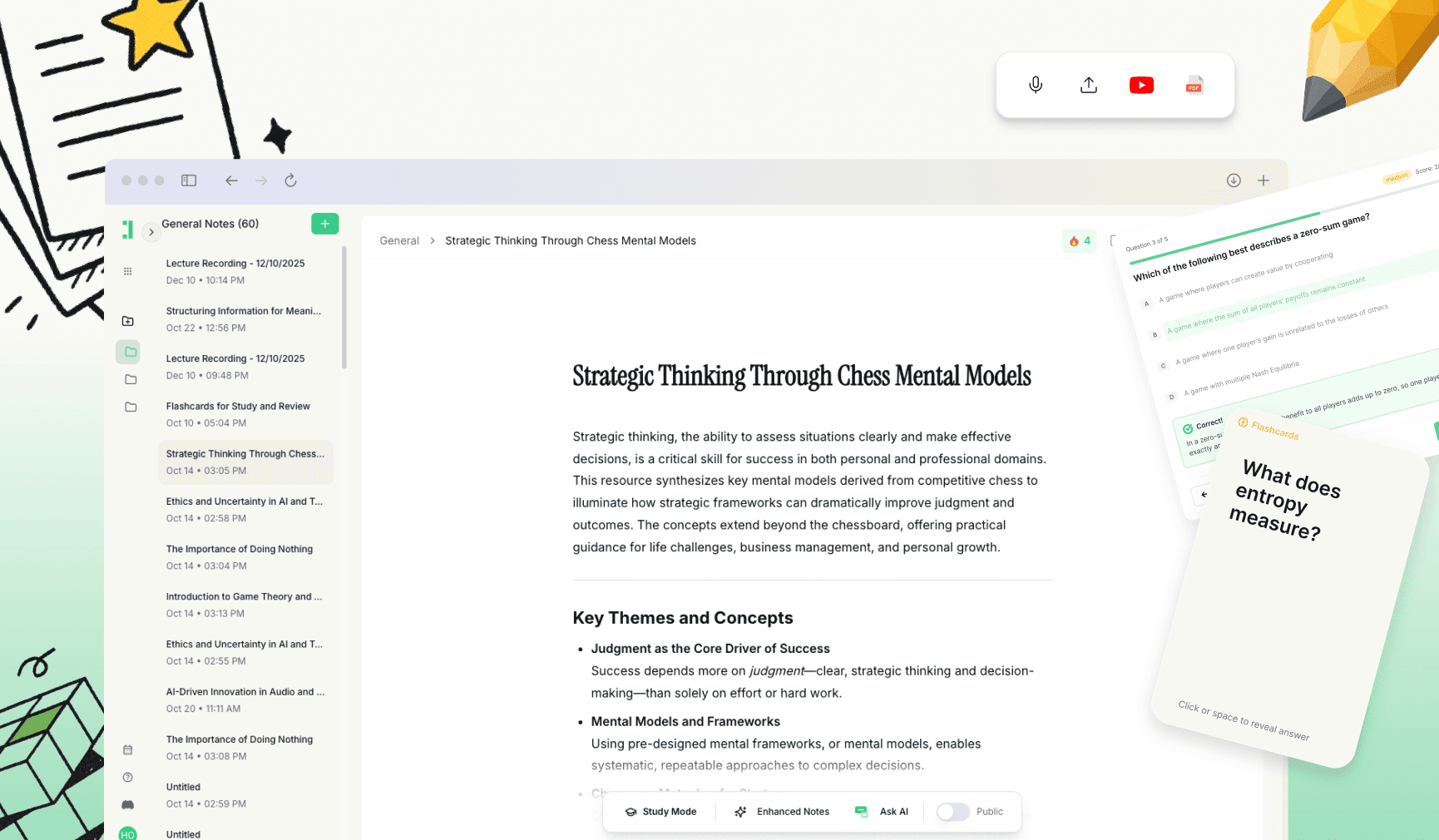
Generate Flashcards for Pressure and Buoyancy
Turn your physics notes, PDFs, slides, or lectures into Pressure and Buoyancy flashcards so you can review faster and remember more. Mastering fluid mechanics requires more than reading; it requires active testing of principles and formulas.
Generate Pressure & Buoyancy FlashcardsUpload Physics Notes
In Duetoday, the process is seamless: upload your study material, generate your deck, edit specific cards if needed, and start your review session immediately.
What are Pressure and Buoyancy flashcards?
Pressure and Buoyancy flashcards cover the fundamental concepts of fluid mechanics, including density, Pascal's principle, atmospheric pressure, and Archimedes' principle. They focus on how fluids exert force and why objects float or sink.
Instead of rereading a textbook chapter ten times, these flashcards force you to recall specific laws and calculate variables like force and area on the spot. This builds the mental muscle needed for physics exams.
If you already have notes, Duetoday can generate a clean deck in minutes, saving you hours of manual typing.
Why flashcards are one of the best ways to study Pressure and Buoyancy
Fluid dynamics involves a mix of conceptual definitions, mathematical relationships, and step-by-step applications of laws. Flashcards help you bridge the gap between knowing a formula and knowing when to use it.
By using active recall and spaced repetition, you ensure that complex concepts like displaced volume and buoyant force stay fresh in your mind without the need for last-minute cramming.
Remember SI units and conversion factors without confusion
Separate similar concepts like gauge pressure vs. absolute pressure
Learn the steps to solve buoyancy problems in sequence
Practice applying the P = F/A formula to different scenarios
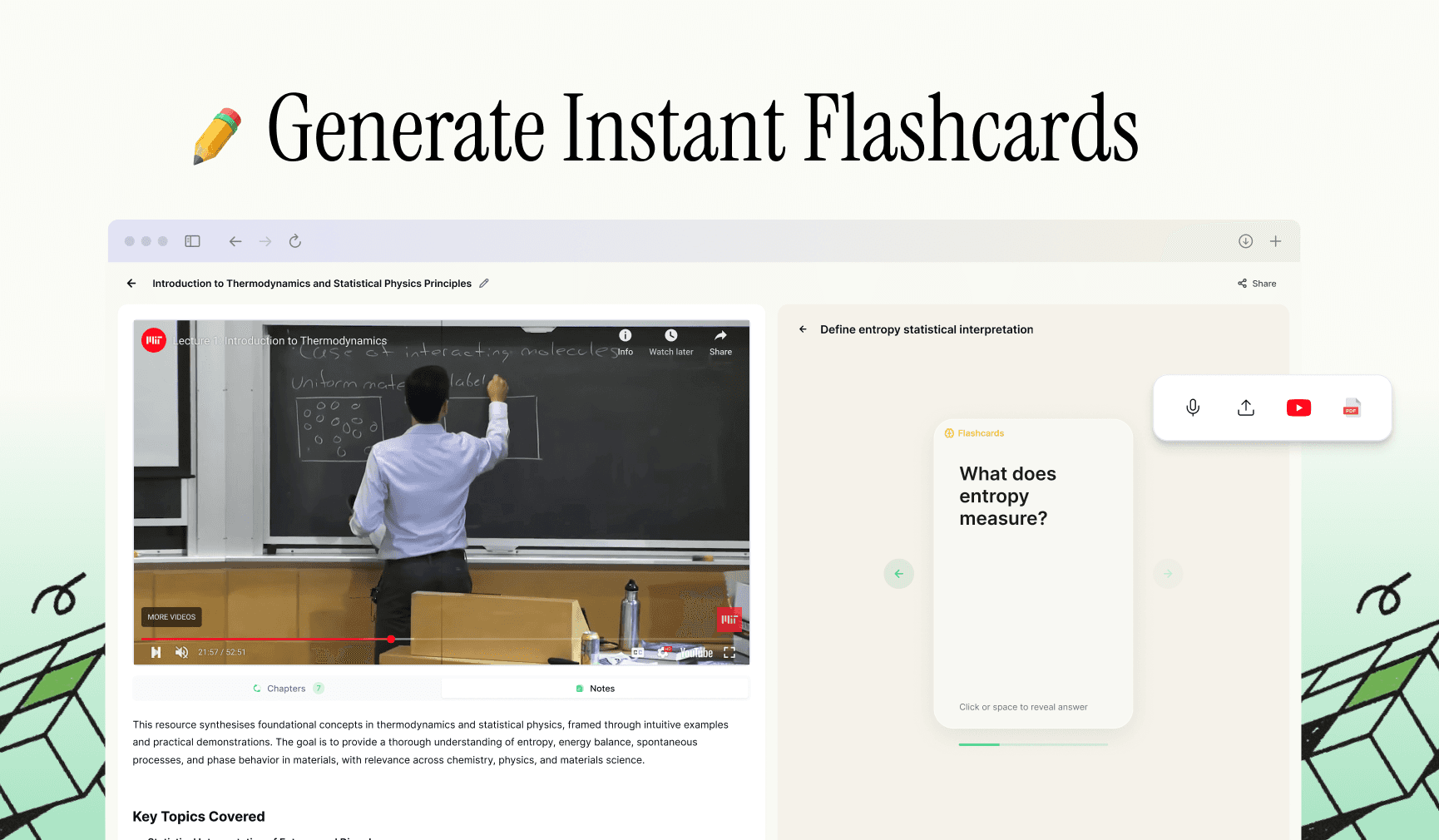
What to include in your Pressure and Buoyancy flashcards
Effective physics flashcards follow the "one idea per card" rule. They should take you from basic definitions to complex application of principles.
Definitions: Fluid pressure, density, and specific gravity.
Principles: Pascal’s, Archimedes’, and Bernoulli’s principles.
Comparisons: The difference between buoyant force and gravitational force.
Application: Calculating pressure at depth or the fraction of a submerged object.
Example prompts: "What is the formula for pressure in a fluid?", "State Archimedes' Principle," and "As depth increases, how does liquid pressure change?"
How to study Pressure and Buoyancy with flashcards
Start with a "two-pass" approach: first, build your deck using your class notes, then review in focused rounds. Focus on the relationship between variables—how changing the area affects pressure, or how volume changes buoyancy.
Generate a deck from your physics textbook or lecture slides.
Do a quick round to identify which formulas you keep forgetting.
Review the most difficult cards daily for at least three days.
Mix in conceptual questions with calculation-based cards.
Perform a final mixed review before your midterm or final.
Generate Pressure and Buoyancy flashcards automatically
Making physics cards manually is slow and often involves messy diagrams. Duetoday simplifies this by allowing you to upload your diagrams and text and converting them into structured study aids instantly.
Upload your PDF or paste your lecture transcript
Click Generate Flashcards
Review, edit, and start mastering fluid mechanics
Generate Pressure & Buoyancy Flashcards in Duetoday
Common Pressure and Buoyancy flashcard mistakes
Avoid making cards that are essentially paragraphs. If a card has too much text, you'll memorize the "shape" of the paragraph instead of the actual physics concept. Ensure you include "why" and "how" cards to test your deep understanding rather than just rote memorization of the P=F/A formula.
Ready to generate your Pressure and Buoyancy flashcards?
Stop rereading and start recalling. Upload your notes to Duetoday and get a study-ready deck in seconds. Works with notes, PDFs, slides, and transcripts.
FAQ
How many flashcards do I need for Pressure and Buoyancy? Usually, 30 to 50 cards are sufficient to cover most introductory physics units on fluids, including formulas and conceptual laws.
What’s the best format for these flashcards? A mix of 'Question/Answer' for definitions and 'Problem/Solution' for calculation practice is most effective.
How often should I review? Review your deck every 24 hours initially, then space out the reviews to every 3-5 days as you become more confident.
Should I make cards from a textbook or slides? Use both! Textbooks provide definitions while slides often highlight the specific problem types your professor favors.
How do I stop forgetting the formulas? Use flashcards that ask you to derive the formula or explain the relationship between variables (e.g., 'What happens to pressure if area doubles?').
What if my flashcards feel too easy? Add 'Slightly Change' cards, where you change one variable in a problem to see if you can still solve for the result.
Can I generate flashcards from a physics PDF? Yes, Duetoday can scan your physics PDFs and extract key concepts to build a deck automatically.
Are digital flashcards better than paper? Digital cards are better for physics because they allow for easier editing and automated spaced repetition scheduling.
How long does it take to make a full deck? With Duetoday, you can generate a full deck in under two minutes from your existing notes.
Can Duetoday handle mathematical formulas? Yes, the AI is designed to recognize and format mathematical symbols and physics equations properly.

Duetoday is an AI-powered learning OS that turns your study materials into personalised, bite-sized study guides, cheat sheets, and active learning flows.