Generate Flashcards for Polymer Chemistry
Generate or make Polymer Chemistry flashcards to master macromolecules, synthesis, and kinetics in this expert study guide.
Generate Flashcards with AI Free

Generate Flashcards for Polymer Chemistry
Turn your notes, PDFs, slides, or lectures into Polymer Chemistry flashcards so you can review faster and remember more. Whether you are tackling step-growth polymerization or analyzing tactile structures, Duetoday helps you master complex macromolecules.
Generate Polymer Chemistry Flashcards
Upload your synthesis notes or paste reaction mechanisms to build your deck.
In Duetoday, the process is seamless: upload your material, generate your deck, review or edit the AI-suggested cards, and start your study session. It’s the fastest way to bridge the gap between reading and remembering.
What are Polymer Chemistry flashcards?
Polymer Chemistry flashcards cover the specific terminology, chemical structures, and thermodynamic principles unique to the study of macromolecules. This includes everything from molar mass distributions and PDI to specific synthesis pathways like anionic or radical polymerization.
The outcome is simple: instead of passively rereading dense textbooks, you test your knowledge of glass transition temperatures (Tg) and chain-growth kinetics. This builds active recall, which is essential for passing advanced chemistry exams.
If you already have notes, Duetoday can generate a clean deck in minutes.
Why flashcards work for Polymer Chemistry
Polymer chemistry requires more than just memorizing formulas; it requires understanding the relationship between molecular structure and bulk properties. Flashcards are ideal for this because they isolate specific variables for quick identification.
Active recall and spaced repetition help you internalize the nuances of polymer behavior without the burnout of traditional cramming. Since the subject is highly visual and procedural, short, frequent testing sessions are more effective than long reading blocks.
Remember PDI and molar mass formulas without cramming
Separate similar concepts (e.g., Thermoplastics vs. Thermosets)
Learn synthesis processes step-by-step (initiation, propagation, termination)
Practice applying the Carothers equation quickly
Memorize common polymer structures and their repeating units
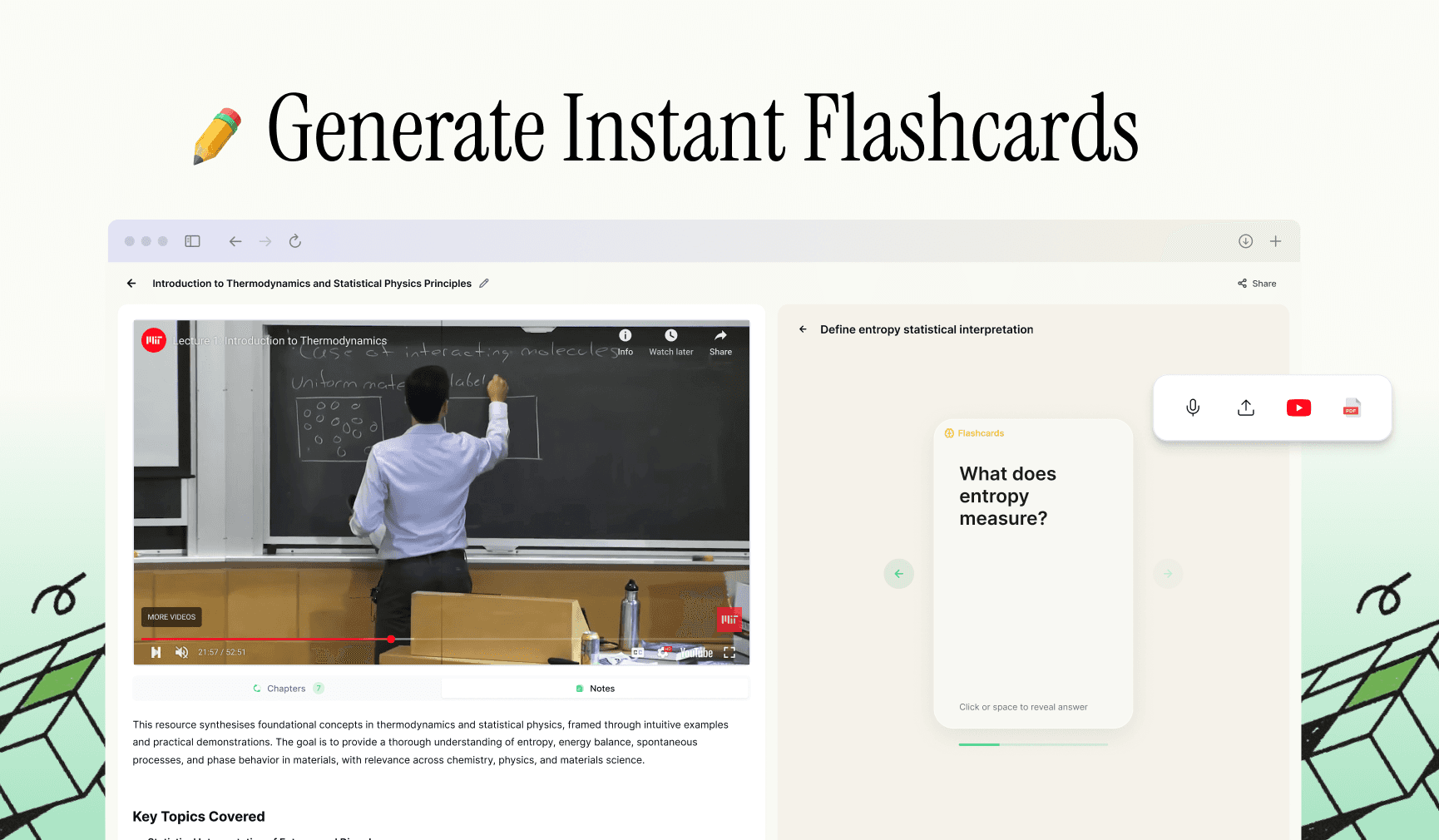
What to include in your Polymer Chemistry flashcards
Effective flashcards follow the one idea per card rule. For Polymer Chemistry, this means focusing on specific mechanisms, definitions, or property-structure relationships. You want to avoid cluttered cards that try to explain an entire polymerization process at once.
Definitions & key terms: What is the polydispersity index? Define living polymerization.
Processes & steps: What are the three stages of free radical polymerization?
Comparisons: How does step-growth differ from chain-growth in terms of monomer consumption?
Application: If the degree of polymerization increases, how does the Tg generally change?
Example Prompts: Calculate Mn if Mo = 100 and Xn = 500, Identify the repeating unit for Nylon 6,6, or What initiator is used in ATRP?
How to study Polymer Chemistry with flashcards
Success in chemistry comes from a two-pass approach. First, generate your deck from your syllabus or lecture slides. Second, review in rounds until the most difficult mechanisms feel like second nature.
Make a deck from your lab notes or textbook chapters.
Do one quick round to identify which catalysts or mechanisms you keep forgetting.
Review these high-difficulty cards daily for a few days.
Mix in structural identification cards with kinetic calculation cards.
Do a final mixed-topic review before your midterm or final exam.
Generate Polymer Chemistry flashcards automatically in Duetoday
Manually drawing chemical structures and writing out lengthy kinetics descriptions on physical cards is slow and messy. Duetoday eliminates the busy work so you can focus on the science.
Upload or paste your Polymer Chemistry slides or PDFs.
Click Generate Flashcards.
Review, edit the chemical notation, and start studying.
Start with your notes and get a deck you can actually use today.
Common Polymer Chemistry flashcard mistakes
Many students make their cards too verbose, trying to fit the entire Flory-Huggins theory on one side. This prevents the brain from making quick associations.
Cards are too long → split into one specific effect or variable per card.
Only memorizing names → add draw the mechanism or predict the product prompts.
Confusing different types of copolymers → create specific comparison cards (Block vs. Graft).
No regular schedule → repeat kinetics cards more often as they require more logic.
Ready to generate your Polymer Chemistry flashcards?
Upload your notes, generate your custom deck, and master polymer science with active recall. Stop rereading your lab manuals and start testing your knowledge.
FAQ
How many flashcards do I need for Polymer Chemistry? Typically, 50-100 cards per unit is ideal to cover definitions, mechanisms, and math formulas without becoming overwhelmed.
What’s the best format for Polymer Chemistry flashcards? A mix of 'Question/Answer' for definitions and 'Image/Structure' cards for identifying monomers and repeating units.
How often should I review Polymer Chemistry flashcards? Review new mechanisms daily and well-known properties (like Tg or Tm) every three days using spaced repetition.
Should I make cards from a textbook or slides? Use lecture slides for the core mechanisms your professor emphasizes, and use the textbook for more detailed thermodynamic proofs.
How do I stop forgetting reaction mechanisms? Use 'Step-by-Step' cards where each card asks for the next logical arrow or intermediate in the polymerization sequence.
What if my flashcards feel too easy? Add application questions, such as 'Predict the change in viscosity if the branching increases,' to challenge your understanding.
Can I generate Polymer Chemistry flashcards from a PDF? Yes, Duetoday can scan your chemistry PDFs and extract key concepts into a structured flashcard deck automatically.
Are digital flashcards better than paper for Chemistry? Digital cards are superior for chemistry because you can easily include complex diagrams and reorganize decks as you master topics.
How long does it take to make a full deck? With Duetoday, a full deck of 50 cards can be generated in under a minute from your uploaded documents.
Can Duetoday organize my flashcards by sub-topic? Yes, you can generate separate decks for synthesis, characterization, and physical properties to keep your study sessions focused.

Duetoday is an AI-powered learning OS that turns your study materials into personalised, bite-sized study guides, cheat sheets, and active learning flows.