Generate Flashcards for Plasma Physics
Make Plasma Physics flashcards to master ionized gases, fusion, and wave dynamics with our easy AI generator.
Generate Flashcards with AI Free

What are Plasma Physics flashcards?
Plasma Physics flashcards are targeted study tools designed to help you master the 'fourth state of matter.' These flashcards cover complex topics ranging from single-particle motion and fluid descriptions to wave oscillations and magnetic confinement. By breaking down high-level concepts like Debye shielding or Langmuir waves into manageable questions, you can systematically build your understanding of ionized gases.
Instead of passively rereading dense textbooks or skimming complex derivations, flashcards force you to engage in active recall. This process strengthens the neural pathways associated with specific plasma phenomena, ensuring you can recall formulas and behaviors during exams or research. If you already have lecture notes or research papers, Duetoday can generate a clean deck in minutes.
Why flashcards work for Plasma Physics
Plasma Physics requires a unique blend of electromagnetism, fluid mechanics, and statistical physics. Flashcards are ideal for this subject because they help you internalize the relationships between particle behavior and collective effects. They allow you to practice the quick mental shifts required to move between kinetic and fluid models without getting bogged down in the math during every review session.
Remember fundamental constants and plasma parameters without cramming.
Separate similar concepts like O-waves vs. X-waves or R-waves vs. L-waves.
Learn multi-step processes like the stages of nuclear fusion or magnetic reconnection.
Practice applying Maxwell’s equations to ionized media quickly.
What to include in your Plasma Physics flashcards
To make your study sessions effective, your Plasma Physics flashcards should focus on 'one idea per card.' This prevents cognitive overload and ensures you truly know the material rather than just recognizing the text. Use a mix of conceptual questions and rapid-fire formula checks to ensure a well-rounded grasp of the subject.
Definitions & Key Terms: "What is the Debye length?" or "Define the Plasma Frequency."
Processes & Steps: "What are the three conditions for Lawson's Criterion?"
Comparisons: "How does a Z-pinch differ from a Theta-pinch?"
Application: "How does the plasma frequency change if the electron density increases?"
Try using prompts like: 'State the adiabatic invariants,' 'What is the physical meaning of the Grad-B drift?', or 'Identify the dispersion relation for Ion Acoustic Waves.'
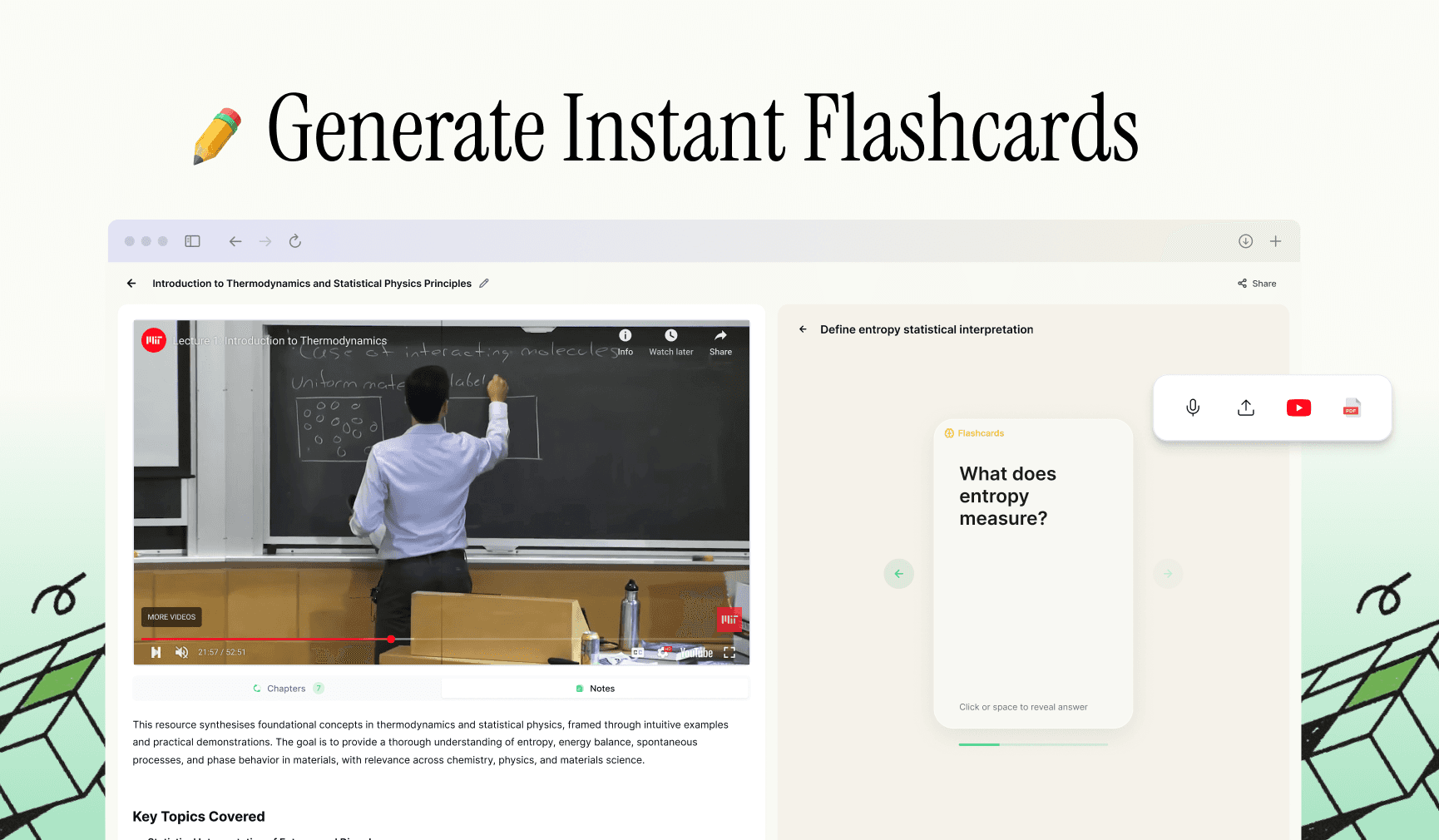
How to study Plasma Physics with flashcards (a simple system)
Mastering plasma physics requires a structured approach. Start with a 'two-pass' system: first, use Duetoday to build a comprehensive deck from your course materials. Then, conduct a rapid-fire round to identify which instabilities or wave modes are tripping you up. By isolating the difficult concepts early, you can focus your energy where it matters most.
Make a deck from your lecture slides or textbook PDFs using Duetoday.
Do one quick round to tag cards as 'Known', 'Learning', or 'Difficult'.
Review 'Difficult' cards daily to master complex drifts and instabilities.
Mix in a few easier cards each session to maintain your foundational knowledge.
Do a final mixed-topic review before your midterm or final exam.
Generate Plasma Physics flashcards automatically in Duetoday
Creating Plasma Physics flashcards by hand is incredibly slow, especially when dealing with complex LaTeX formulas or intricate diagrams. Duetoday eliminates this friction by instantly converting your technical documents into structured study sets. Whether you are dealing with a 50-page PDF on Magnetohydrodynamics (MHD) or handwritten notes on cold plasma waves, our AI handles the heavy lifting.
Upload your Plasma Physics PDFs, slides, or notes.
Click 'Generate Flashcards'.
Review the generated deck, add your own notes, and start studying immediately.
Common Plasma Physics flashcard mistakes (and how to fix them)
Many students create cards that are essentially paragraphs, which makes them impossible to review efficiently. Large blocks of text encourage recognition rather than true recall. Another common mistake is focusing solely on the math while ignoring the underlying physical intuition—make sure your deck asks 'why' a plasma behaves a certain way just as often as it asks for a formula.
Cards are too long: Split complex derivations into multiple 'step-by-step' cards.
Only memorizing formulas: Add cards that ask for the physical significance of each term.
Ignoring boundary conditions: Include specific cards for how plasma interacts with walls or magnetic bottles.
Lack of consistency: Use spaced repetition to ensure you don't forget early concepts like Larmor radius while studying advanced turbulence.
FAQ
How many flashcards do I need for Plasma Physics? Usually 150-200 cards per course module are sufficient to cover core definitions, wave modes, and instabilities without being overwhelmed.
What’s the best format for Plasma Physics flashcards? Question-and-answer format works best. Use the front for a specific concept or formula name, and the back for the definition, derivation step, or physical implication.
How often should I review Plasma Physics flashcards? Review daily when first learning a new topic like MHD, then transition to every 2-3 days using spaced repetition as you become more confident.
Should I make cards from a textbook, lecture notes, or slides? Use a mix. Textbooks are great for formal definitions, while lecture notes often highlight the specific derivations your professor finds most important for exams.
How do I stop forgetting Plasma Physics after a few days? Spaced repetition is the key. Duetoday helps you schedule reviews so you see the hardest cards more frequently until they stick.
What if my flashcards feel too easy or too hard? If they are too easy, you're likely being too broad—break the concepts down further. If too hard, ensure you understand the prerequisite electromagnetism before tackling the plasma application.
Can I generate Plasma Physics flashcards from a PDF automatically? Yes, Duetoday is designed to parse technical PDFs and extract key terminology and concepts into flashcard format automatically.
Are digital flashcards better than paper for Plasma Physics? Digital cards are generally superior because they allow for easier organization of complex formulas and utilize automated spaced repetition algorithms.
How long does it take to make a full Plasma Physics deck? Manually, it can take hours. With Duetoday’s AI generation, you can have a full deck ready in seconds after uploading your notes.
Can Duetoday generate and organize my flashcards for me? Absolutely. Duetoday categorizes information by topic and creates a structured flow so your study sessions are logical and effective.

Duetoday is an AI-powered learning OS that turns your study materials into personalised, bite-sized study guides, cheat sheets, and active learning flows.