Generate Flashcards for pH and pKa
Master acid-base chemistry! Generate flashcards for pH and pKa from your notes. Try for free!
Generate Flashcards with AI Free

Generate Flashcards for pH and pKa
Turn your notes, PDFs, slides, or chemistry lectures into pH and pKa flashcards so you can review faster and remember more. Whether you are tackling Henderson-Hasselbalch or mastering titration curves, active recall is the key to success.
Generate pH and pKa FlashcardsUpload notes / paste text
In Duetoday, the process is seamless: simply upload your chemistry materials, and our AI generates a structured deck. You can then review, edit, and study using spaced repetition to ensure you never forget a formula.
What are pH and pKa flashcards?
pH and pKa flashcards cover the essential quantitative and qualitative aspects of acid-base chemistry. They include definitions of acidity, the relationship between hydronium ion concentration and pH, the mathematical definition of pKa, and how these values predict the ionization state of a molecule.
The outcome is a shift from passive reading to active testing. Instead of staring at a log table or a list of weak acids, you challenge your brain to calculate values and recall relationships quickly, building the mental pathways needed for chemistry exams.
If you already have notes, Duetoday can generate a clean deck in minutes.
Why flashcards are one of the best ways to study pH and pKa
pH and pKa require a mix of rote memorization for constants and functional understanding of logarithmic relationships. Flashcards bridge this gap by forcing you to apply rules in short, sharp bursts. By using active recall and spaced repetition, you move these concepts from short-term memory into long-term mastery.
Remember the difference between strong and weak acids without cramming
Separate similar concepts like pH vs pOH and Ka vs pKa
Learn the steps of the Henderson-Hasselbalch equation incrementally
Practice applying log rules to chemical concentrations quickly
What to include in your pH and pKa flashcards
Effective flashcards follow the "one idea per card" rule. For chemistry, this means focusing on a single calculation, definition, or trend per card rather than trying to summarize an entire chapter on one piece of paper.
The four main card types for this topic include:
Definitions & key terms: "What is the definition of pKa?" "Define an amphiprotic substance."
Processes & steps: "What is the first step in calculating pH from molarity?"
Comparisons: "How does a low pKa differ from a high pKa in terms of acid strength?"
Application: "If [H+] increases by a factor of 10, what happens to the pH?"
Example prompts for your deck: "What is the pH of a neutral solution at 25°C?", "State the formula relating pH and pOH.", "What does it mean if pH = pKa?", "Calculate pH if [H3O+] = 1.0 x 10^-5 M."
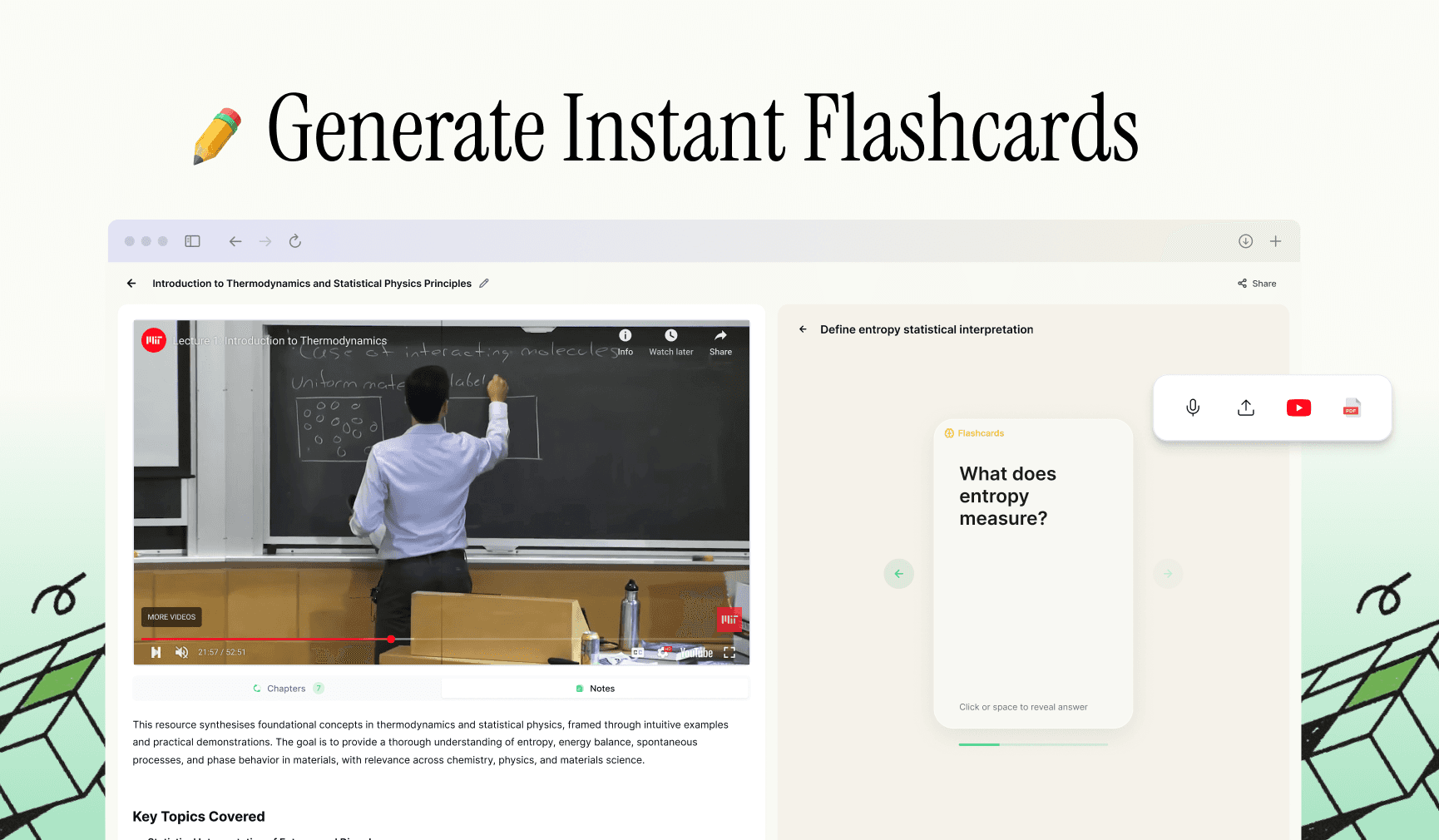
How to study pH and pKa with flashcards (a simple system)
To master acid-base chemistry, use a two-pass approach. First, build your deck from your lecture slides or textbook, then engage in focused review rounds that separate the math from the theory.
Review in quick 10-15 minute sessions, repeating the difficult calculation cards more frequently than the simple definitions. This ensures you aren't wasting time on what you already know.
Make a deck from your notes using Duetoday's AI generator.
Do one quick round to identify which formulas or log rules trip you up.
Review these weak cards daily to build calculation speed.
Mix in conceptual cards (like Le Chatelier’s principle) to provide context.
Do a final mixed review of the entire deck before your chemistry exam.
Generate pH and pKa flashcards automatically in Duetoday
Manually writing out chemical formulas and log equations on paper cards is slow, messy, and often leads to errors in notation. Duetoday eliminates this friction by automating the creation process.
Position yourself for an A by uploading your PDF notes or lecture transcripts. Duetoday instantly extracts the core concepts—like Ka expressions and buffer regions—and formats them into perfect study cards.
Upload or paste your pH and pKa material
Click Generate Flashcards
Review, edit, and start studying immediately
Generate pH and pKa Flashcards in Duetoday
Start with your notes and get a deck you can actually use today.
Common pH and pKa flashcard mistakes (and how to fix them)
Many students create "cluttered" cards that make studying harder. Avoid these common pitfalls to keep your review sessions efficient:
Cards are too long: Don't put the entire titration curve on one card; split it into the equivalence point, half-equivalence point, and buffer region.
Only memorizing formulas: Add cards that ask "why" a pKa value changes with structure.
Confusing pKa and Ka: Use specific comparison cards to highlight the inverse relationship.
Ignoring the units: Ensure your cards specify whether you are working in Molarity or moles.
FAQ
How many flashcards do I need for pH and pKa? Typically, a deck of 30-50 cards is sufficient to cover the definitions, formulas, and common acid/base strengths for a standard chemistry unit.
What’s the best format for pH and pKa flashcards? Question-and-answer format works best. Put a specific problem or term on the front and the solution or definition on the back.
How often should I review my cards? Review once a day leading up to your exam, then use spaced repetition to revisit the material every few days to keep it fresh.
Should I make cards from a textbook or slides? Both. Slides usually contain the high-yield formulas, while textbooks provide the conceptual nuances that make for great 'Why' cards.
How do I stop forgetting the pH formulas? Consistent active recall via flashcards is far more effective than rereading the formulas. Try to solve the calculation on the card before flipping it.
What if my flashcards feel too easy? Add more application prompts, such as 'Predict the pH of a 0.01M HCl solution' instead of just 'What is the formula for pH?'.
Can I generate pH flashcards from a PDF automatically? Yes, Duetoday can process your chemistry PDFs and extract the relevant data to build a deck instantly.
Are digital flashcards better than paper for chemistry? Digital cards allow for quicker organization, the inclusion of chemical diagrams, and built-in spaced repetition algorithms.
How long does it take to make a full deck? With Duetoday, it takes seconds to generate a full deck from your notes, compared to hours of manual writing.
Can Duetoday handle mathematical notation? Yes, Duetoday is designed to organize and format chemical and mathematical equations for clear studying.

Duetoday is an AI-powered learning OS that turns your study materials into personalised, bite-sized study guides, cheat sheets, and active learning flows.