Generate Flashcards for Periodic Trends
Generate Periodic Trends flashcards from your notes in seconds. Try it for free today!
Generate Flashcards with AI Free

Generate Flashcards for Periodic Trends
Turn your chemistry notes, PDFs, slides, or lab lectures into Periodic Trends flashcards so you can review faster and remember more. Understanding how elements behave across the periodic table is the foundation of chemistry, and active recall is the fastest way to master it.
Generate Periodic Trends FlashcardsUpload notes / paste text
In Duetoday, the process is simple: upload your materials, and our AI identifies key recurring patterns to generate a custom deck. You can then review, edit, and study your cards immediately.
What are Periodic Trends flashcards?
Periodic Trends flashcards cover the specific patterns found within the periodic table, including atomic radius, ionization energy, electronegativity, and electron affinity. These cards help you memorize why these trends occur based on effective nuclear charge and electron shielding.
Instead of just staring at a colorful chart, these flashcards force you to predict behavior. By testing yourself, you build a mental map of the elements that sticks much longer than passive rereading. If you already have notes, Duetoday can generate a clean deck in minutes.
Why flashcards work for Periodic Trends
Periodic Trends require a mix of rote memorization and conceptual application. You need to know the 'what' (the direction of the trend) and the 'why' (the underlying physics). Flashcards are the perfect medium to bridge this gap through active recall and spaced repetition.
Remember trend directions without cramming right before the exam.
Separate similar concepts like electronegativity vs. electron affinity.
Learn the 'why' behind the trends, such as the roles of protons and energy levels.
Practice applying rules to specific groups like Halogens or Noble Gases.
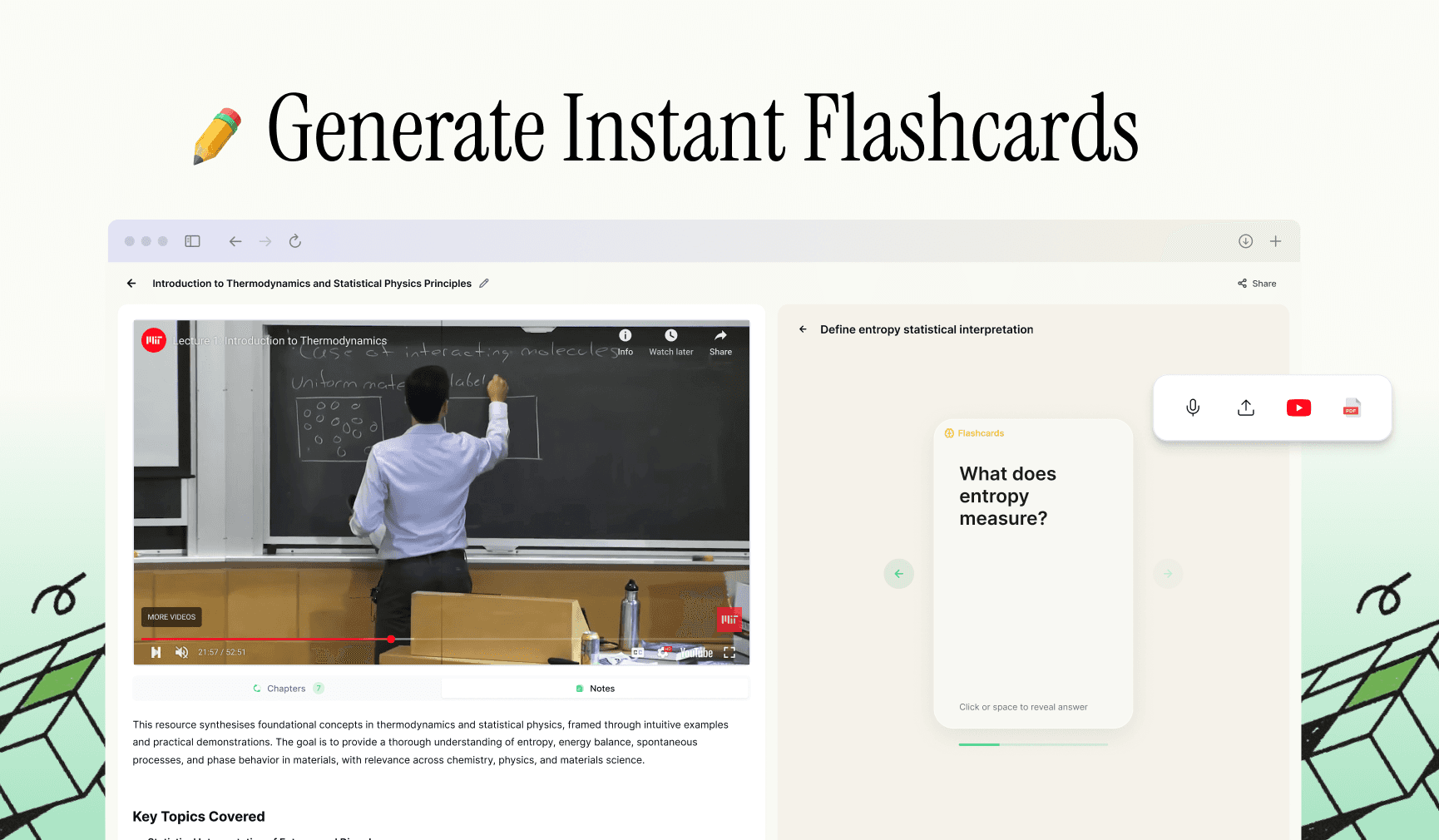
What to include in your Periodic Trends flashcards
The best flashcards for chemistry follow the 'atomic' rule: one idea per card. This prevents you from feeling like you know a concept when you only know half of it. Focus on specific trends and the exceptions that often appear on tests.
Definitions: "What is the definition of first ionization energy?"
Patterns: "Does atomic radius increase or decrease moving down a group?"
Comparisons: "Which has a higher electronegativity: Fluorine or Cesium?"
Logic: "How does electron shielding affect the atomic radius?"
Try these prompts: "Define the Octet Rule," "Explain the trend of metallic character," or "Why does Ionization Energy increase across a period?"
How to study Periodic Trends with flashcards
A simple two-pass system works best for chemistry. Start by building your deck from your textbook or lecture slides, then engage in rounds of focused review. Don't just flip the card—say the answer out loud to ensure you truly understand the logic.
Create your deck using Duetoday's AI generator from your PDF notes.
Do a 'clearance' round to identify which trends confuse you most.
Review the 'hard' cards (like exceptions to the trends) daily.
Mix the cards with other chemistry topics to build lateral thinking skills.
Perform a final review 24 hours before your quiz or midterm.
Generate Periodic Trends flashcards automatically in Duetoday
Making cards by hand is slow, especially when you need to draw diagrams or write out complex definitions. Duetoday eliminates the busy work so you can spend your time actually learning.
Simply upload your chemistry PDF, slides, or even a recording of your professor's lecture. Duetoday transcribes the material and extracts the most important trends into a study-ready deck.
Upload or paste your chemistry material.
Click Generate Flashcards.
Review, edit, and start studying with our AI tutor.
Generate Periodic Trends Flashcards in Duetoday
Common Periodic Trends flashcard mistakes
Many students make cards that are too wordy or focus on the wrong details. Avoid these pitfalls to make your study sessions more effective:
Cards are too long: Split 'Atomic Radius' into two cards for 'Periods' and 'Groups'.
Only memorizing the arrow: Always include a 'Why' card for every trend direction.
Ignoring ions: Make sure to include cards for ionic radius vs. atomic radius.
No review schedule: Spaced repetition is the only way to keep the trends in long-term memory.
Ready to generate your Periodic Trends flashcards?
Stop rereading and start recalling. Turn your notes into a powerful study tool and master the periodic table today.
Start Generating Flashcards
Works with notes, PDFs, slides, and lecture transcripts.
FAQ
How many flashcards do I need for Periodic Trends? Typically, a deck of 20–30 cards is sufficient to cover the four main trends, their definitions, the 'why' behind them, and key exceptions like those found in Group 2 or Group 15.
What’s the best format for Periodic Trends flashcards? Question-and-answer format is best. For example: 'Front: Trend of Electronegativity across a period? Back: Increases due to increased nuclear charge.'
How often should I review Periodic Trends flashcards? You should review them daily for the first three days, then every few days until the patterns become intuitive and you can visualize the table in your head.
Should I make cards from a textbook or slides? Use both. Textbooks provide the 'why,' while lecture slides often highlight the specific trends and exceptions your professor cares about most for the exam.
How do I stop forgetting the trends? Focus on the concept of 'Effective Nuclear Charge.' If you understand how protons pull on electrons, you don't have to memorize the trends—you can derive them.
What if my flashcards feel too easy? Add 'Application' cards. Instead of asking for a trend, ask to rank three specific elements (e.g., Na, Mg, Al) in order of increasing ionization energy.
Can I generate Periodic Trends flashcards from a PDF? Yes, Duetoday specializes in reading chemistry PDFs and extracting the relevant definitions and trends automatically into flashcards.
Are digital flashcards better than paper? Digital cards are superior for Periodic Trends because they use spaced repetition algorithms to ensure you see your weakest trends more often.
How long does it take to make a full deck? Manually, it takes about an hour. With Duetoday, it takes less than a minute once you upload your notes.
Can Duetoday organize my cards? Yes, Duetoday organizes your cards by topic, allowing you to focus specifically on Periodic Trends or combine them with other chemistry modules.

Duetoday is an AI-powered learning OS that turns your study materials into personalised, bite-sized study guides, cheat sheets, and active learning flows.