Generate Flashcards for Particle Physics
Make and generate Particle Physics flashcards to master the Standard Model and subatomic particles with this comprehensive guide.
Generate Flashcards with AI Free
What are Particle Physics flashcards?
Particle Physics flashcards are focused study tools designed to break down the complex subatomic world into digestible snapshots. They cover everything from the fundamental properties of quarks and leptons to the intricate interactions mediated by gauge bosons. Instead of getting lost in dense mathematical derivations, these flashcards focus on key concepts like quantum numbers, decay modes, and conservation laws.
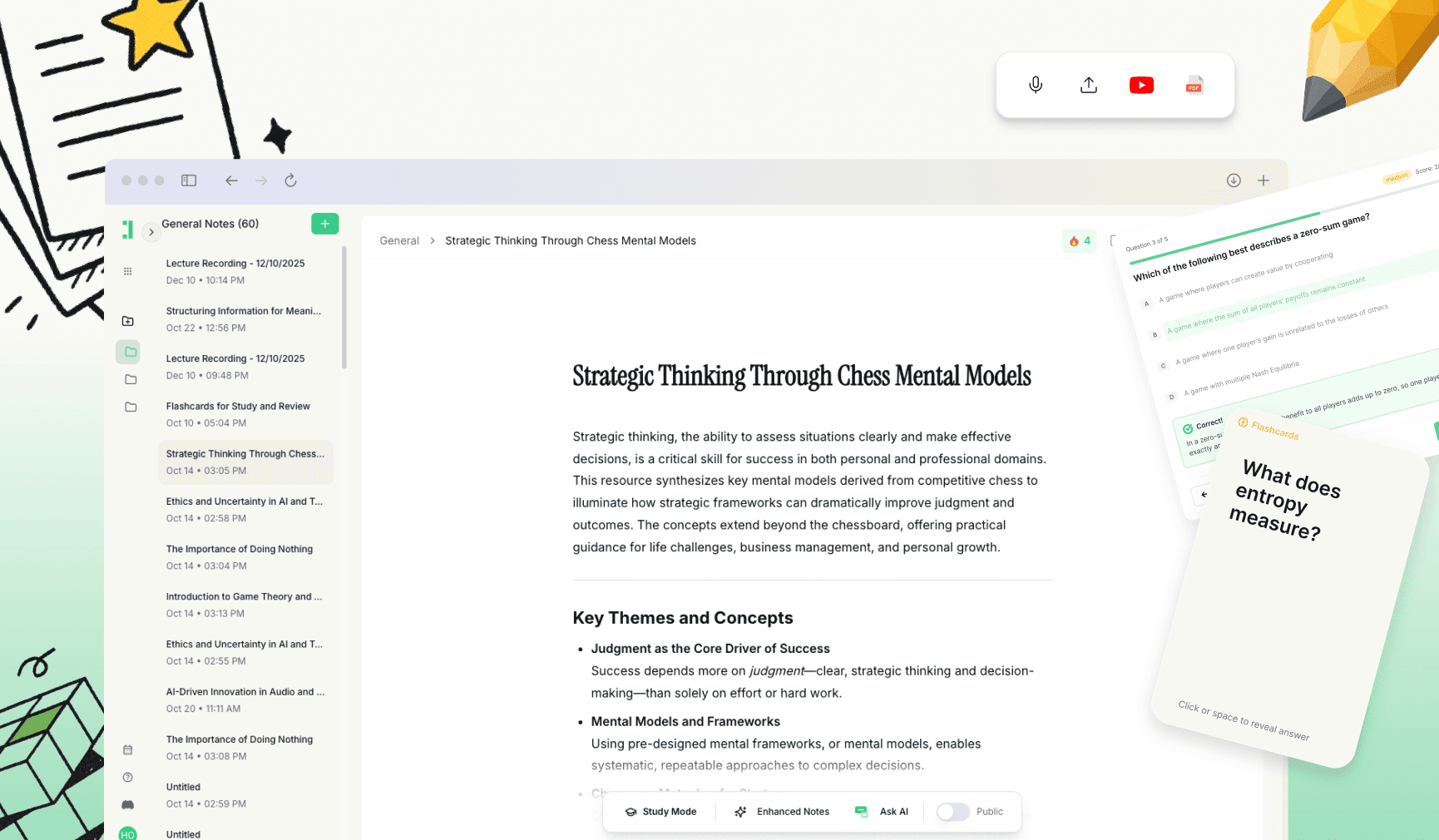
The goal is to shift your study habit from passive reading to active testing. By using flashcards, you force your brain to retrieve specific details about the Standard Model and particle interactions from memory, which is the fastest way to build long-term retention in high-level physics. If you already have lecture notes or a textbook chapter, Duetoday can generate a clean, organized deck in minutes.
Why flashcards are one of the best ways to study Particle Physics
Particle Physics requires a unique blend of conceptual understanding and rote memorization of constants, classifications, and rules. Flashcards excel here because they allow you to isolate individual particles and their properties without the distraction of surrounding text. They utilize active recall and spaced repetition to ensure you don't forget the difference between a muon and a pion halfway through your exam.
Memorize fundamental particle properties (mass, charge, spin) without cramming.
Distinguish between similar groups like Hadrons vs. Leptons or Baryons vs. Mesons.
Master conservation laws (Baryon number, Lepton number, Strangeness) step-by-step.
Quickly identify Feynman diagram components and vertex rules.
What to include in your Particle Physics flashcards
Effective physics flashcards follow the 'atomic' rule: one specific concept per card. This prevents 'recognition bias' where you think you know the answer just because you recognize the context. Use question-based prompts to challenge your understanding of how particles behave under different forces.
Definitions & Key Terms: "What is color charge?" or "Define asymptotic freedom."
Processes & Steps: "What are the steps in Beta-minus decay?"
Comparisons: "How does a W boson differ from a Z boson?"
Application: "Which conservation law is violated in this specific decay scenario?"
Example prompts for your deck: 'List the six flavors of quarks,' 'What is the spin of all fundamental fermions?', 'Which particle mediates the strong nuclear force?', and 'What must be conserved in all weak interactions?'
How to study Particle Physics with flashcards (a simple system)
Start with a 'two-pass' approach. In the first pass, generate your deck based on your current unit—for example, the Standard Model. Review every card once to gauge your baseline. In the second pass, focus heavily on the 'weak' cards where you struggled to recall the quantum numbers or decay products. Short, frequent sessions are more effective than one long marathon.
Make a deck from your PDF notes or textbook chapters using Duetoday.
Complete a quick diagnostic round to flag difficult concepts like CPT symmetry.
Review high-difficulty cards daily for three days to lock them in.
Mix in older cards from previous topics to maintain a global understanding.
Do a final 'randomized' review before your lab or midterm to test speed.
Generate Particle Physics flashcards automatically in Duetoday
Manually writing out the properties of every baryon and meson is tedious and takes away from actual study time. Duetoday eliminates the busywork by using AI to scan your materials and extract the most important technical data for you.
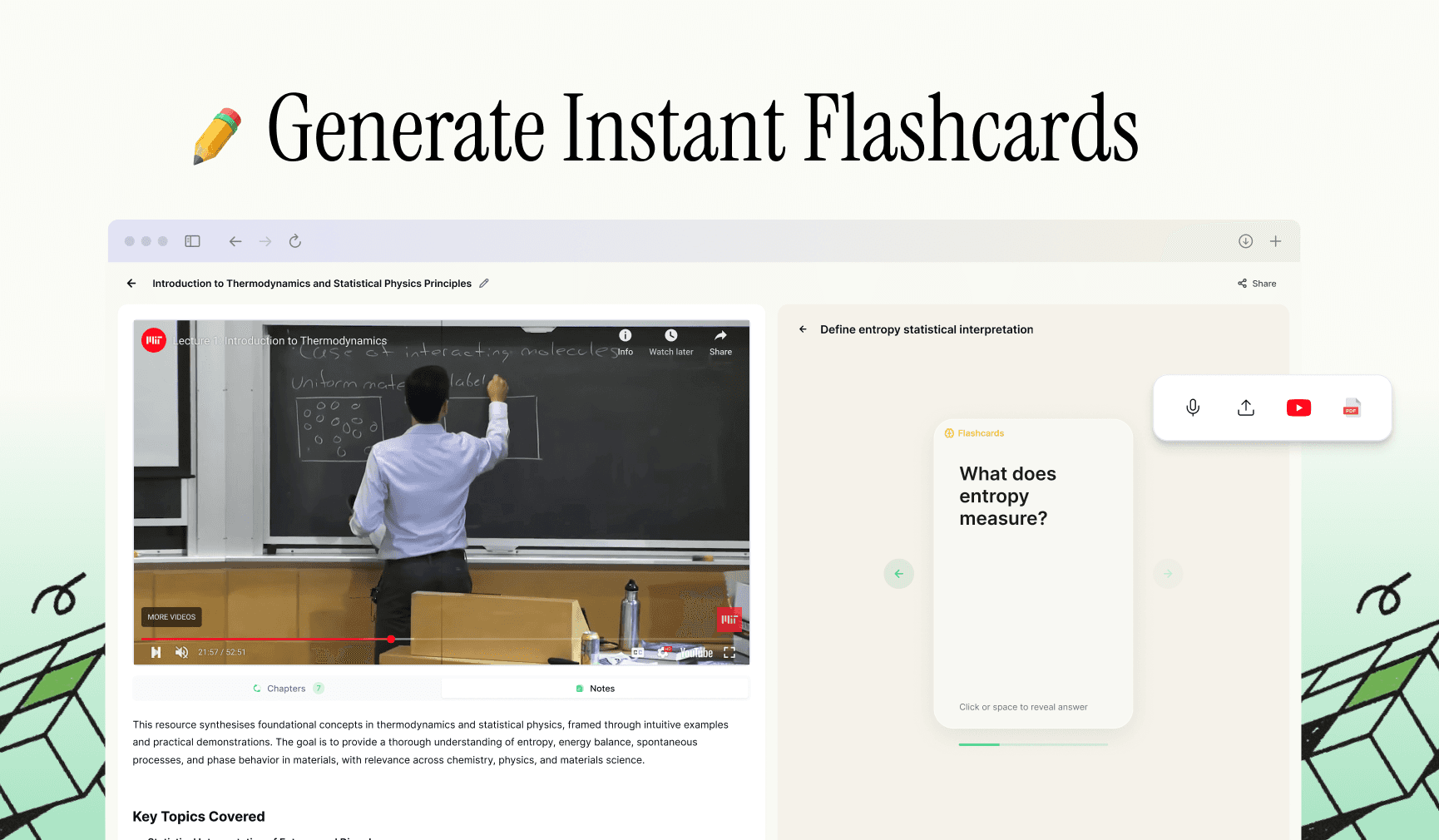
Simply upload your lecture slides, research papers, or handwritten notes, and Duetoday will generate a structured deck of flashcards. You can then refine the cards, add your own diagrams, and start your active recall session immediately.
Upload or paste your Particle Physics material.
Click Generate Flashcards.
Review, edit, and start studying instantly.
Common Particle Physics flashcard mistakes
The most common mistake is creating cards that are too 'wordy.' If a card contains an entire paragraph about the Higgs mechanism, your brain will memorize the shape of the text instead of the actual physics. Break it down. Another mistake is neglecting the 'Why.' Don't just memorize that strangeness isn't conserved in weak interactions; include a card asking why that happens.
Cards are too long: Split complex decays into individual steps.
Only memorizing names: Add cards that ask for the physical implications of a property.
Ignoring symbols: Include cards to identify particles by their standard Greek symbols.
No schedule: Use the spaced repetition features to avoid forgetting early units.
Ready to generate your Particle Physics flashcards?
Stop rereading your heavy physics textbook. Turn your notes into a powerful study tool and master the subatomic world with ease. Upload your material, generate your deck, and start recalling.
FAQ
How many flashcards do I need for Particle Physics? For a standard introductory course, a deck of 80–120 cards typically covers the Standard Model, fundamental forces, and conservation laws effectively.
What’s the best format for Particle Physics flashcards? Question-and-answer format works best. For example: 'Front: Composition of a Proton? Back: Two up quarks, one down quark.'
How often should I review Particle Physics flashcards? Aim for 15 minutes daily. Consistent, short exposure is better for memorizing particle properties than weekly cramming.
Should I make cards from a textbook or slides? Use both. Textbooks are great for deep definitions, while lecture slides often highlight the specific particles and formulas your professor prioritizes.
How do I stop forgetting decay modes after a few days? Use spaced repetition. When you get a decay card right, wait longer to see it again; if you get it wrong, review it every day until it sticks.
What if my flashcards feel too easy? Increase the difficulty by asking for 'application'—instead of asking what a quark is, ask how it contributes to the total charge of a specific baryon.
Can I generate Particle Physics flashcards from a PDF automatically? Yes, Duetoday can process physics PDFs and technical transcripts to create flashcards instantly.
Are digital flashcards better than paper for Physics? Digital cards are often better for complex topics because they allow for easy editing, organization, and automated spaced repetition scheduling.
How long does it take to make a full Particle Physics deck? Manually it could take hours, but with Duetoday’s AI generation, you can have a full deck ready in under a minute.
Can Duetoday handle mathematical formulas on cards? Yes, Duetoday is designed to capture and organize technical information, including formulas and specific particle data.

Duetoday is an AI-powered learning OS that turns your study materials into personalised, bite-sized study guides, cheat sheets, and active learning flows.