Generate Flashcards for Partial Differential Equations
Make and generate Partial Differential Equations flashcards to master heat equations, wave equations, and boundary conditions.
Generate Flashcards with AI Free
What are Partial Differential Equations (PDE) flashcards?
Partial Differential Equations flashcards are targeted study tools designed to break down complex multivariable calculus and physics-based equations into digestible pieces. They cover essential concepts like the heat equation, Laplace's equation, wave equations, and various boundary conditions (Dirichlet, Neumann, Robin). Instead of staring at dense derivations, these flashcards force you to recall the specific steps for solving specific types of PDEs.
The goal of using flashcards for PDEs is to move beyond passive reading. By testing yourself on classification (linear vs. nonlinear), order, and solution methods (separation of variables, Fourier transforms), you build the mental muscle memory required for advanced engineering and physics exams. If you already have lecture notes, Duetoday can generate a clean deck in minutes.
Why flashcards are one of the best ways to study PDEs
Studying Partial Differential Equations requires a mix of memorizing fundamental identities and recognizing structural patterns in equations. Flashcards excel here because they facilitate active recall—the act of pulling information from your brain rather than looking at it in a textbook. This process strengthens neural pathways associated with complex problem-solving.
Remember Green’s functions and Eigenfunctions without last-minute cramming.
Separate similar concepts like Elliptic, Parabolic, and Hyperbolic equations.
Learn derivation processes step-by-step, from initial conditions to final solutions.
Practice applying the method of characteristics quickly under pressure.
What to include in your PDE flashcards
Effective PDE flashcards follow the "one idea per card" rule. Don't try to fit an entire derivation on one card; instead, break the derivation into logical checkpoints. Use specific question-based prompts to ensure you are truly testing your understanding rather than just recognizing symbols.
Definitions & Key Terms: "What defines a quasilinear PDE?" "State the Principle of Superposition."
Processes & Steps: "What is the first step in the Separation of Variables method?"
Comparisons: "What is the difference between a Dirichlet and a Neumann boundary condition?"
Application: "Identify the type of equation: u_tt - c^2 u_xx = 0."
Example prompts include: "What is the physical interpretation of the Heat Equation?", "Write the formula for the 1D Wave Equation solution," and "Define the Laplacian operator in polar coordinates."
How to study PDEs with flashcards (a simple system)
Mastering PDEs is about repetition and pattern recognition. Start by using a "two-pass" approach. In the first pass, focus on definitions and classification. In the second pass, focus on the specific steps for solving boundary value problems. Review your deck in short, 15-minute bursts rather than hour-long marathons to keep your focus sharp.
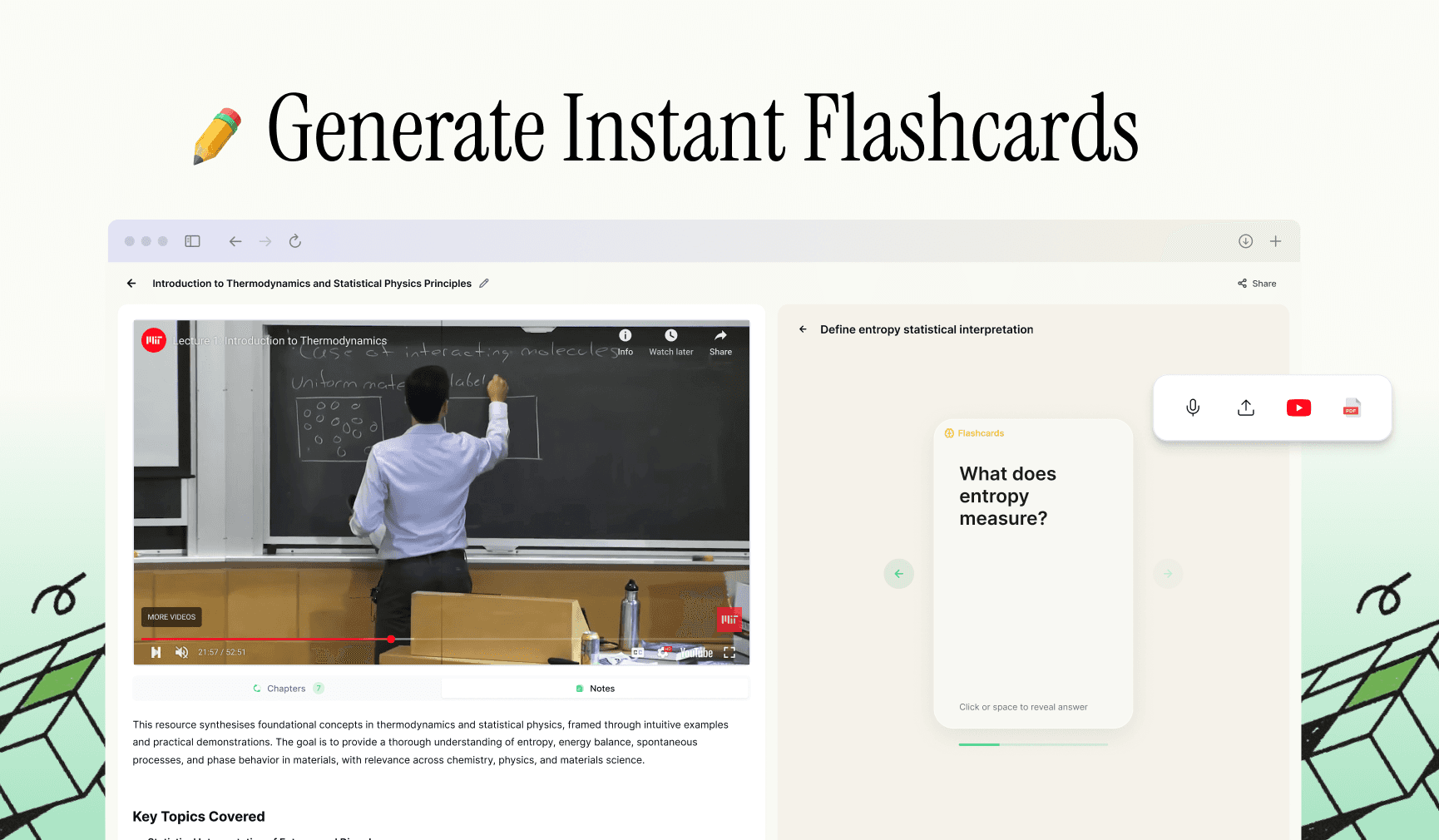
Generate a deck from your textbook chapters or lecture transcripts.
Perform a rapid round to identify which transformation methods (Fourier vs. Laplace) confuse you.
Review these "weak" cards daily for three days straight.
Mix in difficult boundary condition scenarios to challenge your application skills.
Conduct a final mixed review 48 hours before your exam.
Generate PDE flashcards automatically in Duetoday
Creating PDE flashcards manually is a nightmare—drawing Greek symbols and complex fractions by hand takes hours you don't have. Duetoday eliminates this friction. By using AI, you can convert your most difficult math materials into organized, digital study decks instantly.
Simply upload your math PDFs, lecture slides, or even handwritten notes. Our AI understands the LaTeX and mathematical structures within Partial Differential Equations to create accurate, high-quality cards. You spend less time formatting and more time solving equations.
Upload or paste your PDE material into the dashboard.
Click Generate Flashcards and watch the AI process the logic.
Review, edit the LaTeX if needed, and start studying on any device.
Common PDE flashcard mistakes (and how to fix them)
Many students make their PDE cards too cluttered, which leads to "recognition bias" rather than actual learning. Avoid putting an entire multi-page proof on a single card. Instead, create cards for the specific "pivot points" in a proof where a major substitution happens.
Cards are too long: Split complex proofs into individual steps.
Only memorizing the formula: Add cards asking for the physical meaning (e.g., "What does 'u' represent?").
Ignoring boundary conditions: Dedicate cards specifically to how conditions change the solution set.
No schedule: Use a spaced repetition system to ensure you don't forget the Heat Equation while studying the Wave Equation.
Ready to generate your PDE flashcards?
Stop rereading your math textbook and start recalling the solutions. Upload your notes, generate your deck, and master Partial Differential Equations today.
FAQ
How many flashcards do I need for PDEs? Aim for 40-60 cards per major unit. This allows you to cover definitions, classifications, and the 5-6 core methods for solving PDEs.
What’s the best format for PDE flashcards? Question-on-front, answer-on-back works best. Use the front for the equation name or a small problem, and the back for the solution or steps.
How often should I review PDE flashcards? Review new concepts daily. Once you have mastered a method, move it to a weekly review pile to keep it fresh in your long-term memory.
Should I make cards from a textbook or my notes? Use both. Textbooks provide the formal definitions, while lecture notes often contain the specific "tricks" your professor prefers for the exam.
How do I stop forgetting PDE formulas? Use active recall via flashcards to test yourself on the components of the formula (e.g., "What is the 'k' in the diffusion equation?") rather than just the whole string.
What if my flashcards feel too easy or too hard? If they are too easy, you are likely including too many context clues. If they are too hard, you are likely trying to memorize too much information at once.
Can I generate PDE flashcards from a PDF automatically? Yes, Duetoday can read mathematical PDFs and extract the key headings, formulas, and definitions to build a deck for you.
Are digital flashcards better than paper for PDEs? Digital is often better because you can easily edit complex LaTeX math symbols and carry your entire library on your phone.
How long does it take to make a full PDE deck? Manually, it could take hours. With Duetoday, you can generate a comprehensive deck in under 60 seconds.
Can Duetoday organize my math flashcards? Absolutely. You can categorize cards by topic—such as First-Order, Second-Order, or Numerical Methods—to keep your study sessions organized.

Duetoday is an AI-powered learning OS that turns your study materials into personalised, bite-sized study guides, cheat sheets, and active learning flows.