Generate Flashcards for Parallel Computing
Make Parallel Computing flashcards for computer science. Use our guide to generate study sets on MPI and CUDA.
Generate Flashcards with AI Free
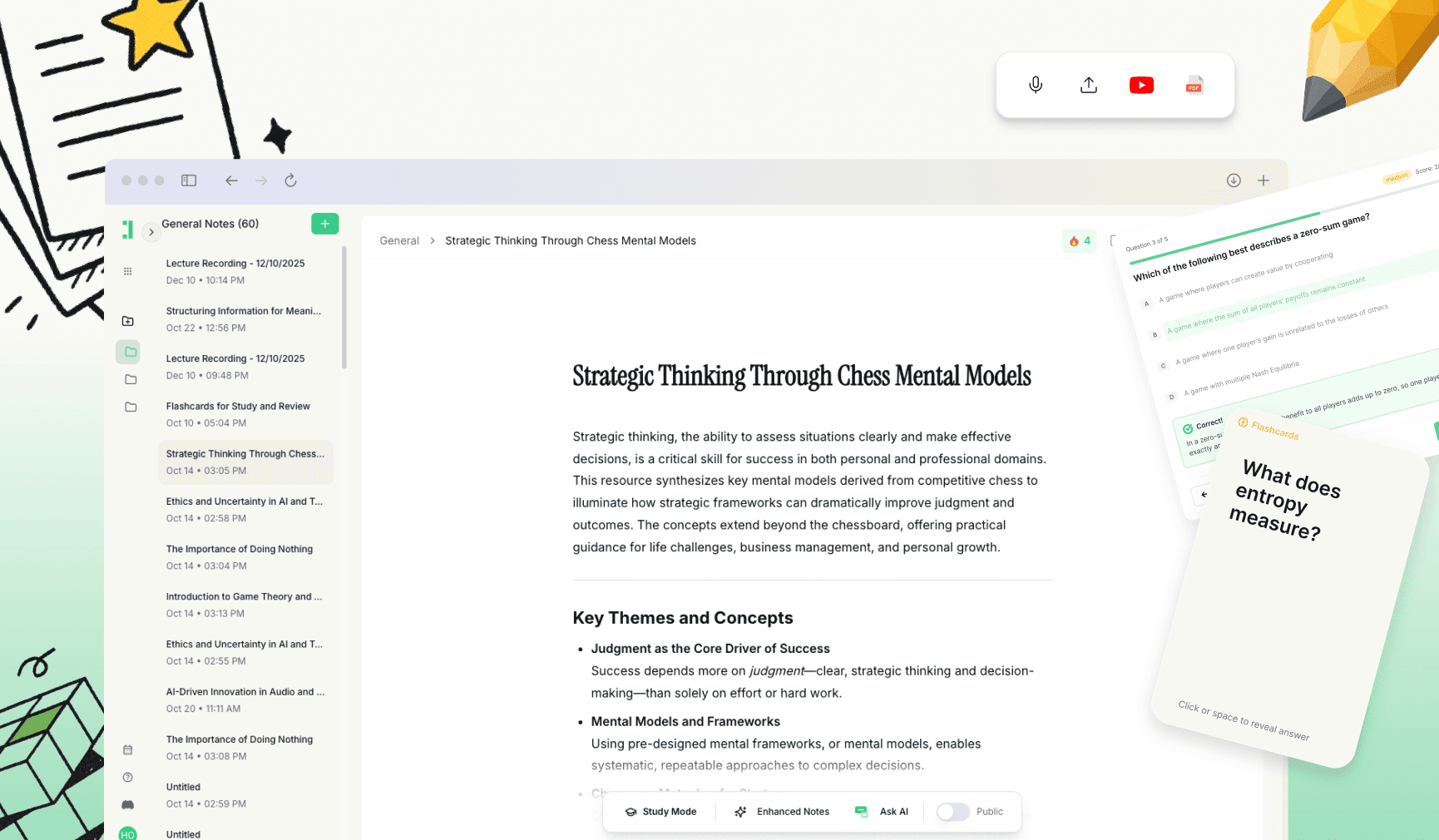
Generate Parallel Computing Flashcards
Turn your notes, PDFs, slides, or complex lecture transcripts into Parallel Computing flashcards so you can review faster and remember more. Whether you are tackling thread synchronization or distributed memory architectures, Duetoday helps you synthesize complex technical data into bite-sized study units.
Generate Parallel Computing FlashcardsUpload notes / paste text
When you use Duetoday, the process is seamless: simply upload your course material, our AI generates structured cards, and you can immediately review, edit, or export them to start your study session.
What are Parallel Computing flashcards?
Parallel Computing flashcards cover essential concepts such as hardware architectures (SIMD vs. MIMD), performance metrics like speedup and efficiency, and programming models like OpenMP or MPI. They transform dense technical documentation into specific questions about data hazards, race conditions, and synchronization primitives.
Instead of passively rereading your textbook, these flashcards force you to test yourself on how processes interact and how data flows across multiple processors. This active retrieval builds the strong neural pathways needed for high-stakes engineering exams. If you already have notes, Duetoday can generate a clean deck in minutes.
Why flashcards work for Parallel Computing
Parallel Computing requires a deep understanding of abstract relationships and rigid logical sequences. Flashcards are ideal for this subject because they help you isolate specific variables in performance equations and visualize the steps of complex algorithms without getting overwhelmed by background noise.
By using active recall and spaced repetition, you focus on the concepts you struggle with most—like cache coherence protocols—while keeping your knowledge of easier topics fresh. This prevents the 'forgetting curve' from wiping out your progress between lectures.
Remember architectural definitions without late-night cramming
Separate similar concepts (e.g., Shared Memory vs. Distributed Memory)
Learn synchronization processes step-by-step (locks, semaphores, barriers)
Practice applying Amdahl’s and Gustafson’s laws quickly

What to include in your Parallel Computing flashcards
Effective flashcards follow the 'atomic' rule: one specific idea per card. This prevents you from recognizing a card just because of its length rather than its content. Use your cards to bridge the gap between theory and technical implementation.
Definitions & key terms: Focus on terms like 'Granularity,' 'Throughput,' and 'Latency.'
Processes & steps: Break down how a message is passed in a distributed system.
Comparisons: Contrast Flynn's Taxonomy categories or different interconnect topologies.
Application: Provide a scenario (e.g., N processors) and ask for the theoretical speedup limit.
Example prompts include: What is the main difference between UMA and NUMA?, Define a race condition in a multi-threaded environment, and State the formula for Amdahl's Law.
How to study Parallel Computing with flashcards
The best approach is a 'two-pass' system. First, build your deck using Duetoday to capture all the core material. Then, perform a high-speed review to identify which categories (like GPU architecture vs. CPU threading) are giving you the most trouble.
Review your 'Weak' cards daily while spacing out the ones you know well. Before a lab or a quiz, mix all your cards together to ensure you can switch contexts between hardware theory and software implementation seamlessly.
Make a deck from your slides or code documentation.
Do one quick round to find weak spots in sync logic.
Review weak cards daily for three to five days.
Mix in a few harder performance modeling cards each session.
Do a final mixed review before your midterm or final.
Generate Parallel Computing flashcards automatically in Duetoday
Making cards manually is slow, messy, and inconsistent—especially with the heavy math and diagrams involved in computing. Duetoday simplifies this by converting your technical files into structured study decks in seconds.
Upload or paste your Parallel Computing material (PDFs/Slides)
Click 'Generate Flashcards'
Review, edit typeset formulas, and start studying
Generate Parallel Computing Flashcards in Duetoday
Start with your notes and get a deck you can actually use today.
Common Parallel Computing flashcard mistakes
Many students make cards that are too long, essentially pasting entire paragraphs onto the back of a card. This leads to 'rote recognition' rather than actual learning. Avoid this by splitting complex laws into multiple cards—one for the formula, one for the variables, and one for the implications.
Cards are too long: split into one functional idea per card
Ignoring the 'Why': include cards that ask why a deadlock occurs, not just what it is
Confusing MPI vs OpenMP: create specific comparison cards for these models
No math practice: create cards that require a quick mental calculation
Ready to generate your Parallel Computing flashcards?
Stop rereading your slides and start recalling the material. Upload your Parallel Computing notes to Duetoday, generate your deck, and master your coursework with active recall.
Start Generating Flashcards
Works with notes, PDFs, slides, and transcripts.

FAQ
How many flashcards do I need for Parallel Computing?
A typical undergraduate module usually requires 100-150 cards to cover everything from hardware architecture to software optimization techniques.
What is the best format for Parallel Computing flashcards?
Question-and-answer format is best. For coding concepts, use 'Fill in the blank' style cards for syntax or 'Problem/Solution' for architectural bottlenecks.
How often should I review Parallel Computing flashcards?
Begin with daily sessions for new topics. As you master concepts like TLP or ILP, you can move them to every 3-4 days using spaced repetition.
Should I make cards from a textbook or lecture notes?
Lecture notes are usually better for exam alignment, but textbooks provide the precise definitions needed for foundational terms.
How do I stop forgetting Parallel Computing after a few days?
Consistency is key. Use an automated tool like Duetoday to keep your review schedule on track so you don't lose progress on complex theories.
What if my flashcards feel too easy?
If cards are too easy, increase the difficulty by asking 'Why' or 'How' instead of just 'What.' Shift from definitions to application and troubleshooting.
Can I generate Parallel Computing flashcards from a PDF?
Yes, Duetoday is designed to parse technical PDFs and extract key concepts, formulas, and definitions into organized flashcards automatically.
Are digital flashcards better than paper for this subject?
Digital cards are superior for computing because you can easily include code snippets, update formulas, and use automated algorithms to track your mastery.
How long does it take to make a full deck?
Manually, it could take hours. With Duetoday’s AI generation, you can have a comprehensive deck ready in under two minutes.
Can Duetoday organize my cards by topic?
Yes, Duetoday categorizes your generated cards so you can study specific sub-topics like 'Shared Memory' or 'Interconnects' individually.

Duetoday is an AI-powered learning OS that turns your study materials into personalised, bite-sized study guides, cheat sheets, and active learning flows.