Generate Flashcards for Organometallic Chemistry
Make Organometallic Chemistry flashcards to master catalytic cycles and ligand bonding. Generate custom study guides from your notes.
Generate Flashcards with AI Free
What are Organometallic Chemistry flashcards?
Organometallic Chemistry flashcards are specialized study tools designed to help you master the complex interactions between organic molecules and metal centers. These cards cover essential topics such as hapticity (η), the 18-electron rule, oxidation states, and the various bonding modes of ligands like carbonyls, phosphines, and carbenes.
The primary outcome of using these flashcards is moving beyond passive reading. Instead of looking at a complex catalytic cycle and hoping it sticks, you test your ability to predict intermediates and identify elementary steps. If you already have lecture slides or textbook notes, Duetoday can generate a clean, organized deck in minutes.
Why flashcards are one of the best ways to study Organometallic Chemistry
Organometallic chemistry requires a unique blend of structural memorization and logical application. Flashcards excel here because they force you to isolate specific variables—like the coordination number of a metal—before moving on to the broader mechanism.
By using active recall and spaced repetition, you reinforce the mental pathways needed to identify complex structures under exam pressure. Instead of cramming 50 pages of notes, you focus on the specific concepts you find most difficult.
Master the 18-electron rule across different metal geometries.
Distinguish between Fischer and Schrock carbenes instantly.
Learn catalytic cycles step-by-step (oxidative addition, migratory insertion, etc.).
Practice identifying hapticity changes in pi-coordinated ligands.
What to include in your Organometallic Chemistry flashcards
Effective chemistry flashcards follow the atomic rule: one concept per card. If a card is too crowded with an entire multi-step mechanism, you won't effectively learn the individual transitions. Focus on question-based prompts that require a specific answer.
Try organizing your deck into these four categories:
Definitions & Structural Rules: What is the 18-electron rule? or Define back-bonding.
Ligand Properties: Is PMe3 a better sigma donor or pi acceptor than PF3?
Elementary Steps: What are the requirements for Reductive Elimination?
Predictive Application: Predict the product of this oxidative addition reaction.
Example Prompts for your deck:
- What is the hapticity of a cyclopentadienyl (Cp) ligand in its most common bonding mode?
- Name the four key steps in the Monsanto Acetic Acid process.
- Explain the Dewar-Chatt-Duncanson model of metal-olefin bonding.
- What happens to the metal oxidation state during Migratory Insertion?
- Calculate the electron count for [Fe(CO)5].
How to study Organometallic Chemistry with flashcards
The best way to study this subject is through a layered approach. First, focus on the structural basics—electron counting and ligand types. Once those are second nature, move on to the more dynamic aspects like reaction mechanisms and catalytic cycles.
Review your deck in short, frequent sessions rather than one long marathon. This allows your brain to consolidate the complex three-dimensional geometry of metal complexes over time.
Generate a deck from your lecture PDFs or textbook chapters.
Perform an initial run to identify which ligands or rules confuse you.
Daily review: focus specifically on the catalytic cycles you struggle to draw.
Periodically shuffle the deck to ensure you aren't just memorizing the order of the cards.
Apply your knowledge by sketching the structures on a whiteboard as you answer.
Generate Organometallic Chemistry flashcards automatically in Duetoday
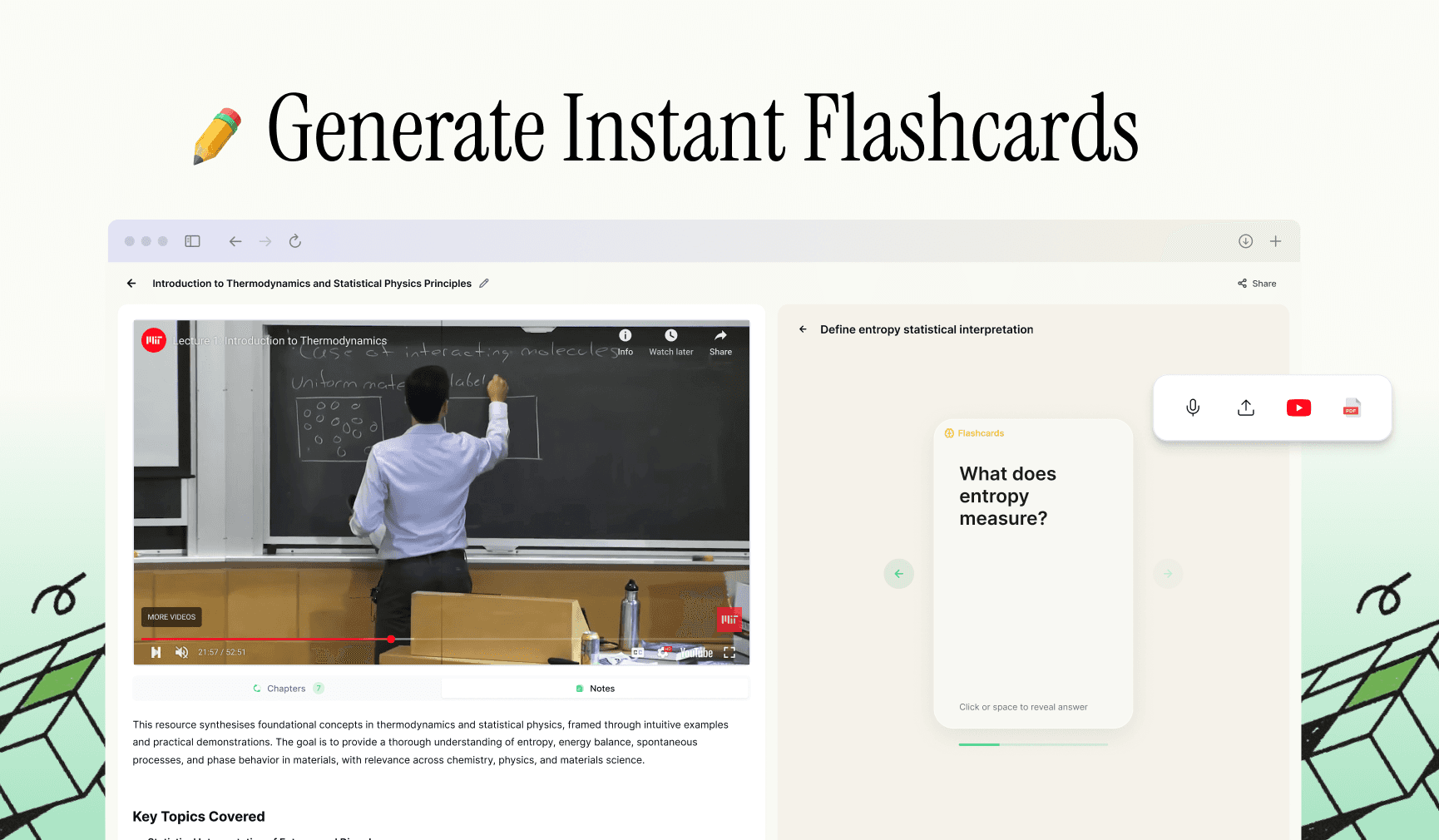
Manually drawing complex organometallic structures and writing out electron counts on paper cards is incredibly time-consuming and prone to errors. Duetoday eliminates this friction by instantly converting your study material into structured digital decks.
Simply upload your PDFs, slides, or handwritten notes. Duetoday’s AI analyzes the chemical symbols and relationships to create high-quality flashcards so you can spend your time studying instead of formatting.
Upload your Organometallic Chemistry syllabus or notes.
Click Generate Flashcards.
Review your new deck and start mastering catalytic cycles.
Common Organometallic Chemistry flashcard mistakes
A common mistake is putting an entire cycle (like the Heck reaction) on a single card. This leads to passive recognition where you think you know it because it looks familiar, but you can't reproduce it from scratch.
Too much detail: Keep cards limited to one step or one rule.
Neglecting oxidation states: Always include the metal's state on your cards.
Ignoring geometry: Don't just learn the names; visualize the 3D structure.
Skipping the 'Why': Don't just memorize the 18-electron rule; ask why a complex might be stable with 16 electrons.
FAQ
How many flashcards do I need for Organometallic Chemistry?
For a typical semester course, a deck of 150-200 cards is usually sufficient to cover the 18-electron rule, ligand types, and primary catalytic cycles.
Should I make cards from my textbook or my lecture slides?
Lecture slides are usually better for highlighting specific mechanisms your professor emphasizes, while textbooks are great for clarifying complex bonding theories.
Can I generate flashcards from a PDF automatically?
Yes, Duetoday is designed to parse PDFs and lecture slides to create accurate chemistry flashcards instantly.
How often should I review my chemistry flashcards?
Review your cards daily for at least 15-20 minutes. Spaced repetition is the key to moving complex formulas from short-term to long-term memory.
Are digital flashcards better than paper for chemistry?
Digital cards are often better for Organometallic chemistry because you can easily include high-resolution images of complex molecular structures and edit them as you learn.
What if my flashcards feel too hard?
If a card is too difficult, it’s likely too broad. Try breaking that specific card into two or three smaller questions.
Can Duetoday handle chemical formulas?
Yes, Duetoday can interpret chemical notation and metal-complex structures to create relevant study prompts.
How do I stop forgetting the catalytic steps?
Create order-based cards. For example, have a card ask: What is the step immediately following oxidative addition in the Suzuki reaction?

Duetoday is an AI-powered learning OS that turns your study materials into personalised, bite-sized study guides, cheat sheets, and active learning flows.