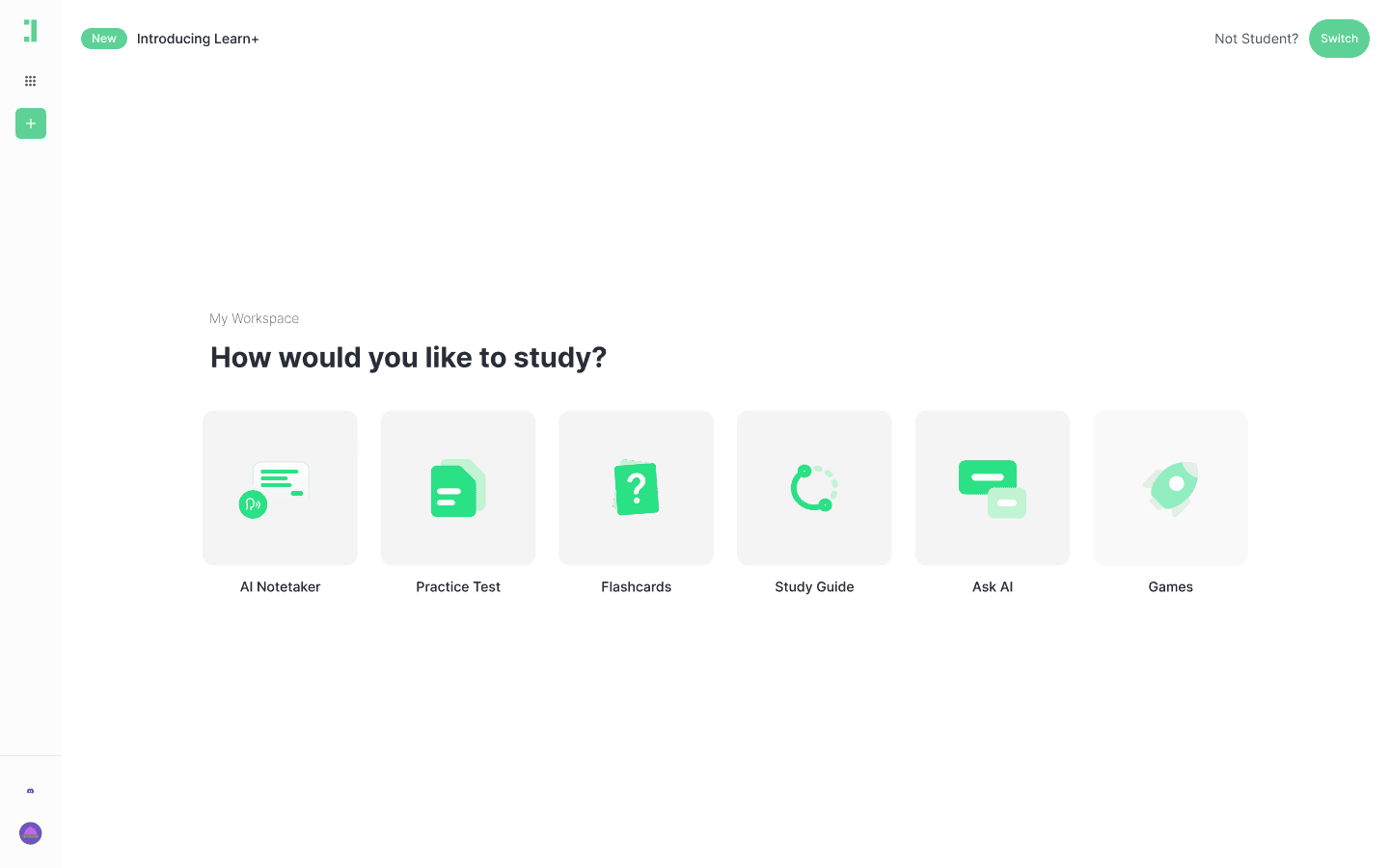
Generate Flashcards for Organic Chemistry I
Make Organic Chemistry I flashcards from your study notes. Generate AI study guides for reactions, mechanisms, and nomenclature.
Generate Flashcards with AI Free
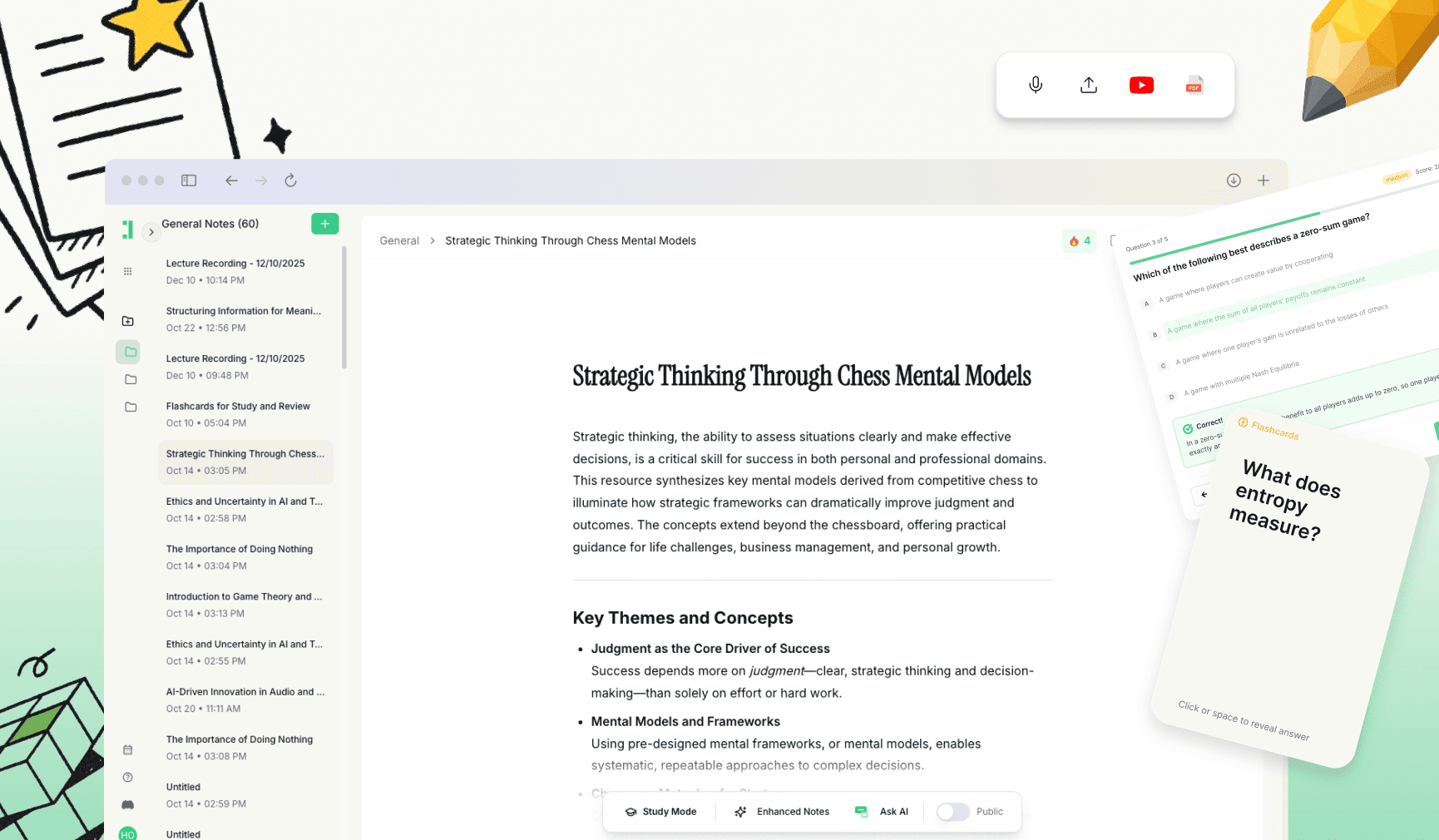
Generate Flashcards for Organic Chemistry I
Turn your notes, PDFs, slides, or lectures into Organic Chemistry I flashcards so you can review faster and remember more. Instead of drowning in complex structures, convert your study material into a structured deck ready for active recall.
Generate Organic Chemistry I FlashcardsUpload notes / paste text
In Duetoday, the process is simple: upload your documents, generate your cards, refine the details, and start your study session. No more manual data entry; just pure learning.
What are Organic Chemistry I flashcards?
Organic Chemistry I flashcards cover the foundational pillars of carbon-based chemistry, including functional groups, IUPAC nomenclature, stereochemistry, and basic reaction mechanisms like SN1, SN2, E1, and E2. They transform dense textbook chapters into bite-sized questions that challenge your brain to retrieve information.
The outcome is a shift from passive reading to active testing. Instead of looking at a reaction map and thinking you know it, flashcards force you to predict the product or name the reagent from memory, building genuine mastery. If you already have notes, Duetoday can generate a clean deck in minutes.
Why flashcards work for Organic Chemistry I
Organic Chemistry I is often called a 'weed-out' course because it requires both high-level visualization and rote memorization of reagents. Flashcards bridge this gap by linking specific chemical structures to their reactivity patterns and spatial arrangements.
By using active recall and spaced repetition, you ensure that you don't just memorize a reaction for a week, but retain it for the final exam. You focus your energy on the mechanisms that actually trip you up while skipping the ones you've already mastered.
Remember functional groups and their properties without cramming
Separate similar concepts (e.g., Nucleophile vs. Base)
Learn multi-step mechanisms stage-by-stage
Practice applying nomenclature rules quickly
Master 3D stereocenter assignments (R/S)
What to include in your Organic Chemistry I flashcards
Effective Organic Chemistry I flashcards follow the "one idea per card" rule. Avoid cluttering a single card with an entire chapter; instead, focus on specific transformations or rules. Using question-based prompts is the fastest way to trigger memory retrieval.
We recommend focusing on four main card types to cover the syllabus effectively:
Definitions & Key Terms: "What is an electrophile?" "Define an anti-periplanar transition state."
Processes & Mechanisms: "What is the first step in an acid-catalyzed hydration?"
Comparisons: "How does a protic solvent affect SN1 vs SN2 reaction rates?"
Application: "Predict the major product of 2-butene reacting with OsO4."
Example prompts for your deck: "What reagent converts an alkene to a diol?", "Identify the hybridisation of the central carbon in an allene", "Which carbocation is more stable and why?", "Draw the Newman projection for the most stable conformation of butane."
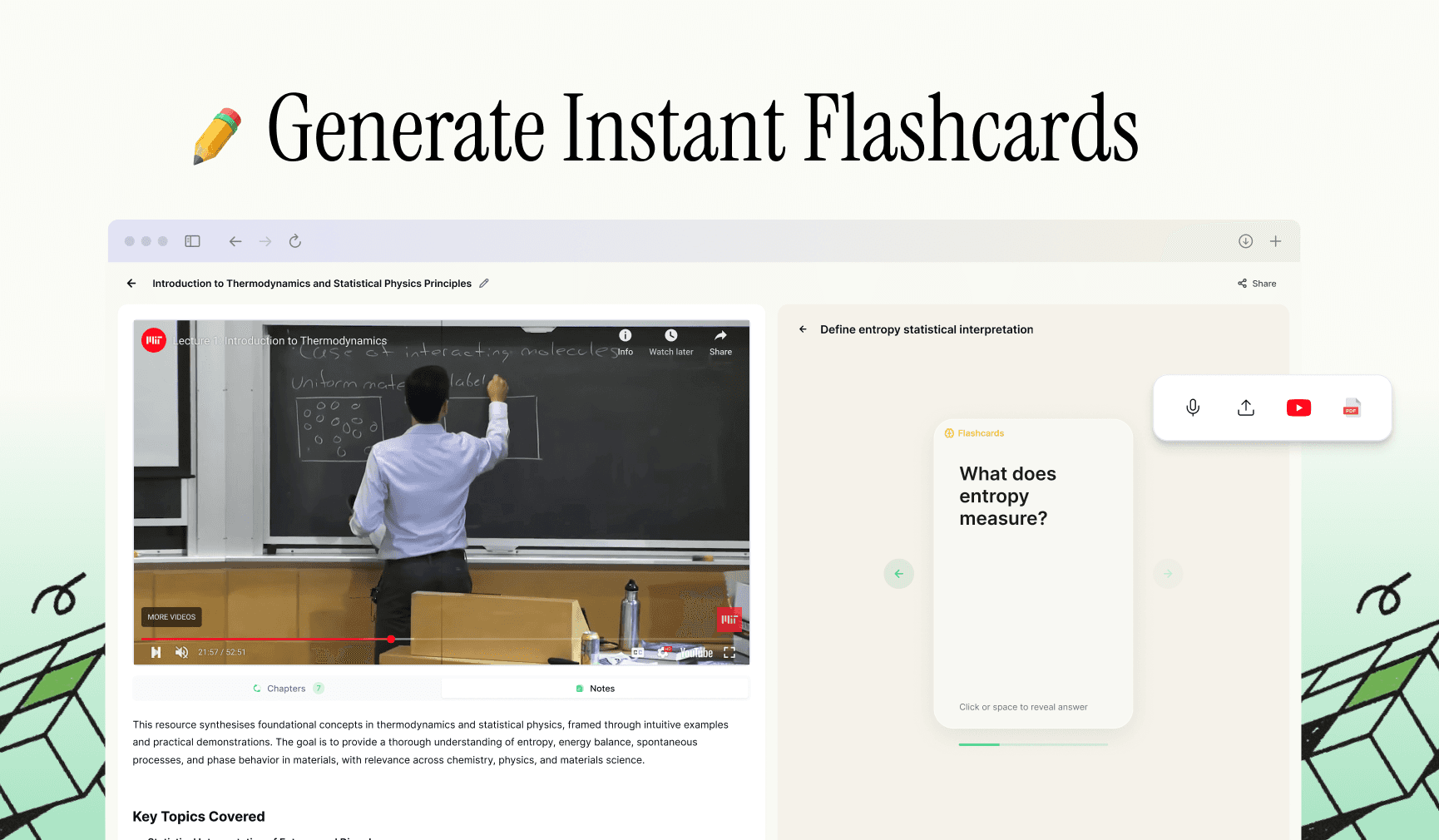
How to study Organic Chemistry I with flashcards (a simple system)
Mastering O-Chem isn't about one long study session; it's about frequent, high-intensity passes through your material. Start by building your deck from your syllabus or lecture slides, then move into a structured review cycle.
The best approach is the "two-pass" method. In the first pass, you identify which reactions you understand and which ones feel like a foreign language. In the second pass, you drill the difficult mechanisms until they become second nature.
Make a deck from your notes (or generate it from content inside Duetoday).
Do one quick round to find weak spots, like stereochemistry or specific reagents.
Review weak cards daily for a few days to build muscle memory.
Mix in a few harder mechanism cards each session to test synthesis skills.
Do a final mixed review before quizzes or midterms to simulate exam conditions.
Generate Organic Chemistry I flashcards automatically in Duetoday
Making cards manually is slow, messy, and inconsistent. Drawing hex rings and arrows on physical paper cards takes hours that you should be spending actually studying the material. Duetoday eliminates the busywork.
With Duetoday, you can take your professor's PowerPoints or your own handwritten notes and turn them into a digital study suite instantly. The AI understands chemical context, ensuring your cards are accurate and relevant.
Upload or paste your Organic Chemistry I material
Click Generate Flashcards
Review, edit, and start studying
Generate Organic Chemistry I Flashcards in Duetoday
Start with your notes and get a deck you can actually use today.
Common Organic Chemistry I flashcard mistakes (and how to fix them)
Most students make cards that are too "wordy." In chemistry, if you can't draw it, you don't know it. Avoid writing long paragraphs on the back of a card; use simple diagrams or short, punchy explanations instead.
Cards are too long: Split complex mechanisms into individual steps.
Only memorizing words: Always ensure you can visualize the molecular structure.
Confusing SN1/SN2/E1/E2: Use comparison cards to highlight the differences in reagents and solvents.
No review schedule: O-Chem is a language; if you don't use it daily, you lose it.
No application practice: Add cards that ask "What happens if we use a bulkier base?"
Ready to generate your Organic Chemistry I flashcards?
Stop rereading your textbook and start recalling the mechanisms. Upload your notes, generate your custom deck, and master Organic Chemistry I with the power of AI-driven active recall.
Start Generating Flashcards
Works with notes, PDFs, slides, and transcripts.
FAQ
How many flashcards do I need for Organic Chemistry I? Typically, a full semester of O-Chem I requires 200–400 cards to cover all functional groups, nomenclature rules, and major reaction mechanisms.
What’s the best format for Organic Chemistry I flashcards? The 'Question on Front, Reaction/Structure on Back' format is best. Use the front for the starting material and reagents, and the back for the major product and mechanism steps.
How often should I review Organic Chemistry I flashcards? Aim for 15-20 minutes every day. Consistency is more important than duration in O-Chem because the concepts build on each other sequentially.
Should I make cards from a textbook, lecture notes, or slides? Lecture notes and slides are usually best as they reflect what your specific professor emphasizes for exams. Use the textbook to clarify confusing steps.
How do I stop forgetting Organic Chemistry I after a few days? Use spaced repetition. Duetoday’s system ensures that the cards you find difficult appear more frequently, while easy cards are pushed back, keeping the info fresh.
What if my flashcards feel too easy or too hard? If they are too easy, you are likely too broad. Break them down into more specific questions. If they are too hard, you might be trying to memorize too much on one card; split it into smaller steps.
Can I generate Organic Chemistry I flashcards from a PDF automatically? Yes, Duetoday allows you to upload a PDF of your textbook or notes and will automatically extract the key concepts into flashcards.
Are digital flashcards better than paper for Organic Chemistry I? Digital cards are superior because they allow for easy editing, can include high-res images of structures, and use algorithms to automate your study schedule.
How long does it take to make a full Organic Chemistry I deck? Manually, it can take hours. With Duetoday, you can generate a comprehensive draft deck in under 60 seconds from your uploaded notes.
Can Duetoday generate and organize my flashcards for me? Absolutely. Duetoday categorizes your content by topic, making it easy to focus specifically on Alkenes, Alkynes, or Stereochemistry whenever you need.

Duetoday is an AI-powered learning OS that turns your study materials into personalised, bite-sized study guides, cheat sheets, and active learning flows.