
Generate Flashcards for Organic Chemistry Basics
Stop cramming! Generate Organic Chemistry flashcards from your notes in seconds. Try it for free today.
Generate Flashcards with AI Free
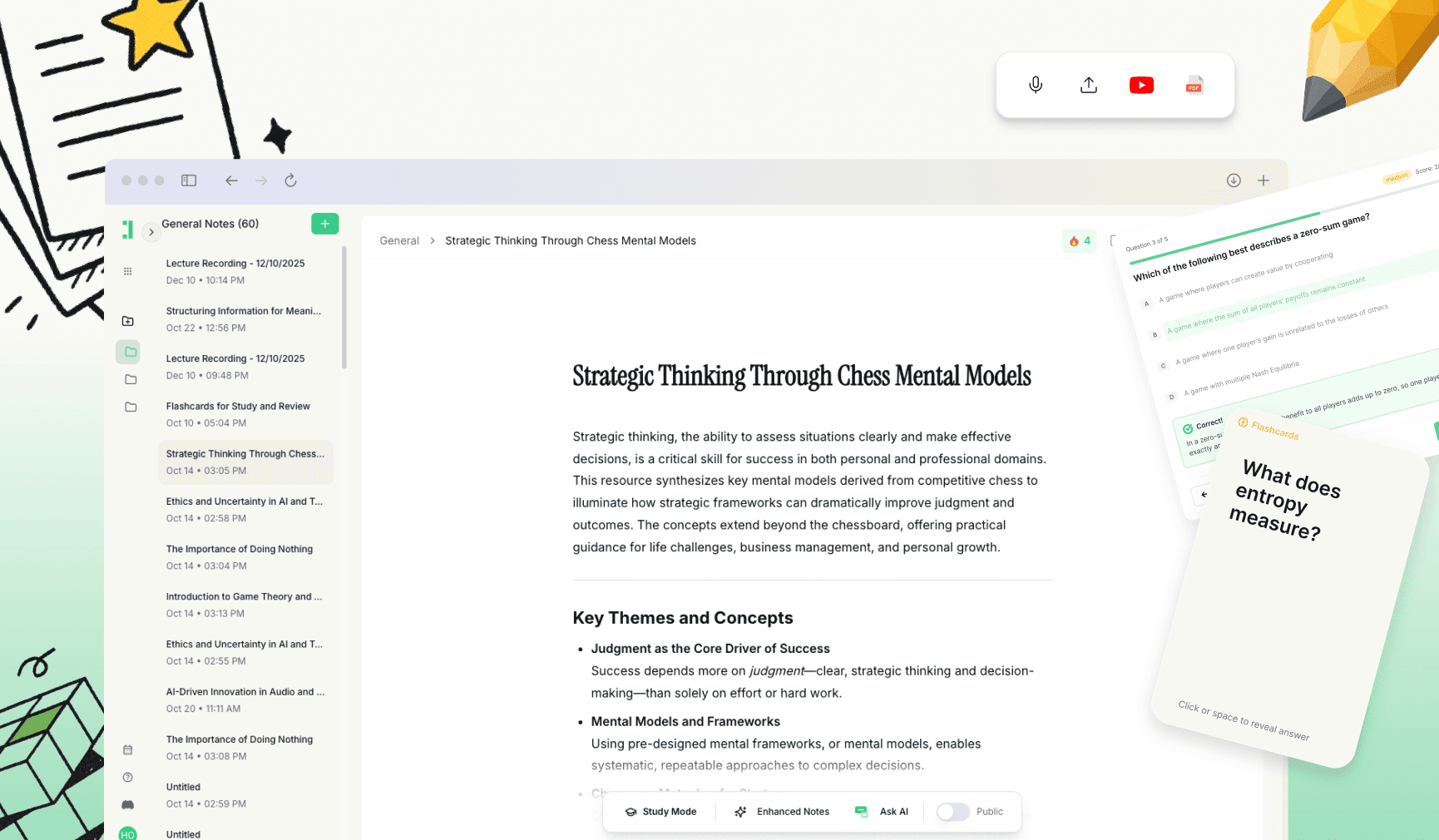
Generate Flashcards for Organic Chemistry Basics
Turn your notes, PDFs, slides, or lectures into Organic Chemistry Basics flashcards so you can review faster and remember more. Whether you are struggling with nomenclature or structural formulas, AI-powered flashcards help you bridge the gap between reading and retaining.
Generate Organic Chemistry FlashcardsUpload notes / paste text
In Duetoday, the process is simple: upload your study material, generate your deck, edit any specific mechanisms, and start your active recall session immediately.
What are Organic Chemistry Basics flashcards?
Organic Chemistry Basics flashcards cover the fundamental building blocks of carbon-based chemistry. This includes identifying functional groups (like alcohols, ketones, and amines), understanding hybridization, naming molecules using IUPAC rules, and recognizing basic stereochemistry.
The goal of these flashcards is to shift your study habit from passive rereading to active testing. Instead of looking at a diagram of benzene, a flashcard forces you to recall its properties, stability, and bonding structure from memory, which is essential for passing complex exams.
If you already have notes, Duetoday can generate a clean deck in minutes.
Why flashcards are one of the best ways to study Organic Chemistry Basics
Organic chemistry is often described as a visual language. It requires a mix of rote memorization for nomenclature and deep conceptual understanding for reaction pathways. Flashcards are perfectly suited for this because they break down massive textbooks into bite-sized, testable units.
By using active recall and spaced repetition, you ensure that you aren't just memorizing a reaction for today, but moving that knowledge into your long-term memory. This prevents the common "I understood it in class but forgot it during the exam" syndrome.
Remember functional groups without late-night cramming.
Separate similar concepts like Sn1 vs Sn2 reactions.
Learn naming conventions step-by-step through repetition.
Practice identifying chiral centers and isomerism quickly.
What to include in your Organic Chemistry Basics flashcards
Effective organic chemistry flashcards follow the "atomicity principle": one idea per card. If a card is too dense, your brain will skip over the hard parts. Focus on turn-based questions that require a specific answer.
There are four main categories of cards you should include in your deck to cover the basics thoroughly:
Definitions & Key Terms: "What is an electrophile?" or "Define resonance."
Functional Group Identification: Show a structure and ask for the name of the group.
IUPAC Rules: "What is the first step in naming a branched alkane?"
Basic Reactions: "Identify the product of an alkene hydrogenation."
Example prompts include: "What is the hybridization of carbon in methane?", "Draw the skeletal structure for 2-propanol", and "Which is more stable: a primary or tertiary carbocation?"
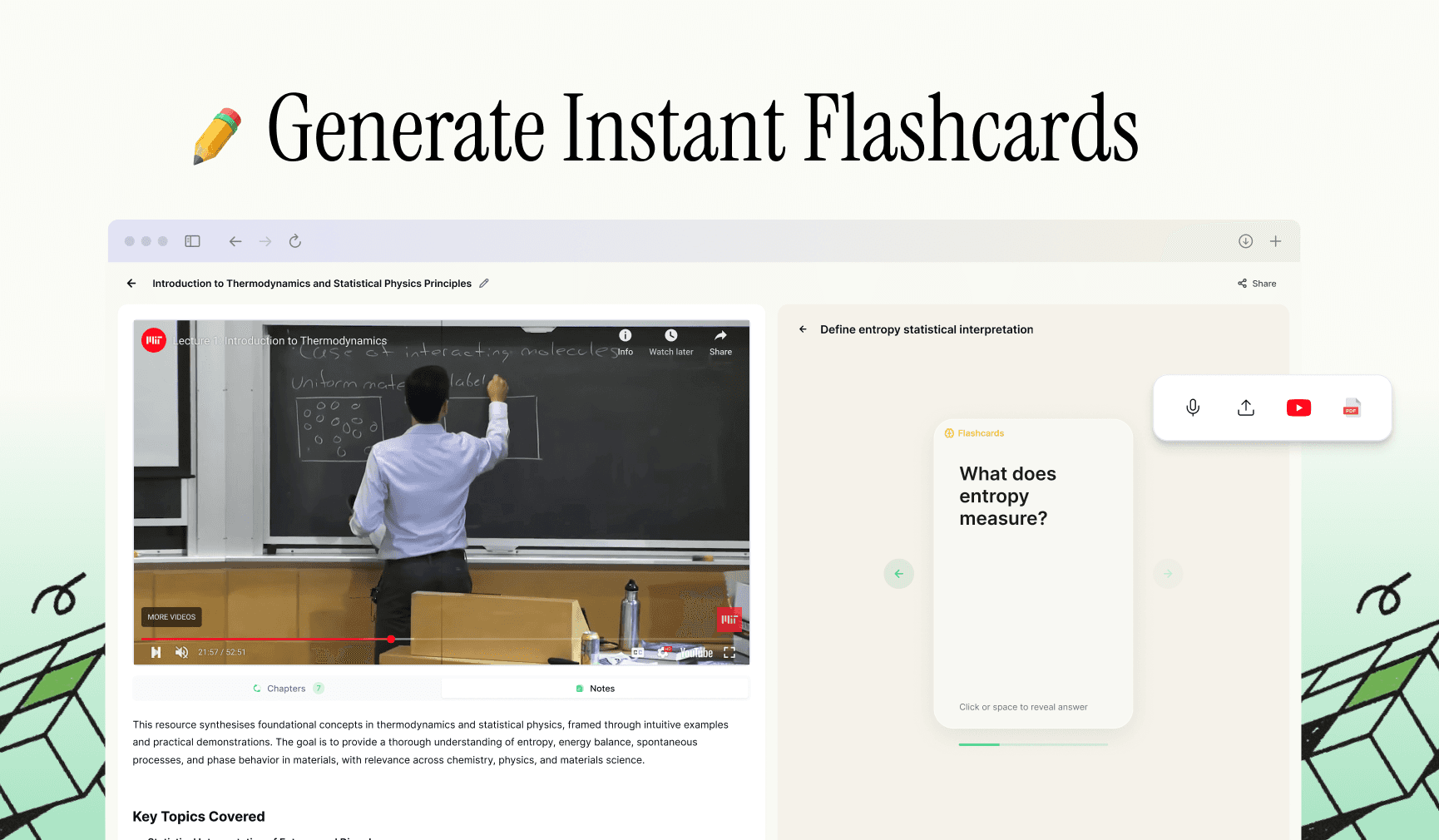
How to study Organic Chemistry Basics with flashcards (a simple system)
To master the foundations of O-Chem, use a two-pass approach. First, build your deck and do a high-level review to get familiar with the shapes and terms. Then, transition into rigorous testing rounds.
Success in this subject comes from frequency, not duration. It is better to study flashcards for 15 minutes every day than for three hours once a week.
Make a deck from your notes or generate it from your textbook chapter.
Do one quick round to identify which functional groups or rules you keep missing.
Review these "weak" cards daily until the patterns become intuitive.
Mix in harder mechanism cards as you get comfortable with the basics.
Do a final mixed-topic review before your midterm or final exam.
Generate Organic Chemistry Basics flashcards automatically in Duetoday
Manually drawing molecules and writing out IUPAC rules on paper cards is incredibly time-consuming. Most students spend more time making the cards than actually studying them. This leads to burnout before the real learning even begins.
Duetoday transforms this workflow. By uploading your PDFs, lecture slides, or even photos of your handwritten notes, the AI identifies the core chemical concepts and builds the deck for you.
Upload or paste your Organic Chemistry material.
Click Generate Flashcards.
Review, edit the structures, and start studying.
Generate Organic Chemistry Flashcards in Duetoday
Start with your notes and get a deck you can actually use today.
Common Organic Chemistry Basics flashcard mistakes
Many students fail because their cards are built incorrectly. Avoid these common pitfalls to ensure your study time is effective:
Cards are too long: Don't put an entire reaction mechanism on one card; break it into individual steps.
Only memorizing names: Ensure you include "why" cards, such as why a certain molecule is a stronger acid.
Ignoring 3D structure: Always include cards that test your ability to visualize molecules in 3D space.
No review schedule: Don't just look at the cards once; use a system that repeats the ones you get wrong.
FAQ
How many flashcards do I need for Organic Chemistry Basics? Usually, 100-150 cards cover the core fundamentals like nomenclature, functional groups, and basic bonding.
What’s the best format for these flashcards? A mix of visual identification (images of structures) and rule-based questions (IUPAC naming steps) works best.
How often should I review them? Daily review is best for O-Chem basics, as the subject builds on itself rapidly.
Should I make cards from a textbook or my lecture notes? Use lecture notes for exam-specific focus, but use the textbook to clarify complex structural concepts.
How do I stop forgetting reactions after a few days? Spaced repetition is key. Duetoday ensures you see the hardest cards more frequently to lock them into your memory.
What if my flashcards feel too easy? Once you master the basics, generate new cards focused on multi-step synthesis and advanced mechanisms.
Can I generate organic chemistry flashcards from a PDF? Yes, Duetoday can read chemistry PDFs and extract key terminology and reactions into cards.
Are digital flashcards better than paper? Yes, because digital cards allow for instant sorting and better handling of complex molecular images.
How long does it take to make a full deck? With AI generation, you can have a full deck ready in under two minutes.
Can Duetoday organize my cards by topic? Yes, it categorizes your cards so you can study functional groups separately from nomenclature rules.
Ready to generate your Organic Chemistry Basics flashcards?
Stop rereading your textbook and start mastering carbon chemistry with active recall. Upload your notes, generate your deck, and ace your next chemistry exam.
Start Generating Flashcards
Works with notes, PDFs, slides, and transcripts.

Duetoday is an AI-powered learning OS that turns your study materials into personalised, bite-sized study guides, cheat sheets, and active learning flows.