Generate Flashcards for Optics
Generate Optics flashcards in seconds. Turn PDFs and notes into study decks. Try for free!
Generate Flashcards with AI Free

What are Optics flashcards?
Optics flashcards are a specialized study tool designed to help you master the physics of light, including its interactions with matter, the instruments used to detect it, and the mathematical models that describe its behavior. These cards cover everything from basic reflection and refraction to complex wave theory, quantum optics, and lens equations.
Instead of passively rereading your textbook or scrolling through lecture slides, optics flashcards force you to engage in active recall. By testing yourself on specific concepts—like Snell's Law or the lens maker's equation—you build stronger neural pathways and identify exactly where your understanding of light behavior is lacking.
If you already have notes or lab reports, Duetoday can generate a clean deck of optics flashcards in minutes, allowing you to spend more time studying and less time formatting.
Why flashcards are one of the best ways to study Optics
Optics is a field that requires a mix of memorizing definitions and applying complex mathematical rules. Flashcards are uniquely suited for this because they allow you to isolate individual variables and geometric relationships that are often lost in long paragraphs of text.
By using active recall and spaced repetition, you ensure that fundamental laws are committed to long-term memory, making it easier to solve advanced problems during exams. Here is why they work so well for physics students:
Remember key terms like 'diffraction,' 'interference,' and 'polarization' without cramming.
Separate similar concepts, such as converging vs. diverging lenses.
Learn optical processes step-by-step, such as the path of light through a microscope.
Practice applying Snell’s Law or thin lens formulas quickly.
What to include in your Optics flashcards
The best optics flashcards follow the 'atomic' rule: one idea per card. This prevents you from simply recognizing a page of text and instead forces you to recall a specific answer. Your deck should contain a mix of theoretical questions, diagram interpretations, and formula applications.
Definitions & key terms: Focus on the fundamental properties of light waves.
Processes & steps: Describe how images are formed by various optical systems.
Comparisons: Contrast different types of mirrors, lenses, and wave behaviors.
Application: Solve for focal length, magnification, or refractive indices.
Use these example prompts for your cards: 'What is the relationship between frequency and wavelength?', 'Define total internal reflection.', 'What is the sign convention for a virtual image in a convex mirror?', and 'State Fermat’s Principle of Least Time.'
How to study Optics with flashcards
Mastering optics requires a systematic approach. Start by creating a comprehensive deck from your lecture notes or textbook chapters. Perform an initial 'diagnostic' pass to see which concepts you've already grasped and which are still confusing. For optics, pay special attention to ray diagrams; you can even include image descriptions on your cards.
Make a deck from your notes or generate it from content using Duetoday.
Do one quick round to find weak spots in your formula memory.
Review weak cards—especially those regarding sign conventions—daily for a few days.
Mix in harder application cards, like calculating the power of a lens system.
Do a final mixed review before your midterm or final exam.
Generate Optics flashcards automatically in Duetoday
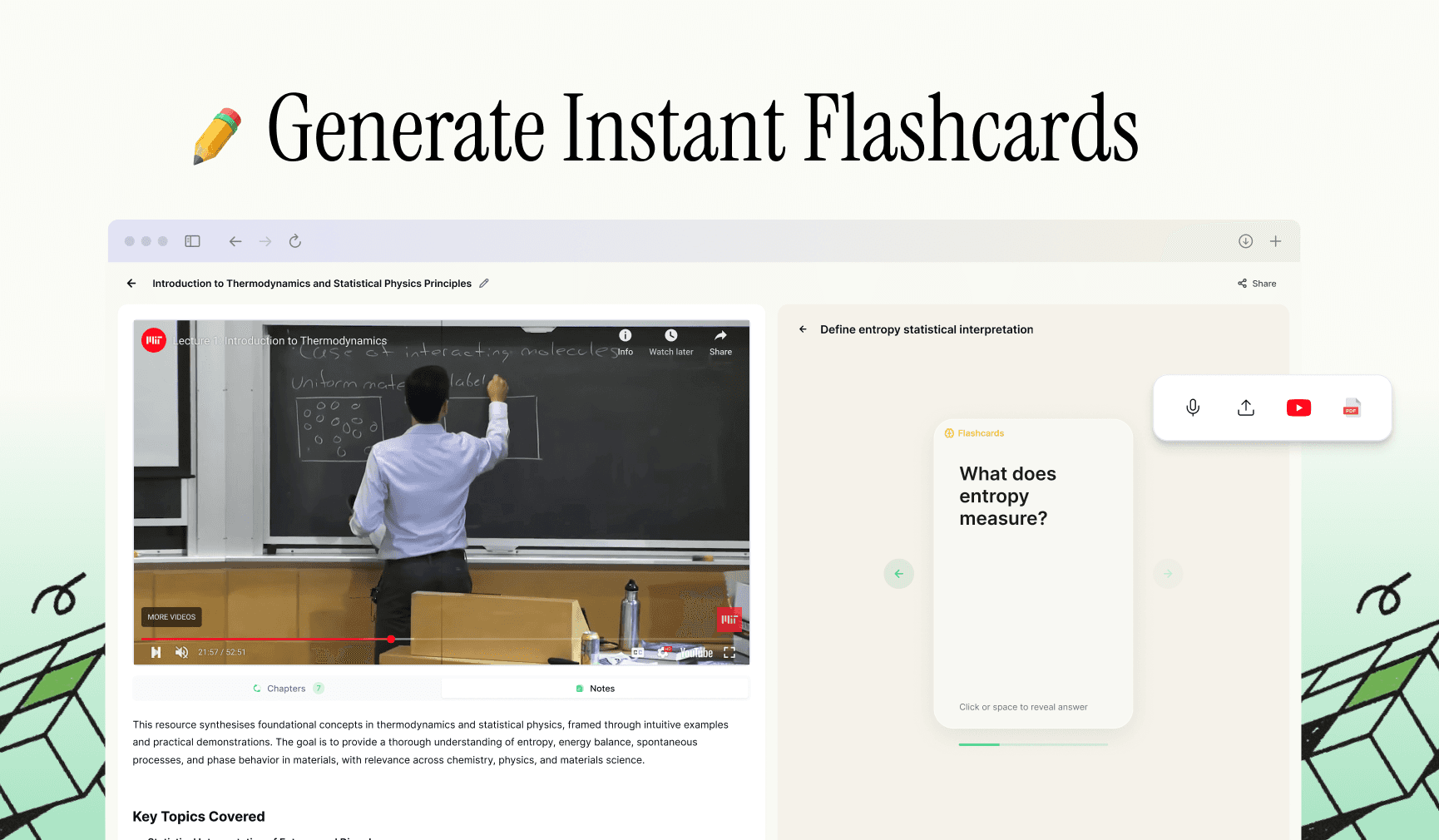
Creating flashcards manually for a subject as technical as optics is slow and prone to errors, especially when copying complex formulas or drawing diagrams. Duetoday eliminates this friction by using AI to analyze your study materials and generate high-quality cards instantly.
Simply upload your PDFs, lecture slides, or even a recording of your optics professor's lecture. Duetoday will extract the core concepts and create a structured deck ready for review.
Upload or paste your Optics material (notes, slides, or transcripts).
Click Generate Flashcards.
Review, edit, and start studying immediately with our built-in spaced repetition system.
FAQ
How many flashcards do I need for Optics? A typical introductory optics course can be covered in 100 to 150 cards, spanning terminology, laws, and basic formula applications.
What’s the best format for Optics flashcards? Question-and-answer format is best. For optics, including a 'Given/Find' scenario for formulas is highly effective.
How often should I review Optics flashcards? You should review your deck daily leading up to an exam, focusing more heavily on cards you consistently get wrong.
Should I make cards from a textbook or lecture notes? Use both. Lecture notes often highlight what the professor thinks is important, while textbooks provide the precise definitions needed for flashcards.
How do I stop forgetting sign conventions after a few days? Create specific comparison cards that contrast real vs. virtual images and how they affect the sign of the focal length.
What if my flashcards feel too easy? Integrate more complex problem-solving prompts where you have to combine two or more optical principles to find an answer.
Can I generate Optics flashcards from a PDF automatically? Yes, Duetoday can scan your optics PDFs and extract key formulas and definitions into a study-ready deck.
Are digital flashcards better than paper for Optics? Digital cards are often better because they allow for easier organization of complex diagrams and use algorithms to schedule your reviews.

Duetoday is an AI-powered learning OS that turns your study materials into personalised, bite-sized study guides, cheat sheets, and active learning flows.