Generate Flashcards for Operations Research
Make Operations Research flashcards from your notes. Generate study guides for optimization and linear programming.
Generate Flashcards with AI Free

Turn your notes into Operations Research flashcards
Turn your notes, PDFs, slides, or lectures into Operations Research flashcards so you can review faster and remember more. Whether you are tackling complex optimization models or stochastic processes, moving from passive reading to active testing is the key to mastery.
Generate Operations Research Flashcards
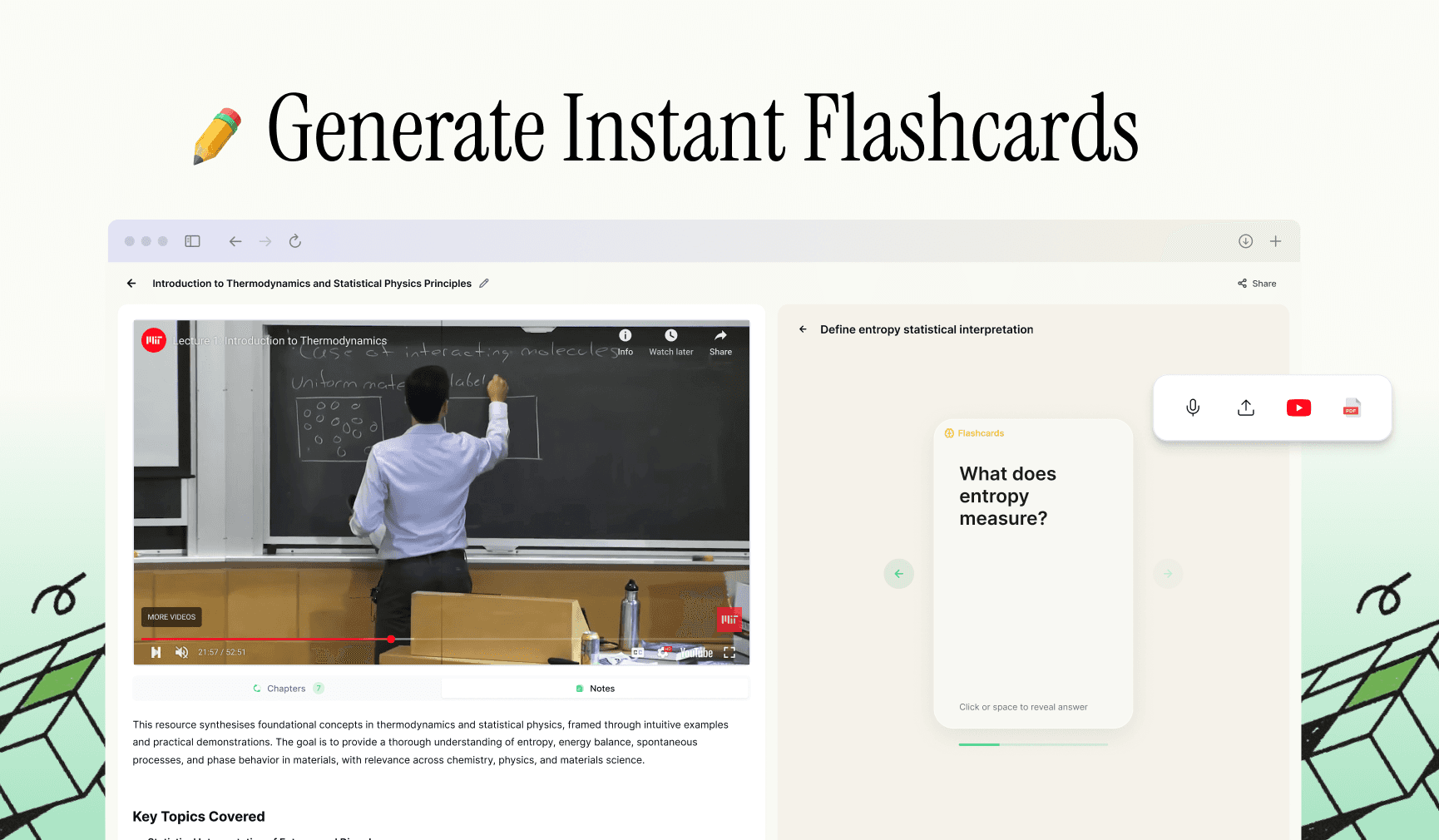
Upload your study materials (PDFs, slides, or lecture notes) and Duetoday will instantly extract key constraints, variables, and formulas into a structured deck for you to review and edit.
What are Operations Research flashcards?
Operations Research (OR) flashcards are concise study tools designed to cover the vast mathematical and analytical methods used in decision-making. These flashcards break down complex topics like linear programming, network flows, inventory control, and game theory into digestible questions and answers.
The outcome is simple: instead of rereading a 50-page chapter on the Simplex method, you test yourself on specific pivot rules and feasibility conditions to build faster mental recall. If you already have notes, Duetoday can generate a clean deck in minutes.
Why flashcards work for Operations Research
Operations Research requires a mix of rote memorization for theorems and procedural memory for algorithms. Flashcards help bridge the gap between understanding a concept and being able to apply it under exam pressure using active recall and spaced repetition.
Remember algorithmic steps (like the Hungarian Method or Big M) without cramming.
Separate similar concepts (e.g., Feasible vs. Optimal solutions).
Learn processes step-by-step (stages of dynamic programming or Markov chains).
Practice identifying model types (Is this a transportation or assignment problem?) quickly.
What to include in your Operations Research flashcards
Effective OR flashcards follow the "one idea per card" rule. Don't try to fit an entire linear program on one card; instead, focus on the individual components that make up the logic.
Definitions & key terms: "What is a shadow price?" "Define the dual of a primal problem."
Processes & steps: "What is the first step in the North-West Corner Rule?"
Comparisons: "How does Integer Programming differ from Linear Programming?"
Application: "When would you use a Monte Carlo simulation?" "What happens if the constraint is violated?"
Use prompts like: "State the purpose of a slack variable," "What are the three components of a queuing system?" or "Define the objective function in a max-flow problem."
How to study Operations Research with flashcards
Using a "two-pass" approach is most effective for technical subjects. First, use your generated deck to familiarize yourself with the definitions. Second, use them to trigger the steps of a calculation or proof.
Make a deck from your notes or textbook chapters.
Do one quick round to find weak spots in your theoretical understanding.
Review weak cards daily to cement formulas like Little's Law.
Mix in a few harder cards each session to simulate exam variety.
Do a final mixed review before your midterms or finals.
Generate Operations Research flashcards automatically
Making cards manually is slow, messy, and takes away from your actual study time. Duetoday automates the tedious part so you can focus on the math.
Upload your OR lecture slides or PDF textbook.
Click Generate Flashcards.
Review, edit the formulas if needed, and start studying immediately.
Common Operations Research flashcard mistakes
Avoid these common pitfalls to ensure your study sessions are productive:
Cards are too long: Don't put an entire algorithm on one card; break it into steps.
Only memorizing definitions: Operations Research is about application; include "Why" and "How" questions.
Ignoring the Dual: Always create cards relating Primal problems to their Duals.
No review schedule: Spaced repetition is vital for complex mathematical notation.
Ready to generate your Operations Research flashcards?
Stop rereading and start recalling. Upload your Operations Research material today and get a deck you can actually use to pass your exams. Duetoday works with notes, PDFs, slides, and transcripts.

FAQ
How many flashcards do I need for Operations Research? It depends on the scope, but typically 50-100 cards per major unit (e.g., Linear Programming) is sufficient to cover key terms and logic.
What’s the best format for OR flashcards? A mix of 'Term/Definition' for vocabulary and 'Step/Action' for algorithms works best.
How often should I review them? Review daily for the first week, then use spaced repetition to increase the gap as you master the concepts.
Should I make cards from a textbook or slides? Use slides for the core concepts your professor emphasizes, and textbooks for the specific mathematical proofs.
How do I stop forgetting formulas? Use 'cloze deletion' flashcards where you leave a part of the formula blank to test your memory.
What if my flashcards feel too easy? Add more application-based scenario questions, such as 'Given X constraint, what is the effect on the feasible region?'
Can I generate flashcards from a PDF automatically? Yes, Duetoday is designed to parse PDFs and instantly convert them into structured flashcard decks.
Are digital flashcards better than paper? Yes, because digital tools allow for instant generation and automated spaced repetition algorithms.
How long does it take to make a full deck? With Duetoday, it takes seconds to generate the draft; you might spend 5-10 minutes refining them.
Can Duetoday handle mathematical symbols? Duetoday's AI is built to recognize and format mathematical logic and notation for technical subjects like OR.

Duetoday is an AI-powered learning OS that turns your study materials into personalised, bite-sized study guides, cheat sheets, and active learning flows.