Generate Flashcards for Numerical Methods
Make study materials for Numerical Methods. Generate flashcards from your engineering or math notes to master algorithms.
Generate Flashcards with AI Free

Generate Flashcards for Numerical Methods
Turn your notes, PDFs, slides, or lectures into Numerical Methods flashcards so you can review faster and remember more. Whether you are tackling iterative methods or error analysis, digital flashcards streamline your study sessions.
Generate Numerical Methods Flashcards
Upload notes / paste text
In Duetoday, the process is simple: upload your material, generate a custom deck, review or edit your cards, and start studying with active recall.
What are Numerical Methods flashcards?
Numerical Methods flashcards cover the key algorithms, convergence criteria, error bounds, and formulas used to solve mathematical problems that don't have analytical solutions. They focus on the 'how' and 'why' of computations like Gaussian elimination or Newton-Raphson.
Instead of passively rereading dense textbooks, these flashcards force you to test yourself on specific steps and conditions for algorithm stability. If you already have notes, Duetoday can generate a clean deck in minutes.
Why flashcards work for Numerical Methods
Numerical Methods requires high-precision memory for formulas and an understanding of logical sequences. Flashcards help you drill the prerequisites for different methods so you don't stall during an exam.
By using active recall and spaced repetition, you move these complex procedures from short-term memory into long-term mastery without the stress of cramming.
Remember complex formulas like Runge-Kutta without confusion.
Separate similar concepts like Bisection vs. Secant methods.
Learn algorithmic processes step-by-step through logical pathways.
Practice identifying which method applies to a specific problem type.
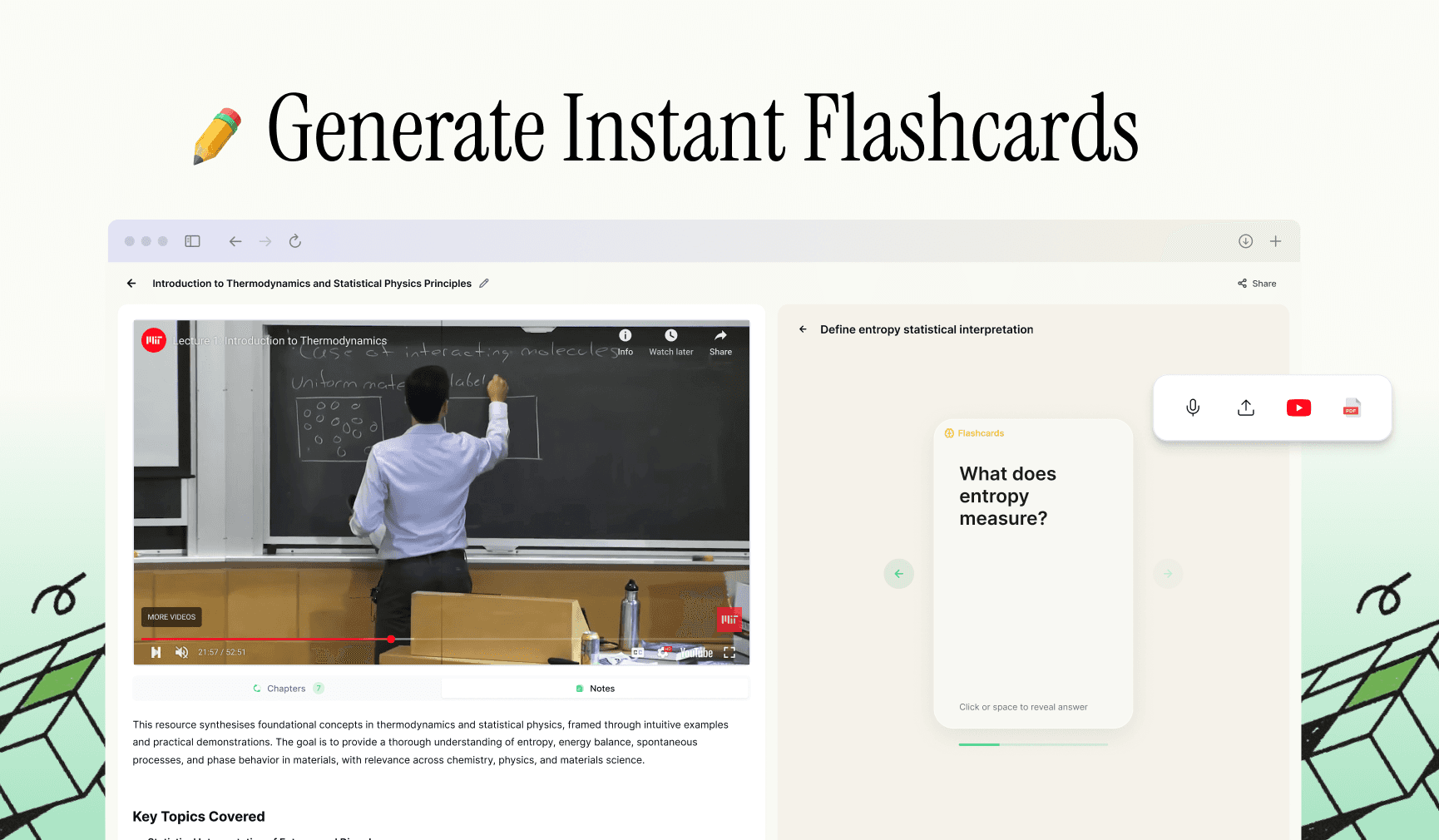
What to include in your Numerical Methods flashcards
Effectiveness in Numerical Methods comes from having one clear idea per card. High-quality cards focus on identifying conditions, such as checking for convergence or selecting the right step size.
We recommend focusing on four main card types to ensure full coverage of the curriculum:
Definitions & Key Terms: "What is the order of convergence?" or "Define ill-conditioned matrix."
Processes & Steps: "What is the first step in the Power Method for eigenvalues?"
Comparisons: "How does the Trapezoidal rule differ from Simpson’s 1/3 rule?"
Application: "When should you use LU Decomposition over Cramer's rule?"
Example prompts include: "State the formula for Newton-Raphson iteration," "What is the condition for the convergence of the Fixed-Point iteration?" and "Explain the truncation error in Taylor series expansions."
How to study Numerical Methods with flashcards
Start with a simple two-pass approach. First, build your deck and do a high-speed round to filter out what you already know. Then, focus strictly on the difficult algorithms and error derivations.
Review in short, focused sessions. It is better to review your Numerical Methods deck for 15 minutes every day than for three hours once a week. This consistency helps you internalize the specific conditions under which numerical schemes remain stable.
Make a deck from your lecture notes or textbook PDFs.
Do one quick round to find weak spots in formula recall.
Review weak cards daily to reinforce convergence criteria.
Mix in harder application cards as you get more comfortable.
Do a final mixed-topic review before your midterm or final.
Generate Numerical Methods flashcards automatically
Making cards manually is slow, especially with complex notation and matrices. Duetoday automates the tedious work so you can jump straight into learning the material.
Upload or paste your Numerical Methods material.
Click Generate Flashcards.
Review, edit, and start studying immediately.
Common Numerical Methods flashcard mistakes
Avoid putting an entire multi-step derivation on one card; it makes the card impossible to review quickly. Instead, break it down: one card for the formula, one for the error bound, and one for the convergence condition. Don't just memorize the name of the method—make sure you have cards that ask 'When does this method fail?' to ensure true understanding.
Ready to generate your Numerical Methods flashcards?
Stop rereading and start recalling. Upload your notes to get a deck you can actually use today.
Start Generating Flashcards
Works with notes, PDFs, slides, and transcripts.
FAQ
How many flashcards do I need for Numerical Methods? Aim for 50-100 cards per major unit to cover formulas and theory.
What’s the best format for Numerical Methods flashcards? Question-and-answer format for formulas and 'identify the error' for stability theory.
How often should I review them? Daily review is best for memorizing iteration patterns and convergence formulas.
Should I make cards from a textbook or slides? Use slides for the key algorithms and textbooks for detailed error analysis proofs.
How do I stop forgetting formulas? Use Duetoday’s spaced repetition to review difficult cards more frequently.
What if my flashcards feel too easy? Add 'constraint' cards, asking how a method changes if the input data is noisy.
Can I generate flashcards from a PDF? Yes, Duetoday can read Numerical Methods PDFs and extract the key concepts.
Are digital cards better than paper? Yes, because digital cards handle the scheduling of reviews automatically.
How long does it take to make a deck? With Duetoday, you can go from PDF to a full deck in under one minute.
Can Duetoday organize my cards by topic? Yes, you can generate separate decks for root-finding, ODEs, and linear systems.

Duetoday is an AI-powered learning OS that turns your study materials into personalised, bite-sized study guides, cheat sheets, and active learning flows.