
Generate Flashcards for Nuclear Physics
Make Nuclear Physics flashcards for free! Use our guide to generate study decks for atomic nuclei, decay, and radiation.
Generate Flashcards with AI Free
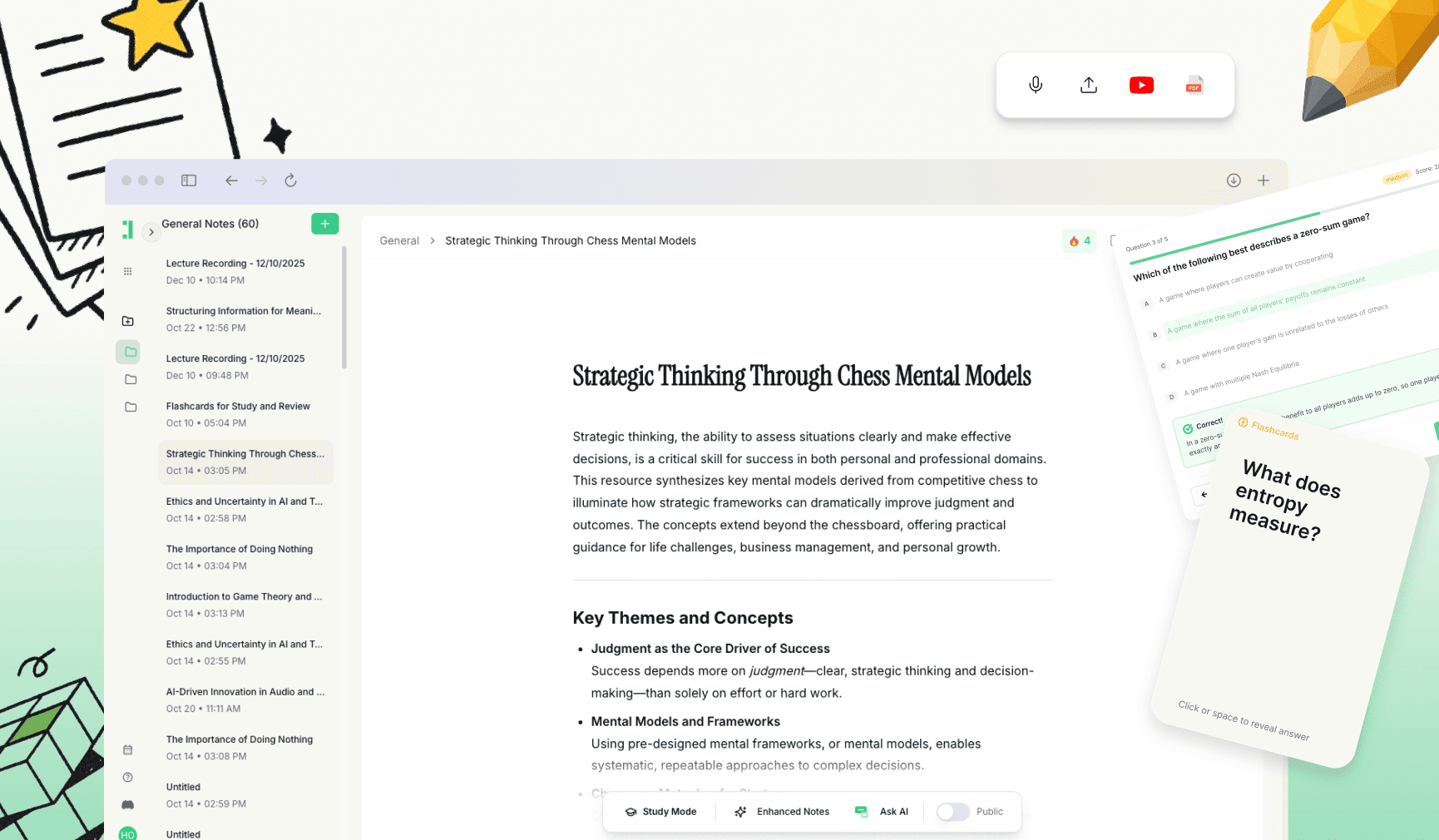
What are Nuclear Physics flashcards?
Nuclear physics flashcards are specialized study tools designed to help you master the complex behavior, structure, and interactions of atomic nuclei. These cards break down dense topics like radioactive decay, nuclear forces, binding energy, and subatomic particles into bite-sized, digestible questions and answers.
By using these flashcards, you shift from passive reading to active testing. Instead of staring at a textbook diagram of alpha decay, you challenge your brain to recall the exact helium nucleus emission and the resulting change in atomic mass. It is the fastest way to build the deep conceptual recall needed for advanced physics exams.
If you already have lecture slides or textbooks, Duetoday can generate a clean deck in minutes so you can skip the manual typing.
Why flashcards are one of the best ways to study Nuclear Physics
Nuclear physics requires a mix of rote memorization for constants and isotopes, and deep logical understanding of energy transitions. Flashcards bridge this gap by forcing your brain to retrieve information without hints, a process known as active recall. Because many concepts in this field are invisible or abstract, constant self-testing is the only way to ensure you actually understand the mechanics.
Spaced repetition helps you tackle the "forgetting curve." By reviewing difficult topics like the Liquid Drop Model or Q-value calculations more frequently than easier topics, you optimize your study time and move information into your long-term memory.
Memorize decay constants and half-life formulas without cramming.
Separate similar concepts like Nuclear Fission vs. Nuclear Fusion.
Learn multi-step processes like the Proton-Proton chain or CNO cycle.
Practice identifying isotopes and balancing nuclear equations quickly.
What to include in your Nuclear Physics flashcards
The secret to effective physics cards is keeping them simple: one concept per card. If a card is too wordy, you’ll end up memorizing the sentence structure rather than the physics. Focus on a mix of theoretical definitions, mathematical relationships, and application-based scenarios.
We recommend organizing your deck into four primary categories to ensure full coverage of the curriculum:
Definitions & Key Terms: "What is the Strong Nuclear Force?" or "Define Mass Defect."
Processes & Steps: "What happens to the N/Z ratio during Beta-plus decay?"
Comparisons: "How does the range of Alpha radiation compare to Gamma radiation?"
Application: "Given the mass of parts vs. the whole, how do you calculate binding energy?"
Example prompts: "What is the unit for activity?", "State the Pauli Exclusion Principle," and "What defines a Magic Number in the Shell Model?"
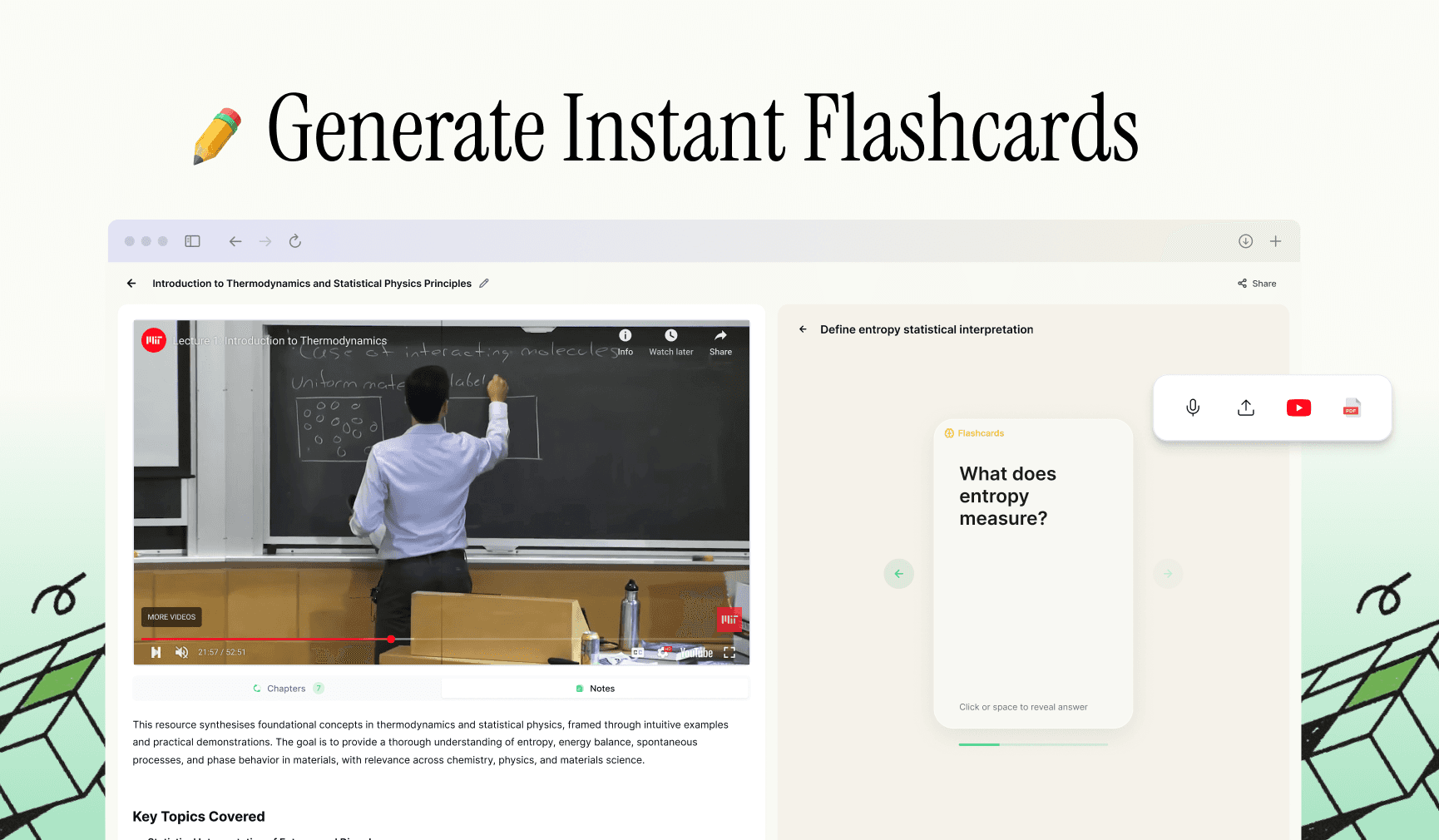
How to study Nuclear Physics with flashcards (a simple system)
To master nuclear physics, you need a two-pass approach. First, use Duetoday to build your deck from your syllabus or notes. This ensures you aren't missing any key variables or constants. Then, perform your first run-through to categorize which concepts fly over your head and which ones you've already mastered.
Focus your energy on the mechanics. Don't just memorize that a Gamma ray is emitted; understand *why* the nucleus was in an excited state. Review your "weak" pile daily, and slowly reintegrate "strong" cards every few days to keep them fresh.
Upload your nuclear physics PDF or lecture slides to Duetoday.
Generate a flashcard deck instantly and filter for specific sub-topics like 'Isotopes'.
Review every card once to flag the ones involving complex math or decay chains.
Study those flagged cards every morning for 10 minutes.
Perform a full deck review 48 hours before your exam.
Generate Nuclear Physics flashcards automatically in Duetoday
Making physics cards manually is a chore. Drawing decay diagrams and typing out Greek symbols like λ (lambda) or μ (mu) takes hours that you should be spending solving problems. Manual cards are often too long and inconsistently formatted, making them harder to study.
Duetoday solves this by using AI to scan your materials. Just upload your PDF or paste your lecture transcript, and our tool extracts the core formulas and definitions for you. You get a professional study deck in seconds.
Upload your textbook chapters or lecture notes.
Click Generate Flashcards.
Instantly review, edit, and start your active recall session.
Generate Nuclear Physics Flashcards in Duetoday. Start with your notes and get a deck you can actually use today.
Common Nuclear Physics flashcard mistakes
The most common mistake is creating cards that are too "heavy." A card that asks you to describe the entire Shell Model is useless. Instead, break it down: one card for the definition, one for the potential well, and one for the energy levels.
Overloading Math: Don't try to derive an entire equation on one card; test the individual variables instead.
Neglecting Units: Always include the units (e.g., Becquerels vs. Curies) on the back of the card.
Ignoring Graphs: If a graph is important (like the Binding Energy per Nucleon curve), generate a card explaining its peaks.
Relying on Recognition: If you think "I know this" without saying the answer out loud, you haven't mastered it.
Ready to generate your Nuclear Physics flashcards?
Stop rereading your physics chapters and start testing your knowledge. Upload your materials and let Duetoday handle the formatting so you can focus on the science.
Start Generating Flashcards. Works with notes, PDFs, slides, and transcripts.
FAQ
How many flashcards do I need for Nuclear Physics?
A typical university module usually requires 150-300 cards to cover everything from basic atomic structure to advanced reactor physics.
What’s the best format for Nuclear Physics flashcards?
The most effective format is the "Question and Answer" style focusing on single variables or specific outcomes of a nuclear reaction.
How often should I review Nuclear Physics flashcards?
Daily review is best for constants and formulas, while conceptual cards can be reviewed every 2-3 days once you understand the underlying logic.
Should I make cards from a textbook or slides?
Use lecture slides for the core exam requirements and textbooks for clarifying complex derivations or finding extra practice problems.
How do I stop forgetting half-life formulas?
Create cards that ask for the formula, the definition of each variable, and simple calculation scenarios to build muscle memory.
Can I generate Nuclear Physics flashcards from a PDF?
Yes, Duetoday can scan your textbook or lecture PDFs and automatically extract the most important definitions and formulas into a deck.
Are digital flashcards better than paper?
For physics, digital cards are often better because they allow for easier editing of complex symbols and include automated spaced repetition algorithms.
How long does it take to make a full deck?
Manually, it can take hours. With Duetoday, you can generate a comprehensive deck from your notes in under 60 seconds.

Duetoday is an AI-powered learning OS that turns your study materials into personalised, bite-sized study guides, cheat sheets, and active learning flows.