Generate Flashcards for Neurobiology
Make custom Neurobiology flashcards from your notes. This guide shows how to generate study sets for brain anatomy and neural pathways.
Generate Flashcards with AI Free
What are Neurobiology flashcards?
Neurobiology flashcards are targeted study tools designed to break down the complex systems of the nervous system into bite-sized, digestible pieces of information. These cards cover everything from the molecular mechanisms of action potentials to the structural organization of the central nervous system. Instead of passively reading a massive textbook, you use these cards to challenge your brain to retrieve specific facts about neurons, neurotransmitters, and sensory pathways.
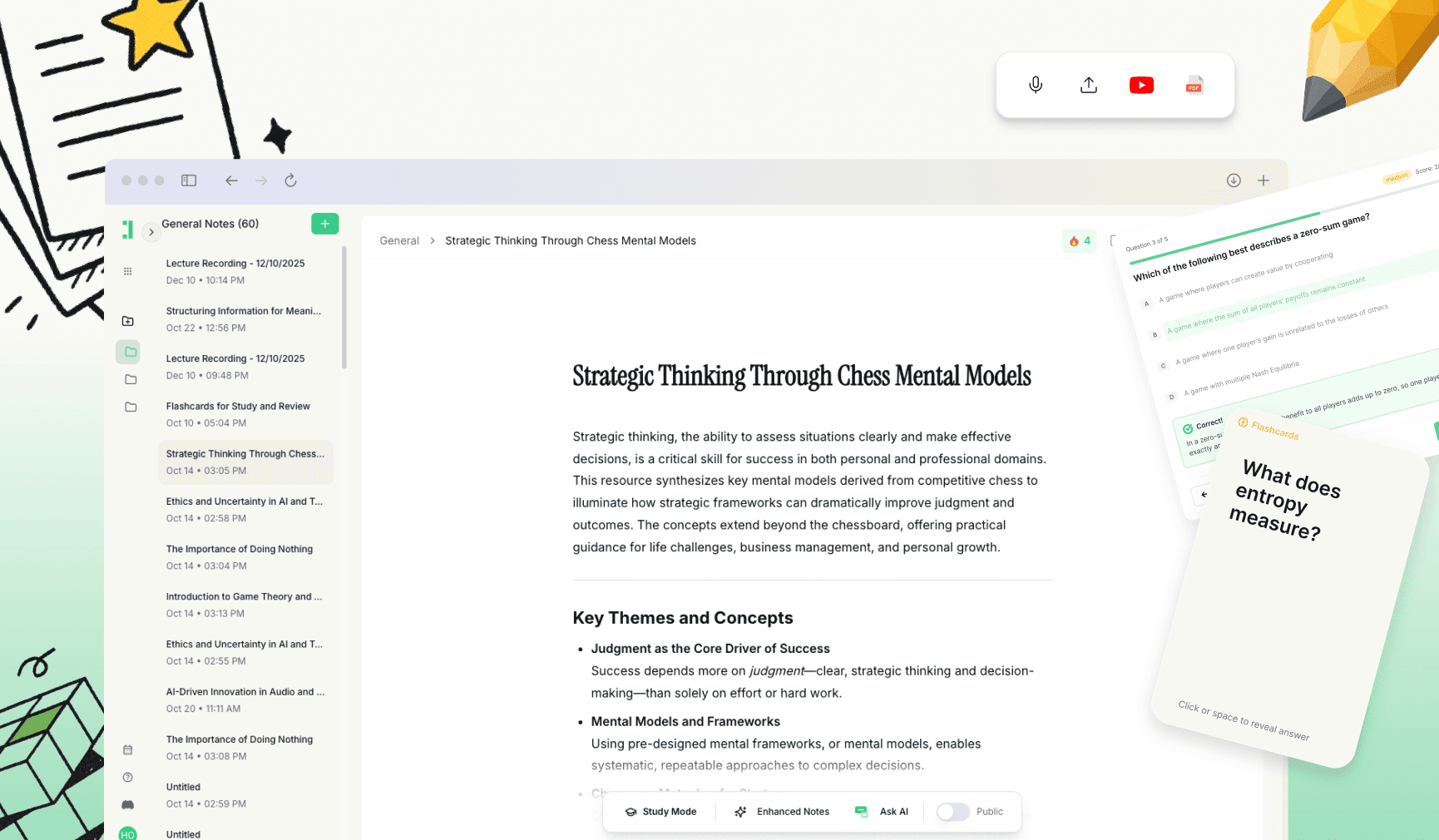
The outcome is a more resilient memory; by testing yourself on specific triggers and responses, you build the neural connections required for high-level recall. If you already have lecture notes or lab slides, Duetoday can generate a clean, organized deck in minutes, saving you hours of manual entry.
Why flashcards are one of the best ways to study Neurobiology
Neurobiology requires a mix of rote memorization (like naming cranial nerves) and deep conceptual understanding (like how ion gradients change during a signal). Flashcards are perfect because they bridge the gap between these two learning styles through active recall and spaced repetition.
Remember complex terms: Master jargon like 'salutatory conduction' or 'hyperpolarization' without cramming.
Separate similar concepts: Easily distinguish between the sympathetic and parasympathetic nervous systems.
Learn pathways step-by-step: Break down the stages of the reflex arc or the visual processing pathway.
Practice application: Quickly identify which neurotransmitter is involved in specific clinical scenarios.
What to include in your Neurobiology flashcards
The secret to effective Neurobiology study is the 'atomic' principle: one specific idea per card. This prevents your brain from getting overwhelmed by the sheer density of the subject matter. Focus your cards on cause-and-effect relationships and structural identification.
Definitions & key terms: What is the function of the Myelin sheath?
Processes & steps: What is the first step in an action potential after the threshold is reached?
Comparisons: How do GABA and Glutamate differ in their effect on postsynaptic potentials?
Application: Which brain region is likely affected if a patient loses fine motor control?
Try these example prompts: 'Define the refractory period,' 'List the three components of a synapse,' or 'State the role of the amygdala in emotional processing.'
How to study Neurobiology with flashcards (a simple system)
Neurobiology is too dense to learn in one sitting. Use a two-pass approach. First, generate your deck from your notes or syllabus. Then, go through the deck once to identify 'cold spots'—the concepts that feel like a foreign language. Focus your energy there.
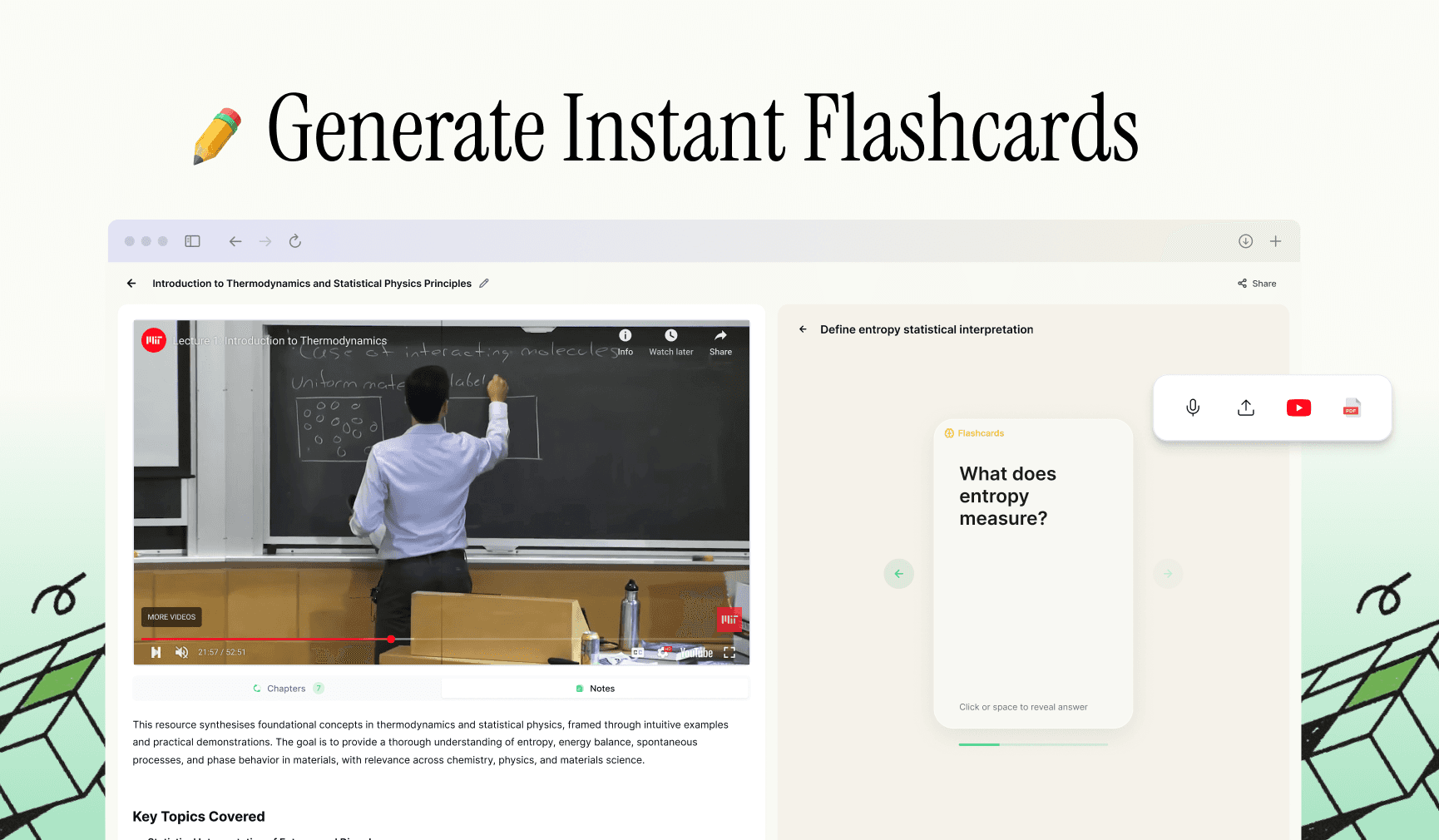
Make a deck from your neurobiology notes or PDF transcripts using Duetoday.
Do a rapid first pass to sort cards into 'mastered' and 'struggling' piles.
Review the 'struggling' cards daily to take advantage of spaced repetition.
Mix in anatomical diagrams to ensure you can visualize the structures you are naming.
Conduct a mixed review session before your exam to ensure long-term retention.
Generate Neurobiology flashcards automatically in Duetoday
Drawing diagrams and writing out neurobiology cards by hand is exhausting and often leads to messy, inconsistent study sessions. Duetoday eliminates the grunt work by using AI to analyze your materials and extract the most important testable points.
Upload your Neurobiology lecture slides or textbook PDFs.
Click Generate Flashcards.
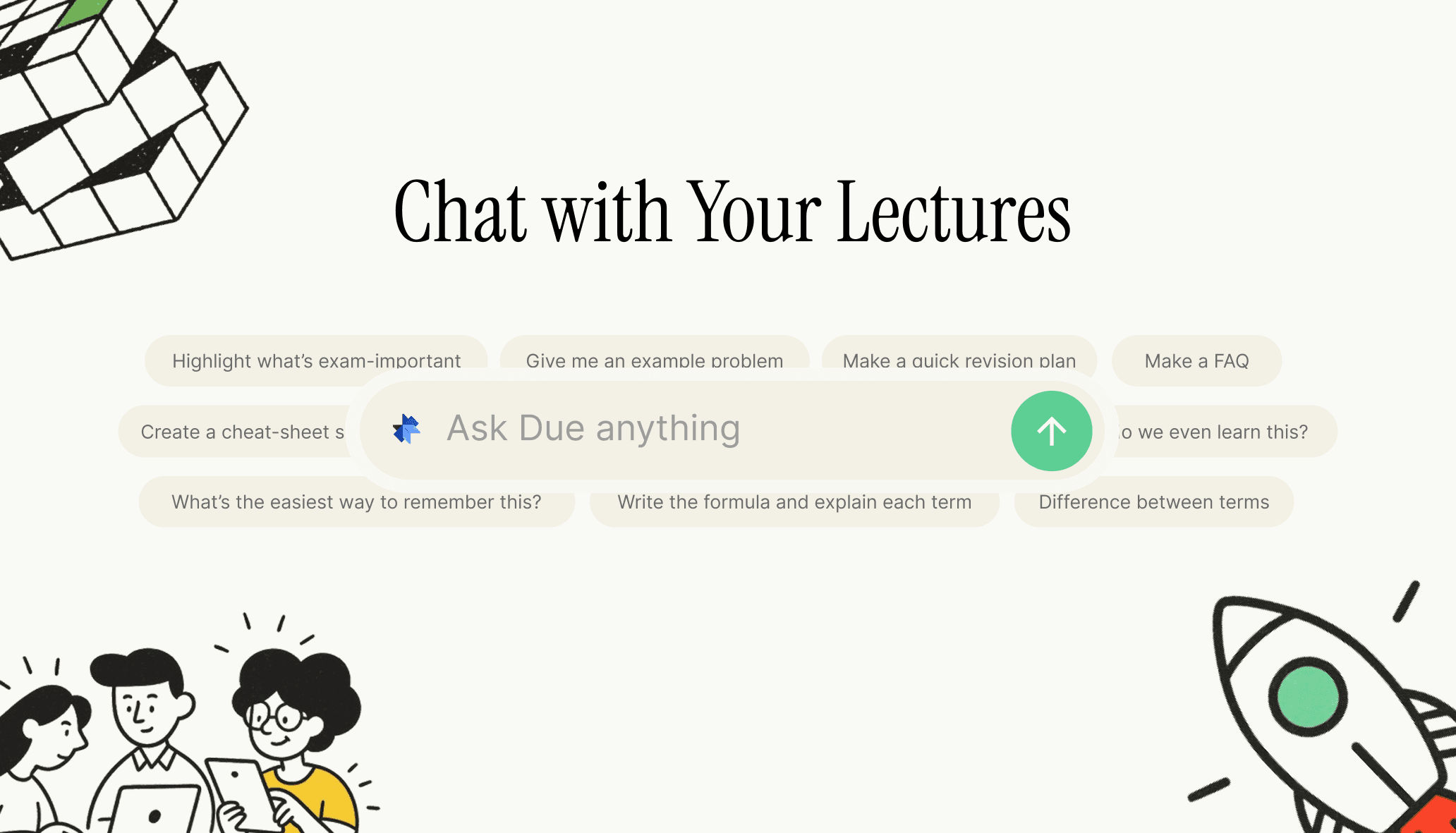
Perfect your deck and start studying instantly with an AI tutor.
Common Neurobiology flashcard mistakes (and how to fix them)
Don't fall into the trap of making cards that are essentially paragraphs. If a card is too long, you'll memorize the 'shape' of the text rather than the actual facts.
Cards are too long: If you're describing the entire cardiac cycle, split it into 5 separate cards.
Ignoring the 'Why': Don't just memorize the name of a pump; add a card asking what happens if that pump fails.
Neglecting anatomy: Always pair the name of a brain structure with its specific physical location or function.
No schedule: Spaced repetition only works if you actually return to the cards every 24-48 hours.
FAQ
How many flashcards do I need for Neurobiology? It depends on the scope, but typically 50-100 cards per chapter is common to cover anatomy, physiology, and chemistry.
What’s the best format for Neurobiology flashcards? Question-and-answer format works best, especially those that ask about the 'input-output' relationship of neurons.
How often should I review my cards? Daily is best for new material. Once you feel confident, you can move to reviewing them every 3-4 days.
Should I make cards from my textbook or lecture slides? Lecture slides are better for focusing on what your professor thinks is important, while textbooks provide the detail needed for 'why' questions.
How do I stop forgetting brain structures? Use image-based flashcards and repeat the cards that you get wrong more frequently using a Spaced Repetition System (SRS).
What if my flashcards feel too easy? Combine concepts. Instead of asking 'What is Dopamine?', ask 'How does Dopamine interact with the basal ganglia?'.
Can I generate Neurobiology flashcards from a PDF? Yes, Duetoday is designed to scan PDFs and extract key terminology and processes into flashcards instantly.
Are digital flashcards better than paper for Neurobiology? Yes, because digital cards allow for faster editing, easier organization of hundreds of terms, and built-in repetition algorithms.
How long does it take to make a full deck? Manually, it can take hours. With Duetoday’s AI, it takes less than a minute after uploading your source material.
Can Duetoday organize my Neurobiology cards? Absolutely. Duetoday categorizes your content so you can focus on specific topics like 'cellular neuro' or 'sensory systems' individually.

Duetoday is an AI-powered learning OS that turns your study materials into personalised, bite-sized study guides, cheat sheets, and active learning flows.