Generate Flashcards for Nervous System
Generate Nervous System flashcards from your notes in seconds. Try Duetoday for free and study smarter.
Generate Flashcards with AI Free
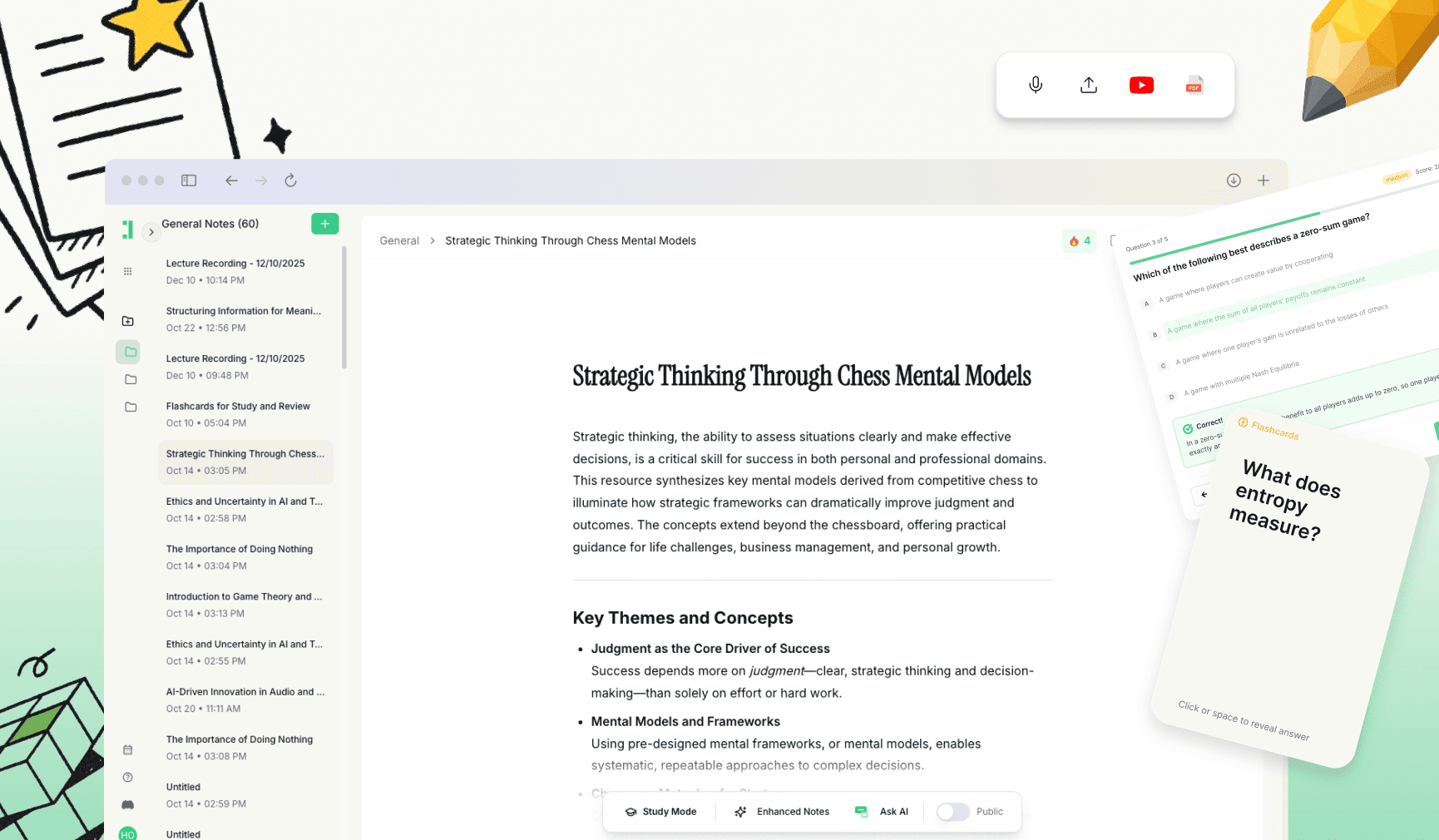
Generate Flashcards for Nervous System
Turn your notes, PDFs, slides, or lectures into Nervous System flashcards so you can review faster and remember more. Whether you are studying for a biology exam or medical boards, mastering the complexities of the brain and spinal cord requires more than just reading.
Generate Nervous System Flashcards Upload notes / paste text
In Duetoday, you simply upload your study materials, and our AI instantly identifies key structures and functions to create a custom deck. You can then review, edit, and use spaced repetition to lock the information into your long-term memory.
What are Nervous System flashcards?
Nervous system flashcards cover the vast network of cells and fibers that transmit nerve impulses throughout the body. This include everything from the anatomy of a neuron and the mechanics of an action potential to the high-level divisions of the Central Nervous System (CNS) and Peripheral Nervous System (PNS).
The goal of these flashcards is to shift you from passive reading to active testing. Instead of looking at a diagram of the brain, a flashcard forces you to identify the specific lobe responsible for executive function or the neurotransmitter involved in muscle contraction. If you already have notes, Duetoday can generate a clean deck in minutes.
Why flashcards work for the Nervous System
The nervous system is heavy on terminology, complex pathways, and physiological sequences. Flashcards are uniquely suited for this topic because they break down massive systems into bite-sized, digestible facts. By using active recall, you force your brain to retrieve the information, which strengthens neural pathways—ironically, the very thing you are studying.
Remember cranial nerves and their functions without cramming.
Separate similar concepts like the Sympathetic vs. Parasympathetic systems.
Learn the stages of an action potential step-by-step.
Practice identifying brain regions and their primary roles.
What to include in your Nervous System flashcards
Effective nervous system cards focus on "one idea per card." Keep them question-based to ensure you are actually testing your knowledge rather than just recognizing text. We recommend focusing on four specific categories to cover all bases.
Definitions & key terms: "What is the myelin sheath?" "Define saltatory conduction."
Processes & steps: "What happens immediately after a neuron reaches threshold potential?"
Comparisons: "How does the white matter differ from gray matter?"
Application: "If the cerebellum is damaged, what physical symptoms might occur?"
Example prompts include: "What is the primary neurotransmitter of the neuromuscular junction?", "Which part of the brain controls involuntary breathing?", and "List the three layers of the meninges from superficial to deep."

How to study the Nervous System with flashcards
Start with a "two-pass" approach. First, generate your deck from your lectures or textbook and do a quick initial run to see which concepts stick. This identifies your "hot spots"—the areas like the brachial plexus or neurotransmitter pathways that need extra attention.
Review in short, focused sessions. Spend 15 minutes a day repeating the cards you got wrong. Over time, mix in the easier cards to ensure you don't forget the basics while you tackle the hard stuff. Consistency is more important than duration when it comes to neurobiology.
Make a deck from your notes or generate it from your PDF.
Do one quick round to find weak spots.
Review weak cards daily for a few days.
Mix in a few harder cards each session.
Do a final mixed review before quizzes/exams.
Generate Nervous System flashcards automatically in Duetoday
Making cards manually for anatomy and physiology is incredibly slow. You end up spending three hours writing cards and only thirty minutes studying them. Duetoday reverses that ratio, letting you focus on learning while the AI handles the organization.
Simply upload your PDF slides or paste your lecture transcript into Duetoday. Our AI understands the context of the nervous system and creates accurate, high-quality question-and-answer pairs instantly.
Upload or paste your Nervous System material.
Click Generate Flashcards.
Review, edit, and start studying immediately.
Generate Nervous System Flashcards in Duetoday
Start with your notes and get a deck you can actually use today.
Common Nervous System flashcard mistakes
Many students make cards that are too "wordy." If a card has a whole paragraph on the back, you'll end up memorizing the flow of the sentences rather than the actual facts. Keep it simple.
Cards are too long: Split complex pathways into multiple cards.
Only memorizing definitions: Add "why" cards to understand the physiology.
Confusing the divisions: Use specific comparison cards for CNS vs PNS.
No review schedule: Ensure you use spaced repetition or you will forget the details.
Ready to generate your Nervous System flashcards?
Stop rereading your textbook and start testing yourself. Upload your notes, generate your deck, and master the nervous system with active recall.
Start Generating Flashcards
Works with notes, PDFs, slides, and transcripts.

FAQ
How many flashcards do I need for the Nervous System? For a standard introductory course, 100-150 cards usually cover the major structures and functions. For advanced neuroanatomy, you may need 300+.
What’s the best format for Nervous System flashcards? Question-and-answer format works best. For anatomy, try naming a structure and asking for its primary function on the back.
How often should I review Nervous System flashcards? Daily reviews are best for the first week. Once you feel confident, you can move to every 3-5 days using a spaced repetition system.
Should I make cards from a textbook or lecture notes? Lecture notes are usually better for identifying what your professor thinks is important, while textbooks are great for filling in gaps regarding complex processes.
How do I stop forgetting the divisions of the brain? Use comparison cards and diagrams. Grouping structures by their embryological origin (forebrain, midbrain, hindbrain) also helps with retention.
What if my flashcards feel too hard? Break the question down. If a card asks for the entire path of a reflex arc, split it into 5 separate cards—one for each component.
Can I generate Nervous System flashcards from a PDF? Yes, Duetoday can scan your lecture PDFs and automatically extract key terms and concepts into flashcard format.
Are digital flashcards better than paper? For the nervous system, digital is often better because you can easily include high-resolution diagrams and use automated spaced repetition algorithms.
How long does it take to make a full deck? Manually it could take hours, but with Duetoday's AI, you can generate a full deck in under sixty seconds after uploading your notes.
Can Duetoday organize my flashcards for me? Yes, Duetoday categorizes your generated cards so you can study by specific sub-topics like "The Eye" or "Action Potentials."

Duetoday is an AI-powered learning OS that turns your study materials into personalised, bite-sized study guides, cheat sheets, and active learning flows.