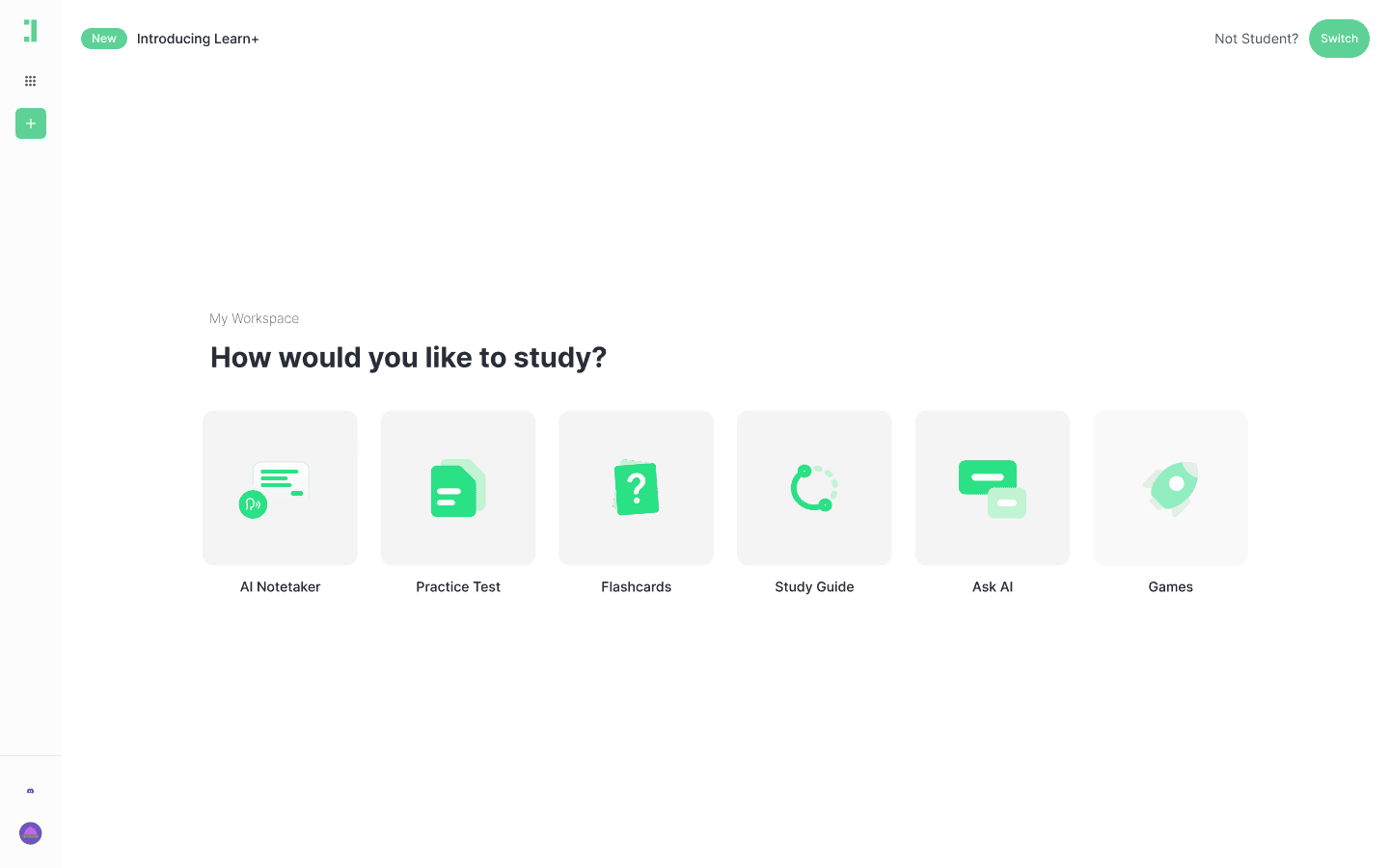
Generate Flashcards for Natural Language Processing
Make flashcards for Natural Language Processing. This guide helps you generate NLP study sets for faster learning.
Generate Flashcards with AI Free
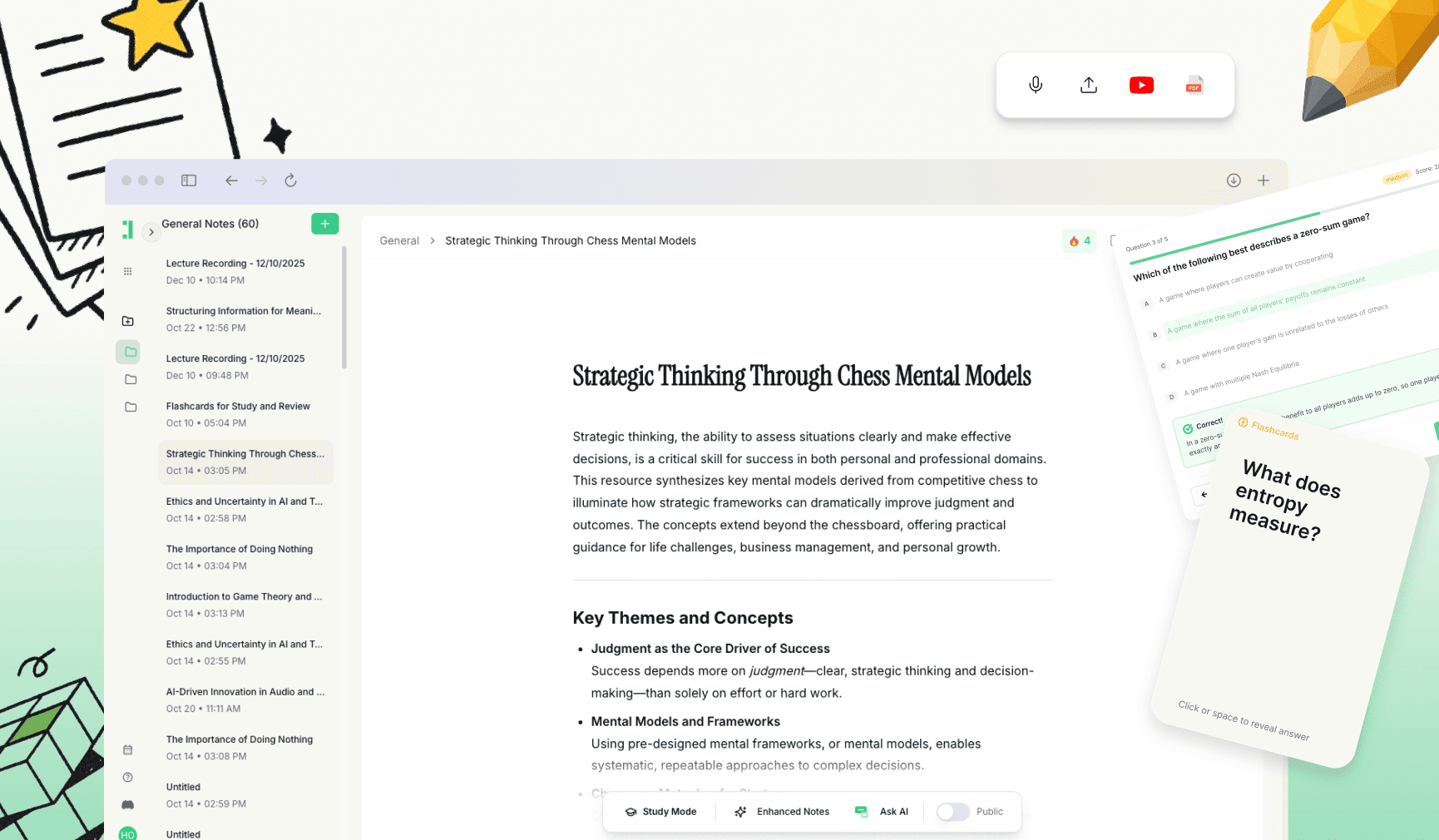
What are Natural Language Processing (NLP) flashcards?
Natural Language Processing flashcards are targeted study tools designed to help you master the intersection of linguistics, computer science, and artificial intelligence. These flashcards cover critical concepts such as tokenization, lemmatization, sentiment analysis, and the architecture of large language models like Transformers. Instead of passively reading through dense textbooks or code documentation, these flashcards force you to engage with the material actively.
By using flashcards for NLP, you transform complex mathematical formulas and algorithmic steps into digestible questions and answers. The goal is to build a mental map of how machines process human language, ensuring you can recall specific techniques and their use cases during exams or technical interviews. If you already have lecture notes or research papers, Duetoday can generate a clean deck in minutes.
Why flashcards are one of the best ways to study NLP
NLP requires a mix of theoretical understanding and technical application. Flashcards are perfect for this because they allow you to bridge the gap between high-level concepts and specific implementation details. By testing yourself on terminology and model logic, you ensure that you don't just recognize the terms when you see them, but can actually define and apply them from scratch.
Using techniques like active recall and spaced repetition helps solidify your understanding of rapidly evolving technologies. Instead of getting overwhelmed by the volume of information in a machine learning course, flashcards help you focus on the core pillars of the subject.
Remember complex transformer architectures without cramming
Separate similar concepts like Stemming vs. Lemmatization
Learn the stages of an NLP pipeline (pre-processing to output)
Practice applying evaluation metrics like BLEU or ROUGE scores quickly
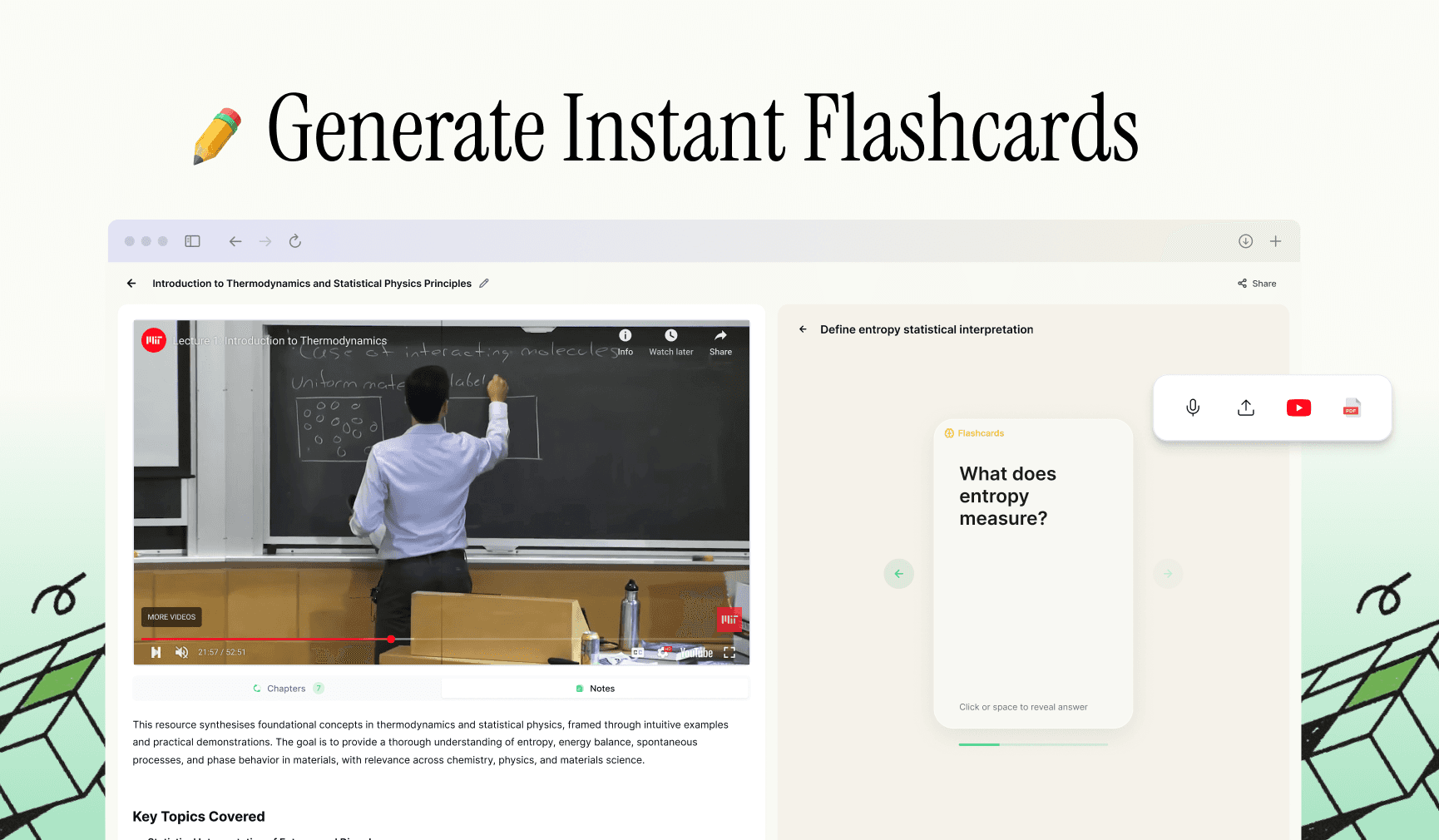
What to include in your NLP flashcards
Effective NLP flashcards follow the principle of atomicity: one simple idea per card. This prevents your brain from feeling overwhelmed and ensures you truly master each individual component of a model or algorithm. You should focus on a mix of terminology, conceptual theory, and tactical application questions.
Definitions & Key Terms: What is Word2Vec? or Define Attention Mechanism.
Processes & Steps: What are the steps in a standard NLP pipeline?
Comparisons: How is an Encoder-only model different from a Decoder-only model?
Application: When would you use TF-IDF over Word Embeddings?
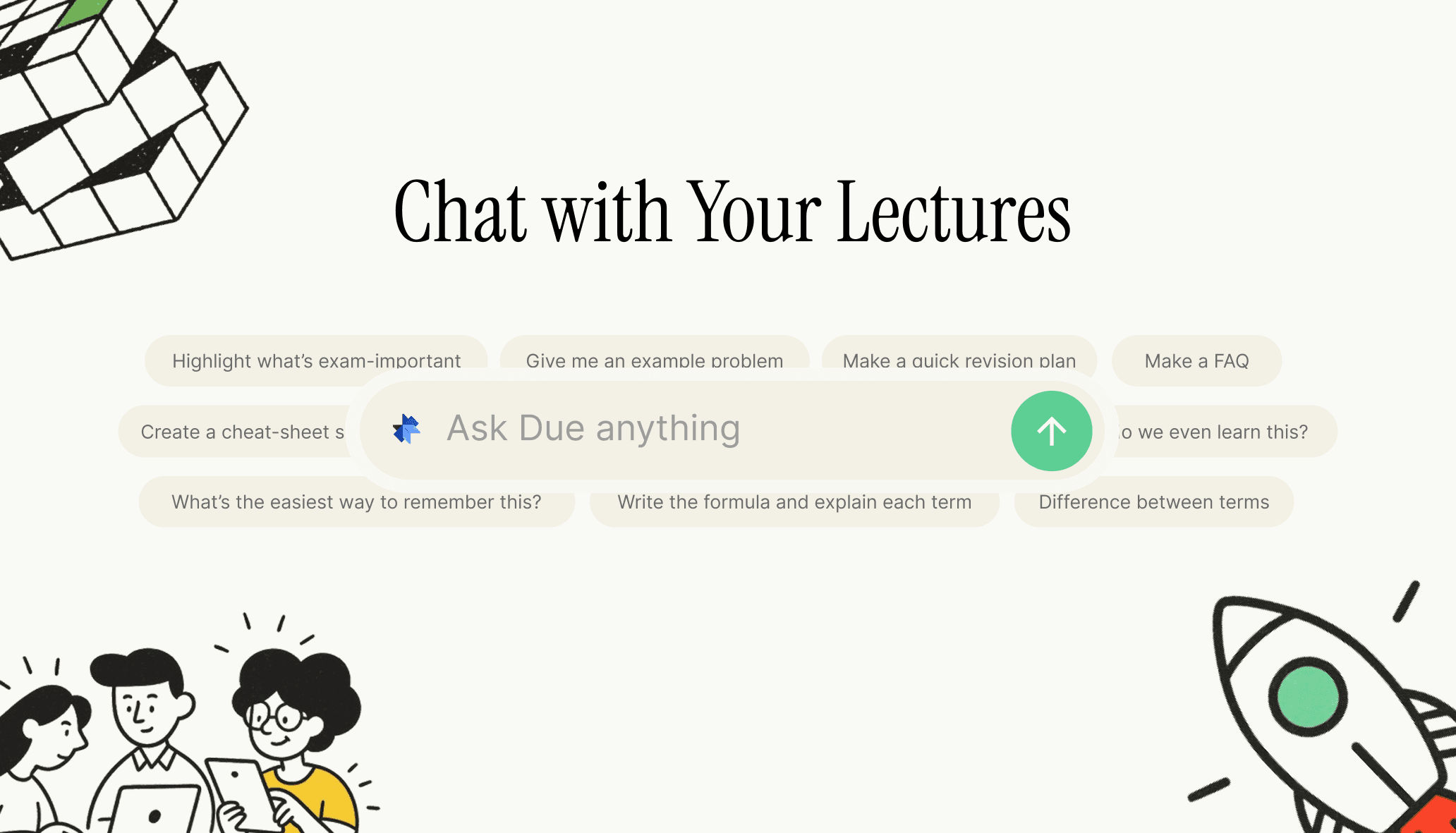
Try using prompts like: Graph the architecture of a BERT model, What is the objective function of GPT? or Explain the vanishing gradient problem in RNNs. These specific prompts turn your study session into a mock technical interview.
How to study NLP with flashcards (a simple system)
To master NLP, you need a consistent workflow. Start by generating a comprehensive deck from your course materials or coding documentation. The first pass should be about identification—figuring out which architectures or formulas you struggle to remember. Use a two-pass approach where you scan the whole deck and then drill down into the difficult cards.
Make a deck from your notes or generate it automatically from your PDF content.
Do one quick round to identify weak spots in your knowledge (e.g., hidden Markov models).
Review these weak cards daily using spaced repetition.
Mix in harder application cards, such as coding syntax or architectural diagrams.
Do a final mixed-topic review before your project deadline or exam.
Generate NLP flashcards automatically in Duetoday
Manually creating flashcards for a subject as technical as NLP is time-consuming. You often spend more time formatting LaTeX formulas or copying diagrams than actually studying. Duetoday eliminates this friction by automating the creation process so you can focus on learning.
Simply upload your lecture slides, research papers, or Python scripts, and our AI will extract the most important concepts to build a structured deck. You can then review, edit, and start your study session immediately.
Upload or paste your NLP material
Click Generate Flashcards
Review, edit, and start studying
Generate Natural Language Processing Flashcards in Duetoday. Start with your notes and get a deck you can actually use today.
Common NLP flashcard mistakes (and how to fix them)
Many students make the mistake of creating flashcards that are far too dense. If a card contains a whole paragraph about the history of NLP, you aren't testing your recall; you're testing your reading speed. Keep cards brief and focused on specific mechanisms.
Cards are too long: split 'Transformer Architecture' into multiple cards (Self-attention, Feed-forward, etc.).
Only memorizing words: ensure you have cards that ask 'Why' a certain model is preferred.
Confusing similar concepts: create specific 'Versus' cards for things like BERT vs. RoBERTa.
No review schedule: use Duetoday to ensure you see your hardest cards more frequently.
FAQ
How many flashcards do I need for NLP? For a standard university course, 150-200 cards usually cover the core terminology and architectures.
What’s the best format for NLP flashcards? A mix of 'Question/Answer' for definitions and 'Image/Label' for model architectures is most effective.
How often should I review NLP flashcards? Ideally, review your cards every daily for the first week, then transition to every 3-4 days as you become more confident.
Should I make cards from a textbook or lecture notes? Lecture notes are better for specific exam preparation, while textbooks are better for foundational theory. Duetoday can process both simultaneously.
How do I stop forgetting NLP concepts after a few days? Spaced repetition is key. Re-testing yourself on 'weak' cards ensures they move from short-term to long-term memory.
What if my flashcards feel too easy or too hard? If they are too easy, increase the complexity by asking for use-case scenarios. If too hard, break the concept into two separate cards.
Can I generate NLP flashcards from a PDF automatically? Yes, you can upload any NLP research paper or slide deck PDF to Duetoday to generate a deck instantly.
Are digital flashcards better than paper for NLP? For NLP, digital is superior because you can easily include code snippets and complex diagrams that are hard to draw by hand.
How long does it take to make a full NLP deck? Manually it could take hours, but with Duetoday, it takes less than 60 seconds after your notes are uploaded.
Can Duetoday organize my flashcards for me? Yes, Duetoday automatically categorizes cards by sub-topic so you can focus on specific areas like 'Neural Networks' or 'Linguistics'.

Duetoday is an AI-powered learning OS that turns your study materials into personalised, bite-sized study guides, cheat sheets, and active learning flows.