Generate Flashcards for Music Theory
Make custom Music Theory flashcards to study chords and scales. Generate study guides for your music theory subjects.
Generate Flashcards with AI Free
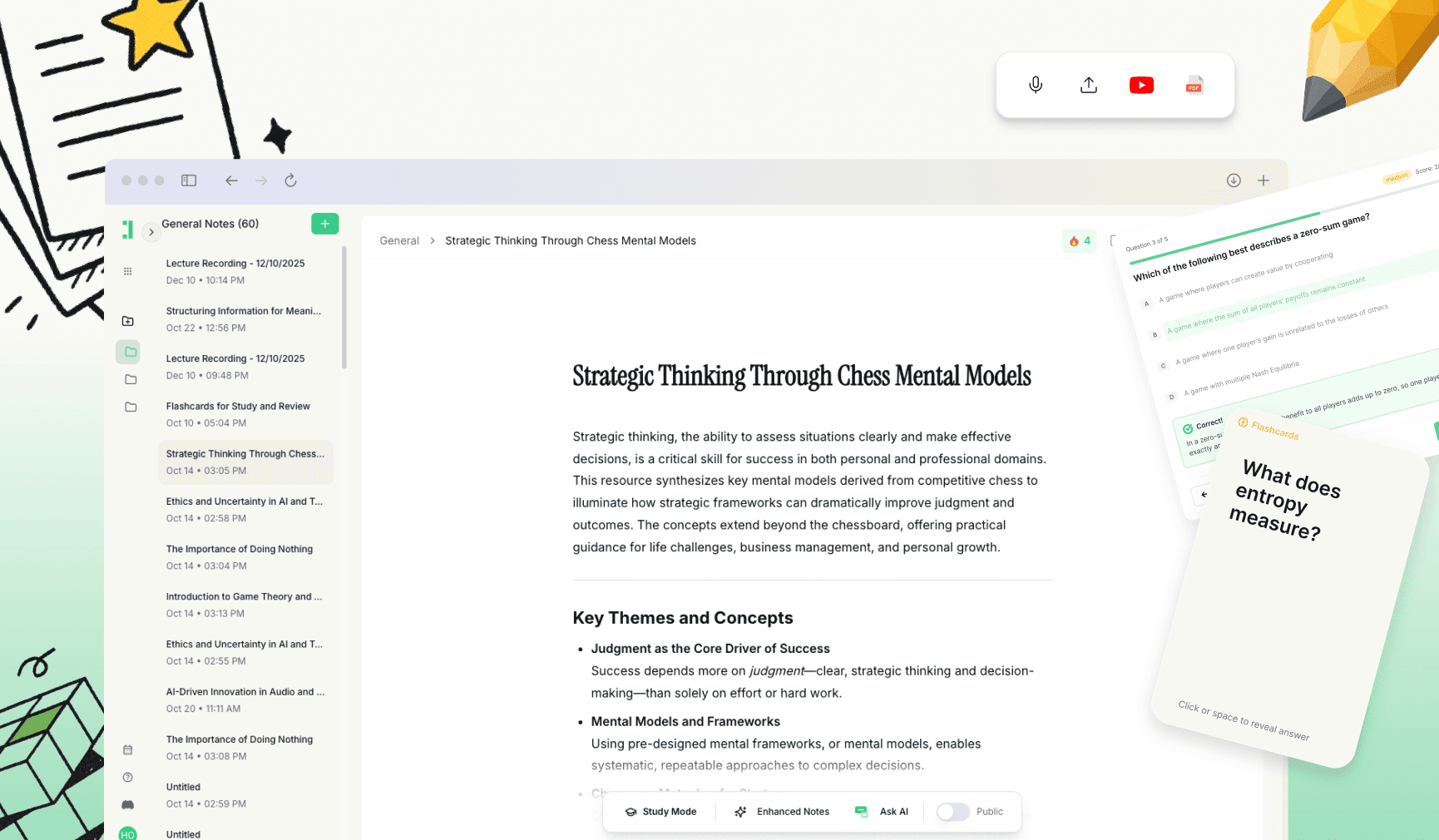
What are Music Theory flashcards?
Music Theory flashcards are specialized study tools designed to help you memorize the building blocks of music—ranging from key signatures and interval identification to complex harmonic analysis and rhythmic patterns. Instead of staring at a staff and hoping the notes stick, these flashcards force you to identify symbols, name chords, and recall definitions instantly.
The goal is to move beyond passive recognition and build fluency. Whether you are prepping for an ABRSM exam or a college harmony course, testing yourself with flashcards ensures you can identify a Minor 7th chord or a F# Major scale without hesitation. If you already have lecture notes or textbook chapters, Duetoday can generate a clean deck in minutes so you can spend more time practicing and less time writing cards.
Why flashcards are one of the best ways to study Music Theory
Music theory is a language of relationships and patterns. Flashcards are uniquely effective because they break down these complex relationships into bite-sized, digestible units of information. By using active recall, you strengthen the neural pathways between seeing a notation and understanding its function.
Using a spaced repetition system allows you to focus on the concepts that trip you up—like the circle of fifths or secondary dominants—while keeping easier concepts like basic clef reading fresh in your mind. This method ensures you aren't just memorizing for a test, but building a foundation for actual performance and composition.
Master key signatures and accidentals without second-guessing
Instantly recognize intervals (Perfect 5ths, Major 3rds, etc.)
Differentiate between similar chord types (Diminished vs. Half-Diminished)
Learn musical terms and Italian markings (Andante, Fortissimo, etc.)
What to include in your Music Theory flashcards
Effective music flashcards follow the principle of one concept per card. If a card is too crowded with information, your brain won't be able to pin down exactly what it’s trying to learn. Focus on creating questions that require a specific, short answer.
Definitions & Key Terms: What does 'subito' mean? or Define a polyrhythm.
Intervals & Scales: What are the notes in an E Major scale? or Identify the inversion of this triad.
Harmonic Functions: What is the Roman numeral for a subdominant chord?
Transposition: If a Bb trumpet plays a C, what is the sounding pitch?
Example prompts include: What is the relative minor of Eb Major?, What scale degree is the 'leading tone'?, and Construct a C Major triad in first inversion.
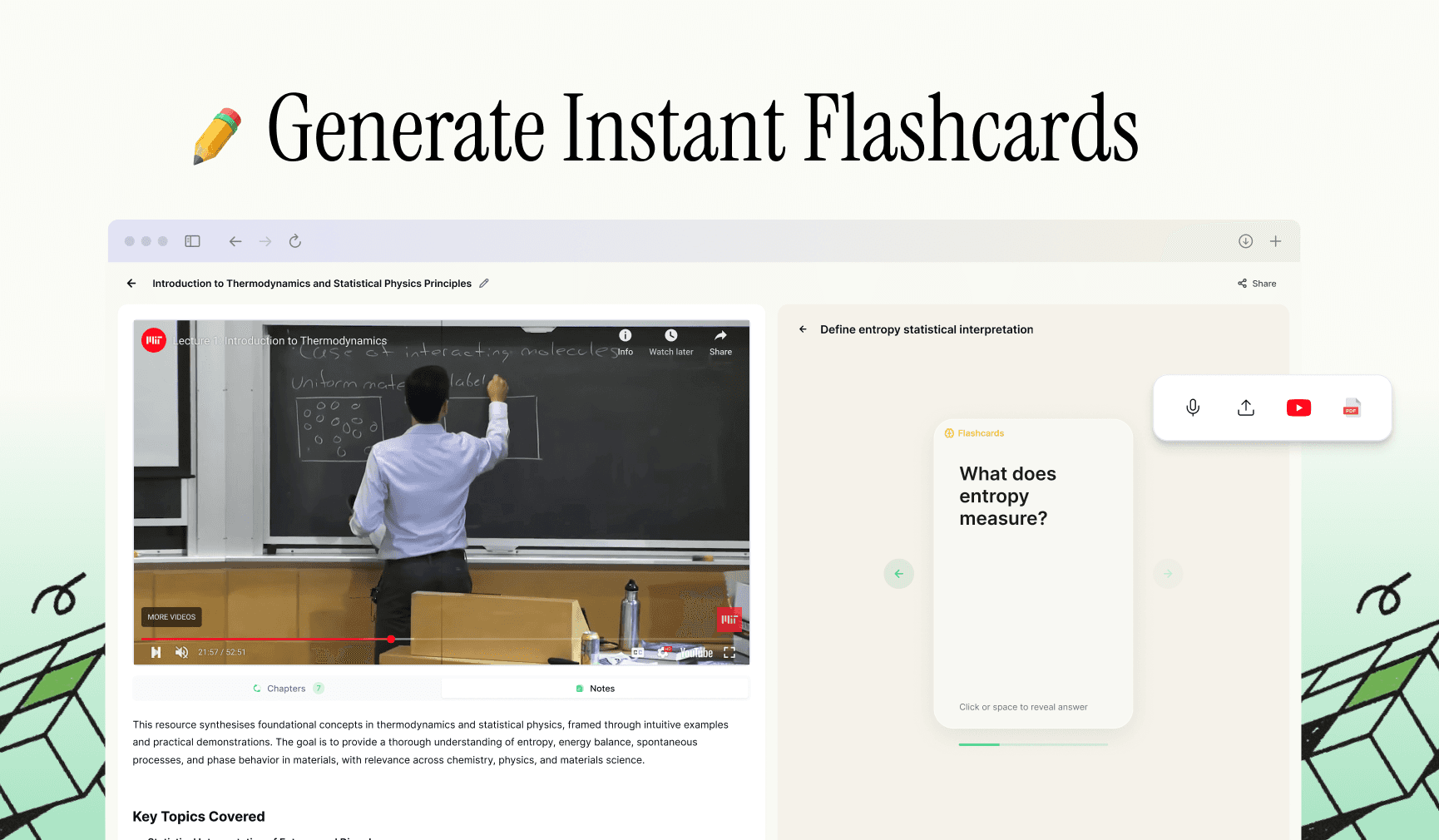
How to study Music Theory with flashcards (a simple system)
To master music theory, you need a two-pass approach. First, build your deck based on your current unit of study—such as diatonic harmony or rhythm. Then, engage in high-frequency review sessions. Because music involves visual symbols, try to visualize the staff or the piano keyboard as you answer each card.
Review in short, focused bursts. It is much better to do 10 minutes of music theory flashcards every day than a two-hour session once a week. This keeps the 'musical vocabulary' at the front of your brain, making it easier to apply during your actual instrument practice.
Generate a deck from your class notes or textbook.
Do a rapid pass to identify which intervals or chords you struggle with.
Review the 'weak' cards daily until they become second nature.
Slowly introduce more complex topics like chromaticism or counterpoint.
Perform a mixed-review session once a week to maintain your overall knowledge.
Generate Music Theory flashcards automatically in Duetoday
Hand-drawing staves and chord diagrams on physical cards is incredibly time-consuming. Duetoday eliminates the busywork by using AI to scan your materials and create a professional deck instantly. Whether you have a PDF of a theory workbook or a transcript of a lecture on jazz harmony, we turn it into an interactive study experience.
Upload your Music Theory PDF, slides, or notes.
Click 'Generate Flashcards' to let the AI analyze the key concepts.
Edit, refine, and start your active recall session immediately.
Generate Music Theory Flashcards in Duetoday
Common Music Theory flashcard mistakes (and how to fix them)
Many students make the mistake of making their cards too broad. For example, asking Explain the Circle of Fifths is too vague. Instead, create separate cards for each key signature. Another common pitfall is ignoring the 'why'—make sure to include a few cards that explain the function of a chord, not just its name. Finally, don't forget to include rhythmic values; many students focus solely on pitch and neglect the mathematical side of music theory.
Ready to generate your Music Theory flashcards?
Stop rereading your theory book and start testing your knowledge. Upload your notes to Duetoday and generate a custom deck today. Whether it's for an exam or personal growth, we help you master the mechanics of music faster.
FAQ
How many flashcards do I need for Music Theory? For a single unit like Major Scales, 15-20 cards is usually enough. For a full semester course, you might end up with 100-200 cards.
What’s the best format for Music Theory flashcards? Question-and-answer format works best. Use the front for the term or symbol and the back for the definition or notes involved.
How often should I review Music Theory flashcards? Daily review is best for memorizing key signatures and intervals. Once you feel confident, you can move to every 3 days.
Should I make cards from a textbook or my own notes? Both are useful, but notes from your teacher often highlight exactly what will be on your specific exam.
How do I stop forgetting key signatures? Use spaced repetition. Reviewing the circle of fifths cards frequently will eventually make the mental calculation second nature.
What if my flashcards feel too easy? If they are too easy, it's time to add complexity, such as Roman numeral analysis or four-part chorale writing rules.
Can I generate Music Theory flashcards from a PDF? Yes, Duetoday can read your sheet music theory PDFs and extract definitions, rules, and concepts into cards.
Are digital flashcards better than paper for music? Yes, because you can easily edit them and add images of musical notation without needing a ruler and pen.
How long does it take to make a full deck? With Duetoday, it takes seconds to generate a draft deck from your uploaded materials.
Can Duetoday organize my cards by topic? Yes, you can generate specific decks for Harmony, Rhythm, History, or any other sub-topic you are studying.

Duetoday is an AI-powered learning OS that turns your study materials into personalised, bite-sized study guides, cheat sheets, and active learning flows.