Generate Flashcards for Momentum and Impulse
Generate Momentum and Impulse flashcards in seconds. Turn notes into study decks. Try for free!
Generate Flashcards with AI Free
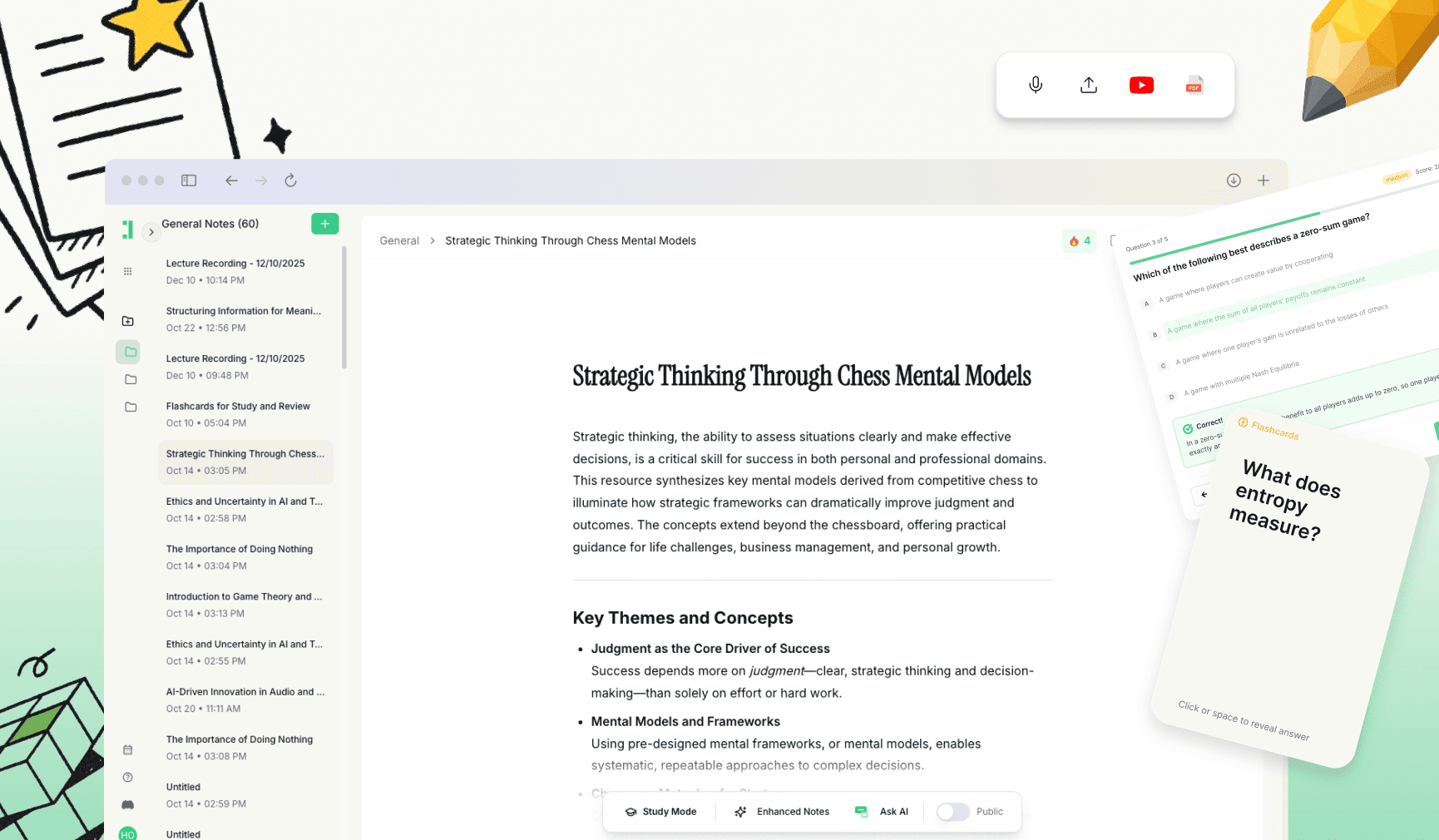
Generate Flashcards for Momentum and Impulse
Turn your physics notes, PDFs, slides, or textbook chapters into Momentum and Impulse flashcards so you can review complex formulas faster and remember concepts for your next exam. Mastering the relationship between force and motion requires more than just reading—it requires active testing.
Generate Momentum and Impulse FlashcardsUpload Physics Notes
In Duetoday, the process is seamless: upload your study material, click generate, and the AI builds a structured deck. You can then edit your cards or start studying immediately using proven recall methods.
What are Momentum and Impulse flashcards?
Momentum and impulse flashcards cover the fundamental physics principles of mass in motion and the changes in that motion. These cards typically include definitions of p=mv, the Impulse-Momentum Theorem, conservation laws, and the differences between elastic and inelastic collisions.
Instead of staring at a textbook page, these flashcards force you to recall the specific vector nature of momentum or calculate the area under a force-time graph. This shift from passive reading to active retrieval builds the neural pathways needed for high-stakes problem-solving.
If you already have lecture notes, Duetoday can generate a clean, organized deck in minutes.
Why flashcards are one of the best ways to study Momentum and Impulse
Physics is a subject that demands both conceptual understanding and the quick application of formulas. Flashcards help bridge the gap between knowing a definition and being able to solve a multi-step word problem under pressure.
Memorize units and vector directions without cramming
Separate similar concepts (e.g., Elastic vs. Inelastic collisions)
Learn derivations step-by-step (from Newton's Second Law to Impulse)
Practice identifying variables in word problems quickly
What to include in your Momentum and Impulse flashcards
Effective physics flashcards follow the "atomic" rule: one idea per card. When you keep cards focused, your brain can isolate exactly where your understanding is breaking down—whether it's the units, the direction, or the algebra.
Definitions & key terms: "What is the definition of linear momentum?"
Processes & steps: "How do you determine the change in momentum from a Force-Time graph?"
Comparisons: "How does an isolated system differ from a non-isolated system regarding momentum?"
Application: "If the time of impact doubles, what happens to the average force for the same change in momentum?"
Example prompts: "Define Impulse in terms of force and time," "What is the law of conservation of momentum?" and "Which quantity is conserved in an inelastic collision?"
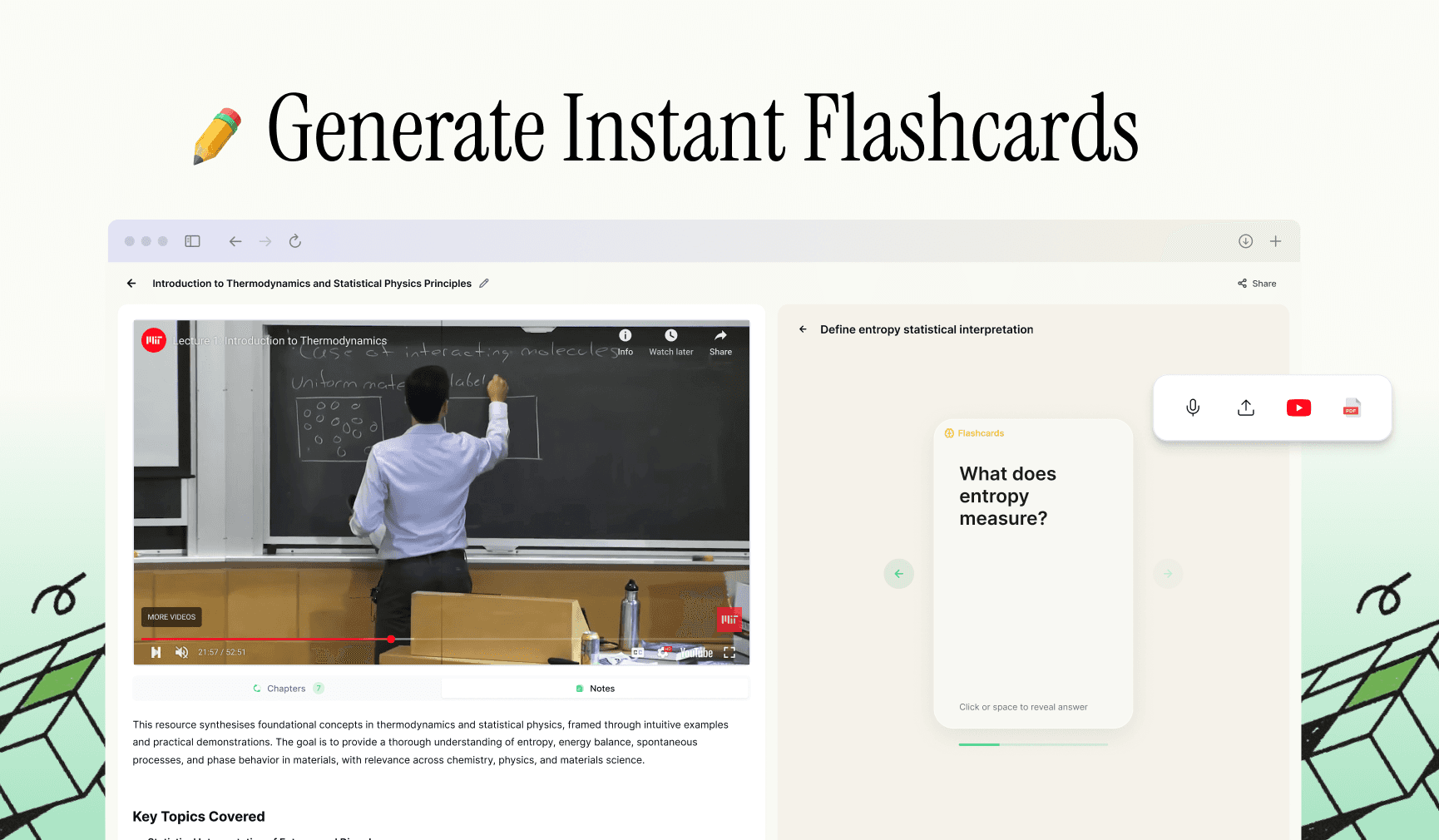
How to study Momentum and Impulse with flashcards (a simple system)
Don't just flip through cards; use a system. Start with a "two-pass" approach. In the first pass, identify which concepts are intuitive and which formulas you keep forgetting. In the second pass, focus heavily on the difficult application questions.
Make a deck from your physics notes or generate it from a PDF in Duetoday.
Do one quick round to flag weak spots like collision types or unit conversions.
Review these "weak" cards daily for five minutes.
Mix in problem-solving cards that require you to sketch a vector diagram.
Do a final mixed review of all topics before your quiz or midterm.
Generate Momentum and Impulse flashcards automatically in Duetoday
Writing out physics flashcards by hand is time-consuming and often results in messy diagrams or incomplete formulas. You should be spending your time solving problems, not rewriting your textbook onto index cards.
Duetoday solves this by turning your study materials into interactive tools. You can upload a PDF of a chapter or a recording of a lecture, and the AI extracts the core math and theory for you.
Upload physics slides or paste lecture transcripts
Click 'Generate Flashcards'
Review the generated deck and start your study session
Generate Momentum and Impulse Flashcards in Duetoday
Start with your notes and get a professional deck you can actually use today.
Common Momentum and Impulse flashcard mistakes
Many students make cards that are essentially paragraphs. If a card takes 30 seconds to read, it isn't a flashcard—it's a note. Avoid these common pitfalls to keep your physics study efficient.
Cards are too wordy: Split the definition and the formula into two different cards.
Ignoring vectors: Always include prompts that ask about the direction of momentum.
Focusing only on p=mv: Ensure you have cards for the Impulse-Momentum theorem and impulse area.
No schedule: Spaced repetition only works if you revisit the hard cards consistently.
FAQ
How many flashcards do I need for Momentum and Impulse? Typically 20-30 cards are enough to cover the core definitions, conservation laws, and different types of collisions.
What’s the best format for these flashcards? Question and answer format is best. For example: "Q: What is the area under a Force vs. Time graph? A: Impulse."
How often should I review them? Review your deck once a day for three days leading up to an exam to move the information into your long-term memory.
Should I make cards from a textbook or my notes? Use both. Textbooks provide precise definitions, while lecture notes often highlight the specific problem types your teacher prefers.
How do I stop forgetting the formulas? Use flashcards to test yourself on the units and the variables, then immediately practice one practice problem using that formula.
What if my flashcards feel too easy? Add application-based cards, such as "Explain why an airbag reduces force in a car crash using the concept of impulse."

Duetoday is an AI-powered learning OS that turns your study materials into personalised, bite-sized study guides, cheat sheets, and active learning flows.