Generate Flashcards for Moles and Molarity
Generate Moles and Molarity flashcards in seconds. Try Duetoday for free and master Chemistry formulas.
Generate Flashcards with AI Free
Generate Flashcards for Moles and Molarity
Turn your chemistry notes, PDFs, textbook chapters, or lecture slides into Moles and Molarity flashcards so you can review faster and remember complex formulas with ease.
Generate Moles and Molarity FlashcardsUpload notes / paste text
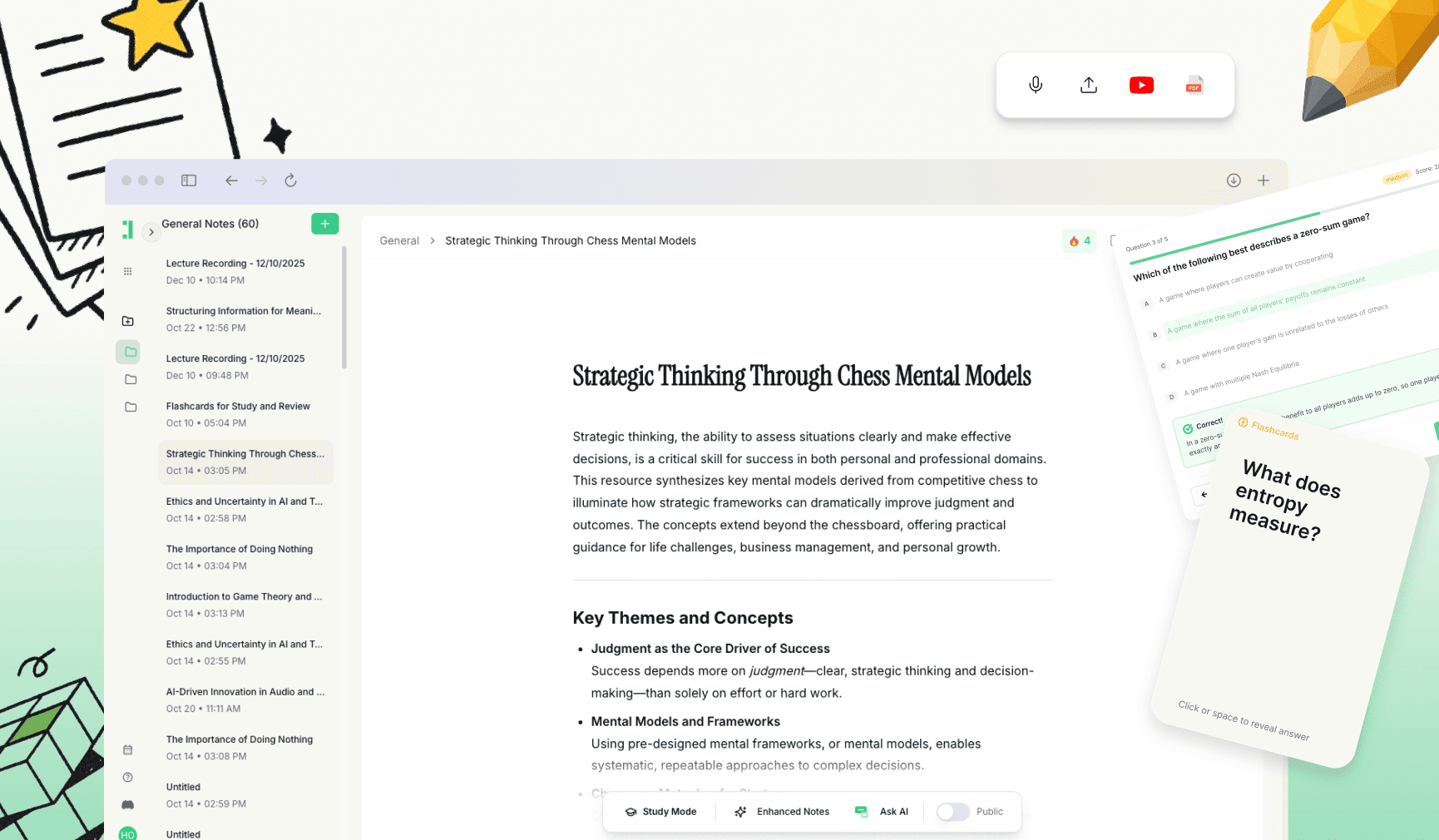
With Duetoday, the process is seamless: simply upload your chemistry materials, and our AI instantly extracts key data to generate a custom deck. You can then review, edit, and start studying with active recall in seconds.
What are Moles and Molarity flashcards?
Moles and Molarity flashcards are specialized study tools designed to help you master the fundamental unit of measurement in chemistry and the concentration of solutes in solutions. They cover everything from Avogadro’s number (6.022 x 10²³) and molar mass to the intricacies of dilution formulas and volumetric calculations.
Instead of passively rereading your textbook, these flashcards force you to retrieve information actively. This method builds a much stronger mental connection to the mathematical relationships required for stoichiometry and lab work. If you already have notes, Duetoday can generate a clean deck in minutes.
Why flashcards work for Moles and Molarity
Moles and Molarity require a mix of rote memorization (constants and units) and procedural application (multi-step conversions). Flashcards are the perfect bridge between these two types of learning by utilizing active recall and spaced repetition.
Remember Avogadro's number and molar mass constants without cramming.
Separate similar concepts like molarity (M) vs. molality (m).
Learn conversion processes step-by-step (grams to moles to molecules).
Practice applying the M1V1 = M2V2 formula quickly under pressure.
What to include in your Moles and Molarity flashcards
Effective chemistry flashcards follow the "one idea per card" rule. Use question-based prompts rather than just writing a term on one side and a definition on the other to maximize cognitive load.
Definitions & key terms: "What is a mole?" "Define molarity in terms of liters."
Processes & steps: "What is the first step in calculating molar mass?"
Comparisons: "How does a solute differ from a solvent?"
Application: "Calculate the moles in 10g of NaCl." "What happens to molarity if the volume doubles?"
Example prompts for your deck:
• "What is the formula for Molarity?"
• "State Avogadro's Number."
• "How do you convert grams to moles?"
• "Define 'Standard Temperature and Pressure' (STP)."
• "What is the unit for Molar Mass?"
How to study Moles and Molarity with flashcards
To master chemistry, use a "two-pass" approach. First, generate your deck and do a high-speed pass to see which formulas you've actually memorized. Then, focus your energy on the cards that involve multi-step conversions, as these are usually the most difficult on exams.
Make a deck from your notes using Duetoday's AI generator.
Do one quick round to identify which conversion factors trip you up.
Review weak cards daily to cement the math in your long-term memory.
Mix in a few "distractor" cards from previous units to stay sharp.
Do a final mixed review of stoichiometry problems before your quiz.
Generate Moles and Molarity flashcards automatically
Making chemistry cards manually is slow and tedious, especially when you have to type out units and subscripts. Duetoday eliminates the manual labor so you can spend your time actually solving problems.
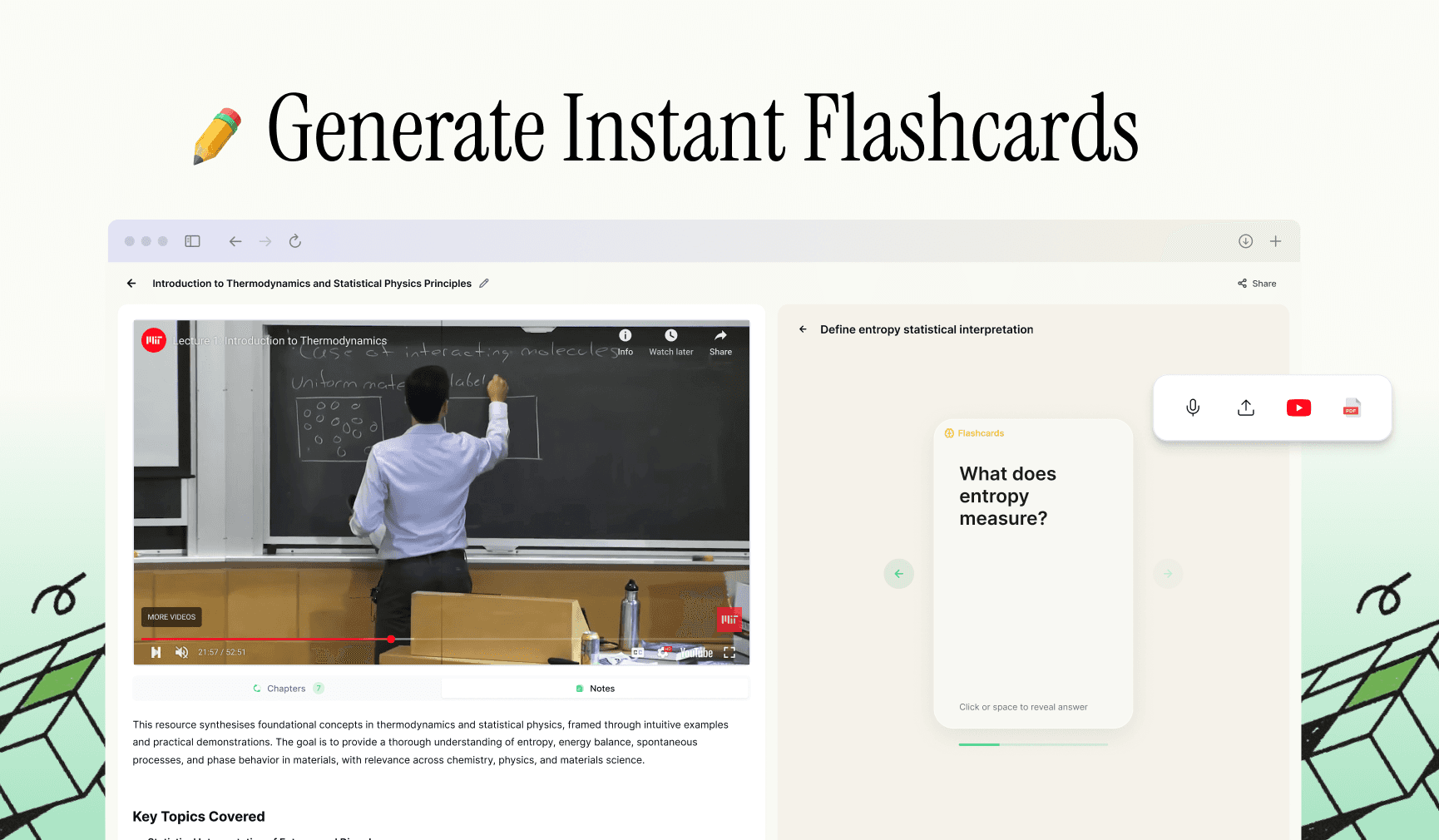
Simply upload your lab notes, PDF chapters, or lecture transcripts, and Duetoday will generate a comprehensive deck focused on the core quantitative concepts of your course.
Upload or paste your Moles and Molarity material.
Click "Generate Flashcards."
Review, edit, and start studying immediately.
Generate Moles and Molarity Flashcards in Duetoday
Start with your notes and get a deck you can actually use today.
Common Moles and Molarity flashcard mistakes
Most students make the mistake of creating cards that are way too wordy. If a card takes 30 seconds to read, it isn't an effective flashcard.
Cards are too long: Split complex stoichiometry problems into smaller sub-steps.
Ignoring units: Always include 'g/mol' or 'mol/L' on your answer side.
Confusing M and n: Create specific comparison cards for Molarity vs. moles.
No calculation practice: Ensure you have cards that require mental math or quick calculator use.
FAQ
How many flashcards do I need for Moles and Molarity? Usually, a deck of 30–50 cards is sufficient to cover definitions, basic formulas, and common conversion scenarios.
What’s the best format for these flashcards? Question-and-answer format is best. For example: 'Q: Formula for Molarity? A: M = moles of solute / liters of solution.'
How often should I review? Review your deck daily for the first three days, then once every three days until your exam to ensure the formulas stay fresh.
Should I make cards from a textbook or notes? Both. Textbooks provide the core theory, while lecture notes often highlight the specific types of problems your professor likes to test.
How do I stop forgetting the formulas? Use spaced repetition. Duetoday's system automatically resurfaces the cards you struggle with more frequently.
What if my cards feel too easy? Add 'Application' cards that provide a word problem instead of just a definition to increase the difficulty.
Can I generate cards from a PDF? Yes, Duetoday can scan any chemistry PDF and extract the most important Moles and Molarity concepts for you.
Are digital flashcards better than paper? Digital cards are superior for chemistry because you can easily include diagrams and they use algorithms to track your progress.
How long does it take to make a full deck? With Duetoday, it takes less than a minute to generate a full deck from your uploaded files.
Can Duetoday handle mathematical formulas? Absolutely. Duetoday is designed to recognize and format chemical symbols and mathematical equations accurately.

Duetoday is an AI-powered learning OS that turns your study materials into personalised, bite-sized study guides, cheat sheets, and active learning flows.