Generate Flashcards for Modern Physics Basics
Convert Modern Physics notes into flashcards instantly. Try out free AI generation today!
Generate Flashcards with AI Free
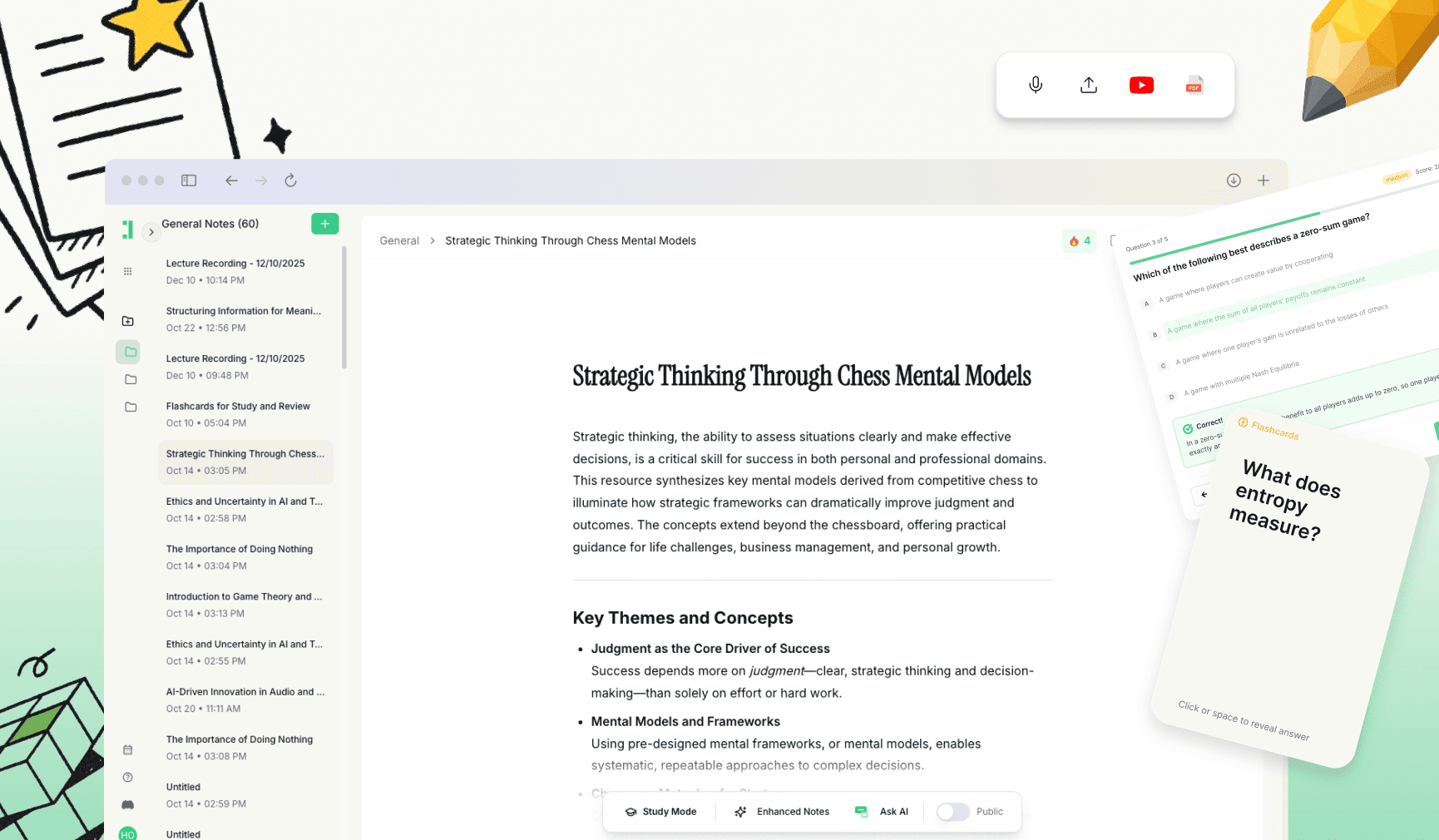
Generate Flashcards for Modern Physics Basics
Turn your notes, PDFs, slides, or lectures into Modern Physics Basics flashcards so you can review faster and remember more. Whether you are struggling with wave-particle duality or special relativity, our AI helps you distill complex theories into bite-sized study units.
Generate Modern Physics FlashcardsUpload notes / paste text
In Duetoday, the process is simple: upload your course materials, click generate, review the AI-suggested cards, and start your study session immediately.
What are Modern Physics Basics flashcards?
Modern Physics Basics flashcards cover the fundamental shifts in physics that occurred in the early 20th century. This includes key terms like photons, probability density, and reference frames, as well as core formulas like E=mc² or the Rydberg formula. They help bridge the gap between classical intuition and quantum reality.
The outcome is simple: instead of rereading dense chapters on the Schrodinger equation, you test yourself on the core assumptions and outcomes, building faster mental recall. If you already have notes, Duetoday can generate a clean deck in minutes.
Why flashcards work for Modern Physics Basics
Modern Physics requires a mix of conceptual understanding and mathematical application. Flashcards help you memorize the constants and definitions while reinforcing the logic behind non-intuitive phenomena. Using active recall and spaced repetition ensures that the difference between an inertial and non-inertial frame stays fresh in your mind.
Remember fundamental constants (Planck’s constant, speed of light) without cramming.
Separate similar concepts like Photoelectric Effect vs. Compton Scattering.
Learn mathematical pathways for solving energy-level transitions.
Practice applying postulates of Special Relativity quickly.
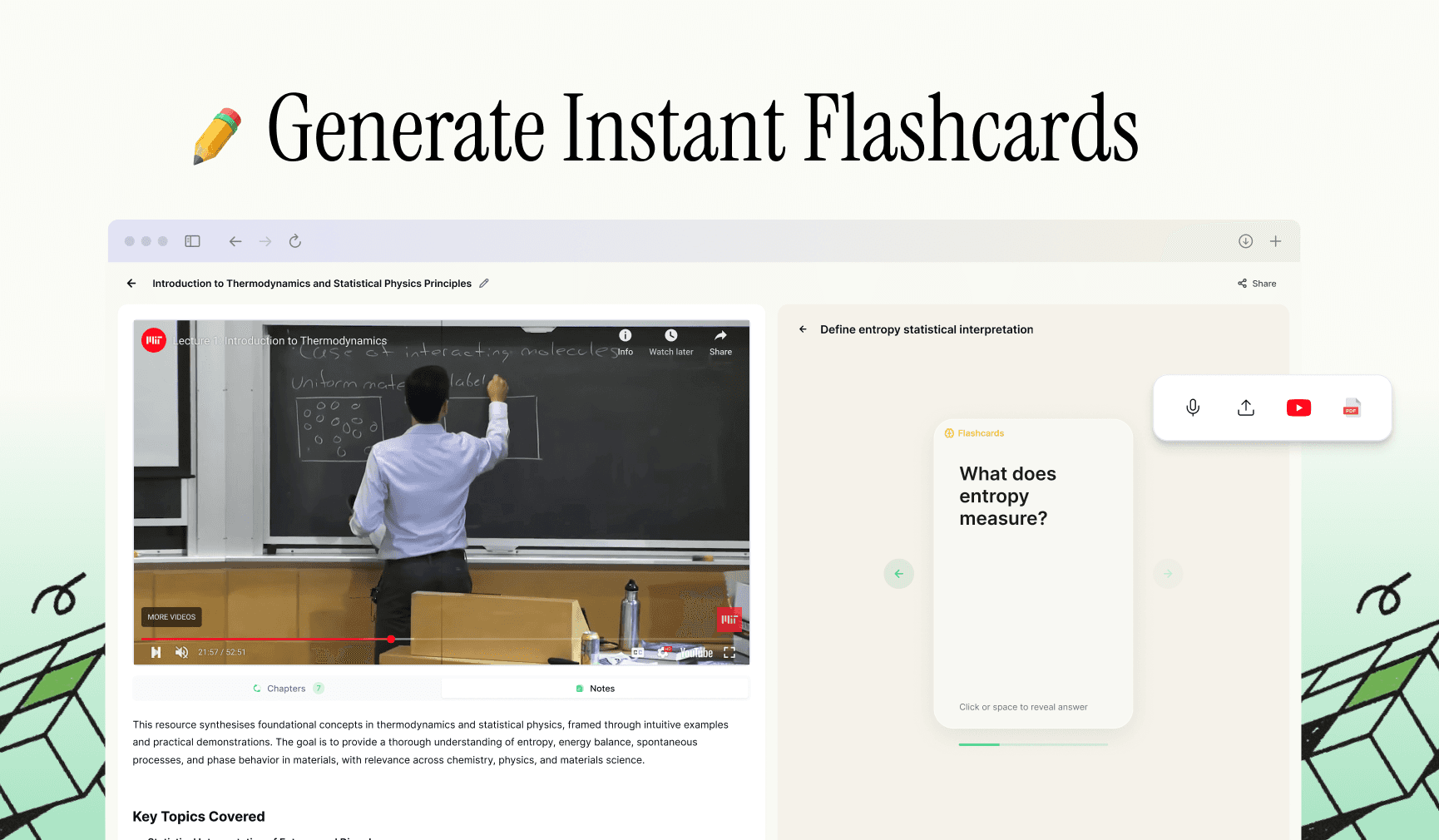
What to include in your Modern Physics Basics flashcards
Good physics flashcards follow the “one idea per card” rule. Instead of asking to 'explain relativity,' ask for a specific postulate. This prevents the 'illusion of competence' where you think you know more than you do.
Definitions & key terms: "What is a Quanta?" or "Define the Heisenberg Uncertainty Principle."
Processes & steps: "What happens to time as an object approaches the speed of light?"
Comparisons: "How does the Bohr model differ from the Schrodinger model?"
Application: "How do you calculate the photon energy given a specific frequency?"
Example prompts: 'What are the two postulates of Special Relativity?', 'Define the work function in the photoelectric effect', 'What is the physical significance of the wave function squared?'
How to study Modern Physics Basics with flashcards
We recommend a two-pass approach. First, generate your deck from your lecture slides to establish the baseline facts. Then, move into deep review sessions where you explain the 'why' behind each card out loud.
Make a deck from your notes or generate it from a PDF textbook.
Do one quick round to identify which concepts (like spin or parity) are confusing.
Review these weak cards daily using spaced repetition.
Mix in calculation-based cards to stay sharp on formulas.
Do a final mixed review before your midterm or final exam.
Generate Modern Physics flashcards automatically in Duetoday
Making cards manually for physics is slow and messy—especially when you have to type out Greek symbols and complex equations. Duetoday automates the heavy lifting.
Upload or paste your Modern Physics material.
Click Generate Flashcards.
Review, edit, and start studying.
Generate Modern Physics Flashcards in Duetoday
Start with your notes and get a deck you can actually use today.
Common Modern Physics flashcard mistakes
The most common mistake is making cards too wordy. If a card has a whole paragraph on it, you aren't testing recall; you're testing reading. Break down the Standard Model or radioactive decay into individual steps. Don't just memorize the name of a formula—make sure you have a card asking when that formula is applicable versus when it fails.
FAQ
How many flashcards do I need for Modern Physics Basics? Typically, a foundational course requires 100-150 cards to cover relativity, quantum precursors, and atomic structure thoroughly.
What’s the best format for Modern Physics flashcards? Question-and-answer format is best. Use the front for a specific prompt and the back for a concise explanation or formula.
How often should I review my physics cards? Use spaced repetition. Review daily initially, then push the interval to every 3-5 days once the concepts start to stick.
Should I make cards from a textbook or my lecture notes? Lecture notes are better for focusing on what your professor deems important, while textbooks are great for clarifying complex derivations.
How do I stop forgetting formulas? Create 'cloze deletion' cards where you have to fill in the missing part of the equation in the context of a problem.
What if my flashcards feel too easy? Increase the difficulty by asking for derivations or 'what if' scenarios rather than just definitions.
Can I generate Modern Physics flashcards from a PDF? Yes, Duetoday can scan your PDF chapters and extract key concepts to build a deck automatically.
Are digital flashcards better than paper for physics? Digital is usually better because you can easily include diagrams of wave patterns and use AI to organize your review schedule.
How long does it take to make a full deck? With Duetoday, you can go from a 50-page PDF to a 50-card deck in under two minutes.
Can Duetoday handle mathematical symbols? Yes, the AI is designed to recognize and format mathematical notation for clear study sessions.

Duetoday is an AI-powered learning OS that turns your study materials into personalised, bite-sized study guides, cheat sheets, and active learning flows.