Generate Flashcards for Modern Physics
Make and generate Modern Physics flashcards to master quantum mechanics and relativity with Duetoday's AI study guide.
Generate Flashcards with AI Free
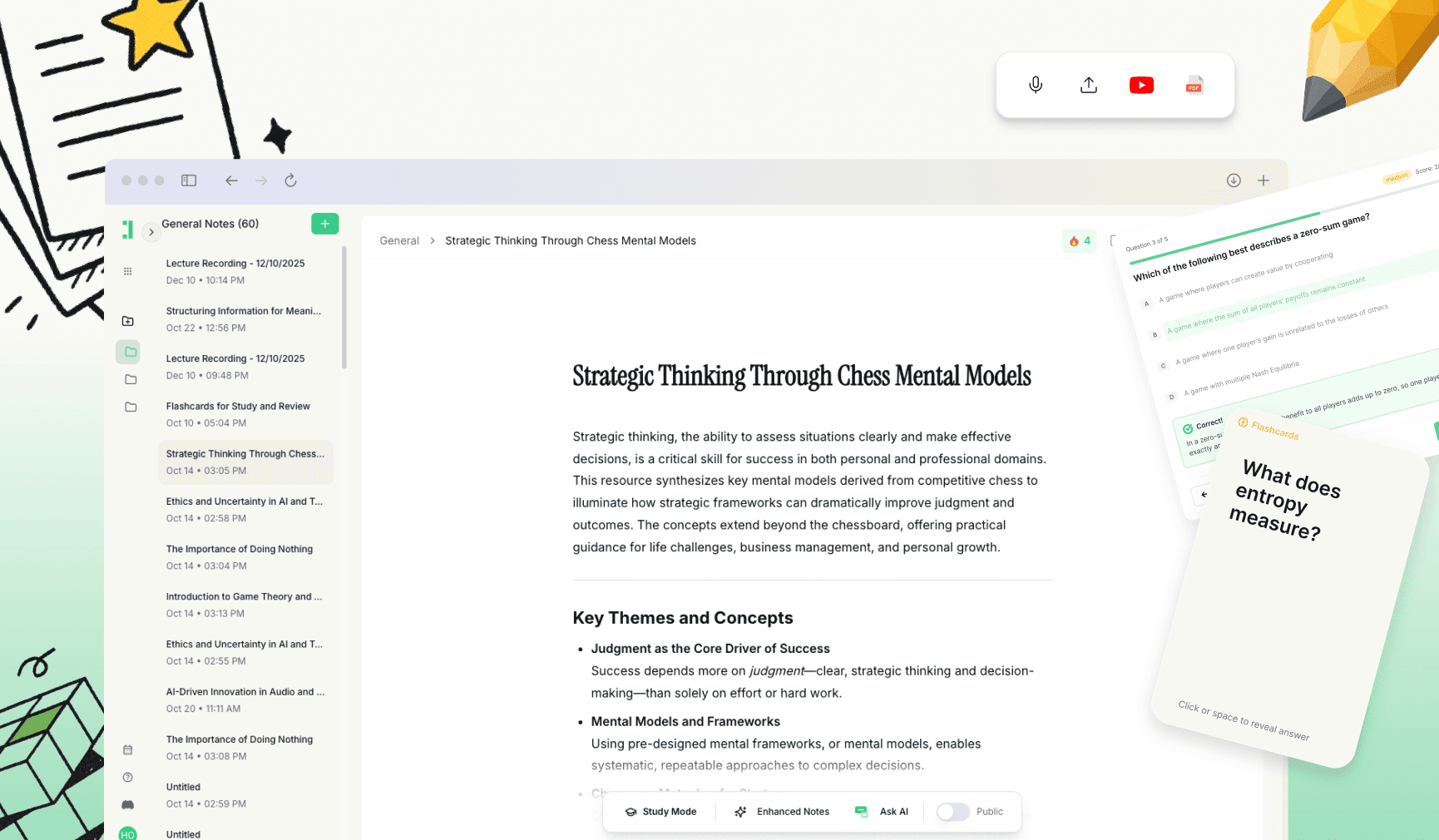
What are Modern Physics flashcards?
Modern Physics flashcards are focused study tools designed to break down the complex, often counterintuitive concepts of 20th and 21st-century physics. These include topics like special relativity, quantum mechanics, nuclear physics, and particle interactions. Instead of struggling through dense textbooks, these flashcards isolate specific variables, postulates, and experimental results into bite-sized questions.
The goal is simple: transform passive reading into active testing. By using Modern Physics flashcards, you force your brain to retrieve information such as the Heisenberg Uncertainty Principle or the photoelectric effect equation from memory, which builds significantly stronger neural pathways than highlighting a page. If you already have lecture slides or PDFs, Duetoday can generate a clean deck in minutes so you can skip the manual data entry.
Why flashcards are one of the best ways to study Modern Physics
Modern Physics requires a mix of theoretical understanding and precise mathematical application. Flashcards excel here because they help you internalize the conceptual shifts—like moving from classical mechanics to quantum probability—without getting overwhelmed by the math all at once.
Master Abstract Concepts: Lock in the nuances of wave-particle duality and time dilation.
Step-by-Step Derivations: Break down the stages of radioactive decay or electron transitions.
Differentiate Models: Easily compare the Bohr model vs. Schrödinger’s quantum model.
Formula Retention: Practice identifying when to use specific constants like Planck’s constant or the Rydberg constant.
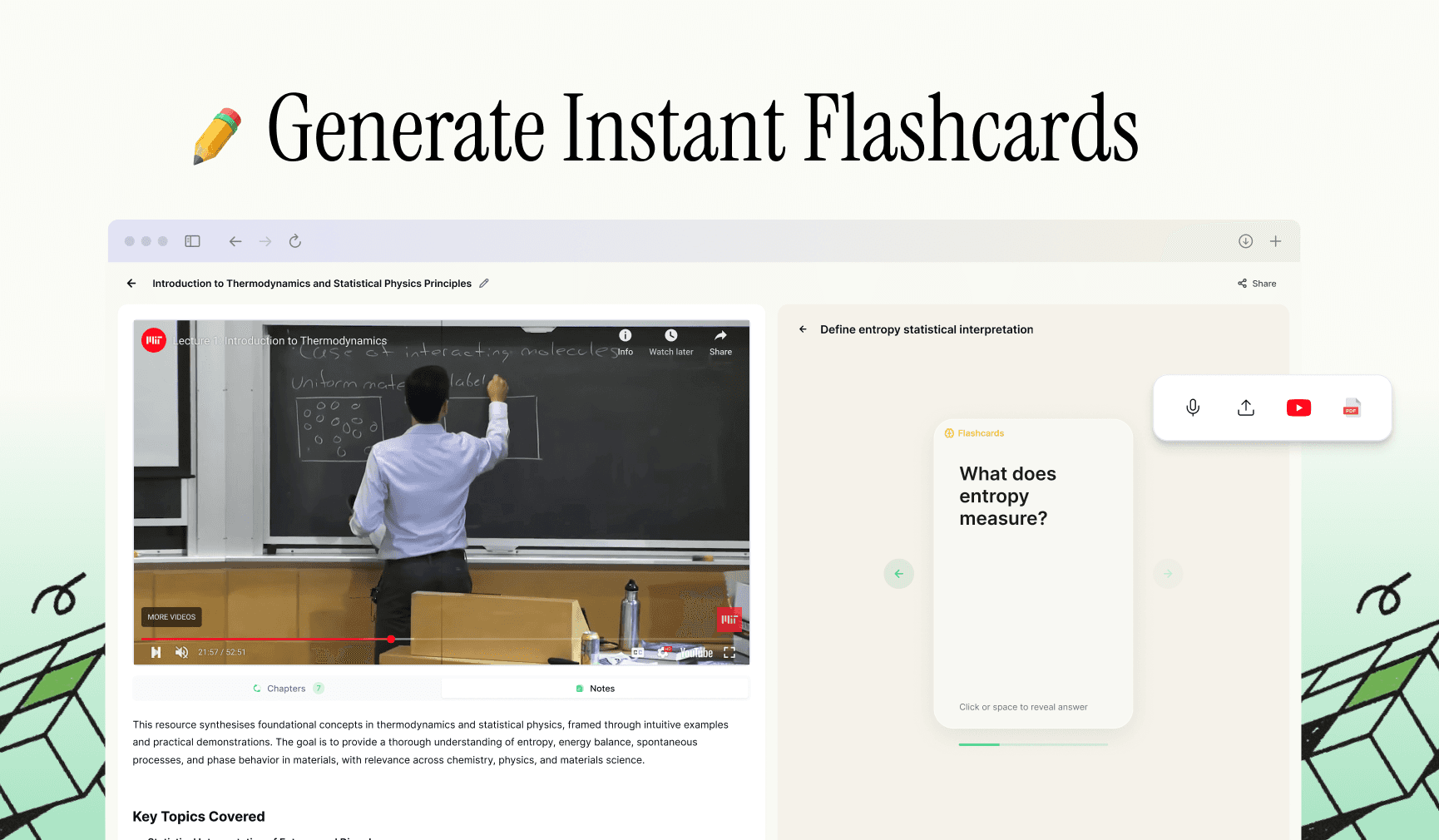
What to include in your Modern Physics flashcards
Effective Modern Physics cards follow the "atomic" rule: one specific idea per card. This prevents you from glazing over complex topics. Your deck should balance conceptual "Why?" questions with practical "How?" application prompts.
Definitions & Key Terms: "What is a photon?" "Define proper time in relativity."
Processes & Steps: "What are the steps of a nuclear fission chain reaction?"
Comparisons: "How does a boson differ from a fermion?"
Application: "What happens to the kinetic energy of an electron if the light frequency increases?"
Example prompts for your deck: "State Einstein’s first postulate of special relativity," "What is the physical significance of the wave function squared?" and "Explain the Compton Effect in one sentence."
How to study Modern Physics with flashcards
Physics isn't about rote memorization; it's about familiarity with principles. Use a two-pass approach. Start by generating a deck from your lecture notes and do a quick run-through to identify which concepts (like spin or parity) feel the most foreign. These are your 'weak cards.'
Generate your deck automatically from your PDF or syllabus.
Perform a daily review of the most difficult quantum concepts.
Mix conceptual cards with short calculation cards to keep your brain agile.
Review your entire deck once a week leading up to your exam.
Generate Modern Physics flashcards automatically in Duetoday
Manually writing out Maxwell’s equations or drawing energy level diagrams on paper cards is incredibly time-consuming. Duetoday eliminates the grunt work by using AI to scan your materials and extract the most testable concepts instantly.
Upload your Modern Physics PDFs, slides, or transcript.
Click "Generate Flashcards."
Edit your cards and start your active recall session immediately.
Generate Modern Physics Flashcards in Duetoday
Stop rereading five-page chapters on special relativity. Upload your notes and get a deck you can actually use today.
Common Modern Physics flashcard mistakes
Avoid these pitfalls to ensure your study time is effective:
Cards are too wordy: If a card has three sentences, split it into three cards.
Ignoring the math: Don't just memorize definitions; include cards that ask for the units or the 'why' behind a formula.
No visual cues: Modern physics is visual. Include descriptions of Feynman diagrams or wave functions.
Zero consistency: Spaced repetition only works if you actually show up every day.
FAQ
How many flashcards do I need for Modern Physics? Most students find that 50-100 high-quality cards per unit (e.g., Quantum or Relativity) provide a comprehensive review without being overwhelming.
What’s the best format for Modern Physics flashcards? A mix of 'Question and Answer' for definitions and 'Scenario and Effect' for theoretical physics principles works best.
How often should I review my cards? Aim for 15-20 minutes every day. Spaced repetition is more effective than a 4-hour session right before a midterm.
Should I make cards from my textbook or my professor's slides? Use both. Slides usually highlight what will be on the test, while textbooks provide the detailed definitions needed for the cards.
How do I stop forgetting formulas? Create cards that ask for the 'meaning' of each variable in the formula rather than just the symbols.
Can I generate flashcards from a PDF? Yes, Duetoday is designed to ingest PDFs and instantly convert the text into structured study flashcards.
Are digital cards better than paper? For Modern Physics, digital is often better because you can easily edit complex definitions and access them anywhere.
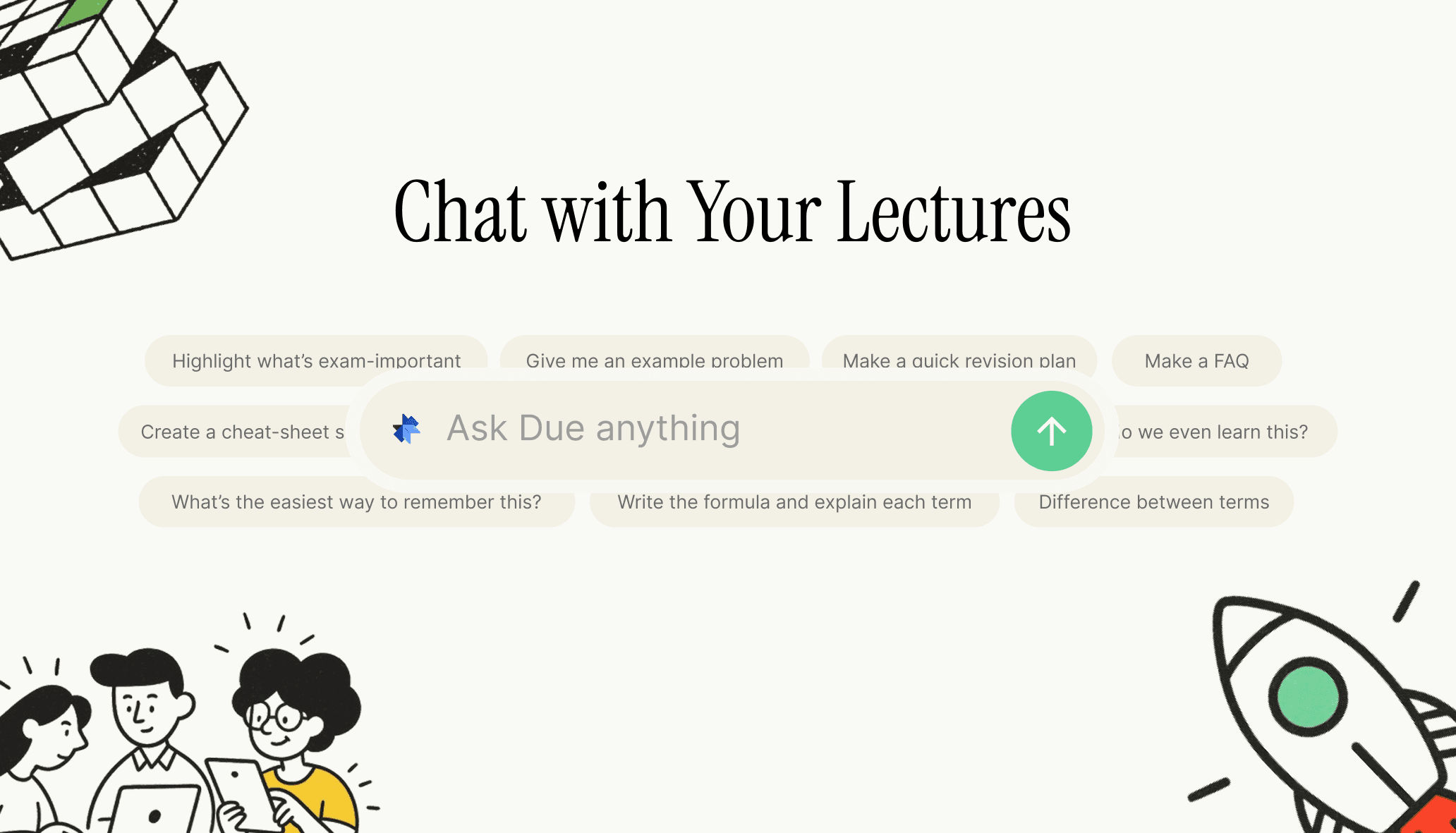
Can Duetoday handle mathematical notation? Yes, Duetoday's AI understands scientific context and can organize formulas into logical question-answer pairs.

Duetoday is an AI-powered learning OS that turns your study materials into personalised, bite-sized study guides, cheat sheets, and active learning flows.