Generate Flashcards for Mendelian Genetics
Generate Mendelian Genetics flashcards in seconds. Turn notes into study tools. Try for free!
Generate Flashcards with AI Free
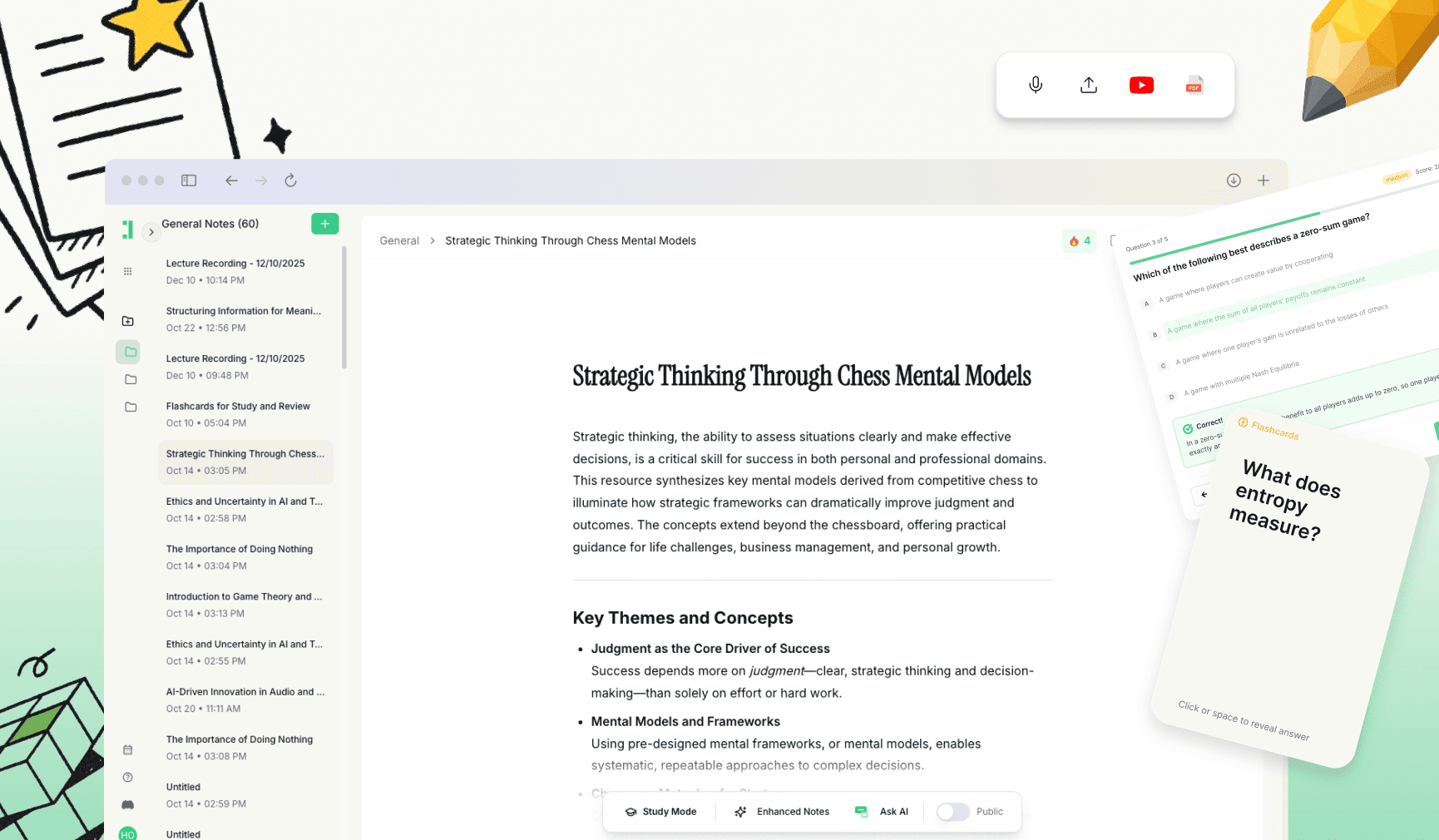
Generate Flashcards for Mendelian Genetics
Turn your notes, PDFs, slides, or lectures into Mendelian Genetics flashcards so you can review faster and remember more.
Making flashcards manually for complex biological inheritance patterns takes hours. With Duetoday, you can automate your study prep. Simply upload your class materials or paste your textbook excerpts, and our AI will extract the most important genetic principles into a ready-to-use deck.
What are Mendelian Genetics flashcards?
Mendelian Genetics flashcards cover the fundamental principles of heredity first discovered by Gregor Mendel. These cards focus on key terms like alleles, genotypes, and phenotypes, as well as the mechanical steps of predicting inheritance using Punnett squares and probability laws.
Instead of just rereading your biology textbook, these cards force you to engage in active recall. You test your ability to distinguish between dominant and recessive traits or predict the phenotypic ratio of a dihybrid cross, which builds much stronger memory pathways than passive highlighting.
If you already have notes, Duetoday can generate a clean deck in minutes.
Why flashcards are one of the best ways to study Mendelian Genetics
Mendelian Genetics requires memorizing specific terminology and applying mathematical rules to biological scenarios. Flashcards help you bridge the gap between knowing a definition and applying a concept.
By using active recall and spaced repetition, you ensure that the difference between homozygous and heterozygous becomes second nature, allowing you to focus on more complex genetic problems during exams.
Remember key terms like alleles, loci, and zygosity without cramming
Separate similar concepts like incomplete dominance vs. codominance
Learn the steps of monohybrid and dihybrid crosses
Practice applying the Law of Segregation and the Law of Independent Assortment
What to include in your Mendelian Genetics flashcards
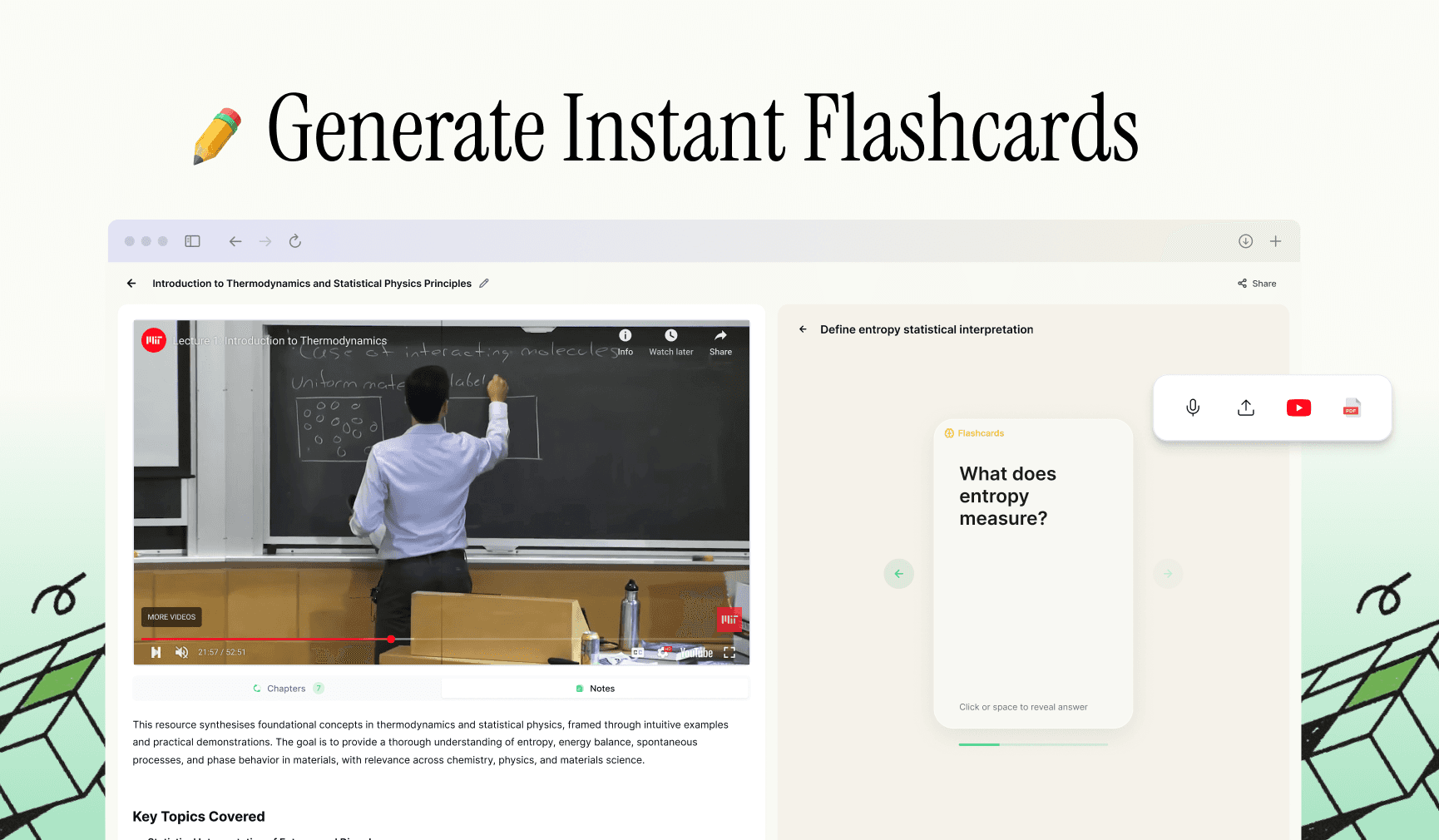
The most effective Mendelian Genetics flashcards follow the "one idea per card" rule and are framed as questions. This prevents you from feeling like you know the material when you've actually only recognized the text.
Definitions & key terms: "What is a phenotype?" "Define an allele in one sentence."
Processes & steps: "What are the four steps of setting up a Punnett square?"
Comparisons: "How is a genotype different from a phenotype?"
Application: "If two heterozygous parents mate, what is the probability of a recessive offspring?"
Use these example prompts for your deck:
Define 'True-breeding' in the context of Mendel's experiments.
What is the phenotypic ratio of a standard Mendelian monohybrid cross?
Explain the Law of Independent Assortment.
What does a 9:3:3:1 ratio represent in genetics?
How does a test cross identify an unknown genotype?
Contrast 'P', 'F1', and 'F2' generations.
How to study Mendelian Genetics with flashcards
To master this topic, use a two-pass approach. First, build your deck based on your lectures, then move into iterative review rounds that focus on application rather than just memorization.
Make a deck from your notes or generate it from your textbook chapter.
Do one quick round to identify which laws or ratios you find most confusing.
Review weak cards—typically dihybrid crosses or probability rules—daily.
Mix in harder application cards that ask you to solve a quick Punnett square.
Do a final mixed review of all inheritance patterns before your quiz.
Generate Mendelian Genetics flashcards automatically in Duetoday
Creating cards for every genetic variation is slow and messy. Duetoday streamlines this by turning your raw biology resources into structured review tools instantly.
Upload or paste your Mendelian Genetics material (PDFs/Slides)
Click “Generate Flashcards”
Review, edit, and start studying with active recall
Common Mendelian Genetics flashcard mistakes
Many students make cards that are too wordy or focus on the wrong details. Avoid these pitfalls:
Cards are too long: Don't put the whole Punnett square explanation on one card; split it into separate steps.
Mixing up terminology: Create specific comparison cards for 'Allele' vs. 'Gene'.
Ignoring the 'Why': Don't just memorize the 3:1 ratio; include a card asking why that ratio occurs.
No practice: Ensure you have cards that require you to do a mental calculation, not just recall a definition.
FAQ
How many flashcards do I need for Mendelian Genetics? Typically, a solid deck consists of 30–50 cards covering terms, laws, and common phenotypic ratios.
What’s the best format for these flashcards? Use the 'Question and Answer' format with clear, single-concept prompts to ensure you aren't memorizing patterns instead of facts.
How often should I review my genetics deck? Review daily leading up to an exam, then every few days to keep the ratios and laws fresh in your long-term memory.
Should I make cards from my textbook or lecture slides? Use both. Textbooks provide the formal definitions, while lecture slides often highlight the specific crosses your professor wants you to master.
How do I stop forgetting the laws of inheritance? Use spaced repetition. Duetoday helps by resurfacing the cards you find difficult more frequently than the ones you know well.
What if my flashcards feel too easy? Start including scenario-based cards, such as predicting outcomes for specific parental genotypes rather than just defining them.
Can I generate genetics flashcards from a PDF automatically? Yes, Duetoday can scan your biology PDFs and instantly create a deck of flashcards for you.
Are digital flashcards better than paper for Mendelian Genetics? Digital cards are often superior because they can handle more complex images of crosses and use algorithms to schedule your reviews.
How long does it take to make a full deck? Manually, it takes hours. With Duetoday's AI, you can have a full Mendelian Genetics deck in under a minute.
Can Duetoday organize my cards by topic? Yes, Duetoday allows you to categorize your cards, making it easy to separate Mendelian basics from more advanced topics like linkage.

Duetoday is an AI-powered learning OS that turns your study materials into personalised, bite-sized study guides, cheat sheets, and active learning flows.