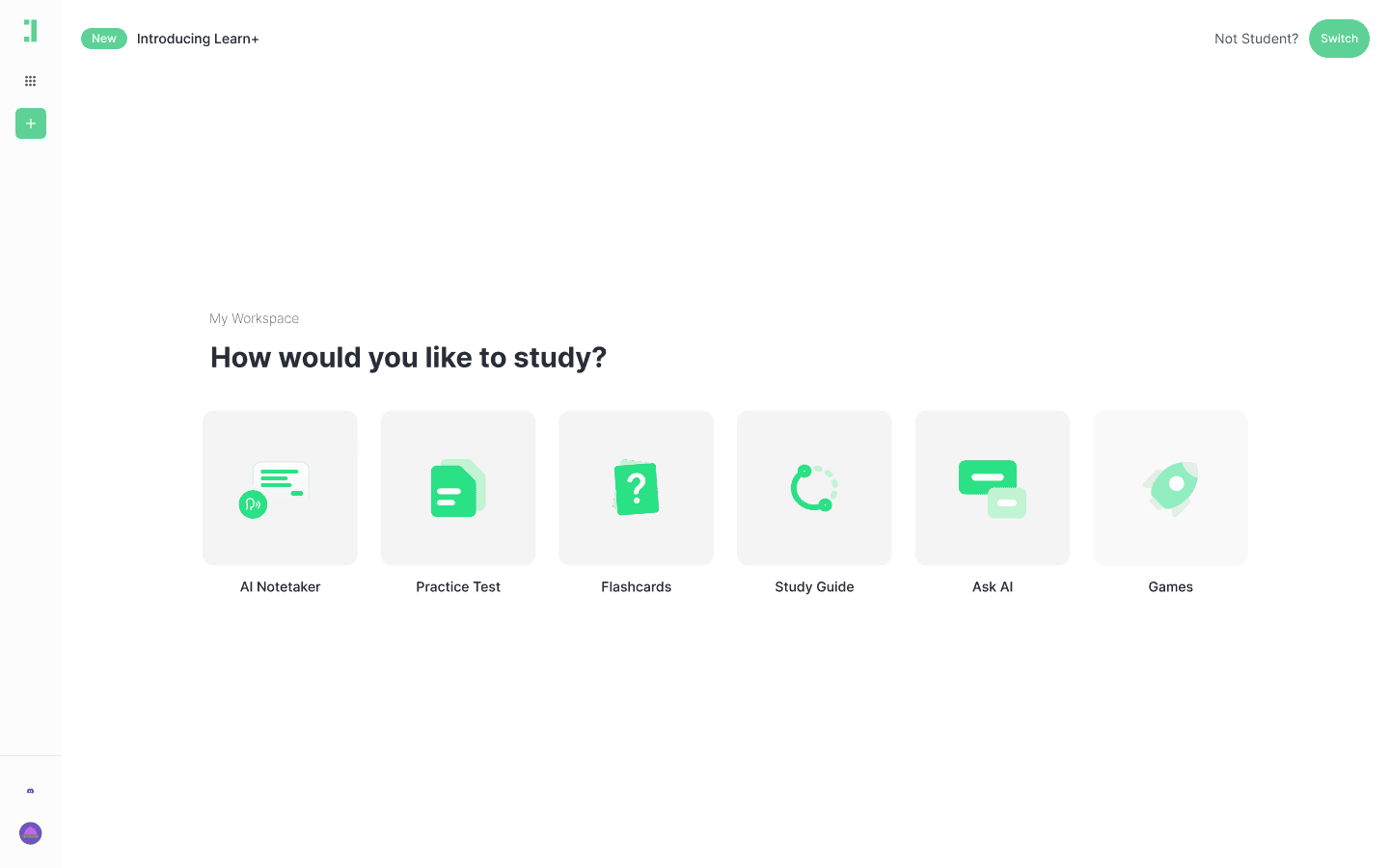
Generate Flashcards for Mechanics of Materials
Make Mechanics of Materials flashcards to master engineering stress, strain, and torsion using our AI tool.
Generate Flashcards with AI Free
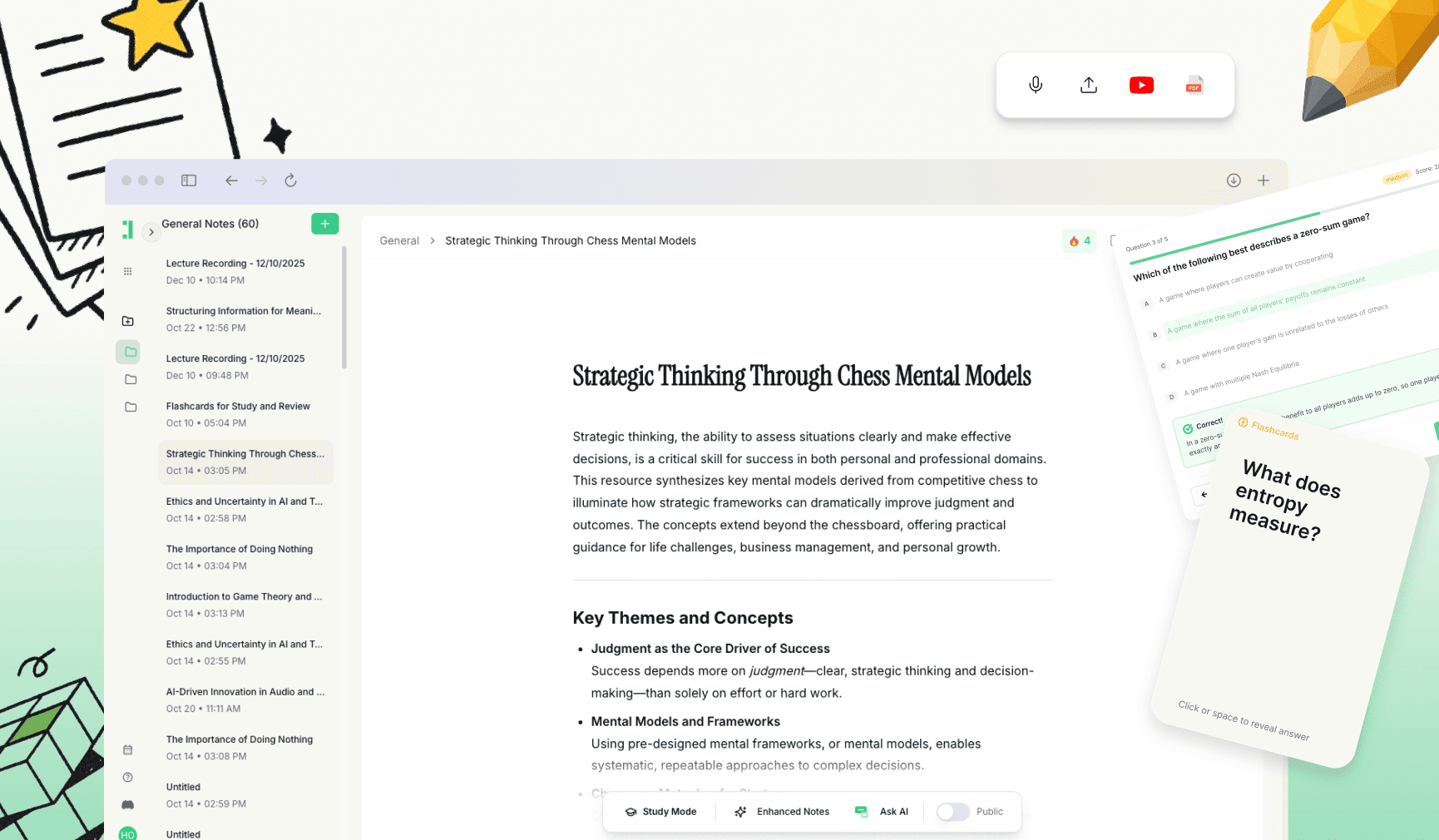
What are Mechanics of Materials flashcards?
Mechanics of Materials flashcards are specialized study tools designed to help engineering students master the relationship between external loads and internal effects in solid bodies. These cards cover fundamental concepts such as stress-strain recovery, axial loading, torsion, bending, and pressure vessels. By breaking down complex derivations and material properties into bite-sized questions, you can focus on the core mechanics without getting lost in overwhelming textbook chapters.
Instead of passively rereading your engineering manuals, these flashcards force you to recall formulas and sign conventions actively. This method builds the mental muscle memory required for structural analysis and design problems. If you already have lecture notes or textbook PDFs, Duetoday can generate a clean, organized deck for you in seconds.
Why flashcards are one of the best ways to study Mechanics of Materials
Mechanics of Materials is a subject built on precise definitions, sign conventions, and multi-step logical processes. Flashcards excel here because they help you isolate specific variables and failure theories, making it easier to apply the right formula to the right scenario during exams.
By utilizing active recall and spaced repetition, you ensure that fundamental concepts like Hooke’s Law or Mohr’s Circle stay fresh in your mind long after the lecture ends. This approach reduces the need for last-minute cramming and improves your ability to visualize how materials deform under pressure.
Memorize material property constants (E, G, Poisson's ratio) effortlessly.
Distinguish between normal stress and shear stress in various loading conditions.
Master the steps for drawing shear and moment diagrams.
Practice recognizing failure criteria like Von Mises or Tresca quickly.
What to include in your Mechanics of Materials flashcards
Effective Mechanics of Materials flashcards should follow the one idea per card rule. Avoid cluttering a single card with an entire derivation; instead, focus on the trigger points that lead to the next step in a solution. Using question-based prompts ensures you are testing your knowledge rather than just recognizing text.
Your deck should be balanced across four main categories to ensure a comprehensive understanding of the structural mechanics curriculum:
Definitions & Key Terms: What is the definition of Plane Strain? or Define Brittle vs. Ductile behavior.
Processes & Steps: What is the first step in constructing a Mohr’s Circle? or How do you find the neutral axis of a composite beam?
Comparisons: How does pure torsion differ from non-uniform torsion?
Application: When would you use the Flexure Formula? or What happens to stress if the cross-sectional area doubles?
Example prompts: State the formula for Elastic Section Modulus, What are the units for J (Polar Moment of Inertia)?, and Define the factor of safety in terms of allowable stress.
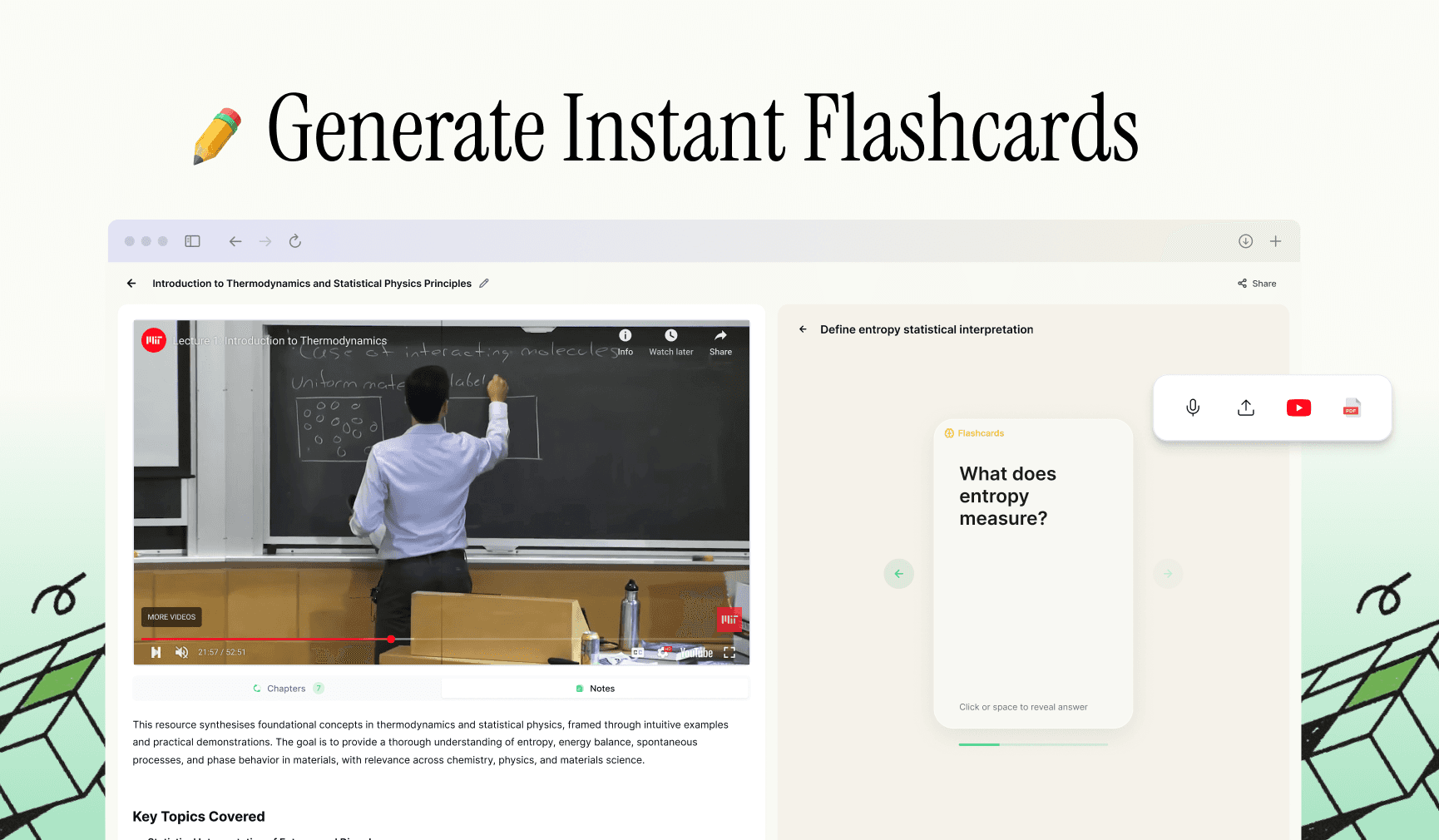
How to study Mechanics of Materials with flashcards (a simple system)
The secret to mastering engineering mechanics isn't just seeing the info—it's testing it. Start by creating a comprehensive deck from your course materials. Once your deck is ready, use a two-pass approach: first, a broad overview to identify concepts you struggle with, and second, a targeted review of those trouble spots.
Engineering problems often build on earlier concepts, so frequent, short review sessions are more effective than one long marathon. Consistency helps you internalize the conventions and units so they become second nature during timed tests.
Generate your deck from your syllabus, textbook chapters, or lecture slides.
Run through the deck once to flag cards where you struggle with the sign convention.
Review these flagged weak cards daily for 5-10 minutes.
Gradually mix in harder application questions involving combined loadings.
Perform a final review of all formulas 48 hours before your exam.
Generate Mechanics of Materials flashcards automatically in Duetoday
Manually writing out engineering formulas and drawing diagrams onto paper cards is incredibly time-consuming—time that would be better spent solving practice problems. Duetoday eliminates this friction by instantly converting your study material into structured flashcards.
With Duetoday, you can upload your complex engineering PDFs or paste your lecture notes, and our AI will identify the core formulas and concepts for you. You get a study-ready deck in seconds, allowing you to move straight to the learning phase.
Upload your Mechanics of Materials PDFs, slides, or transcripts.
Click Generate Flashcards.
Review the AI-generated cards, edit if needed, and start your study session.
Generate Mechanics of Materials Flashcards in Duetoday—Start with your notes and get a deck you can actually use today.
Common Mechanics of Materials flashcard mistakes (and how to fix them)
Many students create cards that are too dense, which makes them difficult to review and harder to remember. Here is how to avoid the most common pitfalls:
Cards are too wordy: Split complex Failure Theories into multiple cards (one for definition, one for the formula, one for a use case).
Ignoring Sign Conventions: Create specific cards just for positive vs negative shear and moment directions.
Relying only on formulas: Include Why cards, such as Why do we ignore the weight of the beam in elementary flexure?
No visual cues: For Mechanics of Materials, try to associate cards with mental images of stress elements or beam cross-sections.
Ready to generate your Mechanics of Materials flashcards?
Stop wasting time on manual data entry and start mastering your engineering coursework. Upload your notes, generate your deck, and start using active recall to ace your next exam.
Start Generating Flashcards
Works with notes, PDFs, slides, and transcripts.
FAQ
How many flashcards do I need for Mechanics of Materials? A typical semester-long course usually requires between 150 to 250 cards to cover all definitions, formulas, and sign conventions across all chapters.
What’s the best format for Mechanics of Materials flashcards? Use a question-and-answer format where the front asks for a specific formula or definition and the back provides the answer with a brief note on units or sign conventions.
How often should I review my cards? For engineering topics, a daily 10-minute session is ideal to keep formulas fresh. Increase frequency as you approach your midterm or final exams.
Should I make cards from a textbook or slides? Use both. Textbooks provide the rigorous definitions, while lecture slides often highlight the specific formulas and methods your professor prioritizes.
How do I stop forgetting formulas after a few days? This is where Spaced Repetition comes in. Duetoday helps you review the cards you find difficult more frequently until they are stored in your long-term memory.
What if my flashcards feel too easy? If cards feel too simple, update them to include Application prompts where you must describe how to solve a specific type of problem rather than just stating a formula.
Can I generate Mechanics of Materials flashcards from a PDF? Yes, Duetoday is designed to parse complex engineering PDFs and extract the most important concepts to create cards automatically.
Are digital flashcards better than paper? For engineering, digital is often better because you can easily edit formulas, organize by chapter, and use AI to generate them instantly from your digital notes.
How long does it take to make a full deck? Manually, it can take hours. With Duetoday, you can generate a comprehensive deck for a single chapter in less than a minute.
Can Duetoday organize my cards by topic? Absolutely. You can generate and categorize your cards by chapters like Torsion, Bending, or Stress Transformation to keep your study sessions focused.

Duetoday is an AI-powered learning OS that turns your study materials into personalised, bite-sized study guides, cheat sheets, and active learning flows.