Generate Flashcards for Mechanical Engineering Statics
Make Mechanical Engineering Statics flashcards to generate better study habits for vector mechanics and equilibrium.
Generate Flashcards with AI Free
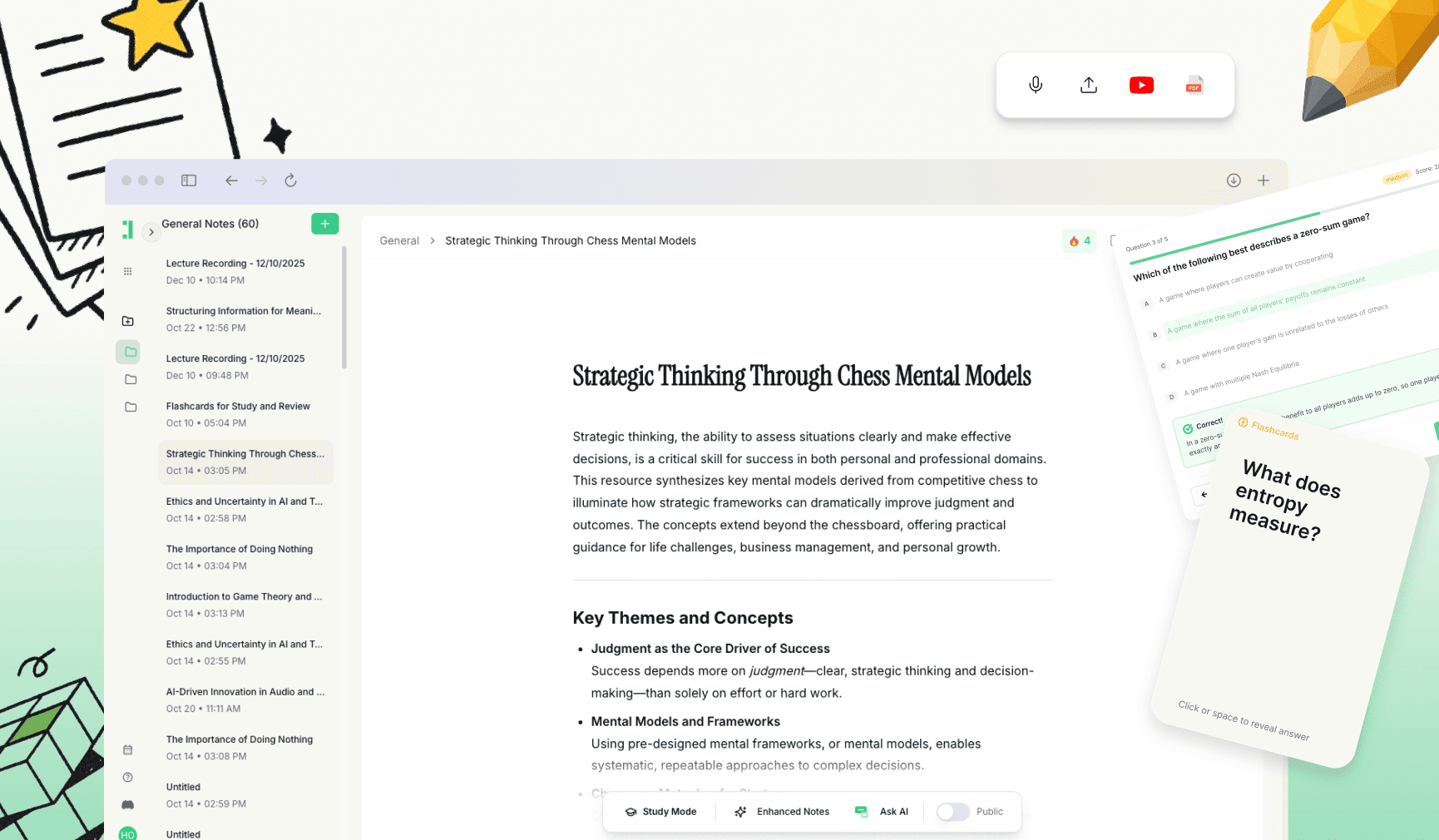
What are Mechanical Engineering Statics flashcards?
Mechanical Engineering Statics flashcards are targeted study tools designed to help you master the principles of rigid-body mechanics at rest. These cards cover essential topics such as vector operations, force system resultants, moments, and the equations of equilibrium. Instead of staring at complex diagrams in a textbook, flashcards force you to recall specific formulas and free-body diagram rules instantly.
The primary outcome of using these flashcards is moving beyond passive reading. By testing yourself on specific concepts like friction coefficients, centroids, and moments of inertia, you build the cognitive speed required for timed exams. If you already have lecture slides or textbook chapters, Duetoday can generate a clean deck of Statics cards in minutes.
Why flashcards work for Mechanical Engineering Statics
Statics is a foundational subject that relies heavily on the relationship between mathematical rules and physical applications. Flashcards are ideal for this because they allow you to isolate individual variables and procedures, such as the steps for solving a 3D equilibrium problem or identifying zero-force members in a truss.
Through active recall and spaced repetition, you reinforce the 'physics intuition' needed to solve problems without constantly checking your reference sheet. Instead of memorizing entire problems, you learn the underlying logic.
Master vector cross-products and dot-products without confusion
Identify the correct support reactions for various connections
Memorize the properties of common geometric areas for centroids
Quickly recall the difference between static and kinetic friction
Internalize the steps for the Method of Joints vs. Method of Sections
What to include in your Statics flashcards
Effective Statics flashcards follow the one idea per card rule. They should transform complex equilibrium problems into manageable, question-based prompts. Using a mix of conceptual and procedural cards ensures you understand both the 'why' and the 'how' of mechanical systems.
Definitions & Key Terms: What is a couple moment? Define a rigid body in the context of Statics.
Processes & Steps: What is the first step in creating a Free Body Diagram (FBD)?
Comparisons: How does a pin support differ from a fixed support regarding reaction forces?
Application: If a force is parallel to an axis, what is its moment about that axis?
Example Prompts:
- State the three equations of equilibrium for a 2D system.
- What characterizes a two-force member?
- Define the right-hand rule for moments.
- How do you calculate the magnitude of a 3D vector from its components?
- What is the Pappus-Guldinus theorem used for?
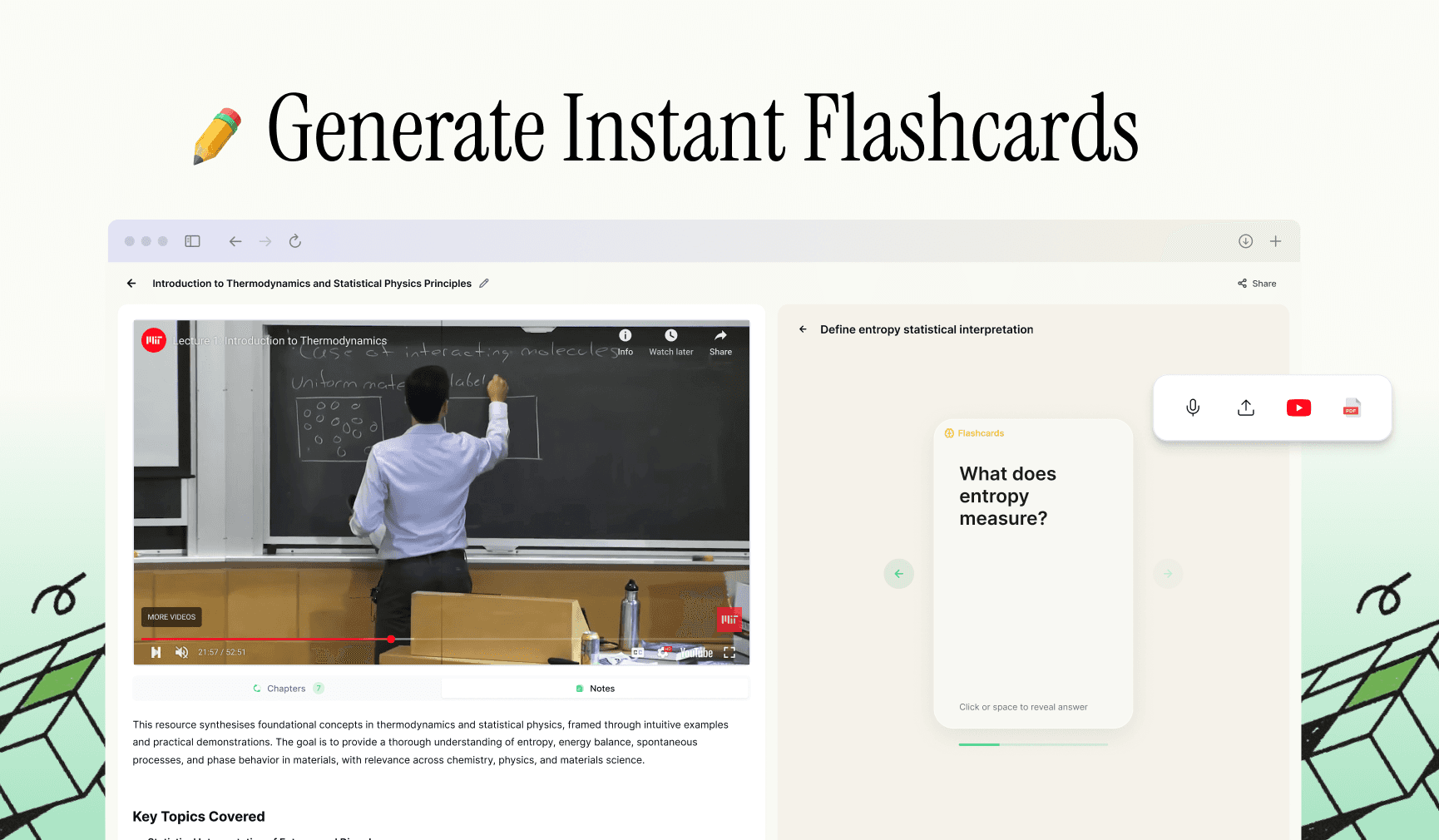
How to study Statics with flashcards (a simple system)
Studying Statics requires a two-pass approach. First, use your flashcards to build a solid foundation of the rules and formulas. Once you have the theory down, move to solving full-scale problems. Use your deck as a 'warm-up' before every problem-solving session to keep the core formulas fresh.
To maximize efficiency, review your deck in quick bursts. Focus heavily on cards representing your 'weak spots'—topics like 3D moments or distributed loads often require more frequent repetition than basic vector addition.
Generate a deck from your syllabus or textbook chapters.
Run a quick diagnostic round to identify which formulas you forget.
Review those difficult reaction force or truss cards daily.
Mix conceptual cards with 'visual identification' cards (e.g., recognizing support types).
Perform a full review 48 hours before your midterm or final.
Generate Statics flashcards automatically in Duetoday
Manually drawing free-body diagrams and writing out equilibrium equations on paper cards is incredibly time-consuming. Duetoday eliminates this friction by using AI to extract the most critical engineering concepts from your study materials instantly.
Simply upload your Statics PDFs, lecture transcripts, or handwritten notes. Duetoday identifies the key formulas, theorems, and procedural steps to create a comprehensive study deck you can use on any device.
Upload your Statics textbook chapters or lecture slides
Click 'Generate Flashcards'
Review, refine, and start mastering your engineering core
Common Statics flashcard mistakes (and how to fix them)
Many students create cards that are too dense, trying to fit an entire truss analysis problem onto one card. This leads to memorizing the solution to one specific problem rather than the general rule. Keep your cards focused on singular principles that can be applied to any problem.
Too many formulas on one card: Split them up; have one card for 2D and one for 3D.
Ignoring sign conventions: Include cards that test you on the standard positive/negative directions.
Neglecting units: Add cards asking for the standard SI and US units for moments and stress.
Lack of visuals: Ensure cards describe or include images of support types (rollers, hinges, fixed).
Ready to generate your Statics flashcards?
Stop rereading your engineering textbook and start building the active recall skills needed to ace your Statics exams. Upload your notes today and let Duetoday build your perfect study deck.
FAQ
How many flashcards do I need for Statics? A solid foundation usually requires 80 to 120 cards covering vectors, equilibrium, structures, friction, and centroids.
What is the best format for Statics flashcards? A mix of 'Definition' cards for theory and 'Procedural' cards for the steps of solving specific types of problems, like truss analysis.
How often should I review Statics flashcards? Review daily for the first week of a new topic, then transition to every 3-4 days to maintain memory through spaced repetition.
Should I make cards from a textbook or slides? Use both. Textbooks are great for formal theorems, while lecture slides often highlight the specific methods your professor prefers for exams.
How do I stop forgetting formulas after a few days? Spaced repetition is key. Duetoday helps by surfacing the cards you struggle with more frequently until they stick.
What if my flashcards feel too easy? If you've mastered the basics, generate new cards focused on 'edge case' scenarios, like non-uniform distributed loads or complex machine analysis.
Can I generate Statics flashcards from a PDF automatically? Yes, Duetoday can process engineering PDFs and extract the most important formulas and concepts into cards.
Are digital flashcards better than paper for Statics? Digital cards are superior for engineering because they are easier to organize, allow for faster searching, and utilize AI for spaced repetition scheduling.
How long does it take to make a full Statics deck? Manually it could take hours, but Duetoday can generate a comprehensive deck from your notes in under a minute.
Can Duetoday organize my flashcards by chapter? Yes, you can generate and categorize decks based on specific topics like Friction, Trusses, or Centroids for targeted study.

Duetoday is an AI-powered learning OS that turns your study materials into personalised, bite-sized study guides, cheat sheets, and active learning flows.