Generate Flashcards for Mechanical Engineering Dynamics
Make and generate Mechanical Engineering Dynamics flashcards to study kinematics, kinetics, and energy methods efficiently.
Generate Flashcards with AI Free
Generate Flashcards for Mechanical Engineering Dynamics
Turn your notes, PDFs, slides, or lectures into Mechanical Engineering Dynamics flashcards so you can review faster and remember more. Whether you are tackling particle kinematics or rigid body kinetics, our tool helps you master the physics of motion.
Generate Dynamics FlashcardsUpload notes
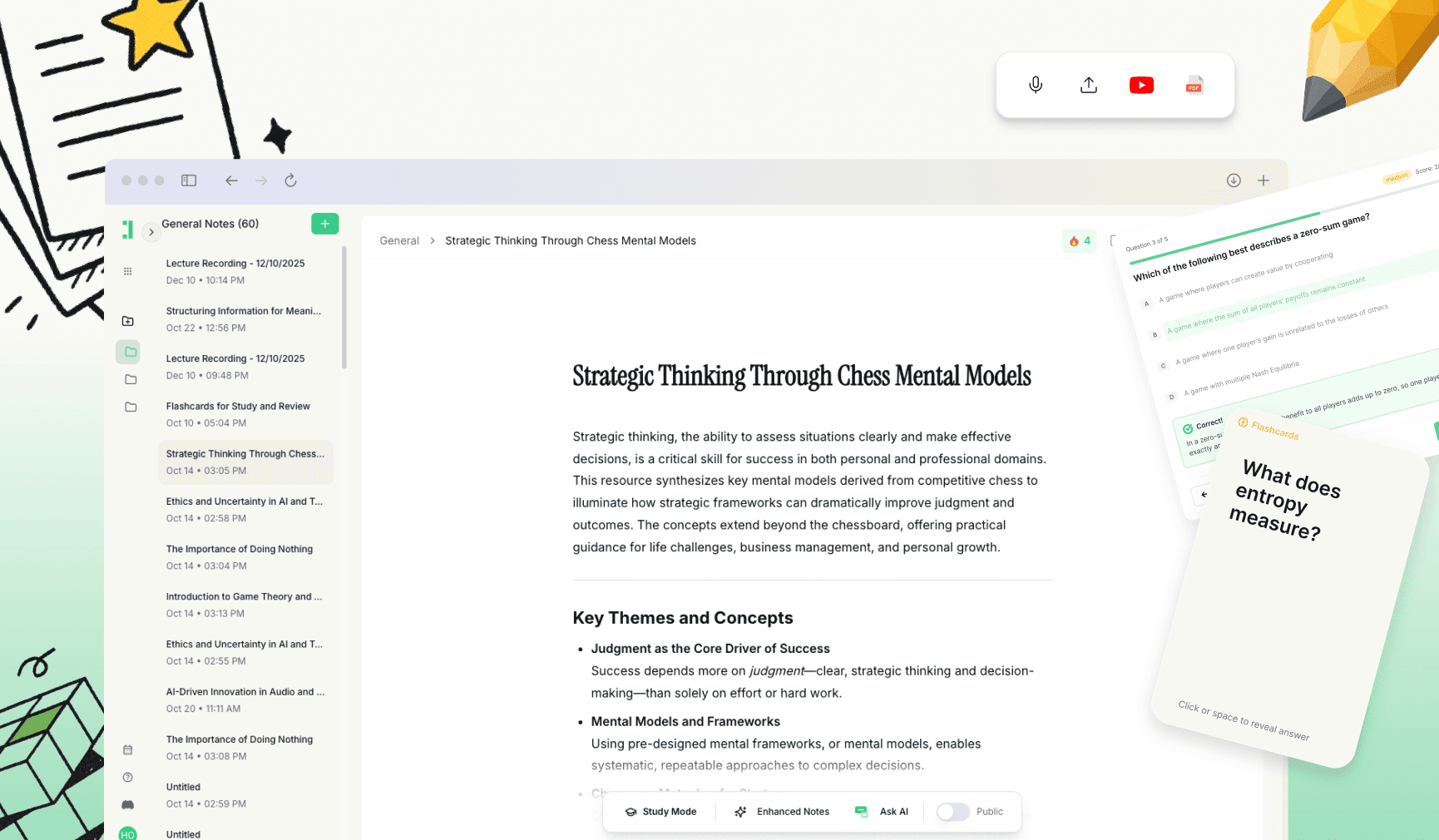
In Duetoday, you simply upload your engineering materials, and our AI generates a structured deck. You can then review, edit, and study using active recall to ensure you're exam-ready.
What are Mechanical Engineering Dynamics flashcards?
Mechanical Engineering Dynamics flashcards cover the study of bodies in motion. These cards focus on key terms, vector equations, laws of motion, and the relationships between force, mass, and acceleration. They help break down complex multi-part problems into manageable concepts.
The outcome is simple: instead of rereading dense textbooks, you test yourself on core principles like impulse-momentum and work-energy. If you already have lecture notes, Duetoday can generate a clean deck in minutes so you can spend your time solving problems rather than writing out cards.
Why flashcards work for Mechanical Engineering Dynamics
Dynamics requires a mix of conceptual understanding and rapid formula application. Flashcards bridge this gap by forcing you to identify which physical law applies to a specific scenario instantly. Using active recall and spaced repetition helps you move these complex derivations from short-term memory into long-term mastery.
Remember vector identities and coordinate systems without cramming
Separate similar concepts (e.g., Rectilinear vs. Curvilinear motion)
Learn multi-step processes like drawing Free Body Diagrams (FBDs)
Practice applying Newton’s Second Law and conservation rules quickly
What to include in your Dynamics flashcards
Effective Dynamics flashcards follow the one idea per card rule. They should be question-based, forcing you to think through the mechanics before seeing the answer. Focus on the 'why' and the 'how' behind the motion.
Definitions & key terms: What is an inertial frame of reference? or Define the coefficient of restitution.
Processes & steps: What are the four steps to solve a relative-velocity problem?
Comparisons: How is polar coordinate acceleration different from normal-tangential acceleration?
Application: When energy is conserved, what is the relationship between T1, V1, T2, and V2?
Example Prompts: State the Work-Energy Principle, Equation for mass moment of inertia of a disk, Difference between kinetics and kinematics, and Formula for angular momentum about a fixed point.
How to study Dynamics with flashcards
Engineering subjects are best mastered with a two-pass approach. First, use flashcards to lock in the formulas and definitions. Second, apply those concepts to practice problems. Review your deck in rounds, focusing heavily on the derivations or signs (positive/negative) that often lead to errors.
Make a deck from your lecture slides or textbook chapters.
Do one quick round to identify which formulas you keep forgetting.
Review weak cards daily, especially vector transformations.
Mix in conceptual cards with calculation-based prompts.
Do a final mixed review of all chapters before your midterm or final.
Generate Dynamics flashcards automatically in Duetoday
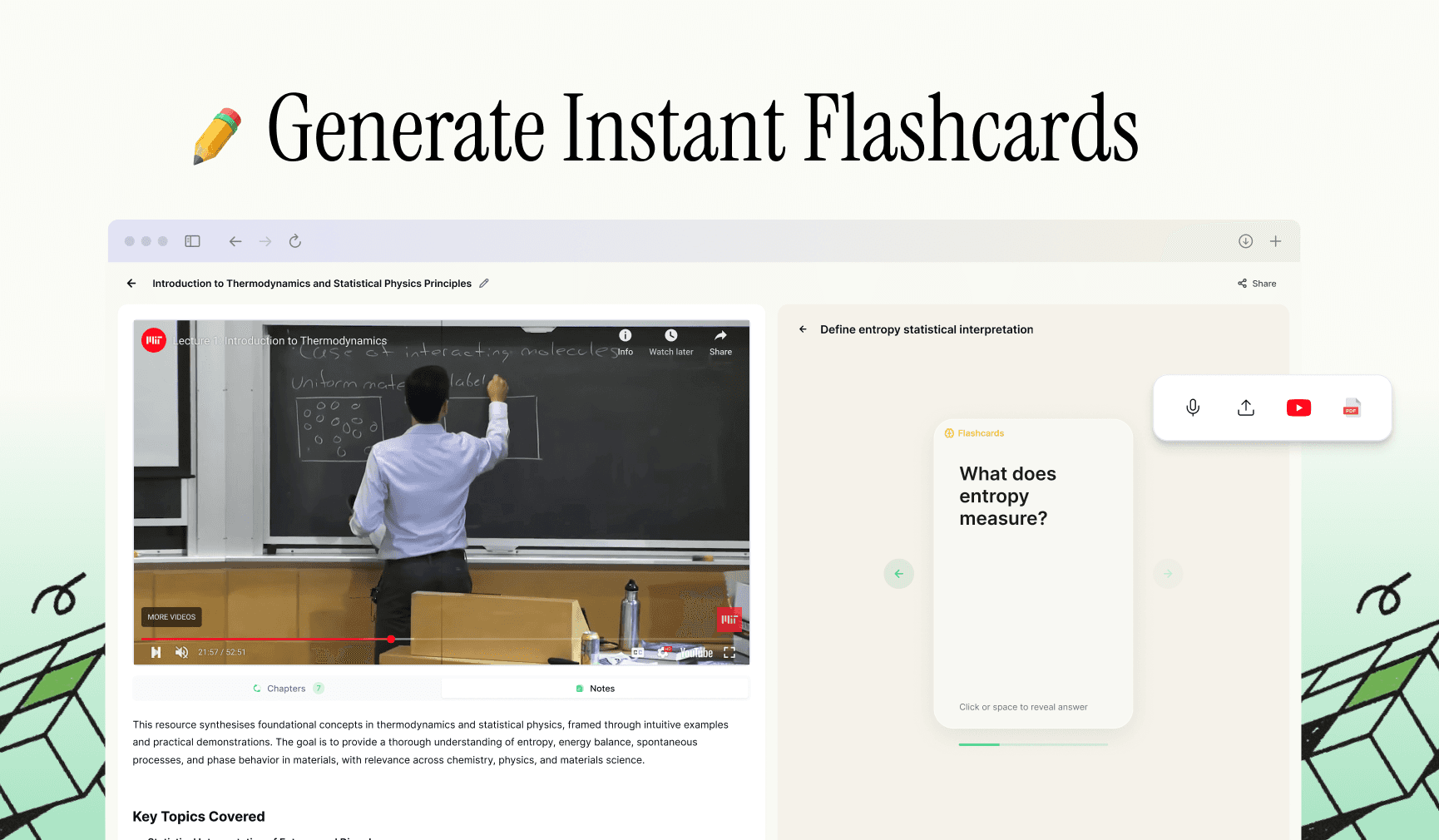
Making engineering cards manually is slow and prone to errors, especially with complex LaTeX formulas or diagrams. Duetoday automates this process so you can get back to your CAD projects and problem sets.
Upload your Dynamics PDF, slides, or textbook snippets.
Click Generate Flashcards.
Review the AI-generated deck, edit for specific nomenclature, and start studying.
Generate Dynamics Flashcards in Duetoday
Start with your notes and get a deck you can actually use today.
Common Dynamics flashcard mistakes
Most students make cards that are too wordy for a technical subject. Split long derivations into individual steps. Don't just memorize the final formula; add cards that ask for the assumptions required (e.g., Is this valid for non-rigid bodies?). Also, avoid ignoring the units—always include SI or US Customary units on your cards to prevent easy mistakes on exams.
Ready to generate your Dynamics flashcards?
Upload your notes, generate your deck, and master the laws of motion with active recall. Duetoday works with PDFs, lecture transcripts, and textbook chapters.
Start Generating Flashcards
FAQ
How many flashcards do I need for Dynamics? Usually 50-80 cards per exam chapter is sufficient to cover key formulas and conceptual definitions.
What’s the best format for Dynamics flashcards? Question on the front (e.g., Equation for Normal Acceleration?) and the symbolic formula with a small diagram description on the back.
How often should I review my cards? Daily for the 3 days leading up to a quiz, and then weekly to keep the formulas fresh for the final exam.
Can I generate cards from a PDF textbook? Yes, Duetoday can parse PDF text and diagrams to create relevant study prompts automatically.
Should I include full problems on cards? No, keep them short. Use cards for the steps of the problem, not the entire calculation.
How do I handle complex formulas? Break the formula into components (e.g., one card for the radial term, one for the transverse term).
Are digital flashcards better for engineering? Yes, because you can easily edit formulas and carry hundreds of cards on your phone without the bulk.
How long does it take to generate a deck? With Duetoday, a full chapter's worth of flashcards is generated in under 60 seconds.
Can I add my own images? Yes, you can edit generated cards to add specific Free Body Diagrams from your notes.
Does this work for Rigid Body Dynamics too? Absolutely, the AI handles both particle and rigid body motion concepts seamlessly.

Duetoday is an AI-powered learning OS that turns your study materials into personalised, bite-sized study guides, cheat sheets, and active learning flows.