Generate Flashcards for Mathematical Statistics
Generate mathematical statistics flashcards to master probability and inference. Make custom study decks from your notes.
Generate Flashcards with AI Free
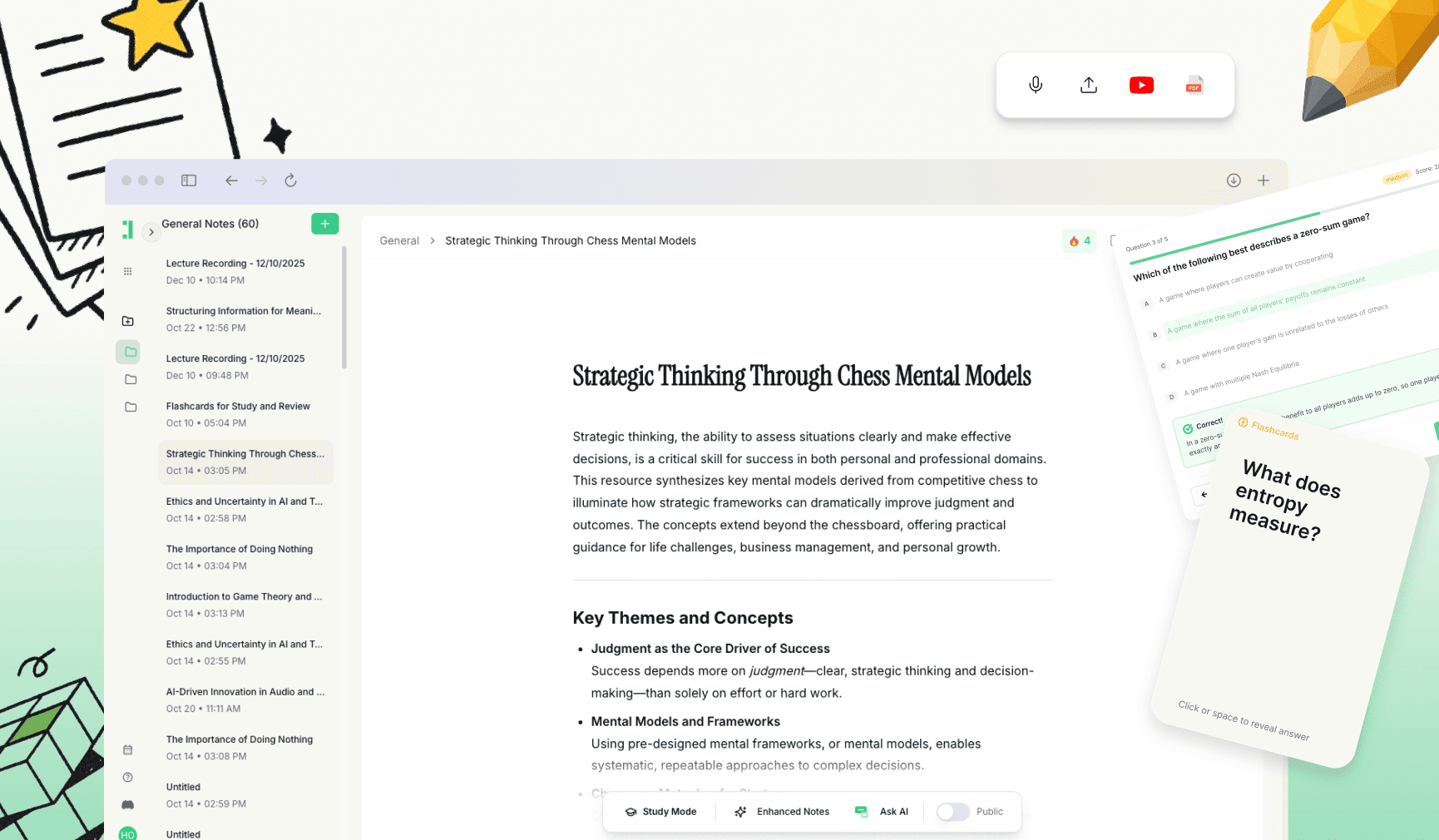
Generate Flashcards for Mathematical Statistics
Turn your complex formulas, probability theorems, and statistical distributions into Mathematical Statistics flashcards so you can master the theory and solve problems faster. Whether you are working through asymptotic theory or Bayesian inference, Duetoday helps you stop staring at textbooks and start active recall.
Generate Mathematical Statistics Flashcards Upload your notes
In Duetoday, you simply upload your lecture slides or textbook PDFs, and our AI extracts the core theorems and formulas to build a custom deck that you can review or edit instantly.
What are Mathematical Statistics flashcards?
Mathematical Statistics flashcards cover the theoretical foundation of data analysis, including probability mass functions, moment-generating functions, and the properties of estimators. They transform dense proofs and definitions into bite-sized questions that test your understanding of how and why statistical methods work.
The outcome is a shift from passive reading to active testing. Instead of hoping you remember the Central Limit Theorem, you test your ability to state its conditions and implications from memory.
Why flashcards work for Mathematical Statistics
This subject requires a precise memory of definitions and the ability to distinguish between similar statistical properties. Flashcards use active recall and spaced repetition to help you lock in these technical details without the burnout of traditional cramming.
Memorize probability distributions (Normal, Binomial, Poisson) and their parameters.
Distinguish between similar concepts like Maximum Likelihood Estimation vs. Method of Moments.
Recall the steps for conducting formal hypothesis tests and confidence intervals.
Practice identifying the correct test statistic for different data scenarios.
What to include in your Mathematical Statistics flashcards
Effective math stats cards are specific. You should focus on one theorem or property per card to avoid cognitive overload. Using question-based prompts ensures you are actually retrieving information rather than just recognizing it.
Definitions & Key Terms: "Define sufficiency in the context of an estimator."
Theorems & Laws: "State the Law of Large Numbers (LLN)."
Properties: "What are the three properties of a valid Cumulative Distribution Function (CDF)?"
Application: "When would you use a T-distribution instead of a Z-distribution?"
Example prompts: "What is the expected value of a Bernoulli distribution?", "How do you calculate the Bias of an estimator?", "Define a Type II error in hypothesis testing."
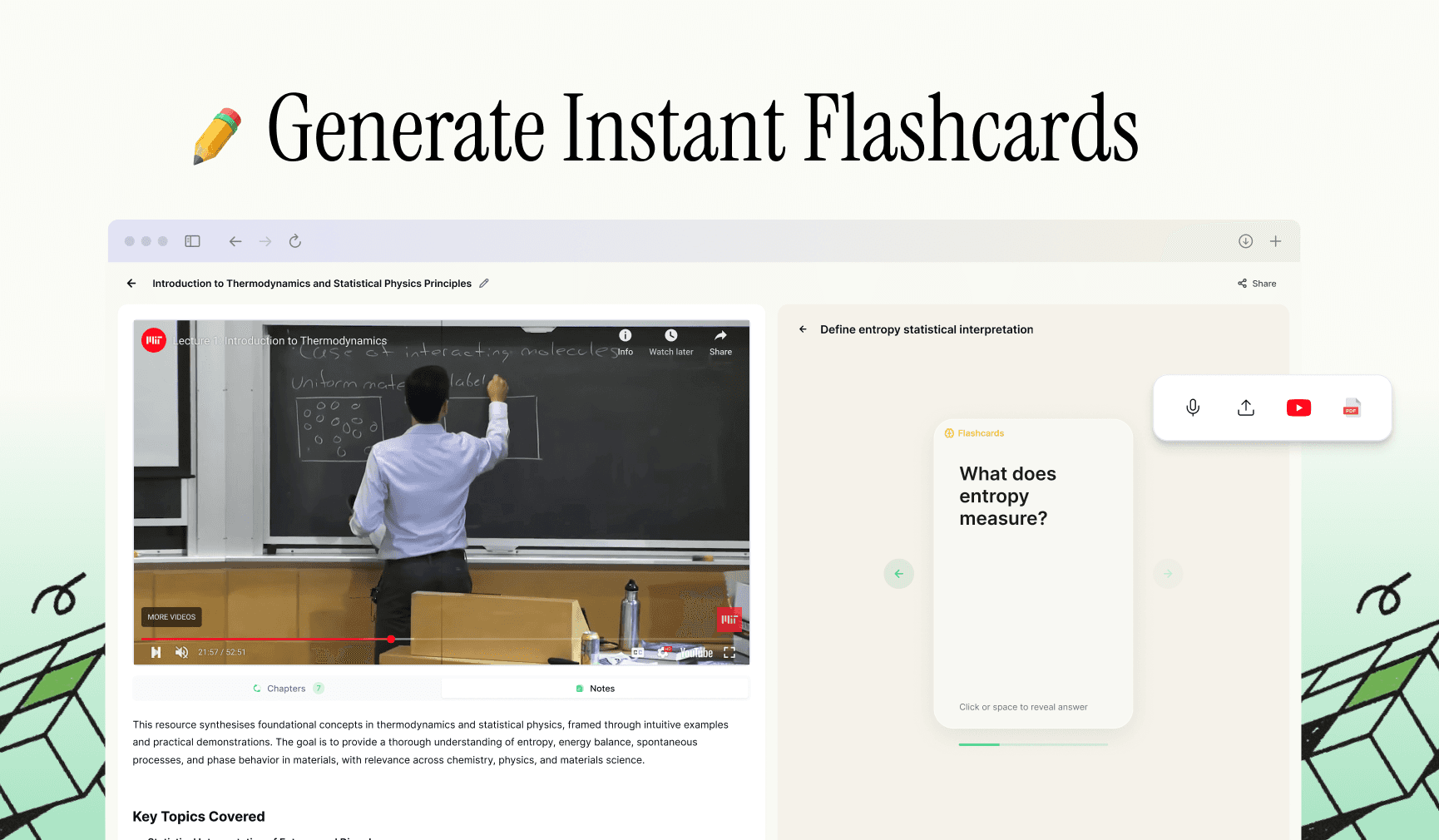
How to study Mathematical Statistics with flashcards
Mastering statistics is about repetition and application. Use a two-pass system: first, build a foundation of definitions, then move into the application of formulas. Review your deck in short, frequent bursts to keep the complex notation fresh in your mind.
Generate your deck from your syllabus or lecture notes.
Cycle through the deck once to flag formulas you consistently forget.
Focus on the 'weak' cards daily until the logic becomes second nature.
Mix theoretical proofs with numerical application cards to stay sharp.
Conduct a full deck review 48 hours before your exam.
Generate Mathematical Statistics flashcards automatically
Hand-writing math flashcards is tedious, especially with complex symbols and LaTeX formatting. Duetoday automates the grunt work so you can spend your time actually learning the material.
Simply upload your PDFs, slides, or handwritten notes, and Duetoday will generate a structured deck of Mathematical Statistics flashcards. You can then refine the cards, add your own notes, and start your study session immediately.
Upload your Mathematical Statistics material
Click 'Generate Flashcards'
Review, edit, and start mastering stats
Generate Mathematical Statistics Flashcards in Duetoday
Start with your notes and get a deck you can actually use today.
Common Mathematical Statistics flashcard mistakes
Many students create cards that are too wordy or focus on the wrong details. Avoid these pitfalls to make your study time more efficient:
Too much text: Don't put an entire five-step proof on one card; break it down.
Ignoring assumptions: Forgetting to include the 'when' (e.g., assuming normality when it's not given).
Focusing only on formulas: Make sure you include 'why' a formula is used, not just the symbols.
Low frequency: Math stats requires daily exposure to stay comfortable with the logic.
Ready to generate your Mathematical Statistics flashcards?
Stop rereading your stats textbook and start recalling the core concepts. Upload your notes, generate your deck, and master Mathematical Statistics with the power of AI-driven active recall.
Start Generating Flashcards
Works with notes, PDFs, slides, and transcripts.
FAQ
How many flashcards do I need for Mathematical Statistics? Typically 100-150 cards per exam module to cover distributions, estimation, and testing.
What’s the best format for these flashcards? Direct questions and 'Fill-in-the-blank' for formula components work best for math subjects.
How often should I review my stats cards? Daily review is recommended for 15-20 minutes to keep statistical notation fresh.
Should I make cards from a textbook or my notes? Both. Use the textbook for formal definitions and your notes for the specific examples your professor emphasized.
How do I stop forgetting formulas? Use spaced repetition; the AI will show you the formulas you struggle with more frequently.
What if the material is too complex? Break the concept down. Instead of one card for 'Bayesian Stats', make five cards for each step of the process.
Can I generate flashcards from a PDF? Yes, Duetoday can read Mathematical Statistics PDFs and convert them into study decks.
Are digital flashcards better than paper? Yes, because they allow for automated spaced repetition and easy editing for complex math symbols.
How long does it take to make a full deck? With Duetoday, you can generate a full deck in under a minute after uploading your notes.
Can Duetoday organize my cards by topic? Yes, you can categorize your decks by sub-topics like 'Probability' or 'Inference' for better organization.

Duetoday is an AI-powered learning OS that turns your study materials into personalised, bite-sized study guides, cheat sheets, and active learning flows.