Generate Flashcards for Materials Science
Easily generate or make Materials Science flashcards. Learn how to turn your engineering notes into study guides.
Generate Flashcards with AI Free
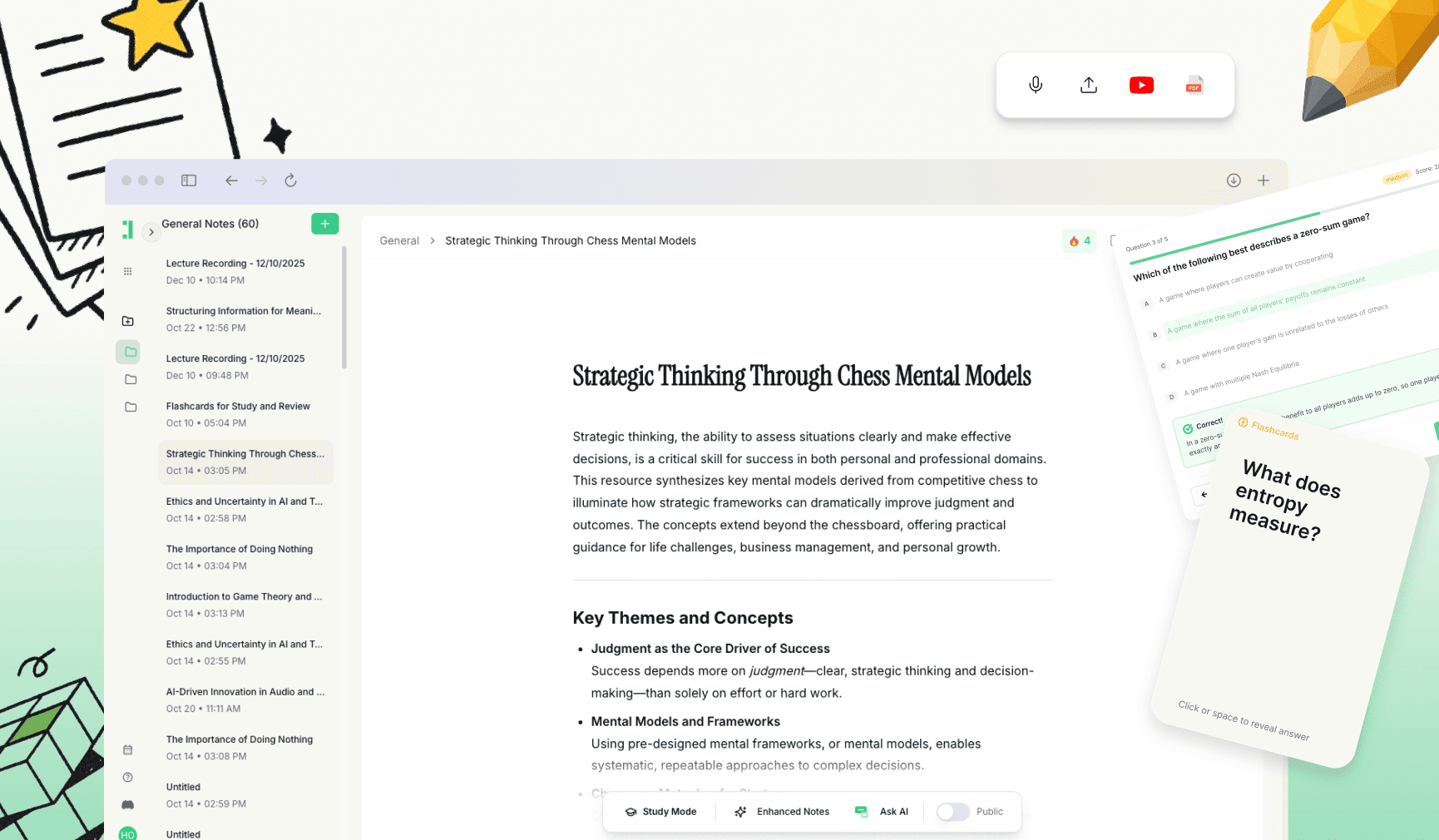
Generate Flashcards for Materials Science
Turn your notes, PDFs, slides, or lectures into Materials Science flashcards so you can review faster and remember more. Whether you are tackling crystallography or mechanical properties, Duetoday helps you convert complex technical data into bite-sized study sets.
How it works in Duetoday: upload your lecture materials or paste your textbook chapters → our AI analyzes the core concepts → generate a custom flashcard deck → review, edit, and start studying immediately.
What are Materials Science flashcards?
Materials Science flashcards are specialized study tools that cover the intersection of chemistry, physics, and engineering. They help you master key terms like lattice constants, Burgers vectors, and eutectic points. Instead of just looking at diagrams, these cards force you to recall specific formulas, material properties, and processing steps.
The outcome is a shift from passive reading to active testing. Instead of rereading your textbook for the third time, you test yourself on core concepts to build long-term memory and prepare for high-stakes engineering exams.
Why flashcards are one of the best ways to study Materials Science
Materials Science requires a mix of rote memorization (classification of materials) and conceptual application (predicting behavior based on structure). Flashcards are perfect for bridging this gap using active recall and spaced repetition.
Remember crystal systems and Bravais lattices without cramming.
Separate similar concepts like toughness vs. hardness or elasticity vs. plasticity.
Learn complex processes step-by-step, such as the stages of precipitation hardening or heat treatment cycles.
Practice applying Mohr's circle or Bragg's Law formulas quickly.
What to include in your Materials Science flashcards
Effective flashcards follow the atomic rule: one specific idea per card. When studying materials, focus on question-based prompts that challenge your understanding of structure-property relationships.
Definitions & Key Terms: What is an interstitial solid solution? or Define the Curie temperature.
Processes & Steps: What are the three stages of creep? or What happens first during cold working?
Comparisons: How is a screw dislocation different from an edge dislocation?
Application: When would you use a ceramic instead of a composite? or What happens to ductility if grain size increases?
Use prompts like: Draw the unit cell for BCC, State the Gibbs Phase Rule, and Explain the effect of carbon content on steel hardness.

How to study Materials Science with flashcards (a simple system)
To master the material, use a two-pass approach. Start by building your deck from your syllabus and lecture slides, then move into a structured review cycle that focuses on your weakest areas.
Make a deck from your notes or generate it from your textbook PDF using Duetoday.
Do one quick round through the whole deck to find weak spots (e.g., phase diagrams).
Review weak cards daily for a few days to build neural pathways.
Mix in harder application cards, such as stress-strain calculations, each session.
Do a final mixed review of all materials before your midterm or final exam.
Generate Materials Science flashcards automatically in Duetoday
Making cards manually for engineering subjects is slow, messy, and inconsistent. Copying diagrams and typing out definitions for every single polymer or alloy takes hours that you could be spending actually studying.
Duetoday streamlines the process: upload your Materials Science notes, PDFs, or slides, and get a professional-grade flashcard deck instantly. You can then edit the AI-generated responses to match your professor's specific requirements.
Upload or paste your Materials Science material.
Click Generate Flashcards.
Review, edit, and start studying in minutes.
Common Materials Science flashcard mistakes
Many students create ineffective cards that focus too much on vocabulary and not enough on logic. Avoid these pitfalls to get more out of your study sessions.
Cards are too long: Don't paste an entire paragraph about the iron-carbon phase diagram. Split it into one idea per card.
Only memorizing words: Add explain why prompts to ensure you understand the mechanics, not just the names.
Confusing similar concepts: Create specific comparison cards for concepts like martensite vs. pearlite.
No review schedule: Spaced repetition only works if you repeat the cards you find difficult more frequently.
Ready to generate your Materials Science flashcards?
Stop rereading and start recalling. Turn your complex engineering notes into a deck you can actually use today to ace your next exam.
Generate Materials Science Flashcards in Duetoday. Works with notes, PDFs, slides, and transcripts.
FAQ
How many flashcards do I need for Materials Science? It depends on the depth of the course, but a typical intro module usually requires 150-250 cards covering crystal structures, properties, and phase diagrams.
What’s the best format for Materials Science flashcards? Question-on-front, answer-on-back is best. For engineering, including short if/then scenarios is highly effective for property predictions.
How often should I review Materials Science flashcards? Daily for the first week after learning a new chapter. Once you've mastered a concept, you can shift to reviewing it once every 4-7 days.
Should I make cards from a textbook or slides? Use both. Textbooks provide the deep definitions, while lecture slides highlight specifically what your professor wants you to know for the exam.
How do I stop forgetting material after a few days? Use Duetoday's spaced repetition system. It ensures that the concepts you struggle with reappear more often than the ones you've mastered.
What if my flashcards feel too easy? Add why questions. Instead of What is the unit cell for Copper? use Why does Copper's FCC structure make it highly ductile?
Can I generate Materials Science flashcards from a PDF automatically? Yes, Duetoday can read your chapter PDFs or lecture slides and extract the most important technical terms and concepts for you.
Are digital flashcards better than paper for Materials Science? Digital is usually better because you can easily include diagrams of crystal structures and phase diagrams without drawing them by hand.
How long does it take to make a full deck? Manually, it can take 3-4 hours per chapter. With Duetoday’s AI generation, you can have a full deck ready in under 60 seconds.
Can Duetoday organize my flashcards by topic? Yes, you can generate and organize decks by specific Materials Science topics like Thermodynamics, Kinetics, or Polymers.

Duetoday is an AI-powered learning OS that turns your study materials into personalised, bite-sized study guides, cheat sheets, and active learning flows.