Generate Flashcards for Mass Spectrometry
Make Mass Spectrometry flashcards from your notes. Learn to generate custom study sets for organic chemistry and analytical physics.
Generate Flashcards with AI Free
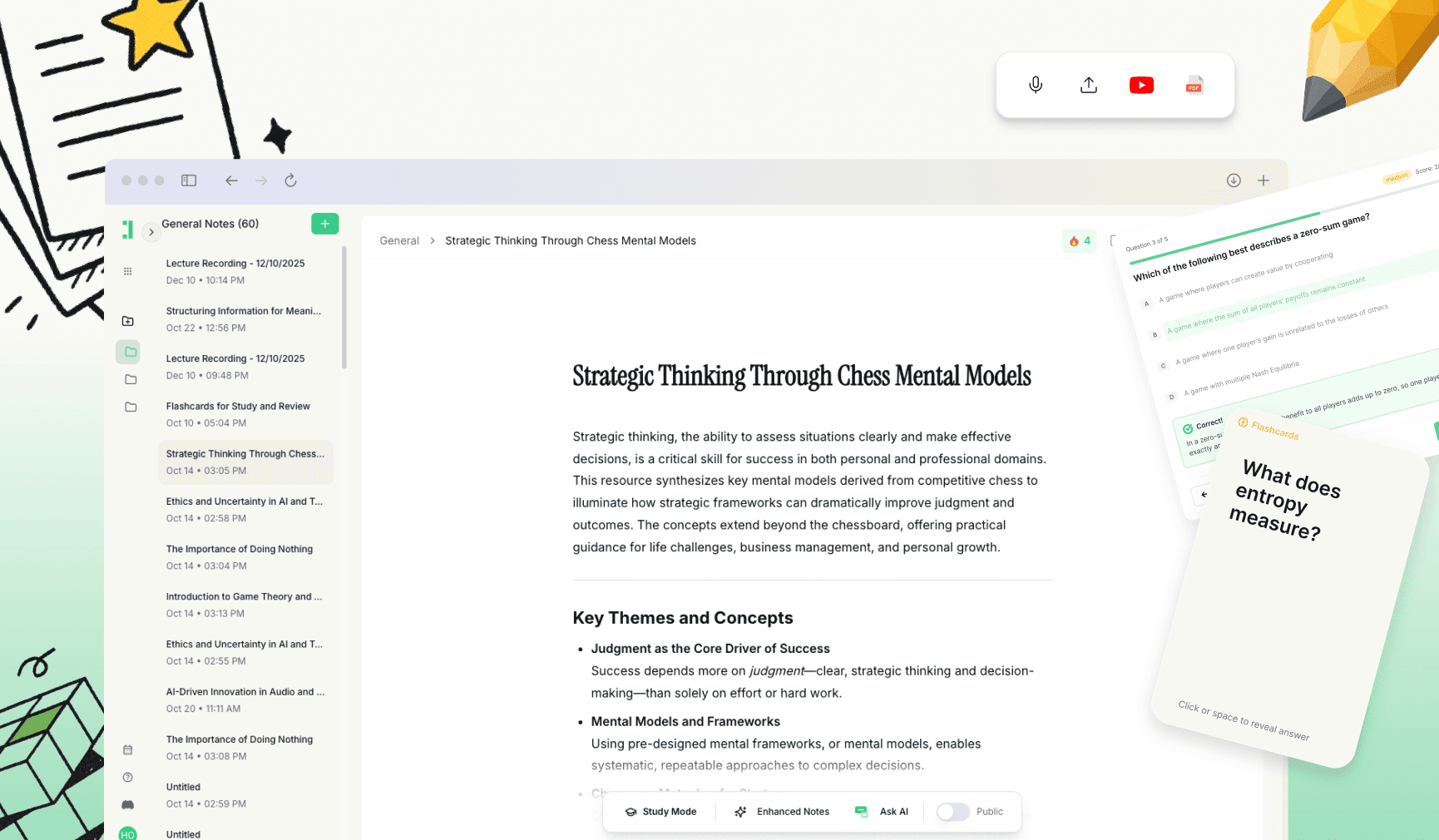
What are Mass Spectrometry flashcards?
Mass spectrometry flashcards are targeted study tools designed to help you master the complex analytical techniques used to measure the mass-to-charge ratio of ions. These flashcards cover critical components like ionization sources (ESI, MALDI, EI), mass analyzers (Quadrupole, TOF, Orbitrap), and the interpretation of isotopic patterns and fragmentation pathways.
Instead of passively rereading dense textbooks or staring at complex spectra, flashcards force you into active recall. By testing your knowledge of m/z ratios and molecular ion peaks, you build the neural pathways required to identify unknown compounds quickly during exams or lab work. If you already have lecture slides or lab notes, Duetoday can generate a clean deck in minutes so you can skip the manual data entry.
Why flashcards are one of the best ways to study Mass Spectrometry
Mass spectrometry is a subject built on specific definitions, structural relationships, and multi-step processes. Flashcards are uniquely suited for this because they allow you to isolate individual variables—like the difference between hard and soft ionization—without getting overwhelmed by the entire spectrum at once.
Using spaced repetition helps you move beyond rote memorization into true functional understanding. By reviewing difficult concepts like the McLafferty rearrangement more frequently than basic definitions, you optimize your study time and ensure long-term retention of analytical chemistry principles.
Memorize m/z ratios for common functional groups without cramming.
Separate similar concepts like Base Peak vs. Molecular Ion Peak.
Learn the step-by-step physics behind various mass analyzers.
Practice identifying McLafferty rearrangements and alpha-cleavages.
What to include in your Mass Spectrometry flashcards
Effectiveness in mass spec stems from the one idea per card rule. Your deck should be built around specific questions that trigger a precise answer, moving from basic vocabulary to complex spectral interpretation. Duetoday ensures your cards are balanced between theory and application.
Definitions & key terms: What is the mass-to-charge ratio (m/z)? Define the nitrogen rule.
Processes & steps: What are the four stages of a Time-of-Flight (TOF) analyzer?
Comparisons: How does Electron Ionization (EI) differ from Chemical Ionization (CI)?
Application: Given a base peak at m/z 91, what structural element is likely present?
Try these example prompts in your deck:
• Define 'Hard Ionization' and give one example.
• What is the isotopic ratio of Chlorine-35 to Chlorine-37?
• Identify the loss of 15 m/z units in a spectrum.
• Explain the role of the detector in a mass spectrometer.
• Why is high vacuum necessary in the mass analyzer?
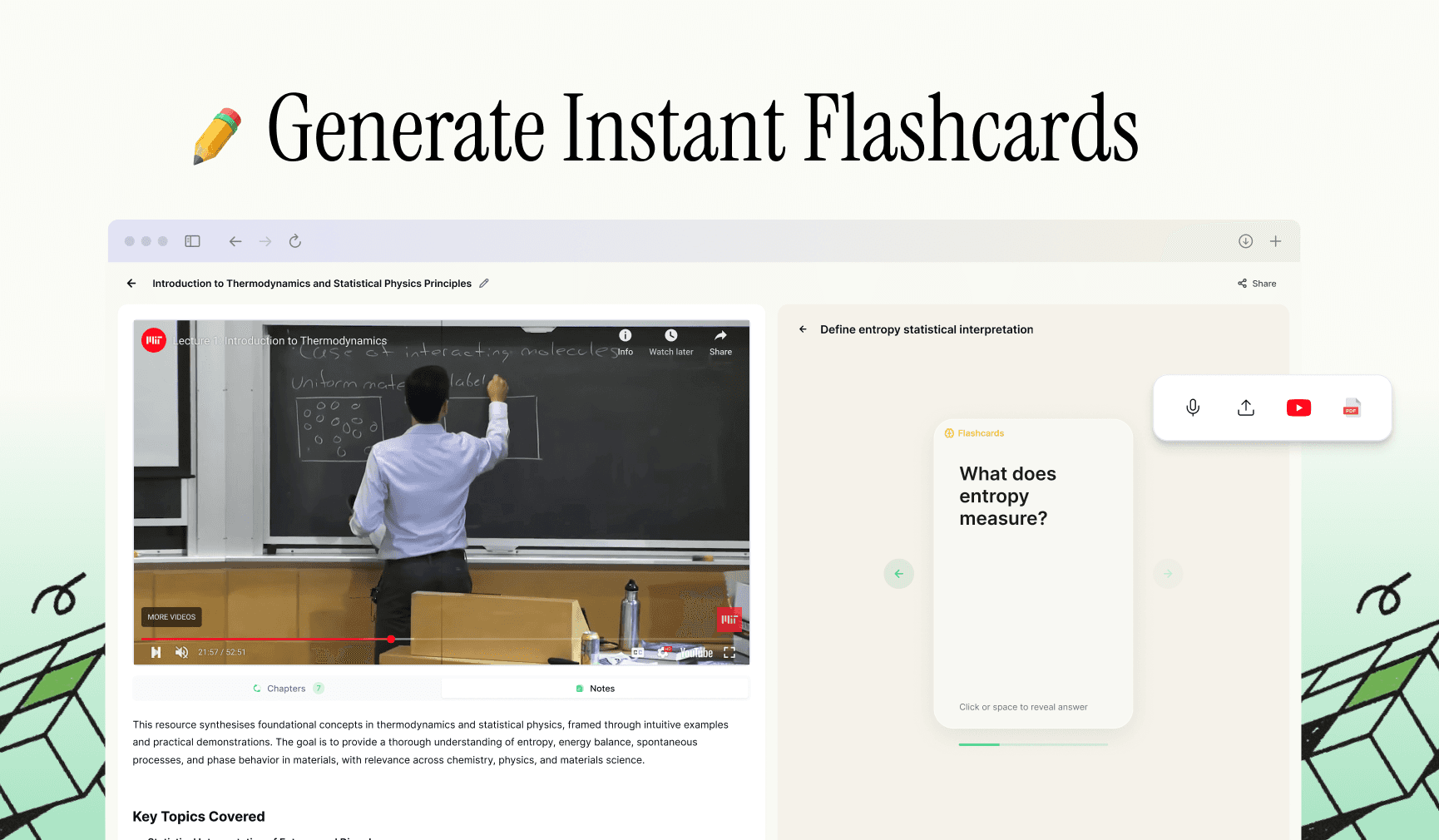
How to study Mass Spectrometry with flashcards (a simple system)
Start by creating a comprehensive deck from your lecture notes or textbook chapters. Once generated, perform an initial diagnostic pass where you go through the entire deck to identify which fragmentation patterns or instrumentation details are clicking and which feel like a foreign language. Repeat the difficult cards daily while pushing the easier ones to every three days.
As you get closer to your exam, mix your flashcards with actual spectral analysis. Look at a card describing an ionization method, then immediately try to find how that method would appear on a real-world mass spectrum printout.
Generate a deck from your PDF notes or slides.
Do one quick round to flag weak spots in instrumentation or theory.
Review high-difficulty cards daily for three days.
Mix in fragmentation application cards with theory cards.
Perform a final randomized review of at least 50 cards before your test.
Generate Mass Spectrometry flashcards automatically in Duetoday
Manually drawing out fragmentation pathways or typing out the mechanics of a reflectron on paper cards is incredibly time-consuming. It takes hours that should be spent actually studying the material. Duetoday automates this process by scanning your study materials and extracting the most important data points into study-ready cards.
Whether you have a 50-page PDF on proteomics or a handwritten set of notes on isotopic clusters, Duetoday formats the information into clear, concise questions and answers.
Upload your Mass Spectrometry slides or lab manual.
Click Generate Flashcards.
Review the AI-generated deck, edit for personal preference, and start studying.
Common Mass Spectrometry flashcard mistakes
Many students make the mistake of putting too much information on a single card. For example, trying to list every single possible fragment for a molecule on one card usually leads to frustration rather than learning. Instead, break it down: one card for the base peak, one for the M+1 peak, and one for a specific cleavage. Don't just memorize the name of the instrument; make sure you have cards that ask *why* a specific analyzer (like an Ion Trap) is used in certain scenarios.
Ready to generate your Mass Spectrometry flashcards?
Stop rereading and start recalling. Upload your notes today and turn your hardest science topic into your strongest subject.
FAQ
How many flashcards do I need for Mass Spectrometry?
A typical undergraduate module usually requires 60–100 cards to cover instrumentation, ionization, and basic fragmentation. More advanced proteomics or forensic sets may require 150+ cards.
What’s the best format for Mass Spectrometry flashcards?
The most effective format is the 'Question and Answer' style where the front asks for a mechanism or definition and the back provides a concise explanation or a visual structural hint.
How often should I review Mass Spectrometry flashcards?
For heavy analytical subjects, a daily 15-minute session is better than a once-a-week 3-hour session. Use spaced repetition to keep information fresh.
Should I make cards from a textbook or lecture notes?
Lecture notes are usually better for exam preparation as they highlight the specific instruments and patterns your professor prioritizes, while textbooks provide broader context.
How do I stop forgetting fragmentation patterns?
Include 'Application' cards that describe a mass loss (e.g., loss of 18 for water) and ask you to name the fragment, rather than just memorizing the formula.
Can I generate Mass Spectrometry flashcards from a PDF?
Yes, Duetoday specializes in reading complex scientific PDFs and converting the text and tables into structured study cards automatically.
Are digital flashcards better than paper for this topic?
Digital is generally superior for Mass Spectrometry because you can easily include high-resolution images of spectra and use AI to organize cards by difficulty.
How long does it take to make a full deck?
Using Duetoday, you can generate a full deck from a lecture file in under 60 seconds. Doing it manually would likely take 2 to 3 hours.
What if my flashcards feel too easy?
If cards feel easy, it's time to add 'Scenario' cards. Instead of asking 'What is CI?', ask 'Which ionization method would you use for a thermally unstable large protein?'.
Can Duetoday handle mathematical formulas in Mass Spec?
Yes, Duetoday can recognize and generate cards based on the mathematical principles of m/z calculations and resolution formulas.

Duetoday is an AI-powered learning OS that turns your study materials into personalised, bite-sized study guides, cheat sheets, and active learning flows.