Generate Flashcards for Magnetism
Generate magnetism flashcards from your notes in seconds. Try Duetoday for free now!
Generate Flashcards with AI Free
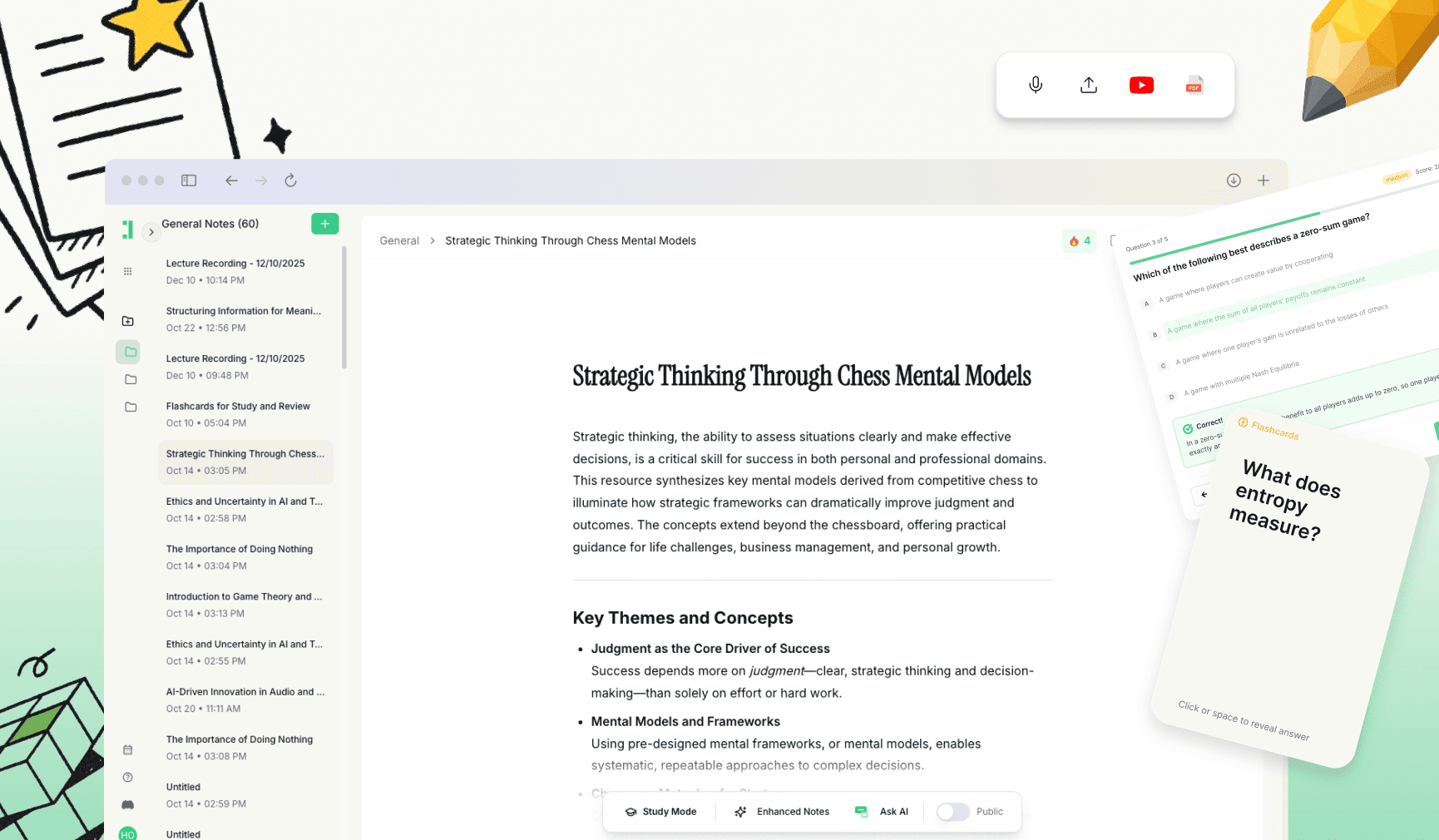
Generate Flashcards for Magnetism
Turn your physics notes, PDFs, slides, or lectures into magnetism flashcards so you can review faster and remember more. Whether you are studying for a high school quiz or a university electromagnetism exam, Duetoday helps you master complex concepts in seconds.
Generate Magnetism FlashcardsUpload notes / paste text
In Duetoday, you simply upload your study material, and our AI identifies key physics laws and formulas to generate a custom deck. You can then review, edit, and use active recall to ensure the information sticks.
What are magnetism flashcards?
Magnetism flashcards cover the fundamental principles of magnetic forces, fields, and materials. They break down complex topics like magnetic flux, Ampere’s Law, Lenz's Law, and the properties of ferromagnetic materials into bite-sized, testable units.
Instead of passively rereading a textbook chapter on electromagnetic induction, you test your knowledge by answering specific questions. This forces your brain to retrieve the information, which builds significantly stronger neural pathways and long-term recall.
If you already have notes, Duetoday can generate a clean deck in minutes.
Why flashcards are one of the best ways to study magnetism
Magnetism is a subject built on specific relationships—like the direction of a force relative to a current or the relationship between electricity and magnetism. Flashcards are ideal because they isolate these variables and force you to visualize the physics in action.
By using active recall and spaced repetition, you ensure that you don't just memorize a formula, but understand when and how to apply it. You can focus your energy on the laws that confuse you most while maintaining your knowledge of the basics.
Remember key terms like Tesla, Weber, and Hysteresis without cramming
Separate similar concepts (e.g., Paramagnetism vs. Diamagnetism)
Learn processes step-by-step (how a motor works or the stages of induction)
Practice applying the Right-Hand Rule quickly
What to include in your magnetism flashcards
Effective magnetism flashcards follow the "atomic" principle: one idea per card. This prevents "the illusion of competence" where you think you know a concept because you recognize parts of a long paragraph.
Your deck should be question-based and cover four main categories to ensure a holistic understanding of the topic.
Definitions & key terms: "What is a magnetic dipole?" "Define magnetic flux in one sentence."
Processes & steps: "What happens to the current when the magnetic field through a loop changes?"
Comparisons: "How is a hard magnet different from a soft magnet?"
Application: "In which direction does the force point if the current is moving upward in a northward field?"
Example prompts for your deck: "What is the SI unit for magnetic flux?", "State Faraday’s Law of Induction," "What are the three most common ferromagnetic elements?", "How does temperature affect magnetic alignment?", "Describe the shape of a magnetic field around a straight wire."
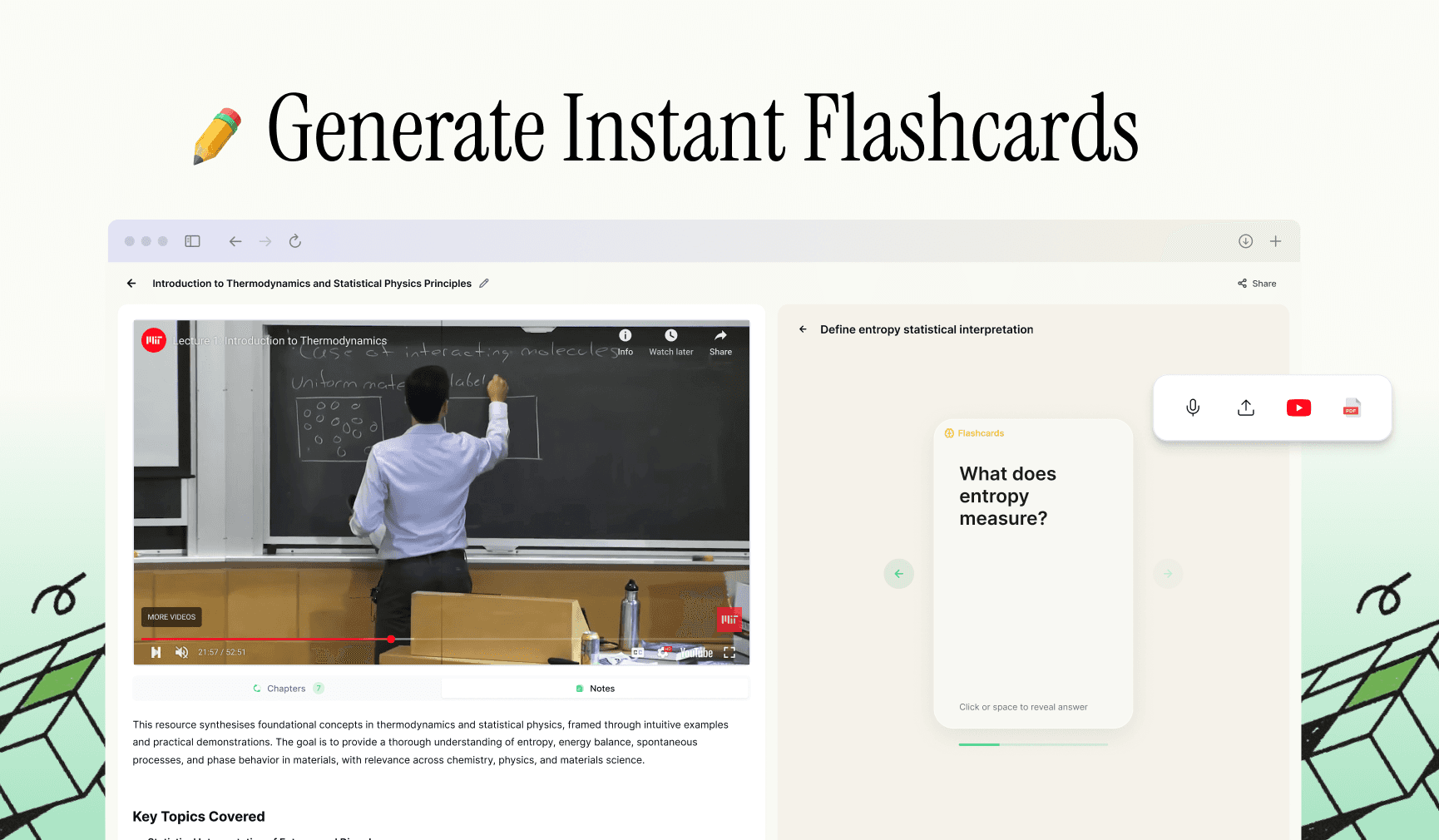
How to study magnetism with flashcards (a simple system)
Magnetism requires both conceptual understanding and spatial reasoning. Use a two-pass approach: first, build your deck from your syllabus or notes, then use focused review rounds to master the material.
Don't try to master the whole deck at once. Start with short, frequent sessions. Visualizing the magnetic field lines while answering the cards can help bridge the gap between theory and application.
Make a deck from your notes (or generate it from content using Duetoday).
Do one quick round to find weak spots like specific formulas or right-hand rules.
Review weak cards daily for a few days to build muscle memory.
Mix in a few harder application cards each session to simulate exam conditions.
Do a final mixed review of all magnetism topics before your exam.
Generate magnetism flashcards automatically in Duetoday
Making physics flashcards manually is slow, messy, and inconsistent. Drawing diagrams or typing out the Greek symbols for flux and permeability takes time you should be spending on actual studying.
Duetoday solves this by automating the creation process. Simply upload your PDF, lecture slides, or even a recording of your physics professor. Our AI identifies the core laws and creates a structured deck for you instantly.
Upload or paste your magnetism material
Click Generate Flashcards
Review, edit, and start studying immediately
Generate Magnetism Flashcards in Duetoday
Start with your notes and get a deck you can actually use today.
Common magnetism flashcard mistakes (and how to fix them)
Most students make cards that are too wordy, which leads to memorizing the "sound" of the sentence rather than the physics concept.
Cards are too long: Split long laws like Maxwell's equations into individual components.
Only memorizing words: Include prompts that ask "why" a field behaves a certain way.
Confusing field directions: Add specific cards for different Right-Hand Rule scenarios.
No review schedule: Magnetism involves many details; use spaced repetition to keep them fresh.
No application practice: Don't just define B-fields; add cards that ask for the force on a moving charge.
Ready to generate your magnetism flashcards?
Stop wasting hours on manual data entry. Upload your notes, generate your deck, and start mastering magnetism with active recall today.
Start Generating Flashcards
Works with notes, PDFs, slides, and transcripts.
FAQ
How many flashcards do I need for magnetism? A standard unit usually requires 40-60 cards to cover all definitions, laws, and common application scenarios.
What’s the best format for magnetism flashcards? Question-and-answer format is best. Use "What is..." for definitions and "What happens if..." for conceptual understanding.
How often should I review magnetism flashcards? Review new cards daily for the first three days, then use spaced repetition to review them once every few days as the exam approaches.
Should I make cards from a textbook, lecture notes, or slides? Use all three. Textbooks provide definitions, while lecture notes usually highlight the specific types of problems your teacher prefers.
How do I stop forgetting magnetism laws after a few days? Spaced repetition is the key. By testing yourself just as you are about to forget, you strengthen the memory significantly more than rereading.
What if my flashcards feel too easy or too hard? If they are too easy, combine concepts. If they are too hard, break the card into two smaller, simpler questions.
Can I generate magnetism flashcards from a PDF automatically? Yes, Duetoday can scan your magnetism PDFs and extract the most important information to create cards instantly.
Are digital flashcards better than paper for magnetism? Digital cards are superior because they use algorithms to show you the cards you struggle with more frequently, saving you time.
How long does it take to make a full magnetism deck? Manually, it can take 2-3 hours. With Duetoday, it takes less than a minute after uploading your materials.
Can Duetoday generate and organize my flashcards for me? Absolutely. Duetoday categorizes your cards and stores them in your library for easy access anytime.

Duetoday is an AI-powered learning OS that turns your study materials into personalised, bite-sized study guides, cheat sheets, and active learning flows.