Generate Flashcards for Machine Learning
Learn how to generate Machine Learning flashcards to master algorithms and data science concepts with this study guide.
Generate Flashcards with AI Free
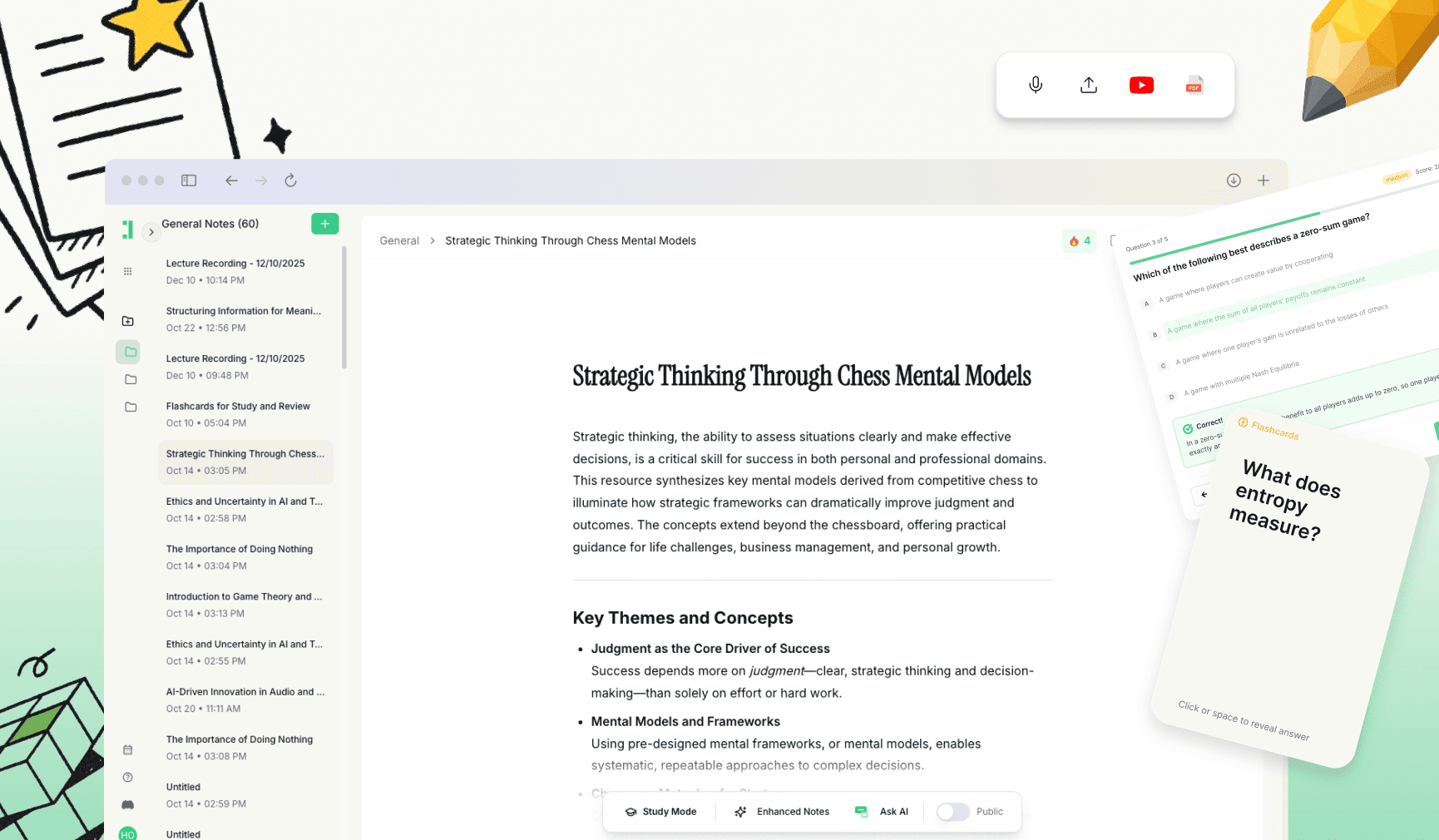
Generate Flashcards for Machine Learning
Turn your notes, PDFs, slides, or lectures into Machine Learning flashcards so you can review faster and remember more. Instead of spending hours manually copying formulas and definitions, let AI handle the heavy lifting so you can focus on mastering complex concepts.
Generate Machine Learning FlashcardsUpload notes / paste text
In Duetoday, the process is simple: upload your study material, click generate, review the AI-created cards, and start your study session immediately.
What are Machine Learning flashcards?
Machine Learning flashcards are bite-sized study aids that cover essential topics like supervised learning, neural network architectures, bias-variance tradeoffs, and optimize functions. They distill complex mathematical theories and programming concepts into quick-fire questions and answers.
By using these cards, you move away from passive rereading toward active self-testing. This builds stronger neural pathways for recalling how a specific algorithm works or which loss function is best for a given task. If you already have notes, Duetoday can generate a clean deck in minutes.
Why flashcards are one of the best ways to study Machine Learning
Machine Learning requires a mix of conceptual understanding and technical memorization. Flashcards help bridge the gap between knowing a definition and understanding how to apply a model. They use active recall and spaced repetition to ensure you don't forget the difference between L1 and L2 regularization the day after you read about them.
Remember key terms like Backpropagation or Overfitting without cramming.
Separate similar concepts (e.g., K-Means vs. KNN).
Learn processes step-by-step, such as the gradient descent update rule.
Practice applying rules and formulas for evaluation metrics like Precision and Recall.
What to include in your Machine Learning flashcards
The most effective Machine Learning flashcards follow the one idea per card rule. They should be question-based and focus on both the what and the why. We recommend breaking your materials down into four distinct categories to ensure full coverage of the subject.
Definitions & Key Terms: What is a Hyperparameter? or Define Stochastic Gradient Descent.
Processes & Steps: What are the four main steps in a standard ML pipeline?
Comparisons: How is Random Forest different from Gradient Boosting?
Application: When would you use a Softmax activation function versus a Sigmoid?
Example prompts: Explain the purpose of a validation set, What does the Area Under the ROC Curve represent? and What happens if the learning rate is too high?
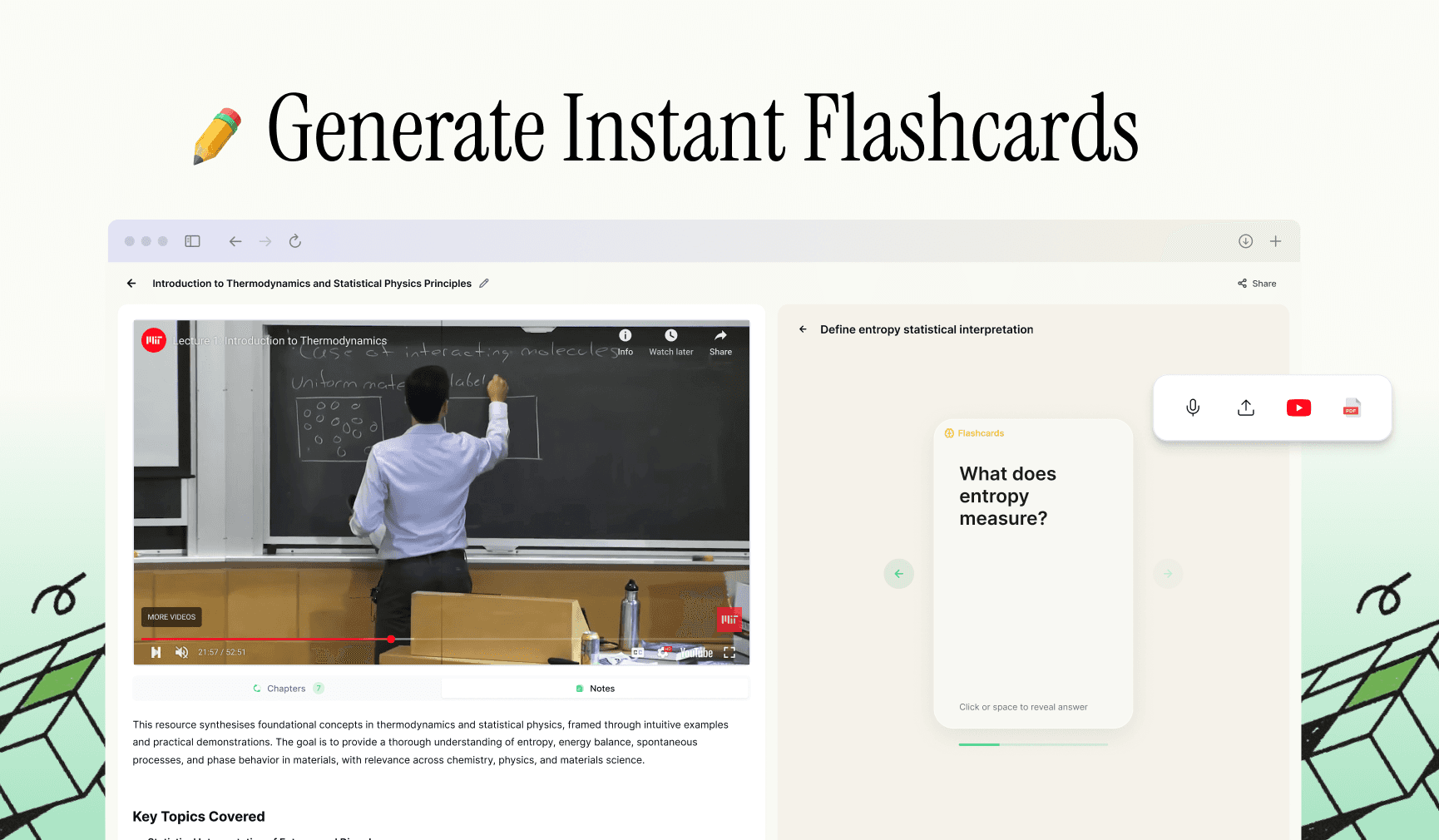
How to study Machine Learning with flashcards (a simple system)
Mastering Machine Learning isn't about memorizing a textbook; it's about frequent, high-intensity review. We recommend a two-pass approach: first, use AI to build your deck from your syllabus, then iterate through rounds of testing until the concepts stick.
Review in short, focused sessions. If a card about Eigenvalues is easy, move it to a weekly review. If a card about Kernel Tricks is hard, see it every day until it becomes second nature.
Make a deck from your notes or generate it automatically from your PDF chapters.
Do one quick round to find weak spots in your math or coding logic.
Review weak cards daily for at least three days.
Mix in harder application cards as you get more comfortable.
Do a final mixed review of all models before your exam or technical interview.
Generate Machine Learning flashcards automatically in Duetoday
Making cards manually for a subject as technical as Machine Learning is slow and prone to errors, especially with complex equations. Duetoday eliminates the friction by turning your technical documents into structured study tools instantly.
Simply upload your lecture slides or paste your research paper text. Our AI understands the context of the material, ensuring that your cards are accurate and relevant to your specific curriculum.
Upload or paste your Machine Learning material
Click Generate Flashcards
Review, edit, and start studying
Generate Machine Learning Flashcards in Duetoday
Start with your notes and get a deck you can actually use today.
Common Machine Learning flashcard mistakes
Many students make the mistake of creating encyclopedia cards—cards that are far too long. If a card takes 30 seconds to read, it isn't a flashcard. Another common error is focusing only on vocabulary while ignoring the underlying math or logic.
Cards are too long: Split complex architectures like Transformers into multiple cards.
Only memorizing words: Always include why prompts to test your deep understanding.
Confusing similar models: Use comparison cards to highlight the trade-offs between algorithms.
No review schedule: Ensure you are using spaced repetition for better long-term retention.
Ready to generate your Machine Learning flashcards?
Stop rereading and start recalling. Upload your notes today and let Duetoday build your perfect Machine Learning study deck in seconds.
Start Generating Flashcards
Works with notes, PDFs, slides, and transcripts.
FAQ
How many flashcards do I need for Machine Learning? For a standard introductory course, 150-200 cards usually cover the core algorithms, notation, and evaluation metrics effectively.
What’s the best format for Machine Learning flashcards? A mix of Term/Definition and Scenario/Action works best. For example: If a model has high variance, what should you do to the complexity?
How often should I review ML flashcards? Daily for new concepts, and then once every 3-5 days for established concepts using spaced repetition.
Should I make cards from a textbook or slides? Use slides for the high-level concepts your professor values, and use the textbook to generate cards for specific mathematical proofs or edge cases.
How do I stop forgetting formulas after a few days? Practice the formula's application on a card. Instead of just writing the formula, ask What does the 'w' represent in this linear regression formula?
What if my flashcards feel too easy? That means it's time to add application questions. Switch from What is a Decision Tree? to In what scenario would a Decision Tree outperform a Neural Network?
Can I generate ML flashcards from a PDF automatically? Yes, Duetoday can scan your Machine Learning PDFs and extract the most important concepts to create a full deck instantly.
Are digital flashcards better than paper for ML? Digital is superior for ML because you can easily include code snippets, complex diagrams of neural networks, and use AI to update your deck.
How long does it take to make a full Machine Learning deck? Manually, it can take hours. With Duetoday, it takes less than a minute once your materials are uploaded.
Can Duetoday organize my cards by topic? Yes, you can generate and categorize your cards by specific sub-modules like Deep Learning, Reinforcement Learning, or Data Preprocessing.

Duetoday is an AI-powered learning OS that turns your study materials into personalised, bite-sized study guides, cheat sheets, and active learning flows.