
Generate Flashcards for Logic and Proofs
Make or generate Logic and Proofs flashcards for computer science or math. Turn notes into study guides for logic rules.
Generate Flashcards with AI Free
What are Logic and Proofs flashcards?
Logic and Proofs flashcards are structured study tools designed to help you master the formal language of mathematics and philosophy. These cards cover essential elements such as propositional logic, truth tables, logical equivalences, and various proof techniques like induction, contradiction, and direct proof. Instead of simply rereading complex theorems, these flashcards force you to define operators, verify logical steps, and recognize valid argument forms on the spot.
By using flashcards for Logic and Proofs, you shift from passive reading to active engagement. Whether you are identifying the negation of a quantified statement or recalling the specific steps of a proof by contraposition, these cards build the mental muscle memory needed for exams and advanced problem-solving.
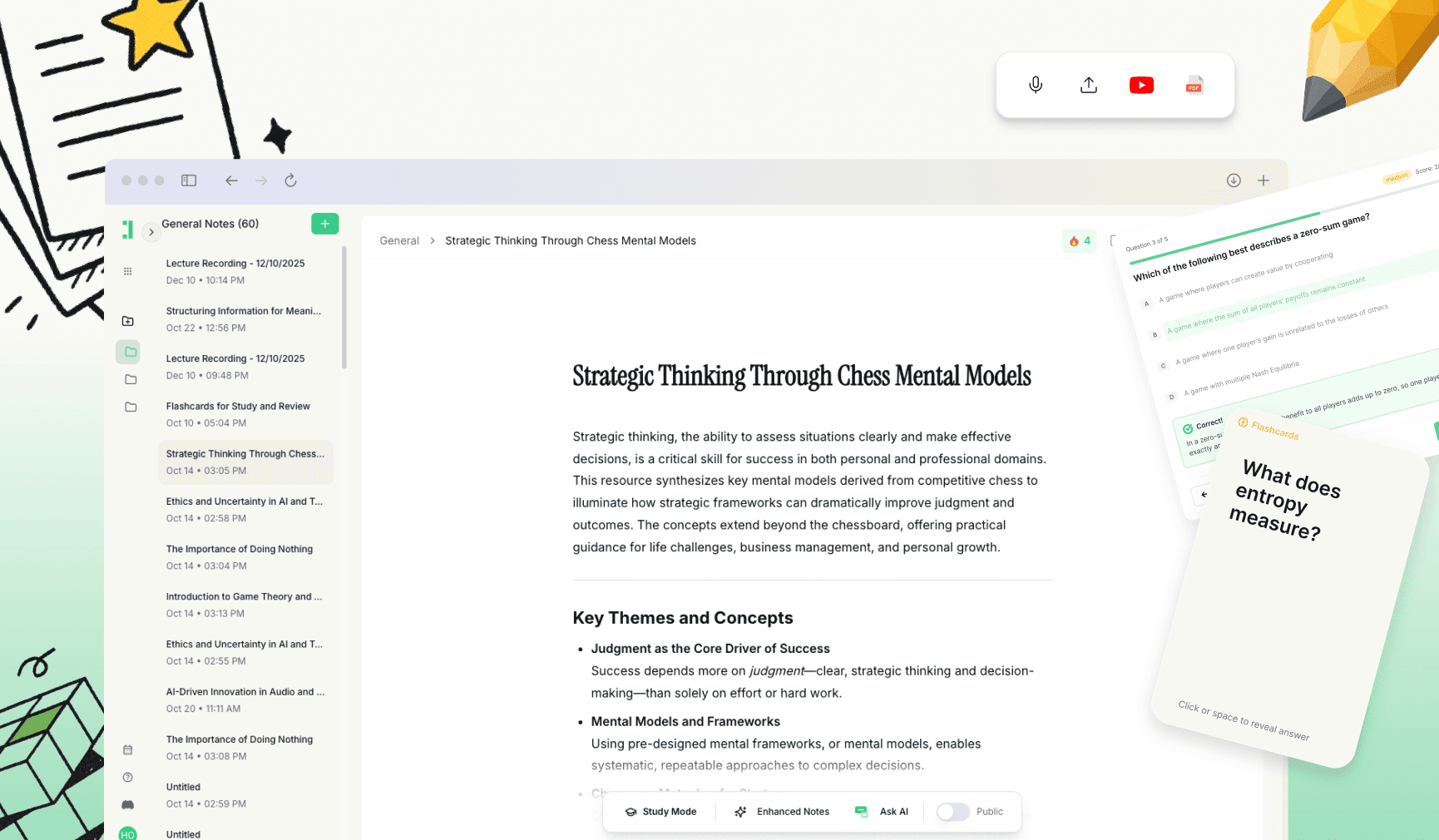
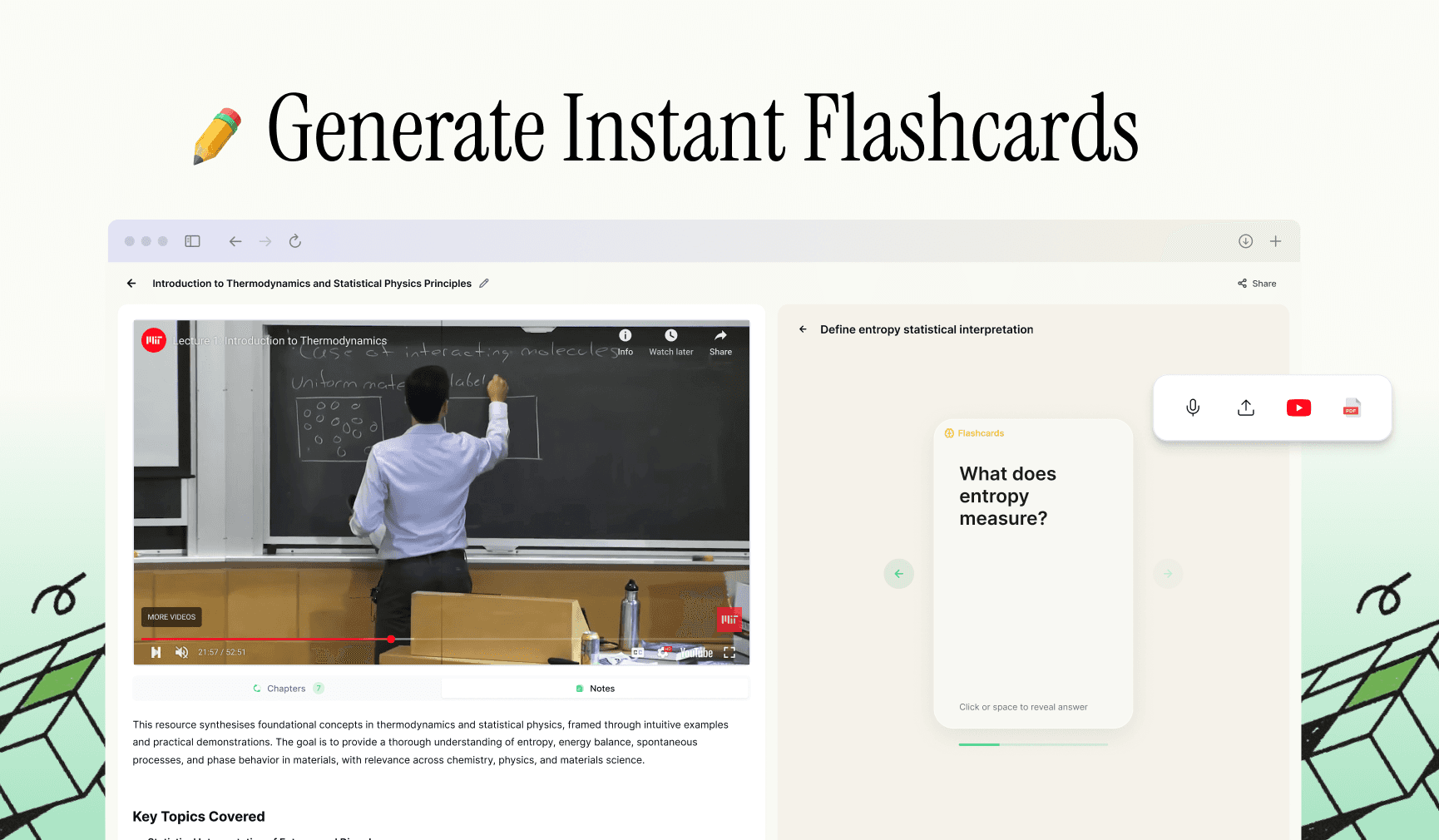
If you already have lecture notes or textbook chapters, Duetoday can generate a clean, organized deck of Logic and Proofs flashcards in minutes.
Why flashcards are one of the best ways to study Logic and Proofs
Logic is built on rigid rules and symbolic relationships that require high precision. Flashcards are uniquely suited for this subject because they break down dense, abstract concepts into manageable, bite-sized units of information. This prevents cognitive overload and ensures you master the foundational symbols before moving on to complex derivations.
The system works through active recall and spaced repetition. By testing yourself on a specific rule—like De Morgan's Laws—you strengthen the neural pathways associated with that concept. Over time, you stop second-guessing the symbols and start focusing on the higher-level strategy of the proof itself.
Memorize truth tables for various logical connectives without rote cramming.
Distinguish between similar concepts like Converse, Inverse, and Contrapositive.
Learn the specific structure of different proof methods (e.g., Mathematical Induction).
Practice identifying logical fallacies and invalid arguments quickly.
What to include in your Logic and Proofs flashcards
Effective Logic flashcards follow the "atomic" rule: one specific idea per card. This ensures you aren't just memorizing a block of text, but actually understanding the logical mechanics. Your deck should balance definitions of symbols with the practical application of proof strategies.
Definitions & Key Terms: "Define a Tautology" or "What is a Predicate?"
Rules of Inference: "What is the rule for Modus Ponens?" or "State the Law of Syllogism."
Comparisons: "How does an existential quantifier differ from a universal quantifier?"
Application: "What is the first step in a Proof by Contradiction?"
Use prompts like: "State the negation of (P ∧ Q)", "Write the contrapositive of P → Q", "Define the base case in Induction", and "What is the truth value of P ∨ ¬P?"
How to study Logic and Proofs with flashcards
To master this subject, use a two-pass approach. First, focus on the "grammar" of logic—symbols and truth tables. Once those are second nature, move on to the "syntax" of proofs. Review your deck in short, intense bursts rather than marathon sessions to keep your logical reasoning sharp.
Make a deck from your notes or generate it automatically from your slides.
Run a quick diagnostic round to identify which logical rules confuse you.
Review difficult proofs or truth tables daily until they become intuitive.
Mix the cards to ensure you can identify proof methods out of order.
Perform a final review of formal notation before your next exam.
Generate Logic and Proofs flashcards automatically in Duetoday
Manually drawing truth tables and writing out proof steps on physical cards is time-consuming and prone to errors. Duetoday eliminates this friction by instantly converting your study materials into high-quality digital flashcards.
Simply upload your logic PDFs, lecture slides, or typed notes. Our AI analyzes the logical structures and generates specific questions that challenge your understanding of the material. Within seconds, you have a study-ready deck that you can edit and refine.
Upload or paste your Logic and Proofs material
Click Generate Flashcards
Review, edit, and start mastering your proofs
Common Logic and Proofs flashcard mistakes
Avoid these common pitfalls to make your study sessions more effective:
Too much text: Don't put an entire proof on one card; break it into individual steps.
Ignoring the 'Why': Don't just memorize the rule; include a prompt asking why a specific inference is valid.
Mixing symbols: Ensure your cards clearly distinguish between similar symbols (like ∨ and ∪).
No practice: Always include a few "blank" cards where you must derive a small truth table from scratch.
FAQ
How many flashcards do I need for Logic and Proofs? Aim for 40–60 cards covering the core rules of inference, quantifiers, and basic proof structures. Quality and focus are more important than sheer volume.
What is the best format for these flashcards? Use a 'Question on Front, Answer on Back' format. Use clear symbolic notation (like ¬, ∧, ∨) to mirror what you will see on your exams.
Should I make cards from my textbook or lecture notes? Use lecture notes for the specific proof methods your professor emphasizes, but refer to your textbook for precise formal definitions.
How do I stop forgetting the rules of inference? Consistency is key. Review your inference rule cards daily for 5-10 minutes using spaced repetition to move them into your long-term memory.
Can I generate Logic flashcards from a PDF? Yes, Duetoday can read your Logic and Proofs PDFs and automatically extract theorems, rules, and definitions to create a full deck.
Are digital flashcards better than paper? Digital cards are superior for Logic because they allow you to easily edit complex symbols and use spaced repetition algorithms to focus on your weakest areas.
How long does it take to make a full deck? Manually, it can take hours. With Duetoday’s AI generation, you can have a comprehensive deck ready in under a minute.
Can Duetoday handle mathematical symbols? Yes, Duetoday is designed to recognize and organize formal logical and mathematical notation for clear study sessions.

Duetoday is an AI-powered learning OS that turns your study materials into personalised, bite-sized study guides, cheat sheets, and active learning flows.