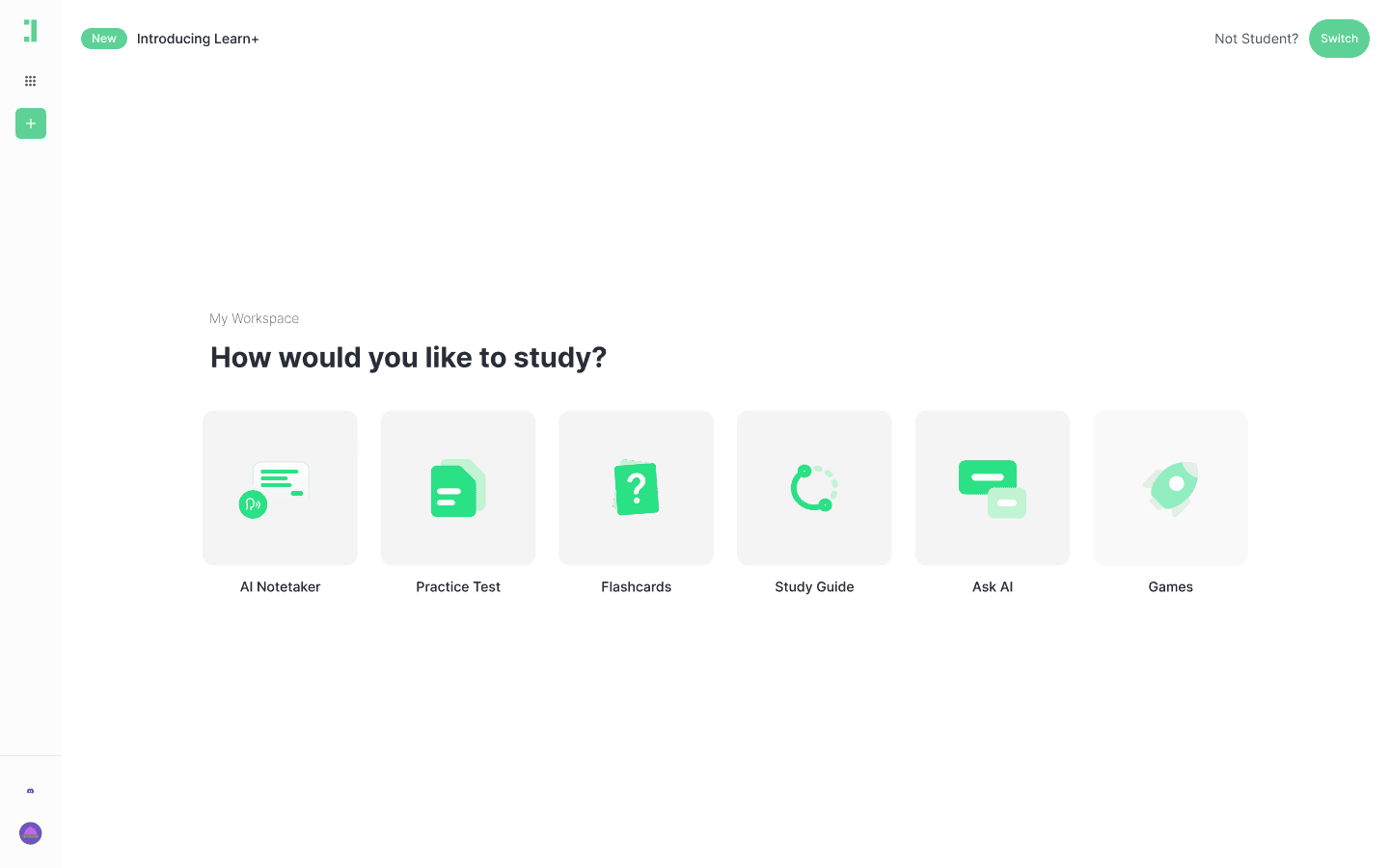
Generate Flashcards for Lenses and Mirrors
Generate Lenses and Mirrors flashcards in seconds. Use AI to turn notes into study decks. Try for free!
Generate Flashcards with AI Free
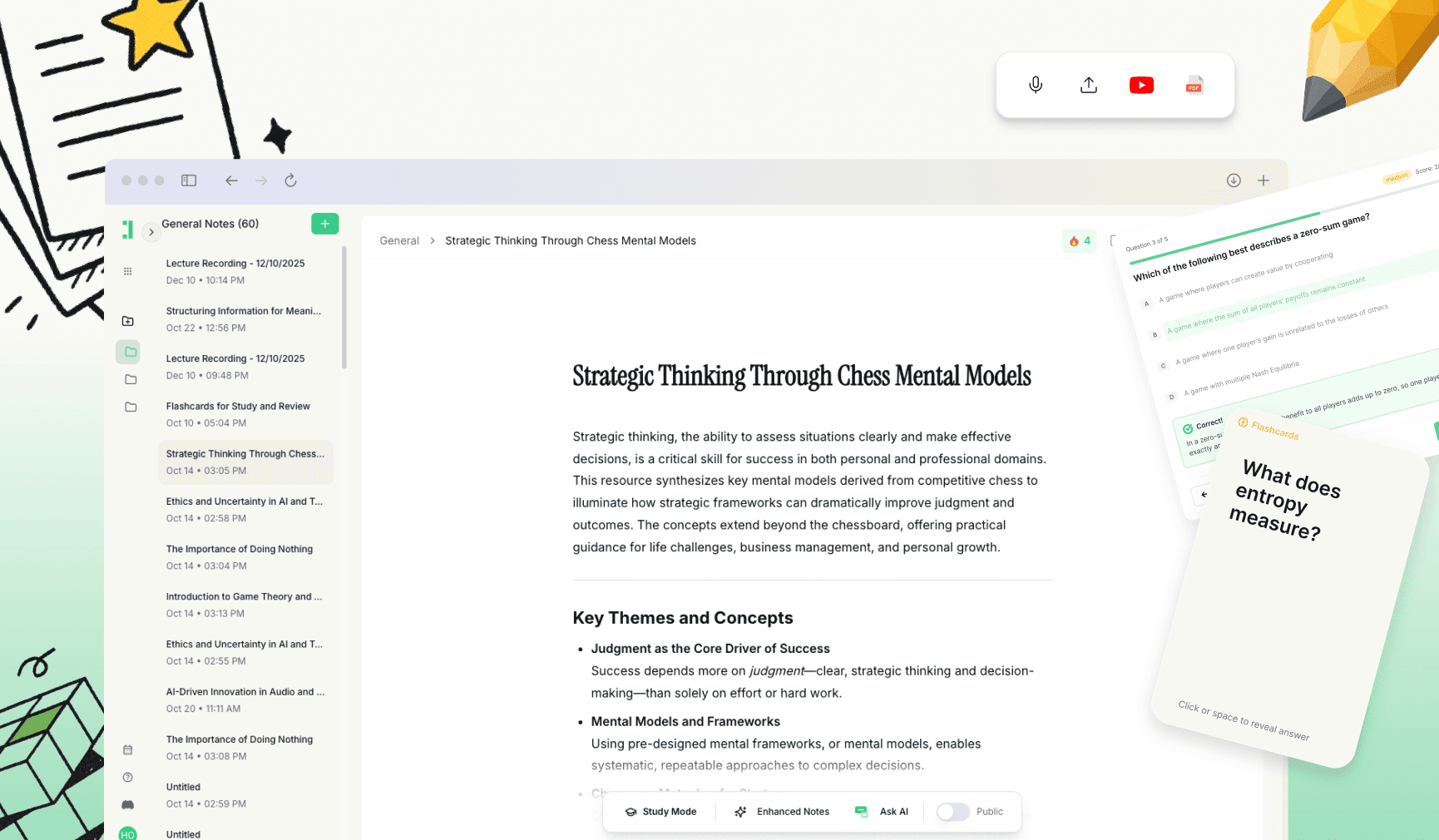
Generate Flashcards for Lenses and Mirrors
Turn your physics notes, PDFs, textbook chapters, or lecture slides into Lenses and Mirrors flashcards so you can review optics faster and remember more for your exams.
Try Duetoday: Upload your notes/PDFs or paste your text to get started.
In Duetoday, the process is simple: you upload your physics materials, our AI generates a structured deck, you review or edit the results, and then you start studying immediately with active recall.
What are Lenses and Mirrors flashcards?
Lenses and Mirrors flashcards cover the fundamental principles of geometric optics. This includes understanding how light interacts with concave and convex surfaces, memorizing the lens maker's formula, and identifying different types of images (real vs. virtual, upright vs. inverted).
The outcome is a shift from passive reading to active testing. Instead of staring at ray diagrams in a textbook, you test your ability to predict image placement and characteristics, which builds long-term recall and confidence during lab practicals or tests.
If you already have notes on optics, Duetoday can generate a clean deck in minutes.
Why flashcards work for Lenses and Mirrors
Optics is a subject that relies heavily on identifying specific relationships between object distance, focal length, and image properties. Flashcards are ideal for this because they isolate these variables and force your brain to retrieve the correct rule or formula without hints.
Through active recall and spaced repetition, you ensure that you don't just recognize a concave mirror, but that you can instantly recall its properties at various focal points.
Remember sign conventions (positive vs. negative) without cramming.
Separate similar concepts like converging vs. diverging lenses.
Learn ray tracing steps for both mirrors and lenses.
Practice applying the magnification formula quickly.
What to include in your Lenses and Mirrors flashcards
To make effective flashcards for optics, follow the "one idea per card" rule. Use question-based prompts that simulate the types of problems you will see on a physics exam.
We recommend focusing on these four categories:
Definitions: "What is the principal axis?" "Define the focal point."
Processes: "What is the first ray drawn in a ray diagram for a convex lens?"
Comparisons: "How does a concave mirror differ from a convex mirror in image formation?"
Application: "If an object is placed at 2F for a converging lens, where is the image?"
Example Prompts:
- Define total internal reflection.
- What type of image does a plane mirror always produce?
- What is the sign for the focal length of a diverging lens?
- Write the mirror equation.
- What is the relationship between radius of curvature and focal length?
- Describe the image formed by a concave mirror when the object is inside the focal point.
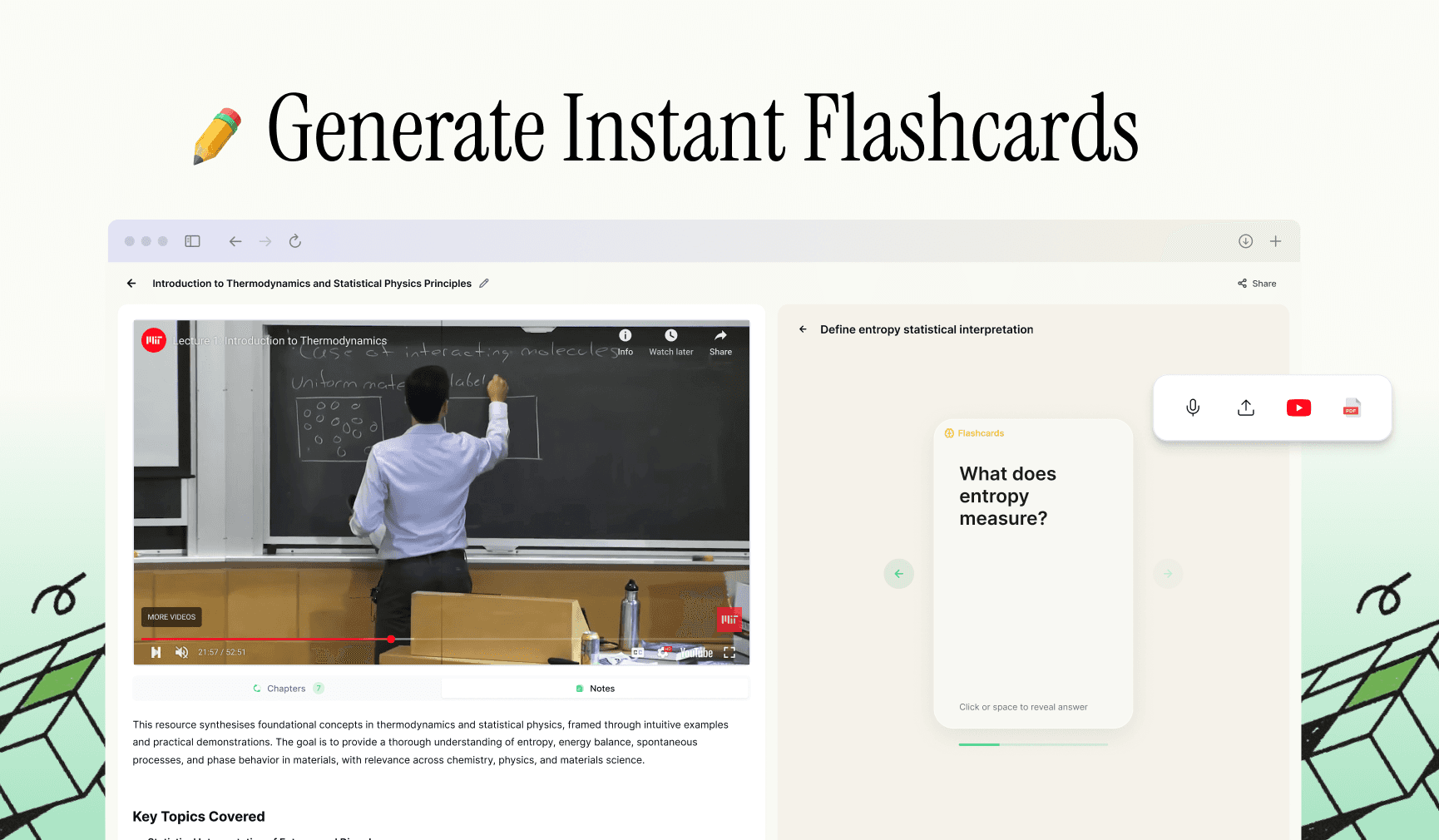
How to study Lenses and Mirrors with flashcards
Studying optics requires a two-pass approach. First, you must understand the theory, and then you must drill the application until it becomes second nature.
Start by building your deck and doing a quick round to identify which specific scenarios (like virtual images in convex mirrors) are confusing you. Focus your energy there.
Make a deck from your physics notes or textbook PDFs.
Do one quick round to find weak spots in sign conventions or ray rules.
Review weak cards daily to cement the math and logic.
Mix in harder application cards that ask you to calculate magnification.
Do a final mixed review of all optics concepts before your exam.
Generate Lenses and Mirrors flashcards automatically in Duetoday
Drawing ray diagrams manually and writing out countless cards for focal points is slow and takes away from actual study time. Duetoday automates the tedious part of the process.
Simply upload your study guide or lecture transcript, and our AI will extract the most important formulas and concepts to create a high-quality deck instantly.
Upload or paste your optics material.
Click Generate Flashcards.
Review, edit, and start studying.
Generate Lenses and Mirrors Flashcards in Duetoday. Start with your notes and get a deck you can actually use today.
Common Lenses and Mirrors flashcard mistakes
Many students create poor optics cards that lead to rote memorization rather than understanding. Avoid these common pitfalls:
Cards are too long: Don't try to explain the entire theory of light on one card; split it into individual properties.
Only memorizing formulas: Include cards that ask *why* a sign is negative, not just the formula itself.
Ignoring sign conventions: These are the most common points of failure in physics; dedicate specific cards to them.
No visual prompts: Describe the visual ray diagram in the question to help mental visualization.
Ready to generate your Lenses and Mirrors flashcards?
Stop rereading your physics textbook. Upload your notes, generate your deck, and master geometric optics with active recall.
Start Generating Flashcards. Works with notes, PDFs, slides, and transcripts.
FAQ
How many flashcards do I need for Lenses and Mirrors? Usually, 30 to 50 cards are sufficient to cover the main definitions, formulas, and image formation scenarios for a standard physics unit.
What’s the best format for optics flashcards? Question-and-answer format is best, specifically focusing on "If [X] happens, then [Y] is the result" scenarios.
How often should I review these flashcards? Review daily leading up to your exam. Once you master a concept like plane mirrors, reduce its frequency and focus on concave/convex rules.
Should I make cards from a textbook or my own notes? Both. Your notes contain what your teacher emphasizes, while the textbook provides the technical precision needed for formulas.
How do I stop forgetting the sign conventions? Use flashcards specifically for signs. Ask: 'Is f positive or negative for a diverging lens?' and repeat until it is instinctual.
What if my flashcards feel too easy? Add application questions. Instead of defining magnification, ask yourself to solve for image height given specific object parameters.
Can I generate flashcards from a PDF automatically? Yes, Duetoday allows you to upload any physics PDF and converts the text and concepts into flashcards instantly.
Are digital flashcards better than paper for physics? Digital is often better because you can easily edit formulas and use spaced repetition algorithms that paper cards don't offer.
How long does it take to make a full optics deck? Using Duetoday, it takes less than a minute. Manually, it could take over an hour to write and draw out 40 cards.
Can Duetoday handle the math formulas for lenses? Absolutely. Duetoday's AI recognizes the mirror and lens equations and can generate questions based on their components.

Duetoday is an AI-powered learning OS that turns your study materials into personalised, bite-sized study guides, cheat sheets, and active learning flows.