Generate Flashcards for Laplace Transforms
Make Laplace Transform flashcards for differential equations. Generate AI study guides to master s-domain formulas and inverse transforms.
Generate Flashcards with AI Free
What are Laplace Transforms flashcards?
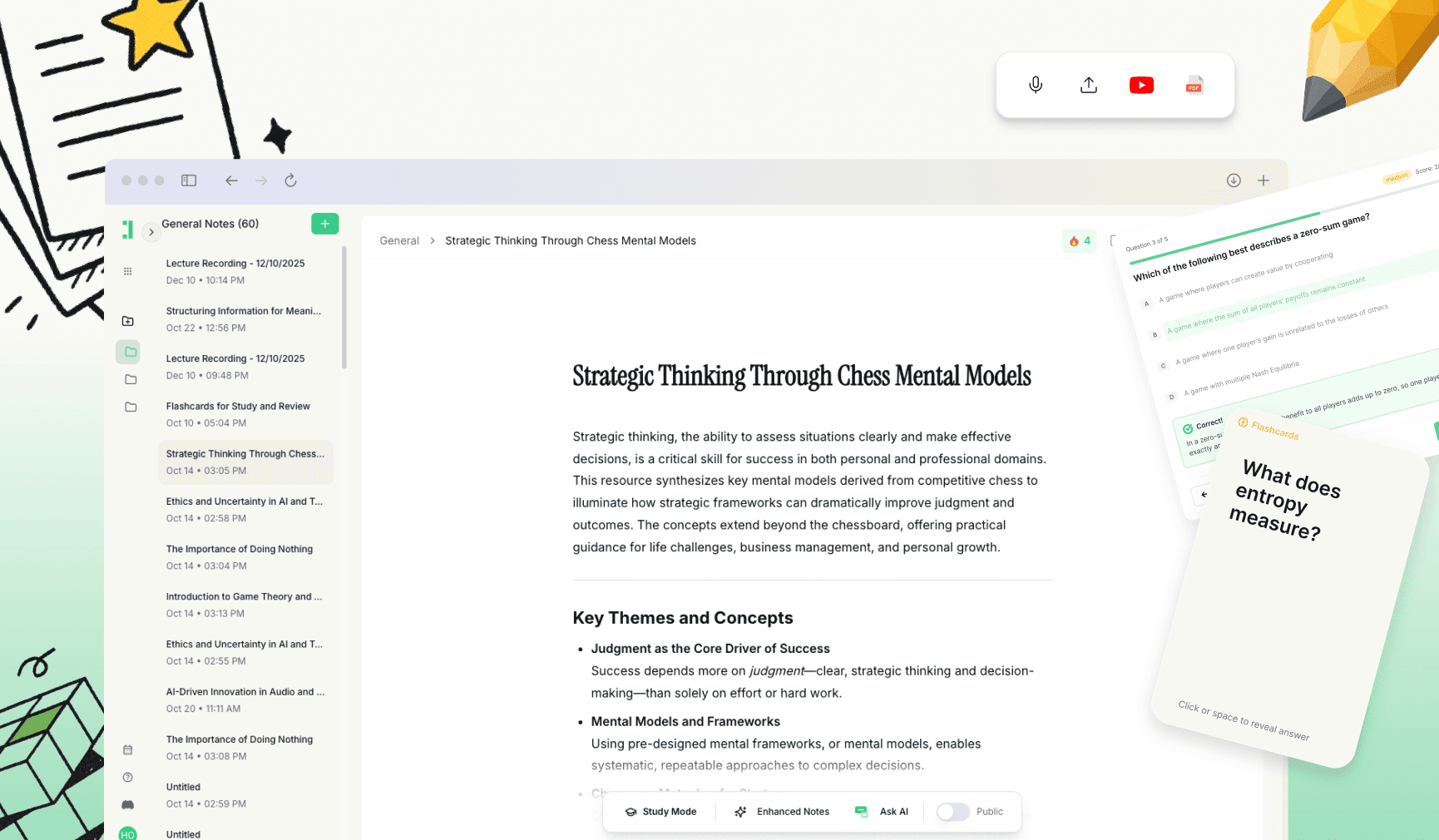
Laplace Transforms flashcards are specialized study tools designed to help you master the transition between the time domain and the s-domain. These cards typically cover standard transform pairs, operational theorems like linearity and shifting, and the mechanics of solving initial value problems using differential equations. By breaking down complex integral definitions into bite-sized units, these flashcards make it easier to memorize the 'language' of engineering mathematics.
The primary outcome of using these cards is mental fluency. Instead of constantly flipping to the back of a textbook for a table of transforms, you build the muscle memory required to recognize patterns in complex functions immediately. If you already have lecture notes or a table of integrals, Duetoday can generate a clean, organized deck in minutes so you can spend your time solve problems instead of writing out cards.
Why flashcards are one of the best ways to study Laplace Transforms
Laplace Transforms require a mix of rote memorization and logical application. You need to know the basic transform of a sine wave by heart, but you also need to understand how a frequency shift alters that transform. Flashcards bridge this gap by forcing active recall, ensuring you aren't just recognizing the formulas but actually retrieving them from memory.
Spaced repetition is particularly effective here because transform pairs are often easily confused. By reviewing your cards in timed intervals, you strengthen the neural pathways for the specific rules that trip you up the most, such as the difference between the first and second shifting theorems.
Memorize common transform pairs (step functions, exponentials, polynomials) without cramming.
Separate similar concepts like differentiation in the time domain vs. the s-domain.
Learn multi-step processes for partial fraction decomposition.
Practice applying the Inverse Laplace Transform rules quickly.
What to include in your Laplace Transforms flashcards
Effective Laplace flashcards follow the "one idea per card" rule. Rather than putting an entire differential equation on one card, break it into the transform step, the algebraic manipulation, and the inverse transform. This keeps your brain focused on one specific rule at a time.
Definitions & Key Terms: "What is the integral definition of the Laplace Transform?"
Transform Pairs: "What is L{e^{at}}?" or "What is the transform of sin(bt)?"
Theorems: "State the First Shifting Theorem (s-shifting)."
Application: "What is the first step in solving a second-order ODE with Laplace?"
Try these prompts: "Transform of t^n", "Inverse transform of 1/(s-a)", "How to handle a Unit Step Function", and "The Convolution Theorem formula."
How to study Laplace Transforms with flashcards
Start with a "two-pass" approach. In the first pass, focus entirely on the basic transform table. You cannot solve complex problems if you are struggling to remember what 1/s^2 represents. Once those are locked in, move to the operational theorems.
Review your deck in short, intense sessions. Laplace Transforms involve heavy notation, so it is often helpful to keep a scratchpad nearby to jot down the math quickly before flipping the card to check your answer.
Generate a deck from your calculus or DE notes in Duetoday.
Do a quick round to identify which pairs (like cos vs sin) you keep swapping.
Review the "Heavy Hitters" (shifting and partial fractions) daily.
Mix in inverse transforms to ensure you can work in both directions.
Perform a final review of the initial value problem steps before your exam.
Generate Laplace Transforms flashcards automatically in Duetoday
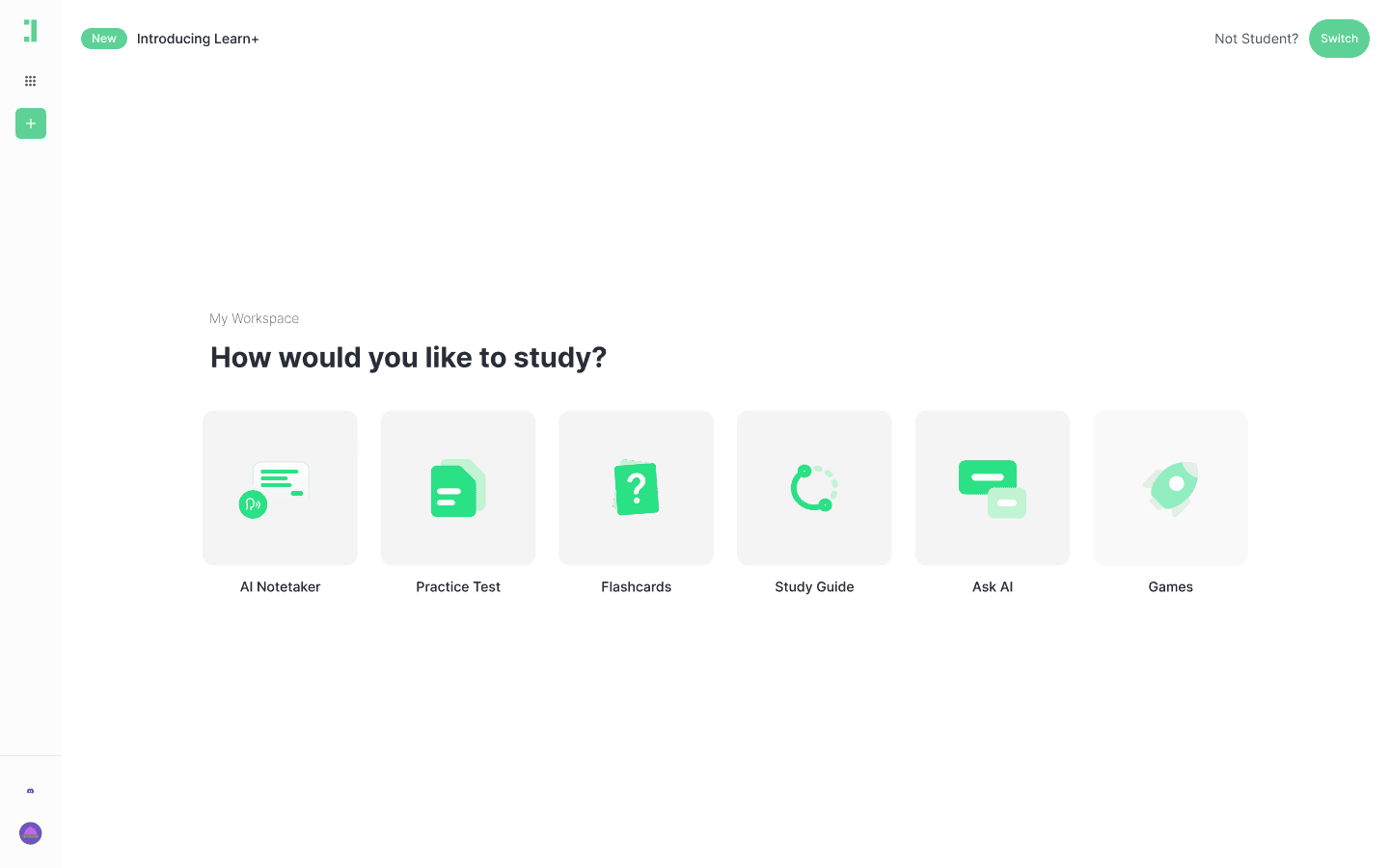
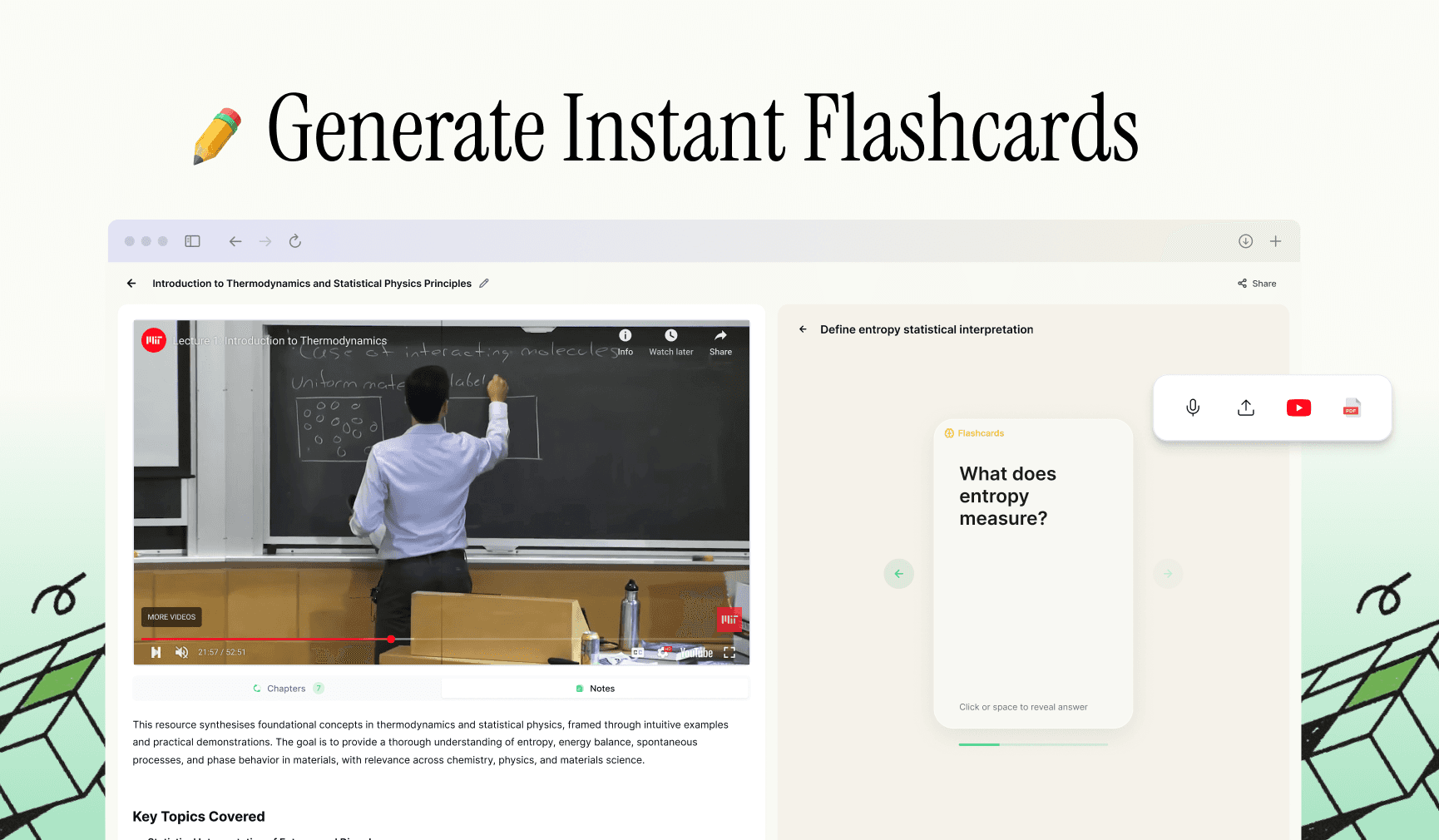
Making math flashcards manually is a nightmare—drawing integral symbols and fractions by hand is slow and often leads to messy cards that are hard to read later. Duetoday eliminates this friction by instantly converting your PDFs and slides into digital cards.
Simply upload your lecture notes, and Duetoday will identify the core formulas and theorems, creating a structured deck that follows the best practices of active recall.
Upload your Laplace Transform tables or ODE notes.
Click Generate Flashcards.
Edit any complex LaTeX notation and start studying.
Common Laplace Transform flashcard mistakes
Cards are too complex: Don't put a whole 4-page problem on one card; split it into transform, algebra, and inverse steps.
Ignoring the Region of Convergence: Always include the 's > a' condition where applicable.
Forgetting Inverse Transforms: Ensure half your deck is dedicated to going from F(s) back to f(t).
Skipping the basic algebra: Add cards for partial fraction templates, as this is where most students fail.
FAQ
How many flashcards do I need for Laplace Transforms? Usually, a deck of 30 to 50 cards is sufficient to cover the standard transform table, the primary theorems, and several inverse transform examples.
What’s the best format for these flashcards? A prompt-and-response format works best. Put the function f(t) on the front and the transform F(s) on the back, along with any necessary conditions.
How often should I review them? Daily for the first week until the transform pairs are instinctive, then every few days to maintain the knowledge for your final exam.
Should I make cards from my textbook or slides? Use both. Textbooks provide the formal definitions, while lecture slides often show the specific types of problems your professor prefers to test.
How do I stop forgetting the shifting theorems? Create comparison cards that specifically ask "What is the difference between the s-shift and the t-shift?" to highlight the contrast.
What if the formulas look too similar? Use Duetoday to add specific hints or labels to your cards to help distinguish between similar transforms like sine and hyperbolic sine.
Can I generate Laplace flashcards from a PDF? Yes, Duetoday can scan your textbook PDF or lecture handouts to extract the key mathematical formulas automatically.
Is digital better than paper for math? Digital is often better for Laplace because you can easily include complex notation and use spaced repetition algorithms that paper cards can't mimic.
How long does it take to make a full deck? With Duetoday, it takes less than a minute. Manually, it could take over an hour to write out all the notation and pairs correctly.
Can Duetoday organize my cards by difficulty? Yes, the system identifies core concepts versus advanced theorems so you can focus on building a strong foundation first.

Duetoday is an AI-powered learning OS that turns your study materials into personalised, bite-sized study guides, cheat sheets, and active learning flows.