Generate Flashcards for Kinematics
Generate Kinematics flashcards from your notes in seconds. Try Duetoday for free now!
Generate Flashcards with AI Free
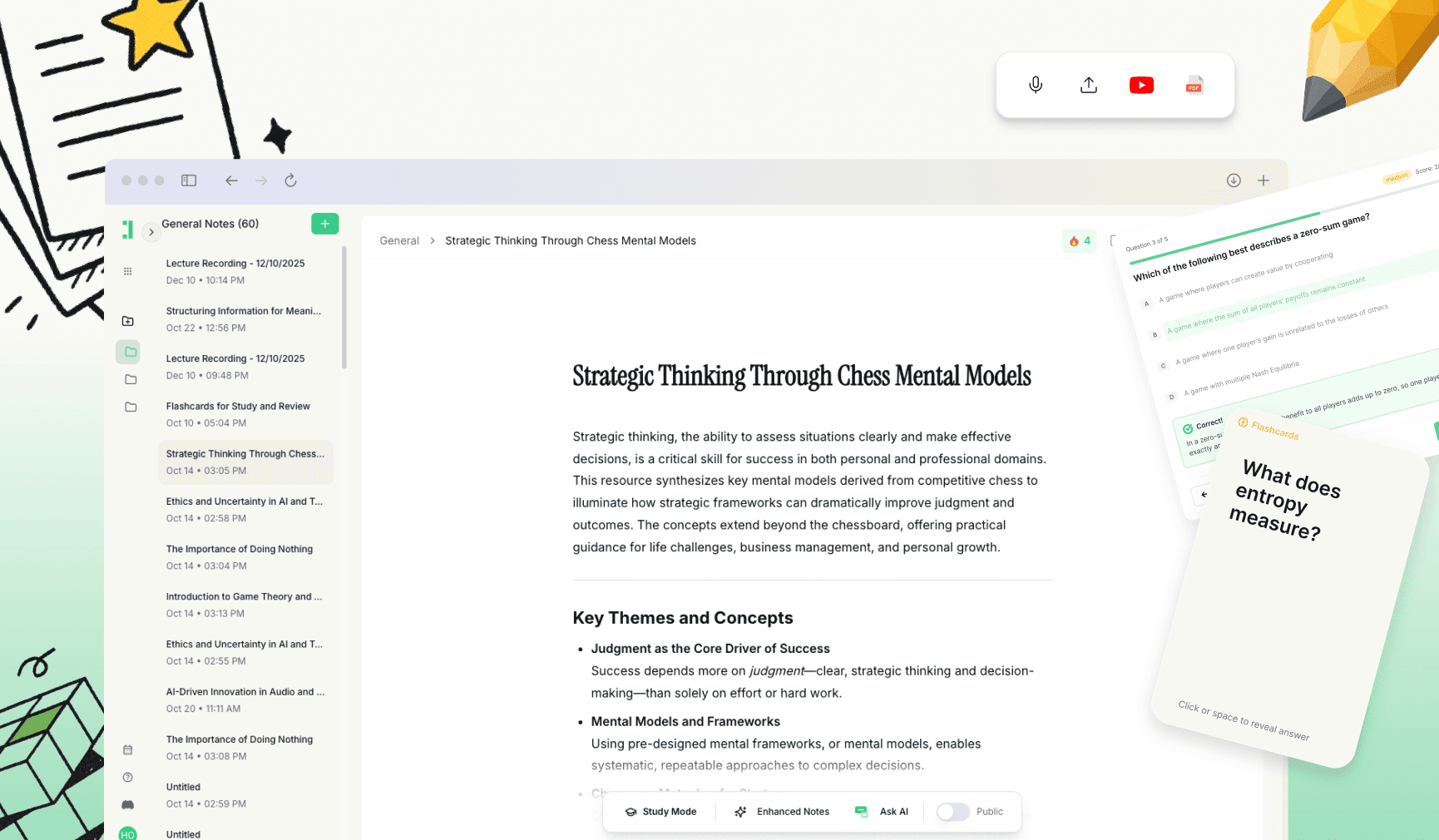
Generate Flashcards for Kinematics
Turn your notes, PDFs, slides, or lectures into Kinematics flashcards so you can review faster and remember more. Understanding motion doesn't have to be a struggle when you have the right tools to test your knowledge.
Generate Kinematics FlashcardsUpload notes / paste text
In Duetoday, the process is simple: upload your physics materials, generate a comprehensive deck, review or edit the cards, and start studying with active recall. No more manual data entry.
What are Kinematics flashcards?
Kinematics flashcards cover the fundamental principles of motion without considering the forces that cause it. They focus on key terms like displacement, velocity, acceleration, and time, as well as the essential SUVAT equations and graphical interpretations of motion.
The outcome is a shift from passive reading to active testing. Instead of rereading a textbook chapter on projectile motion, you test yourself on specific variables and relationships to build long-term recall. If you already have notes, Duetoday can generate a clean deck in minutes.
Why flashcards work for Kinematics
Kinematics requires a mix of conceptual definitions and the quick application of mathematical formulas. Flashcards are one of the most effective ways to master this branch of physics because they force you to retrieve information from memory rather than just recognizing it on a page.
Remember key terms like scalar vs. vector without cramming
Separate similar concepts (e.g., average speed vs. instantaneous velocity)
Learn kinematics processes step-by-step (analyzing free fall or projectile paths)
Practice applying SUVAT rules/formulas quickly under pressure
What to include in your Kinematics flashcards
The best Kinematics flashcards follow the "one idea per card" rule. They should be question-based to trigger active recall. Avoid putting a whole page of notes on one card; instead, break them down into specific prompts.
Definitions & key terms: "What is the definition of acceleration?"
Processes & steps: "What is the first step in solving a 2D projectile motion problem?"
Comparisons: "How does a distance-time graph differ from a velocity-time graph?"
Application: "If acceleration is constant and negative, what happens to the velocity over time?"
Example prompts: "State the kinematic equation for displacement without final velocity," "What does the slope of a velocity-time graph represent?" and "Define free fall in a vacuum."
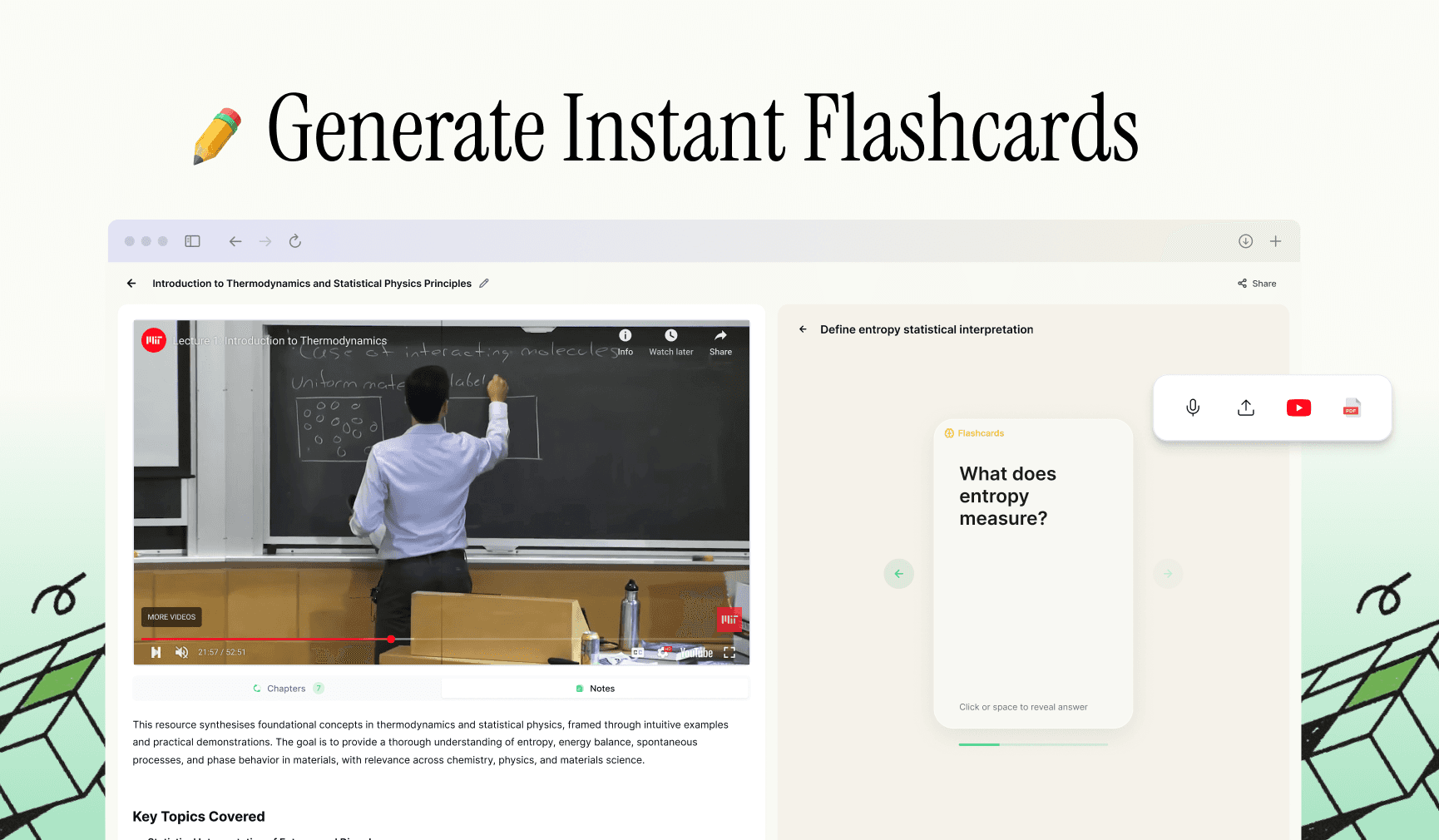
How to study Kinematics with flashcards (a simple system)
Mastering physics requires a structured approach. We recommend a "two-pass" workflow: first, build your deck from your syllabus or notes, then review in rounds to identify your weak spots.
Make a deck from your notes (or generate it from content using AI).
Do one quick round to find weak spots in equations or graphs.
Review weak cards daily for a few days until the formulas feel like second nature.
Mix in a few harder projectile motion cards each session.
Do a final mixed review before your physics quizzes or exams.
Generate Kinematics flashcards automatically in Duetoday
Making cards manually is slow, messy, and inconsistent. You often end up spending more time writing the cards than actually studying them. Duetoday fixes this by automating the creation process.
Simply upload your Kinematics notes, PDFs, or lecture slides. Duetoday's AI analyzes the physics concepts and generates a study-ready deck instantly. You can then edit the cards for clarity and start your review session immediately.
Upload or paste your Kinematics material
Click Generate Flashcards
Review, edit, and start studying
Generate Kinematics Flashcards in Duetoday
Start with your notes and get a deck you can actually use today.
Common Kinematics flashcard mistakes (and how to fix them)
Most students make cards that are too wordy or don't actually test their understanding of the physics. Here is how to avoid those traps:
Cards are too long: Split complex derivations into one idea per card.
Only memorizing words: Add "explain why the slope is zero" prompts to test concepts.
Confusing displacement and distance: Add specific comparison cards for vectors.
No review schedule: Use spaced repetition to repeat weak cards more often.
No application practice: Include cards that ask you to identify which SUVAT equation to use based on given variables.
Ready to generate your Kinematics flashcards?
Stop rereading your physics textbook. Upload your notes, generate your deck, and master Kinematics with active recall. It's the fastest way to prepare for your next exam.
Start Generating Flashcards
Works with notes, PDFs, slides, and transcripts.
FAQ
How many flashcards do I need for Kinematics? Typically, 30-50 cards cover the basics, including definitions, basic equations, and graph interpretations.
What’s the best format for Kinematics flashcards? Question-and-answer format is best. Always include units (like m/s^2) on the back of the card.
How often should I review Kinematics flashcards? Review daily when first learning the equations, then every few days to keep the concepts fresh in your mind.
Should I make cards from a textbook or slides? Both. Textbooks provide depth, while slides usually highlight the specific formulas your instructor wants you to know.
How do I stop forgetting Kinematics formulas? Use them in practice problems immediately after reviewing the flashcard to cement the application in your memory.
What if my flashcards feel too easy? Add "why" questions. Instead of just identifying a graph, ask why the slope represents acceleration in that specific context.
Can I generate Kinematics flashcards from a PDF automatically? Yes, Duetoday can scan your physics PDFs and extract the most important Kinematics concepts for you.
Are digital flashcards better than paper for Kinematics? Digital cards are often better because they use spaced repetition algorithms to show you the hardest cards more frequently.
How long does it take to make a full Kinematics deck? With Duetoday, it takes less than a minute. Manually, it could take over an hour to write out 40-50 cards.
Can Duetoday organize my flashcards for me? Yes, Duetoday categorizes your cards by topic so you can focus specifically on Kinematics or mix it with Dynamics later.

Duetoday is an AI-powered learning OS that turns your study materials into personalised, bite-sized study guides, cheat sheets, and active learning flows.