Generate Flashcards for Japanese Grammar
Make custom Japanese Grammar flashcards for any JLPT level. Generate study sets from your notes to master particles and verbs.
Generate Flashcards with AI Free
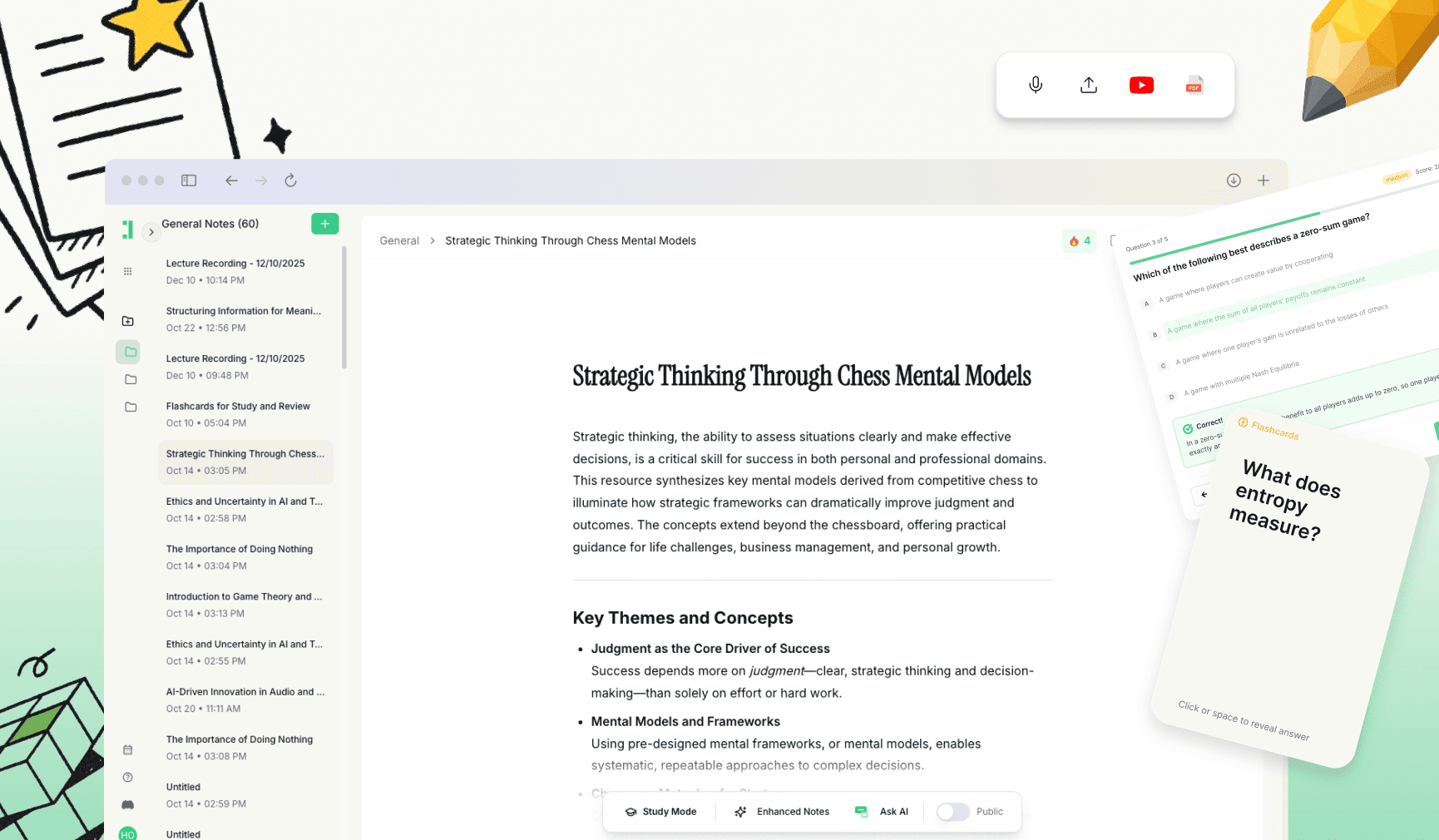
What are Japanese Grammar flashcards?
Japanese grammar flashcards are specialized study tools designed to help learners master sentence structures, particles, and conjugation patterns. Unlike simple vocabulary cards, these cards focus on the mechanics of the language, such as when to use 'ga' versus 'wa' or how to transition from dictionary form to polite 'masu' form. They bridge the gap between knowing words and actually building meaningful sentences.
The goal is to move beyond passive recognition. Instead of just reading a textbook, Japanese grammar flashcards require you to actively construct a phrase or identify a rule in context. If you already have lesson notes or textbooks, Duetoday can generate a clean deck in minutes so you can spend your time studying rather than typing.
Why flashcards are one of the best ways to study Japanese Grammar
Japanese grammar thrives on pattern recognition and repetition. Because the grammar structure (SOV) is often the reverse of English, your brain needs constant exposure to rewire its processing habits. Flashcards facilitate this through active recall, forcing you to pull the grammar rule from memory rather than just glancing at a page.
Internalize particle usage (ni, de, wo, e) without second-guessing
Master verb conjugations (Te-form, Passive, Causative) through drilling
Distinguish between similar grammar points (e.g., ~koto vs ~no)
Practice natural sentence flow and subordinate clauses
What to include in your Japanese Grammar flashcards
To make effective cards, follow the 'one idea per card' rule. Avoid cramming five different grammar rules onto one side. Instead, focus on specific applications and variations that you will actually encounter in conversation or exams like the JLPT.
Particle Identification: Fill in the blank: Watashi ___ pizza o tabemasu.
Conjugation Challenges: What is the Te-form of 'Iku' (to go)?
Meaning & Nuance: What is the difference between ~sou desu and ~rashii desu?
Sentence Scrambles: Rearrange these 4 words into a grammatically correct sentence.
Example prompts include: 'What particle marks the destination of movement?', 'Translate: I want to eat sushi using ~tai form', and 'Change 'Tabeta' into the formal negative form.'

How to study Japanese Grammar with flashcards (a simple system)
Mastering Japanese requires a 'two-pass' approach. First, use your cards to learn the fundamental rule. Second, use them to recognize that rule in a full sentence context. Don't just memorize a definition; memorize how the grammar feels in action.
Generate a deck from your class notes or a grammar guide like Genki or Tae Kim.
Do a 'recognition round' to see which particles or conjugations trip you up.
Review the difficult 'weak' cards daily using spaced repetition.
Gradually increase the complexity by adding cards with more Kanji.
Perform a final review before your JLPT or classroom quiz.
Generate Japanese Grammar flashcards automatically in Duetoday
Creating grammar decks manually is incredibly tedious—typing out Hiragana, Kanji, and English translations takes forever. Duetoday eliminates this friction by instantly converting your learning materials into study-ready decks.
Simply upload your grammar PDFs, textbook photos, or lecture transcripts into Duetoday. Our AI identifies the grammar points and creates structured flashcards with clear questions and answers. You can immediately review them on your phone or desktop, ensuring your study sessions are productive from the very first minute.
Upload or paste your Japanese grammar material
Click 'Generate Flashcards'
Review, edit, and start mastering Japanese
Common Japanese Grammar flashcard mistakes
Many learners make cards that are too long, which leads to 'recognition' rather than 'recall.' If your card has a whole paragraph on it, your brain will memorize the shape of the paragraph rather than the grammar rule itself.
Cards are too wordy: Keep it to one specific grammar point per card.
Ignoring Kanji: Always include the Kanji you are currently learning alongside the grammar.
No audio context: Try to read the cards out loud to build muscle memory.
Neglecting particles: Make specific cards just for tricky particle distinctions.
FAQ
How many flashcards do I need for Japanese grammar? For a single JLPT level like N5, you might have 80–120 cards covering specific grammar points and their variations.
What’s the best format for Japanese flashcards? A prompt on the front (e.g., a sentence with a blank) and the correct grammar/explanation on the back works best.
How often should I review Japanese grammar? Daily review is essential for the first two weeks of learning a new concept to move it into long-term memory.
Should I make cards from a textbook or slides? Both. Textbooks provide the rule, while lecture slides often provide the natural examples used by your teacher.
How do I stop forgetting particles? Use 'cloze deletion' cards where the particle is missing from a sentence, forcing you to choose the right one based on context.
What if my cards feel too easy? Add more Kanji or remove the English hints to increase the difficulty level.
Can I generate flashcards from a Japanese PDF? Yes, Duetoday can process Japanese text in PDFs to create accurate grammar and vocabulary cards.
Are digital flashcards better than paper? Yes, because digital tools like Duetoday use algorithms to show you the hardest cards more frequently.
How long does it take to make a full deck? With Duetoday, you can generate a full deck for a grammar chapter in less than 60 seconds.
Can Duetoday handle Kanji and Furigana? Yes, the tool is designed to recognize and organize Japanese characters for effective study.

Duetoday is an AI-powered learning OS that turns your study materials into personalised, bite-sized study guides, cheat sheets, and active learning flows.