
Generate Flashcards for Introduction to Economics
Generate high-quality Economics flashcards from your notes in seconds. Try it for free today!
Generate Flashcards with AI Free
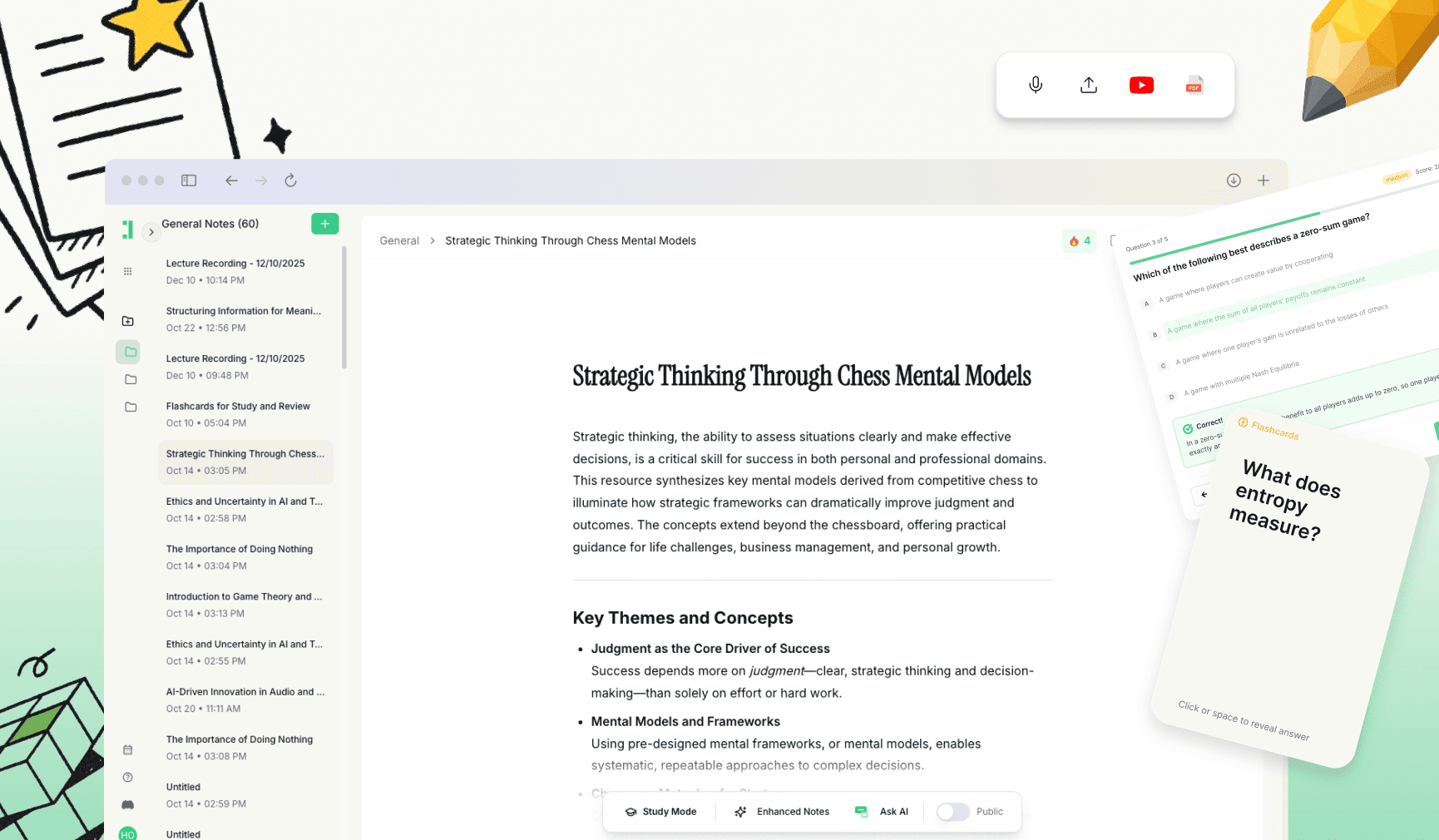
Generate Flashcards for Introduction to Economics
Turn your notes, PDFs, slides, or lectures into Introduction to Economics flashcards so you can review faster and remember more. Whether you are tackling microeconomics or fundamental macro principles, our AI helps you distill complex theories into digestible study bites.
Generate Economics FlashcardsUpload notes / paste text
In Duetoday, the process is simple: upload your materials, generate a structured deck, review or edit the cards to fit your needs, and start studying with active recall immediately.
What are Introduction to Economics flashcards?
Introduction to Economics flashcards cover the foundational building blocks of how markets and economies function. This includes key terms like scarcity and opportunity cost, supply and demand curves, market equilibrium, and basic macroeconomic indicators like GDP and inflation.
The outcome is a shift from passive reading to active testing. Instead of rereading a textbook chapter five times, you test your brain's ability to retrieve information, which builds stronger long-term memory and identifies exactly where your knowledge gaps are.
If you already have notes, Duetoday can generate a clean deck in minutes.
Why flashcards are one of the best ways to study Economics
Economics requires a mix of rote memorization for definitions and logical application for graphs and formulas. Flashcards bridge this gap by forcing you to explain the "why" behind a shift in a curve or the "what" of a specific fiscal policy.
By using active recall and spaced repetition, you ensure that you aren't just memorizing words, but understanding relationships between variables.
Remember complex terms like 'Elasticity' without last-minute cramming
Separate similar concepts (e.g., Comparative Advantage vs. Absolute Advantage)
Learn economic cycles and pathways step-by-step
Practice applying rules and formulas to hypothetical market scenarios
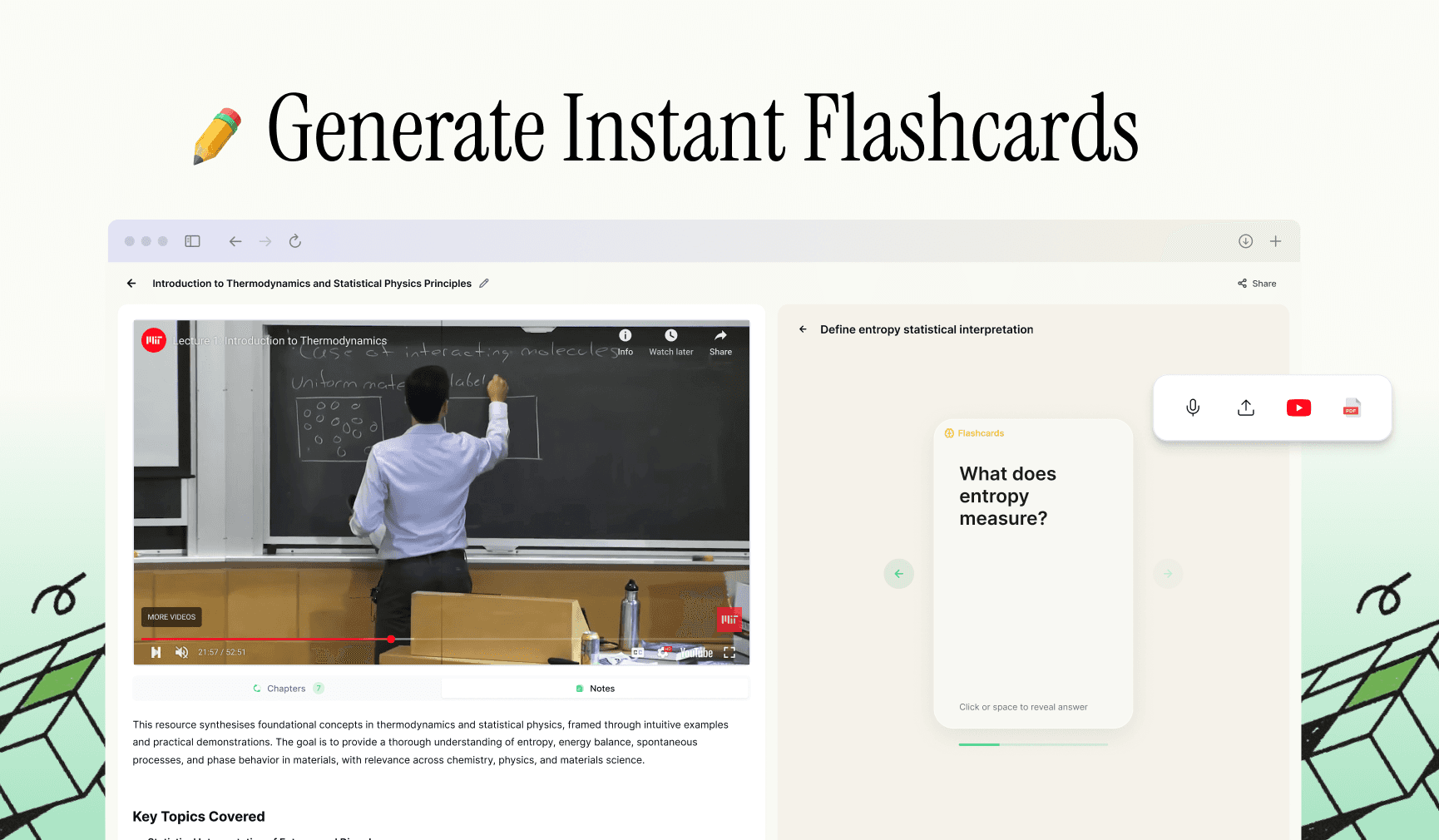
What to include in your Economics flashcards
Good economics flashcards follow the "atomic" rule: one idea per card. It is better to have five simple cards than one card with a giant paragraph on it. Focus on turning your lecture slides into specific questions.
Definitions & key terms: "What is the Law of Diminishing Returns?"
Processes & steps: "What happens to price when demand exceeds supply?"
Comparisons: "How is a Monopoly different from an Oligopoly?"
Application: "If the Fed raises interest rates, what happens to investment?"
Example prompts include: "Define Opportunity Cost," "Explain the shift in the Demand curve vs. movement along the curve," and "List the four factors of production."
How to study Economics with flashcards (a simple system)
Use a two-pass approach. First, generate your deck and do a quick run-through to see which concepts (like 'Deadweight Loss') confuse you. In the second pass, focus heavily on those difficult cards.
Make a deck from your textbook or lecture notes.
Do one quick round to find weak spots in your understanding.
Review weak cards daily for three days straight.
Mix in harder application-based cards as you improve.
Do a final mixed review 48 hours before your exam.
Generate Economics flashcards automatically in Duetoday
Making cards manually is slow and moving graphs from paper to digital is a mess. Duetoday automates the tedious part so you can get straight to the learning.
Upload your Econ PDF or paste your lecture transcript.
Click Generate Flashcards.
Review the AI-generated deck and start your session.
Generate Introduction to Economics Flashcards in Duetoday
Start with your notes and get a deck you can actually use today.
Common Economics flashcard mistakes
Many students make cards that are essentially whole textbook paragraphs. Avoid these traps:
Cards are too wordy: Split one big concept into three smaller questions.
Only memorizing definitions: Add cards that ask "What is the effect of X on Y?"
Ignoring the 'Why': Always include the reasoning behind a market shift.
Inconsistency: Economics builds on itself; review old cards once a week.
Ready to generate your Economics flashcards?
Stop rereading your highlighted textbook. Upload your notes, generate your deck, and master economics with active recall.
Start Generating Flashcards
Works with notes, PDFs, slides, and transcripts.
FAQ
How many flashcards do I need for Intro to Econ? Usually, a single chapter requires 20–40 cards to cover all definitions and primary concepts.
What’s the best format for Econ flashcards? A question-on-front, answer-on-back format works best, especially for causal relationships (If A happens, then B).
How often should I review them? Daily for the first week, then every few days using spaced repetition to move the info to long-term memory.
Should I make cards from the textbook or lectures? Lectures usually highlight what the professor thinks is important for the exam, so start there.
How do I stop forgetting formulas? Use 'cloze deletion' cards where you fill in a missing part of the formula.
What if the flashcards feel too easy? Add 'scenario' cards where you have to predict a market outcome based on a change in variables.
Can I generate Econ cards from a PDF? Yes, Duetoday can read your economics PDF and extract the key terms and concepts automatically.
Are digital cards better than paper? Digital is better for Econ because you can easily include graphs and use AI to shuffle your weak points.
How long does it take to make a deck? With Duetoday, you can turn a 20-page PDF into a deck in under 60 seconds.
Can Duetoday organize my cards by topic? Yes, you can categorize decks by Micro, Macro, or specific units like 'Market Structures'.

Duetoday is an AI-powered learning OS that turns your study materials into personalised, bite-sized study guides, cheat sheets, and active learning flows.