Generate Flashcards for Inorganic Chemistry
Make inorganic chemistry flashcards fast. Generate study guides for chemical bonding, catalysts, and molecular structures.
Generate Flashcards with AI Free
What are Inorganic Chemistry flashcards?
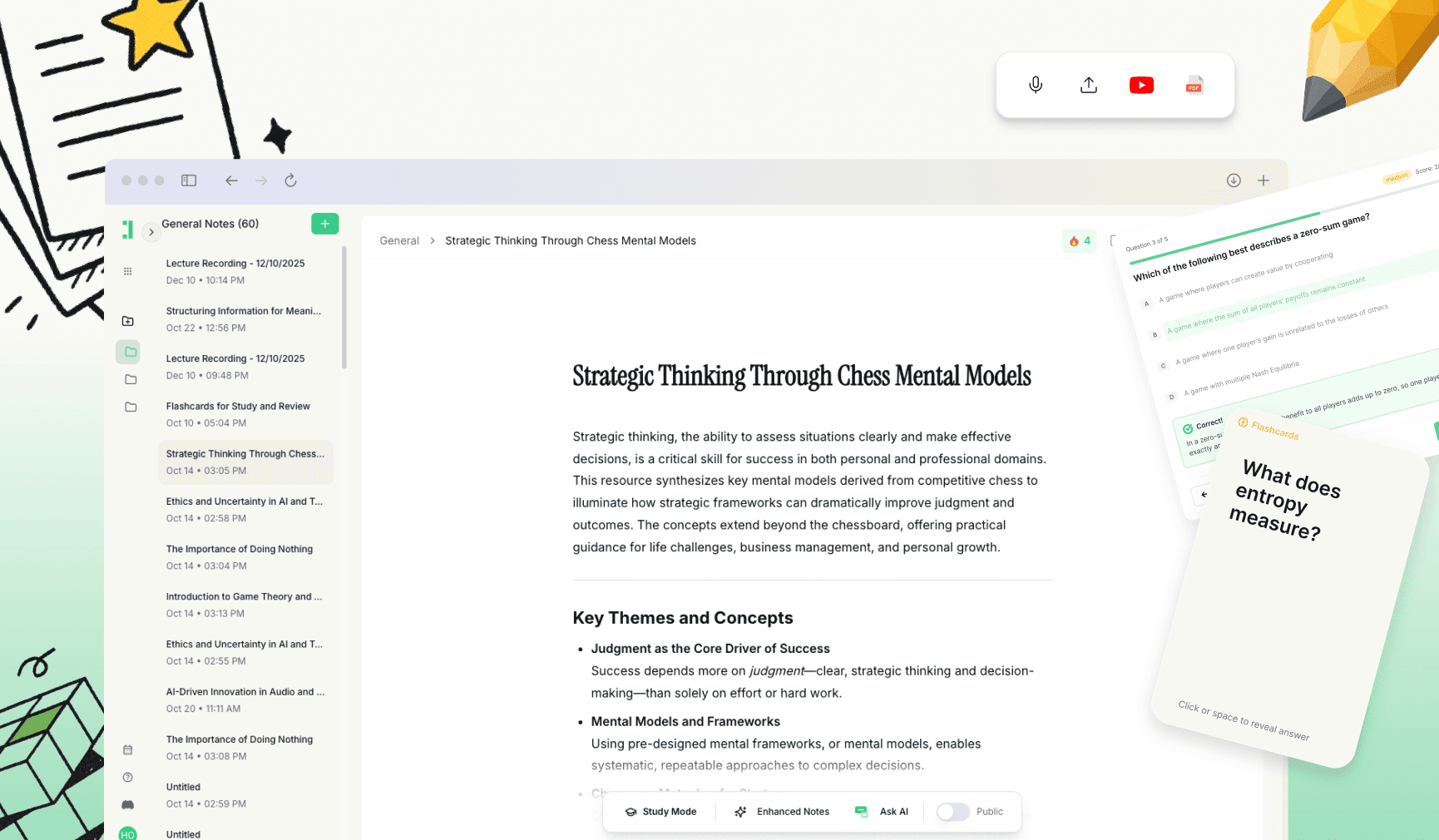
Inorganic chemistry flashcards are specialized study tools designed to help you master the properties, behaviors, and reactions of inorganic compounds. This subject covers everything from the intricacies of the periodic table and transition metals to coordination chemistry and crystal field theory. Instead of simply reading through chapters on molecular geometry or reaction mechanisms, these flashcards force you to recall specific information instantly.
The outcome is a deeper understanding of the relationships between elements and their chemical environments. By testing yourself on specific ligands, oxidation states, or lattice energies, you build the mental agility required for complex problem-solving. If you already have notes, Duetoday can generate a clean deck in minutes, saving you hours of manual transcription.
Why flashcards are one of the best ways to study Inorganic Chemistry
Inorganic Chemistry is a unique blend of rigid rules and various exceptions. Flashcards are ideal for this because they link specific concepts to direct outcomes, helping you memorize trends across the periodic table and the specific electronic configurations of metals. By using active recall, you strengthen the neural pathways associated with these complex structures.
Using a system of spaced repetition ensures that you don't just memorize the material for a day, but retain it for your final exams. You move from passive reading to active engagement with the material.
Identify trends like electronegativity and atomic radii instantly.
Differentiate between similar coordination geometries (e.g., Octahedral vs. Tetrahedral).
Memorize the steps of catalytic cycles and industrial processes.
Practice predicting reaction products based on periodic properties.
What to include in your Inorganic Chemistry flashcards
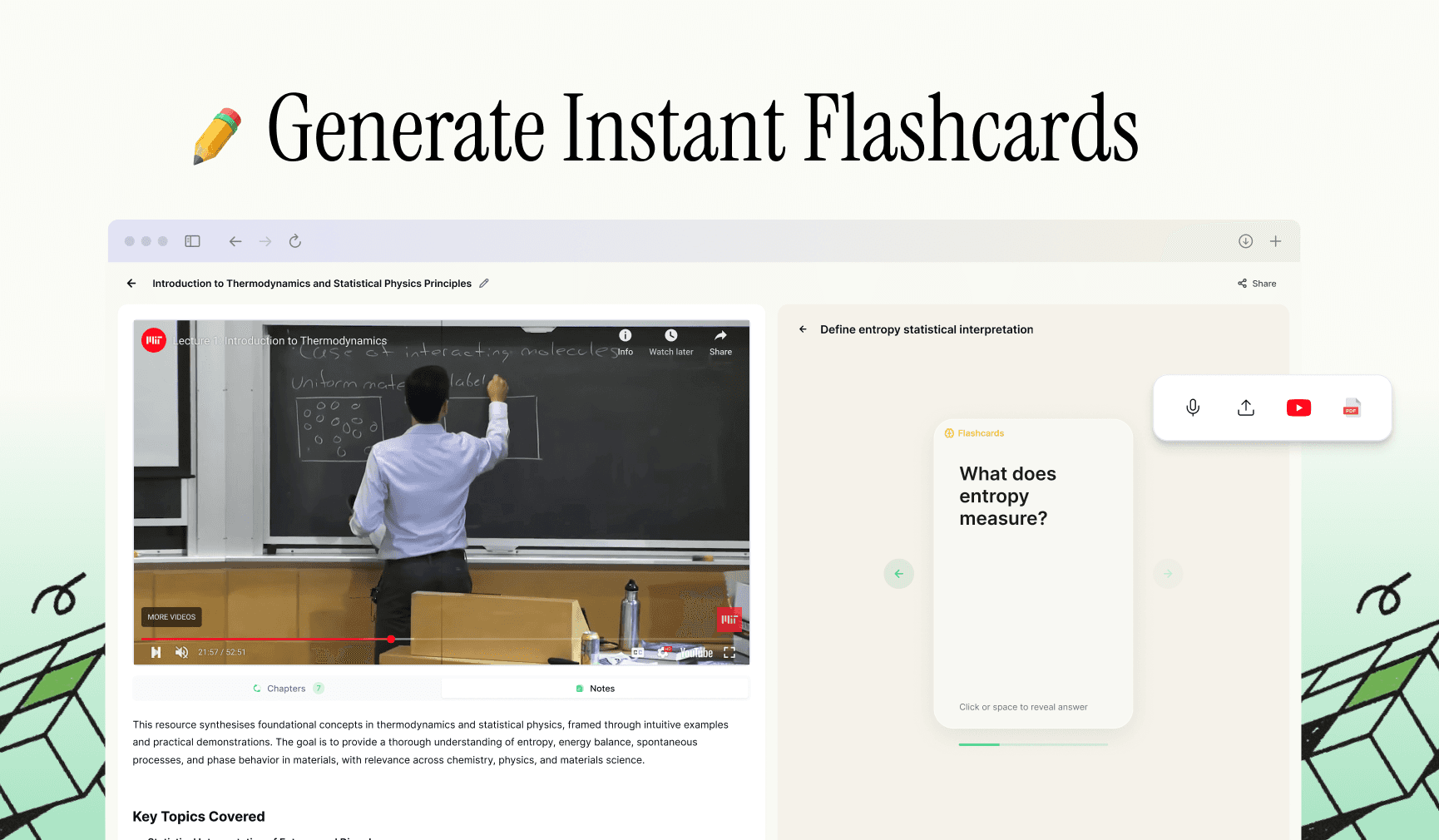
Effective inorganic flashcards follow the one idea per card rule. They should be question-based and focus on the mechanics of why atoms and molecules behave the way they do. By breaking down large topics like Symmetry or Bioinorganic Chemistry into bite-sized questions, you avoid the cognitive overload common with this subject.
Definitions & Key Terms: Define the Chelate Effect in coordination chemistry.
Processes & Steps: What is the first step in the Monsanto acetic acid process?
Comparisons: How does High Spin differ from Low Spin in octahedral complexes?
Application: What happens to the oxidation state of the metal during oxidative addition?
Try using prompts like: State the 18-electron rule, Describe the d-orbital splitting in square planar complexes, or What is the trend for first ionization energy across Period 3?
How to study Inorganic Chemistry with flashcards
Start with a two-pass approach. Use your lecture notes or textbook to build a comprehensive deck, then perform an initial run-through to categorize cards by difficulty. Focus your energy on the concepts that involve exceptions to the rules, as these are most frequent in exams.
Generate a deck from your PDF notes or lecture slides.
Do a rapid pass to identify which group trends or mechanisms are hardest for you.
Review those difficult cards daily using Duetoday’s AI-powered feedback.
Mix in easier cards periodically to ensure you don't lose the fundamentals.
Run a mixed review session that combines different chapters to test your ability to switch contexts.
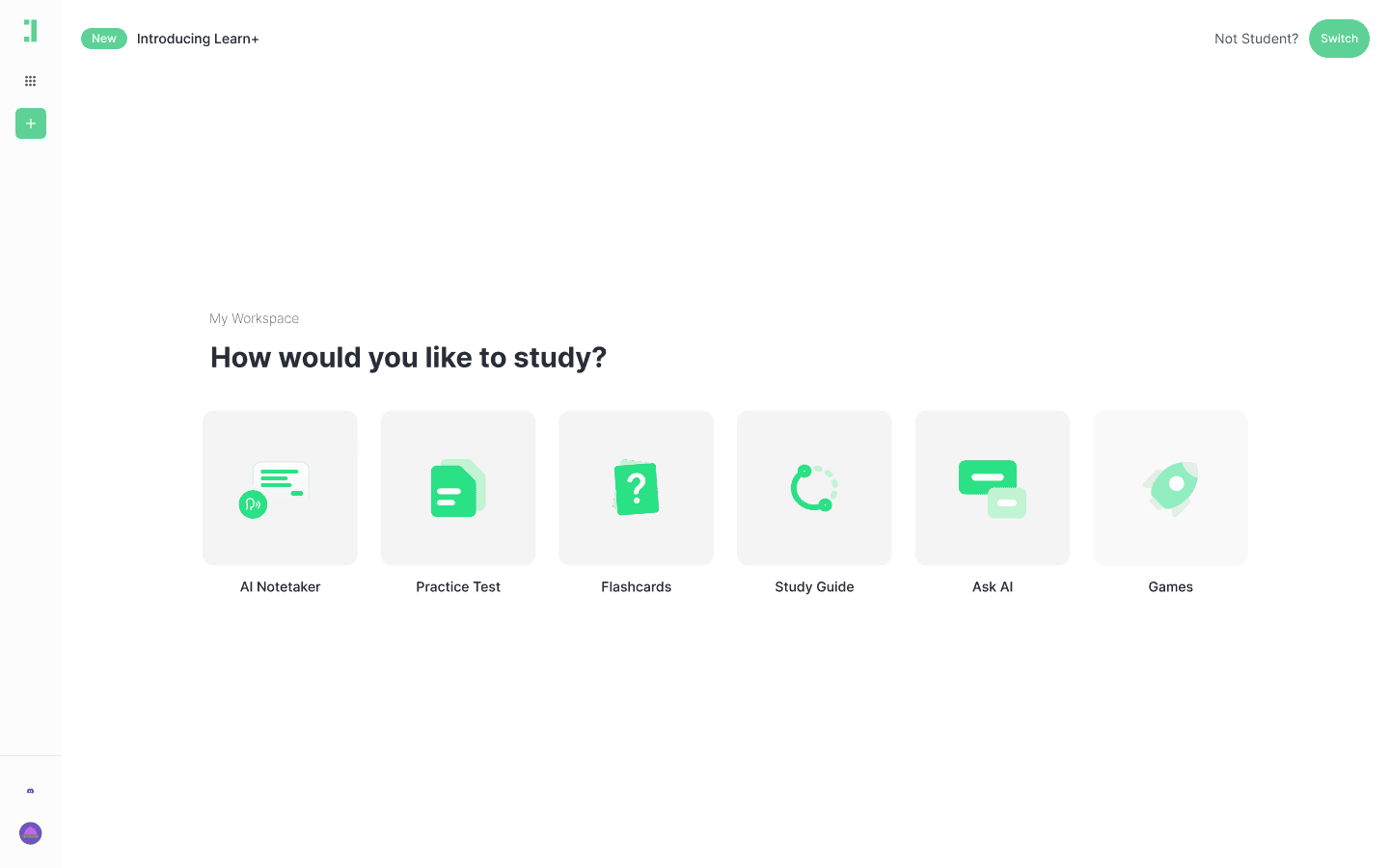
Generate Inorganic Chemistry flashcards automatically in Duetoday
Making flashcards by hand is notoriously slow, especially when you need to draw Lewis structures or complex coordination spheres. Duetoday eliminates this friction by instantly converting your study material into structured flashcards.
Upload your Inorganic Chemistry PDF or paste your lecture transcript.
Click Generate Flashcards.
Review, edit the details, and start your study session immediately.
Common Inorganic Chemistry flashcard mistakes
The most common mistake is creating cards that are too wordy. If a card contains an entire paragraph about MO theory, you will memorize the paragraph structure rather than the concept. Keep it concise. Also, avoid just memorizing names; ensure you have cards that ask Why? to bridge the gap between rote memorization and true chemistry expertise.
FAQ
How many flashcards do I need for Inorganic Chemistry? It depends on the scope, but typically 150-200 cards per major exam allow you to cover the periodic table, bonding, and coordination chemistry in detail.
What’s the best format for these flashcards? Question-and-answer format is best. For chemistry, visual descriptions of molecular shapes or electron configurations are highly effective.
How often should I review? Aim for short 15-minute sessions daily. Spaced repetition works best when you touch the material frequently rather than in one long stretch.
Should I make cards from a textbook or slides? Use your lecture slides for the core material prioritized by your professor, and use the textbook to fill in gaps for complex mechanisms.
How do I stop forgetting trends? Create cards that compare and contrast elements. Instead of just memorizing Chlorine, compare it to Fluorine to understand the why.
What if my cards feel too easy? If you know the answer instantly, archive the card and generate more application-based questions that involve multi-step reasoning.
Can I generate flashcards from a PDF? Yes, Duetoday is designed to read PDFs and slides to extract key inorganic concepts and transform them into cards.
Are digital flashcards better than paper for chemistry? Digital cards are generally better because they allow for instant organization, AI-generation, and use spaced repetition algorithms that paper cannot offer.
How long does it take to make a full deck? With Duetoday, you can generate a full deck from a chapter in less than a minute, compared to over an hour by hand.
Can Duetoday organize my cards? Yes, Duetoday organizes your flashcards into decks based on the topics found in your uploaded materials.

Duetoday is an AI-powered learning OS that turns your study materials into personalised, bite-sized study guides, cheat sheets, and active learning flows.